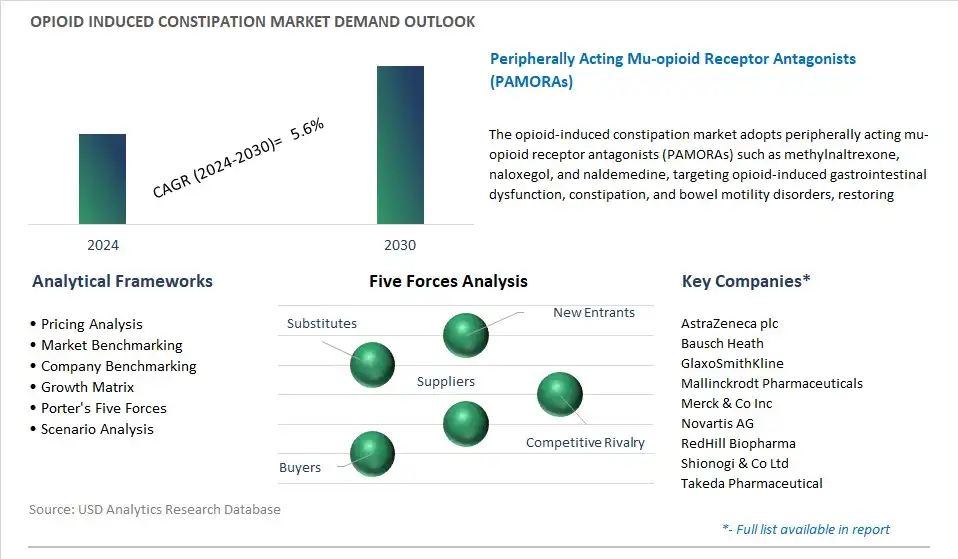
Opioid Induced Constipation Market is estimated to increase at a growth rate of 5.6% CAGR over the forecast period from 2024 to 2030.
The global Opioid Induced Constipation Marketstudy analyzes and forecasts the market size across 6 regions and 24 countries for diverse segments including By Type (Branded, Generics), By Drug Class (Aminosalicylates, Digestive enzymes, Proton Pump Inhibitors, Laxatives, Anti-Emetics, H2 Antagonists, Anti-Diarrheal, Biologics/Biosimilar, Others), By Route of Administration (Oral, Injectable, Others), By Application (Crohn's disease, Ulcerative colitis, GERD, IBS, Others), By Distribution Channel (Hospital Pharmacies, Retail Pharmacies, Online Pharmacies).
An introduction to Opioid Induced Constipation Market in 2024
In 2024, the opioid-induced constipation (OIC) market is witnessing significant growth driven by the rising prevalence of chronic pain conditions, increased opioid prescription rates, and the demand for effective management of opioid-related gastrointestinal side effects. OIC, a common and debilitating complication of opioid therapy, is characterized by symptoms such as infrequent bowel movements, straining, and incomplete evacuation, negatively impacting patient quality of life and treatment adherence. With advancements in pharmacotherapy, non-pharmacological interventions, and patient education strategies, the market is experiencing rapid expansion and adoption of novel therapies aimed at alleviating OIC symptoms, improving bowel function, and enhancing patient well-being.
Opioid Induced Constipation Market Trend: Focus on Development of Novel Treatment Modalities
A prominent trend in the Opioid Induced Constipation (OIC) Market is the focus on the development of novel treatment modalities. OIC is a common and debilitating side effect of opioid therapy, impacting the quality of life of patients with chronic pain conditions. While traditional laxatives are commonly used for managing OIC, there's a growing demand for more effective and targeted treatment options. Pharmaceutical companies and researchers are exploring novel pharmacological approaches, including peripherally acting mu-opioid receptor antagonists (PAMORAs), serotonin agonists, and bile acid modulators, to address the underlying mechanisms of OIC and provide symptom relief. Additionally, advancements in drug delivery technologies, such as extended-release formulations and combination therapies, aim to enhance treatment efficacy and patient compliance. This trend towards the development of novel treatment modalities drives market growth and innovation in the OIC Market, offering new therapeutic options for patients and healthcare providers.
Opioid Induced Constipation Market Driver: Increasing Prescription of Opioid Analgesics for Pain Management
A significant driver propelling the Opioid Induced Constipation (OIC) Market is the increasing prescription of opioid analgesics for pain management. Opioid medications are widely used for the treatment of acute and chronic pain conditions, including cancer pain, postoperative pain, and chronic non-cancer pain. However, opioid therapy is associated with gastrointestinal side effects, including constipation, due to the activation of opioid receptors in the gastrointestinal tract. As the prescription rates of opioid analgesics continue to rise globally, driven by factors such as aging populations, increasing prevalence of chronic pain conditions, and expanding access to pain management therapies, the incidence of OIC increases correspondingly. Healthcare providers are increasingly recognizing the need for effective management of OIC to improve patient adherence to opioid therapy and enhance overall treatment outcomes, stimulating market demand for OIC therapeutics and driving innovation in the field.
Market Opportunity Development of Personalized and Targeted Therapies
An enticing opportunity within the Opioid Induced Constipation (OIC) Market lies in the development of personalized and targeted therapies. OIC is a heterogeneous condition with variable symptom severity and treatment response among patients. Personalized medicine approaches, such as pharmacogenomics and biomarker-based diagnostics, offer opportunities to identify individuals at higher risk of developing OIC and tailor treatment strategies to their specific needs. Additionally, targeting specific molecular pathways involved in opioid-induced gastrointestinal dysfunction, such as the mu-opioid receptor pathway or the enteric nervous system, can lead to the development of more efficacious and well-tolerated therapies. By investing in personalized medicine initiatives and precision therapeutics, pharmaceutical companies can optimize treatment outcomes, reduce healthcare costs associated with OIC management, and improve patient satisfaction and adherence to opioid therapy, thereby addressing unmet medical needs and driving market growth in the OIC Market.
Opioid Induced Constipation Market Market Segmentation
By Type
Branded
Generics
By Drug Class
Aminosalicylates
Digestive enzymes
Proton Pump Inhibitors
Laxatives
Anti-Emetics
H2 Antagonists
Anti-Diarrheal
Biologics/Biosimilar
Others
By Route of Administration
Oral
Injectable
Others
By Application
Crohn's disease
Ulcerative colitis
GERD
IBS
Others
By Distribution Channel
Hospital Pharmacies
Retail Pharmacies
Online Pharmacies
Geographical Analysis
North America (United States, Canada, Mexico)
Europe (Germany, France, United Kingdom, Spain, Italy, Rest of Europe)
Asia Pacific (China, India, Japan, South Korea, Rest of Asia Pacific)
South America (Brazil, Argentina, Rest of South America)
Middle East and Africa (Saudi Arabia, UAE, Rest of Middle East, South Africa, Egypt, Rest of Africa)
Opioid Induced Constipation Market Companies
AstraZeneca plc
Bausch Heath
GlaxoSmithKline
Mallinckrodt Pharmaceuticals
Merck & Co Inc
Novartis AG
RedHill Biopharma
Shionogi & Co Ltd
Takeda Pharmaceutical
Reasons to Buy the Opioid Induced Constipation Market Study
• Deepen your industry insights and navigate uncertainties for strategy formulation, CAPEX, and Operational decisions
• Gain access to detailed insights on the Opioid Induced Constipation Market, encompassing current market size, growth trends, and forecasts till 2030.
• Access detailed competitor analysis, enabling competitive advantage through a thorough understanding of market players, strategies, and potential differentiation opportunities
• Stay ahead of the curve with insights on technological advancements, innovations, and upcoming trends
• Identify lucrative investment avenues and expansion opportunities within the Opioid Induced Constipation Market industry, guided by robust, data-backed analysis.
• Understand regional and global markets through country-wise analysis, regional market potential, regulatory nuances, and dynamics
• Execute strategies with confidence and speed through information, analytics, and insights on the industry value chain
• Corporate leaders, strategists, financial experts, shareholders, asset managers, and governmental representatives can make long-term planning scenarios and build an integrated and timely understanding of market dynamics
• Benefit from tailored solutions and expert consultation based on report insights, providing personalized strategies aligned with specific business needs.
TABLE OF CONTENTS
1 Introduction to 2024 Opioid Induced Constipation Market
1.1 Market Overview
1.2 Quick Facts
1.3 Scope/Objective of the Study
1.4 Market Definition
1.5 Countries and Regions Analyzed
1.6 Units, Currency, and Conversions
1.7 Industry Value Chain
2 Research Methodology
2.1 Market Size Estimation
2.2 Sources and Research Methodology
2.3 Data Triangulation
2.4 Assumptions and Limitations
3 Executive Summary
3.1 Global Opioid Induced Constipation Market Size Outlook, $ Million, 2021 to 2030
3.2 Opioid Induced Constipation Market Outlook by Type, $ Million, 2021 to 2030
3.3 Opioid Induced Constipation Market Outlook by Product, $ Million, 2021 to 2030
3.4 Opioid Induced Constipation Market Outlook by Application, $ Million, 2021 to 2030
3.5 Opioid Induced Constipation Market Outlook by Key Countries, $ Million, 2021 to 2030
4 Market Dynamics
4.1 Key Driving Forces of Opioid Induced Constipation Industry
4.2 Key Market Trends in Opioid Induced Constipation Industry
4.3 Potential Opportunities in Opioid Induced Constipation Industry
4.4 Key Challenges in Opioid Induced Constipation Industry
5 Market Factor Analysis
5.1 Value Chain Analysis
5.2 Competitive Landscape
5.2.1 Global Opioid Induced Constipation Market Share by Company (%), 2023
5.2.2 Product Offerings by Company
5.3 Porter’s Five Forces Analysis
5.4 Pricing Analysis and Outlook
6 Growth Outlook Across Scenarios
6.1 Growth Analysis-Case Scenario Definitions
6.2 Low Growth Scenario Forecasts
6.3 Reference Growth Scenario Forecasts
6.4 High Growth Scenario Forecasts
7 Global Opioid Induced Constipation Market Outlook by Segments
7.1 Opioid Induced Constipation Market Outlook by Segments, $ Million, 2021- 2030
By Type
Branded
Generics
By Drug Class
Aminosalicylates
Digestive enzymes
Proton Pump Inhibitors
Laxatives
Anti-Emetics
H2 Antagonists
Anti-Diarrheal
Biologics/Biosimilar
Others
By Route of Administration
Oral
Injectable
Others
By Application
Crohn's disease
Ulcerative colitis
GERD
IBS
Others
By Distribution Channel
Hospital Pharmacies
Retail Pharmacies
Online Pharmacies
8 North America Opioid Induced Constipation Market Analysis and Outlook To 2030
8.1 Introduction to North America Opioid Induced Constipation Markets in 2024
8.2 North America Opioid Induced Constipation Market Size Outlook by Country, 2021-2030
8.2.1 United States
8.2.2 Canada
8.2.3 Mexico
8.3 North America Opioid Induced Constipation Market size Outlook by Segments, 2021-2030
By Type
Branded
Generics
By Drug Class
Aminosalicylates
Digestive enzymes
Proton Pump Inhibitors
Laxatives
Anti-Emetics
H2 Antagonists
Anti-Diarrheal
Biologics/Biosimilar
Others
By Route of Administration
Oral
Injectable
Others
By Application
Crohn's disease
Ulcerative colitis
GERD
IBS
Others
By Distribution Channel
Hospital Pharmacies
Retail Pharmacies
Online Pharmacies
9 Europe Opioid Induced Constipation Market Analysis and Outlook To 2030
9.1 Introduction to Europe Opioid Induced Constipation Markets in 2024
9.2 Europe Opioid Induced Constipation Market Size Outlook by Country, 2021-2030
9.2.1 Germany
9.2.2 France
9.2.3 Spain
9.2.4 United Kingdom
9.2.4 Italy
9.2.5 Russia
9.2.6 Norway
9.2.7 Rest of Europe
9.3 Europe Opioid Induced Constipation Market Size Outlook by Segments, 2021-2030
By Type
Branded
Generics
By Drug Class
Aminosalicylates
Digestive enzymes
Proton Pump Inhibitors
Laxatives
Anti-Emetics
H2 Antagonists
Anti-Diarrheal
Biologics/Biosimilar
Others
By Route of Administration
Oral
Injectable
Others
By Application
Crohn's disease
Ulcerative colitis
GERD
IBS
Others
By Distribution Channel
Hospital Pharmacies
Retail Pharmacies
Online Pharmacies
10 Asia Pacific Opioid Induced Constipation Market Analysis and Outlook To 2030
10.1 Introduction to Asia Pacific Opioid Induced Constipation Markets in 2024
10.2 Asia Pacific Opioid Induced Constipation Market Size Outlook by Country, 2021-2030
10.2.1 China
10.2.2 India
10.2.3 Japan
10.2.4 South Korea
10.2.5 Indonesia
10.2.6 Malaysia
10.2.7 Australia
10.2.8 Rest of Asia Pacific
10.3 Asia Pacific Opioid Induced Constipation Market size Outlook by Segments, 2021-2030
By Type
Branded
Generics
By Drug Class
Aminosalicylates
Digestive enzymes
Proton Pump Inhibitors
Laxatives
Anti-Emetics
H2 Antagonists
Anti-Diarrheal
Biologics/Biosimilar
Others
By Route of Administration
Oral
Injectable
Others
By Application
Crohn's disease
Ulcerative colitis
GERD
IBS
Others
By Distribution Channel
Hospital Pharmacies
Retail Pharmacies
Online Pharmacies
11 South America Opioid Induced Constipation Market Analysis and Outlook To 2030
11.1 Introduction to South America Opioid Induced Constipation Markets in 2024
11.2 South America Opioid Induced Constipation Market Size Outlook by Country, 2021-2030
11.2.1 Brazil
11.2.2 Argentina
11.2.3 Rest of South America
11.3 South America Opioid Induced Constipation Market size Outlook by Segments, 2021-2030
By Type
Branded
Generics
By Drug Class
Aminosalicylates
Digestive enzymes
Proton Pump Inhibitors
Laxatives
Anti-Emetics
H2 Antagonists
Anti-Diarrheal
Biologics/Biosimilar
Others
By Route of Administration
Oral
Injectable
Others
By Application
Crohn's disease
Ulcerative colitis
GERD
IBS
Others
By Distribution Channel
Hospital Pharmacies
Retail Pharmacies
Online Pharmacies
12 Middle East and Africa Opioid Induced Constipation Market Analysis and Outlook To 2030
12.1 Introduction to Middle East and Africa Opioid Induced Constipation Markets in 2024
12.2 Middle East and Africa Opioid Induced Constipation Market Size Outlook by Country, 2021-2030
12.2.1 Saudi Arabia
12.2.2 UAE
12.2.3 Oman
12.2.4 Rest of Middle East
12.2.5 Egypt
12.2.6 Nigeria
12.2.7 South Africa
12.2.8 Rest of Africa
12.3 Middle East and Africa Opioid Induced Constipation Market size Outlook by Segments, 2021-2030
By Type
Branded
Generics
By Drug Class
Aminosalicylates
Digestive enzymes
Proton Pump Inhibitors
Laxatives
Anti-Emetics
H2 Antagonists
Anti-Diarrheal
Biologics/Biosimilar
Others
By Route of Administration
Oral
Injectable
Others
By Application
Crohn's disease
Ulcerative colitis
GERD
IBS
Others
By Distribution Channel
Hospital Pharmacies
Retail Pharmacies
Online Pharmacies
13 Company Profiles
13.1 Company Snapshot
13.2 SWOT Profiles
13.3 Products and Services
13.4 Recent Developments
13.5 Financial Profile
List of Companies
AstraZeneca plc
Bausch Heath
GlaxoSmithKline
Mallinckrodt Pharmaceuticals
Merck & Co Inc
Novartis AG
RedHill Biopharma
Shionogi & Co Ltd
Takeda Pharmaceutical
14 Appendix
14.1 Customization Offerings
14.2 Subscription Services
14.3 Related Reports
14.4 Publisher Expertise
By Type
Branded
Generics
By Drug Class
Aminosalicylates
Digestive enzymes
Proton Pump Inhibitors
Laxatives
Anti-Emetics
H2 Antagonists
Anti-Diarrheal
Biologics/Biosimilar
Others
By Route of Administration
Oral
Injectable
Others
By Application
Crohn's disease
Ulcerative colitis
GERD
IBS
Others
By Distribution Channel
Hospital Pharmacies
Retail Pharmacies
Online Pharmacies
