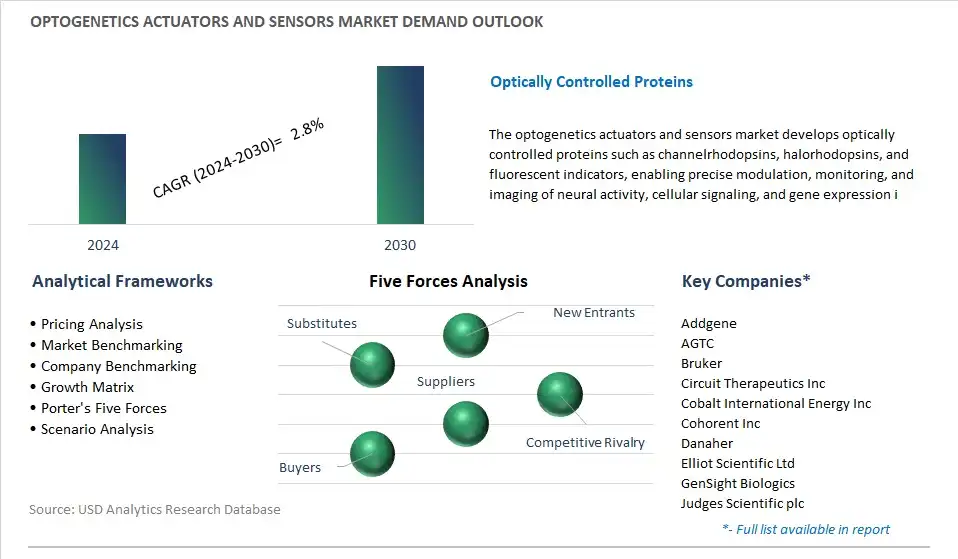
Optogenetics Actuators and Sensors Market is estimated to increase at a growth rate of 2.8% CAGR over the forecast period from 2024 to 2030.
The global Optogenetics Actuators and Sensors Marketstudy analyzes and forecasts the market size across 6 regions and 24 countries for diverse segments including By Product (Actuators, Sensors), By Disease Type, Retinal Disorders, Parkinson’s Disease, Anxiety & Depression, Autism, Schizophrenia, Others).
An introduction to Optogenetics Actuators and Sensors Market in 2024
The optogenetics actuators and sensors market is witnessing significant growth in 2024, driven by advancements in neuroscience research, the demand for precise manipulation and monitoring of neural activity, and the increasing adoption of optogenetic tools in basic science and therapeutic applications. Optogenetics actuators and sensors enable researchers to control and observe specific neuronal populations with unprecedented spatiotemporal precision using light-sensitive proteins and genetic manipulation techniques. With ongoing technological innovations, development of novel optogenetic tools, and expanding applications in neuroscience, the market is experiencing rapid expansion, fostering collaborations between academia, industry, and healthcare providers to unlock new insights into brain function and develop innovative treatments for neurological disorders.
Optogenetics Actuators and Sensors Market Trend: Advancements in Optogenetic Tools and Techniques
A prominent trend in the Optogenetics Actuators and Sensors Market is the continuous advancements in optogenetic tools and techniques. Optogenetics has revolutionized neuroscience research by enabling precise control of neuronal activity using light-sensitive proteins called opsins. Researchers are continually developing novel optogenetic actuators and sensors with enhanced properties such as improved light sensitivity, temporal precision, and cell-type specificity. Additionally, advancements in gene delivery methods, viral vectors, and optoelectronic devices contribute to the development of more sophisticated optogenetic tools for modulating and monitoring neural circuits with high spatiotemporal resolution. This trend towards technological innovation drives market growth and expansion in the Optogenetics Actuators and Sensors Market, offering researchers versatile tools for dissecting neural circuits and understanding brain function.
Optogenetics Actuators and Sensors Market Driver: Increasing Adoption of Optogenetics in Basic Research and Therapeutic Applications
A significant driver propelling the Optogenetics Actuators and Sensors Market is the increasing adoption of optogenetics in basic research and therapeutic applications. Optogenetic techniques allow precise control and manipulation of neural activity with millisecond precision, offering unprecedented insights into brain function, behavior, and neurological disorders. In basic research, optogenetics is widely used to study neural circuits, synaptic plasticity, and the mechanisms underlying neurological diseases such as Parkinson's disease, epilepsy, and depression. Furthermore, optogenetics holds immense potential for therapeutic applications, including neural prosthetics, deep brain stimulation, and optogenetic therapy for neurological and psychiatric disorders. As researchers and clinicians recognize the utility and versatility of optogenetic tools in neuroscience and neuroengineering, the demand for optogenetic actuators and sensors continues to rise, driving market growth and investment in optogenetics technology.
Market Opportunity Development of Miniaturized and Wireless Optogenetic Devices
An enticing opportunity within the Optogenetics Actuators and Sensors Market lies in the development of miniaturized and wireless optogenetic devices. Traditional optogenetic setups often require cumbersome equipment and tethered optical fibers, limiting experimental flexibility and impeding translational applications in freely moving animals or human subjects. Developing miniaturized and wireless optogenetic devices offers several advantages, including improved mobility, reduced experimental artifacts, and enhanced compatibility with chronic implantation and long-term studies. By miniaturizing optogenetic actuators and sensors and incorporating wireless communication capabilities, manufacturers can overcome existing technical challenges and expand the utility of optogenetics in behavioral neuroscience, neural engineering, and clinical neurology. These innovative devices offer opportunities for non-invasive modulation of neural circuits in freely behaving animals or patients, enabling novel research paradigms and therapeutic interventions in neuroscience and neurology, thereby driving market growth and addressing unmet needs in optogenetics research and applications.
Optogenetics Actuators and Sensors Market Market Segmentation
By Product
Actuators
-Channelrhodopsin
-Halorhodopsin
-Archaerhodopsin
Sensors
-Genetically Encoded Calcium Indicators
-Voltage-Sensitive Fluorescent Proteins
-pH Sensors
By Disease Type
Retinal Disorders
Parkinson’s Disease
Anxiety & Depression
Autism
Schizophrenia
Others
Geographical Analysis
North America (United States, Canada, Mexico)
Europe (Germany, France, United Kingdom, Spain, Italy, Rest of Europe)
Asia Pacific (China, India, Japan, South Korea, Rest of Asia Pacific)
South America (Brazil, Argentina, Rest of South America)
Middle East and Africa (Saudi Arabia, UAE, Rest of Middle East, South Africa, Egypt, Rest of Africa)
Optogenetics Actuators and Sensors Market Companies
Addgene
AGTC
Bruker
Circuit Therapeutics Inc
Cobalt International Energy Inc
Cohorent Inc
Danaher
Elliot Scientific Ltd
GenSight Biologics
Judges Scientific plc
Laserglow technologies
Merck KGaA
Noldus Information Technology
Prizmatix
REGENXBIO Inc
Scientifica
Shanghai Laser & Optics Century Co. Ltd
The Jackson Laboratory
Thorlabs Inc
Visual Solutions Inc
Reasons to Buy the Optogenetics Actuators and Sensors Market Study
• Deepen your industry insights and navigate uncertainties for strategy formulation, CAPEX, and Operational decisions
• Gain access to detailed insights on the Optogenetics Actuators and Sensors Market, encompassing current market size, growth trends, and forecasts till 2030.
• Access detailed competitor analysis, enabling competitive advantage through a thorough understanding of market players, strategies, and potential differentiation opportunities
• Stay ahead of the curve with insights on technological advancements, innovations, and upcoming trends
• Identify lucrative investment avenues and expansion opportunities within the Optogenetics Actuators and Sensors Market industry, guided by robust, data-backed analysis.
• Understand regional and global markets through country-wise analysis, regional market potential, regulatory nuances, and dynamics
• Execute strategies with confidence and speed through information, analytics, and insights on the industry value chain
• Corporate leaders, strategists, financial experts, shareholders, asset managers, and governmental representatives can make long-term planning scenarios and build an integrated and timely understanding of market dynamics
• Benefit from tailored solutions and expert consultation based on report insights, providing personalized strategies aligned with specific business needs.
TABLE OF CONTENTS
1 Introduction to 2024 Optogenetics Actuators and Sensors Market
1.1 Market Overview
1.2 Quick Facts
1.3 Scope/Objective of the Study
1.4 Market Definition
1.5 Countries and Regions Analyzed
1.6 Units, Currency, and Conversions
1.7 Industry Value Chain
2 Research Methodology
2.1 Market Size Estimation
2.2 Sources and Research Methodology
2.3 Data Triangulation
2.4 Assumptions and Limitations
3 Executive Summary
3.1 Global Optogenetics Actuators and Sensors Market Size Outlook, $ Million, 2021 to 2030
3.2 Optogenetics Actuators and Sensors Market Outlook by Type, $ Million, 2021 to 2030
3.3 Optogenetics Actuators and Sensors Market Outlook by Product, $ Million, 2021 to 2030
3.4 Optogenetics Actuators and Sensors Market Outlook by Application, $ Million, 2021 to 2030
3.5 Optogenetics Actuators and Sensors Market Outlook by Key Countries, $ Million, 2021 to 2030
4 Market Dynamics
4.1 Key Driving Forces of Optogenetics Actuators and Sensors Industry
4.2 Key Market Trends in Optogenetics Actuators and Sensors Industry
4.3 Potential Opportunities in Optogenetics Actuators and Sensors Industry
4.4 Key Challenges in Optogenetics Actuators and Sensors Industry
5 Market Factor Analysis
5.1 Value Chain Analysis
5.2 Competitive Landscape
5.2.1 Global Optogenetics Actuators and Sensors Market Share by Company (%), 2023
5.2.2 Product Offerings by Company
5.3 Porter’s Five Forces Analysis
5.4 Pricing Analysis and Outlook
6 Growth Outlook Across Scenarios
6.1 Growth Analysis-Case Scenario Definitions
6.2 Low Growth Scenario Forecasts
6.3 Reference Growth Scenario Forecasts
6.4 High Growth Scenario Forecasts
7 Global Optogenetics Actuators and Sensors Market Outlook by Segments
7.1 Optogenetics Actuators and Sensors Market Outlook by Segments, $ Million, 2021- 2030
By Product
Actuators
-Channelrhodopsin
-Halorhodopsin
-Archaerhodopsin
Sensors
-Genetically Encoded Calcium Indicators
-Voltage-Sensitive Fluorescent Proteins
-pH Sensors
By Disease Type
Retinal Disorders
Parkinson’s Disease
Anxiety & Depression
Autism
Schizophrenia
Others
8 North America Optogenetics Actuators and Sensors Market Analysis and Outlook To 2030
8.1 Introduction to North America Optogenetics Actuators and Sensors Markets in 2024
8.2 North America Optogenetics Actuators and Sensors Market Size Outlook by Country, 2021-2030
8.2.1 United States
8.2.2 Canada
8.2.3 Mexico
8.3 North America Optogenetics Actuators and Sensors Market size Outlook by Segments, 2021-2030
By Product
Actuators
-Channelrhodopsin
-Halorhodopsin
-Archaerhodopsin
Sensors
-Genetically Encoded Calcium Indicators
-Voltage-Sensitive Fluorescent Proteins
-pH Sensors
By Disease Type
Retinal Disorders
Parkinson’s Disease
Anxiety & Depression
Autism
Schizophrenia
Others
9 Europe Optogenetics Actuators and Sensors Market Analysis and Outlook To 2030
9.1 Introduction to Europe Optogenetics Actuators and Sensors Markets in 2024
9.2 Europe Optogenetics Actuators and Sensors Market Size Outlook by Country, 2021-2030
9.2.1 Germany
9.2.2 France
9.2.3 Spain
9.2.4 United Kingdom
9.2.4 Italy
9.2.5 Russia
9.2.6 Norway
9.2.7 Rest of Europe
9.3 Europe Optogenetics Actuators and Sensors Market Size Outlook by Segments, 2021-2030
By Product
Actuators
-Channelrhodopsin
-Halorhodopsin
-Archaerhodopsin
Sensors
-Genetically Encoded Calcium Indicators
-Voltage-Sensitive Fluorescent Proteins
-pH Sensors
By Disease Type
Retinal Disorders
Parkinson’s Disease
Anxiety & Depression
Autism
Schizophrenia
Others
10 Asia Pacific Optogenetics Actuators and Sensors Market Analysis and Outlook To 2030
10.1 Introduction to Asia Pacific Optogenetics Actuators and Sensors Markets in 2024
10.2 Asia Pacific Optogenetics Actuators and Sensors Market Size Outlook by Country, 2021-2030
10.2.1 China
10.2.2 India
10.2.3 Japan
10.2.4 South Korea
10.2.5 Indonesia
10.2.6 Malaysia
10.2.7 Australia
10.2.8 Rest of Asia Pacific
10.3 Asia Pacific Optogenetics Actuators and Sensors Market size Outlook by Segments, 2021-2030
By Product
Actuators
-Channelrhodopsin
-Halorhodopsin
-Archaerhodopsin
Sensors
-Genetically Encoded Calcium Indicators
-Voltage-Sensitive Fluorescent Proteins
-pH Sensors
By Disease Type
Retinal Disorders
Parkinson’s Disease
Anxiety & Depression
Autism
Schizophrenia
Others
11 South America Optogenetics Actuators and Sensors Market Analysis and Outlook To 2030
11.1 Introduction to South America Optogenetics Actuators and Sensors Markets in 2024
11.2 South America Optogenetics Actuators and Sensors Market Size Outlook by Country, 2021-2030
11.2.1 Brazil
11.2.2 Argentina
11.2.3 Rest of South America
11.3 South America Optogenetics Actuators and Sensors Market size Outlook by Segments, 2021-2030
By Product
Actuators
-Channelrhodopsin
-Halorhodopsin
-Archaerhodopsin
Sensors
-Genetically Encoded Calcium Indicators
-Voltage-Sensitive Fluorescent Proteins
-pH Sensors
By Disease Type
Retinal Disorders
Parkinson’s Disease
Anxiety & Depression
Autism
Schizophrenia
Others
12 Middle East and Africa Optogenetics Actuators and Sensors Market Analysis and Outlook To 2030
12.1 Introduction to Middle East and Africa Optogenetics Actuators and Sensors Markets in 2024
12.2 Middle East and Africa Optogenetics Actuators and Sensors Market Size Outlook by Country, 2021-2030
12.2.1 Saudi Arabia
12.2.2 UAE
12.2.3 Oman
12.2.4 Rest of Middle East
12.2.5 Egypt
12.2.6 Nigeria
12.2.7 South Africa
12.2.8 Rest of Africa
12.3 Middle East and Africa Optogenetics Actuators and Sensors Market size Outlook by Segments, 2021-2030
By Product
Actuators
-Channelrhodopsin
-Halorhodopsin
-Archaerhodopsin
Sensors
-Genetically Encoded Calcium Indicators
-Voltage-Sensitive Fluorescent Proteins
-pH Sensors
By Disease Type
Retinal Disorders
Parkinson’s Disease
Anxiety & Depression
Autism
Schizophrenia
Others
13 Company Profiles
13.1 Company Snapshot
13.2 SWOT Profiles
13.3 Products and Services
13.4 Recent Developments
13.5 Financial Profile
List of Companies
Addgene
AGTC
Bruker
Circuit Therapeutics Inc
Cobalt International Energy Inc
Cohorent Inc
Danaher
Elliot Scientific Ltd
GenSight Biologics
Judges Scientific plc
Laserglow technologies
Merck KGaA
Noldus Information Technology
Prizmatix
REGENXBIO Inc
Scientifica
Shanghai Laser & Optics Century Co. Ltd
The Jackson Laboratory
Thorlabs Inc
Visual Solutions Inc
14 Appendix
14.1 Customization Offerings
14.2 Subscription Services
14.3 Related Reports
14.4 Publisher Expertise
By Product
Actuators
-Channelrhodopsin
-Halorhodopsin
-Archaerhodopsin
Sensors
-Genetically Encoded Calcium Indicators
-Voltage-Sensitive Fluorescent Proteins
-pH Sensors
By Disease Type
Retinal Disorders
Parkinson’s Disease
Anxiety & Depression
Autism
Schizophrenia
Others
