Organic Baby Food Market is estimated to increase at a growth rate of 12.7% CAGR over the forecast period from 2024 to 2030.
The Organic Baby Food Market Study forecasts the market size across 6 regions and 24 countries for diverse segments including-Type (Milk Formula, Ready-to-feed, Dried Food, Prepared Food, Others), Packaging (Jar, Pouch, Paper Box), Age Group (Up to 6 Months, 6 to 12 Months, 12 to 18 Months, Above 18 Months), Distribution Channel (Speciality Stores, Supermarkets and Hypermarkets, Pharmacies, Online).
An Introduction to Organic Baby Food Market, 2024
Organic Baby Food: The market for organic baby food is primarily driven by the increasing consumer preference for natural, pesticide-free, and nutritionally superior options for infant nutrition. Key drivers include the demand for baby food made from organically grown ingredients, free from synthetic pesticides, GMOs, and other additives, ensuring higher nutritional value and reduced exposure to potentially harmful substances. The appeal lies in organic baby food's emphasis on health, safety, and the belief that organic products support a baby's development, catering to parents seeking wholesome and environmentally conscious choices for their infants.
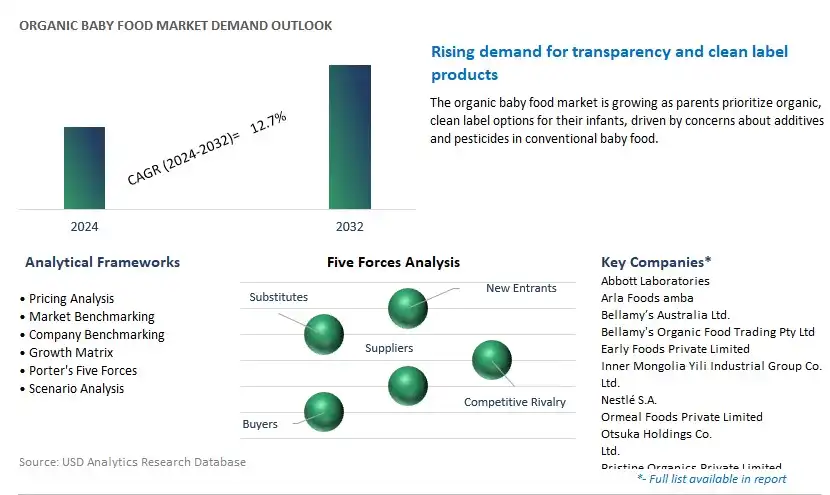
Organic Baby Food Market Trend: Growing Preference for Organic and Natural Products
A prominent trend in the organic baby food market is the growing preference for organic and natural products among parents. Concerns about harmful additives, pesticides, and genetically modified ingredients have prompted a shift towards organic baby food products. This trend aligns with the increased emphasis on healthier dietary choices for infants and toddlers, driving the demand for organic baby food options that offer transparency in sourcing, natural ingredients, and nutritional benefits.
Organic Baby Food Market Driver: Parental Focus on Health and Nutrition
The driver propelling the organic baby food market is the heightened focus of parents on the health and nutrition of their infants. Parents prioritize providing wholesome and nutrient-rich foods to support their child's growth and development. Organic baby food, free from synthetic additives and produced with organic farming practices, appeals to parents seeking products that align with their desire for healthier options, thereby influencing the market demand for organic baby food.
Organic Baby Food Market Opportunity: Expansion of Product Varieties and Distribution Channels
An opportunity within the organic baby food market lies in expanding product varieties and distribution channels. Investing in the development of diverse organic baby food options, such as new flavors, textures, or formulations that cater to specific dietary needs or developmental stages, presents an opportunity. Moreover, exploring and expanding distribution channels, including online platforms, specialty stores, and partnerships with healthcare providers, could increase accessibility and reach a broader consumer base, thereby increasing market penetration and meeting the growing demand for organic baby food products. This expansion strategy could enhance market presence and cater to the evolving needs of health-conscious parents.
Organic Baby Food Market Segmentation
Type
Milk Formula
Ready to Feed
Dried Food
Prepared Food
Others
Packaging
Jar
Pouch
Paper Box
Age Group
Upto 6 Months
6 to 12 Months
12 to 18 Months
Above 18 Months
Distribution Channel
Speciality Stores
Supermarkets and Hypermarkets
Pharmacies
Online
Geographical Segmentation
• North America (US, Canada, Mexico)
• Europe (Germany, UK, France, Spain, Italy, Russia, Rest of Europe)
• Asia Pacific (China, India, Japan, South Korea, South East Asia, Rest of Asia Pacific)
• South America (Brazil, Argentina, Rest of South America)
• Middle East and Africa (Saudi Arabia, UAE, Rest of Middle East, Egypt, South Africa, Nigeria, Rest of Africa)
Organic Baby Food Companies Profiled in the Study-
Abbott Laboratories
Arla Foods amba
Bellamy’s Australia Ltd.
Bellamy's Organic Food Trading Pty Ltd
Early Foods Private Limited
Inner Mongolia Yili Industrial Group Co., Ltd.
Nestlé S.A.
Ormeal Foods Private Limited
Otsuka Holdings Co., Ltd.
Pristine Organics Private Limited
Slurp Farm Private Limited
The Kraft Heinz Company
Tiny Spoon Foods Private Limited
Reasons to Buy the Organic Baby Food Market Study
• Deepen your industry insights and navigate uncertainties for strategy formulation, CAPEX, and Operational decisions
• Gain access to detailed insights on the Organic Baby Food Market, encompassing current market size, growth trends, and forecasts till 2030.
• Access detailed competitor analysis, enabling competitive advantage through a thorough understanding of market players, strategies, and potential differentiation opportunities
• Stay ahead of the curve with insights on technological advancements, innovations, and upcoming trends
• Identify lucrative investment avenues and expansion opportunities within the Organic Baby Food Market industry, guided by robust, data-backed analysis.
• Understand regional and global markets through country-wise analysis, regional market potential, regulatory nuances, and dynamics
• Execute strategies with confidence and speed through information, analytics, and insights on the industry value chain
• Corporate leaders, strategists, financial experts, shareholders, asset managers, and governmental representatives can make long-term planning scenarios and build an integrated and timely understanding of market dynamics
• Benefit from tailored solutions and expert consultation based on report insights, providing personalized strategies aligned with specific business needs.
TABLE OF CONTENTS
1 Introduction To 2024 Organic Baby Food Markets
1.1 Market Overview
1.2 Quick Facts
1.3 Scope/Objective of the Study
1.4 Market Definition
1.5 Countries and Regions Included
1.6 Units, Currency, and Conversions
1.7 Industry Value Chain
2 Research Methodology
2.1 Market Size Estimation
2.2 Sources and Research Methodology
2.3 Data Triangulation
2.4 Assumptions and Limitations
3 Executive Summary
3.1 Global Organic Baby Food Market Size Outlook, $ Million, 2021 to 2030
3.2 Organic Baby Food Market Outlook by Type, $ Million, 2021 to 2030
3.3 Organic Baby Food Market Outlook by Product, $ Million, 2021 to 2030
3.4 Organic Baby Food Market Outlook by Application, $ Million, 2021 to 2030
3.5 Organic Baby Food Market Outlook by Key Countries, $ Million, 2021 to 2030
4 Market Dynamics
4.1 Key Driving Forces of Organic Baby Food Industry
4.2 Key Market Trends in Organic Baby Food Industry
4.3 Potential Opportunities in Organic Baby Food Industry
4.4 Key Challenges in Organic Baby Food Industry
5 Market Factor Analysis
5.1 Competitive Landscape
5.1.1 Global Organic Baby Food Market Share by Company
5.1.2 Product Offerings by Company
5.2 Porter’s Five Forces Analysis
6 Growth Outlook Across Scenarios
6.1 Growth Analysis-Case Scenario Definitions
6.2 Low Growth Scenario Forecasts
6.3 Reference Growth Scenario Forecasts
6.4 High Growth Scenario Forecasts
7 Global Organic Baby Food Market Outlook by Segments
7.1 Organic Baby Food Market Outlook by Segments
Type
Milk Formula
Ready to Feed
Dried Food
Prepared Food
Others
Packaging
Jar
Pouch
Paper Box
Age Group
Upto 6 Months
6 to 12 Months
12 to 18 Months
Above 18 Months
Distribution Channel
Speciality Stores
Supermarkets and Hypermarkets
Pharmacies
Online
8 North America Organic Baby Food Market Analysis and Outlook To 2030
8.1 Introduction to North America Organic Baby Food Markets in 2024
8.2 North America Organic Baby Food Market Size Outlook by Country, 2021-2030
8.2.1 United States
8.2.2 Canada
8.2.3 Mexico
8.3 North America Organic Baby Food Market size Outlook by Segments, 2021-2030
Type
Milk Formula
Ready to Feed
Dried Food
Prepared Food
Others
Packaging
Jar
Pouch
Paper Box
Age Group
Upto 6 Months
6 to 12 Months
12 to 18 Months
Above 18 Months
Distribution Channel
Speciality Stores
Supermarkets and Hypermarkets
Pharmacies
Online
9 Europe Organic Baby Food Market Analysis and Outlook To 2030
9.1 Introduction to Europe Organic Baby Food Markets in 2024
9.2 Europe Organic Baby Food Market Size Outlook by Country, 2021-2030
9.2.1 Germany
9.2.2 France
9.2.3 Spain
9.2.4 United Kingdom
9.2.4 Italy
9.2.5 Russia
9.2.6 Norway
9.2.7 Rest of Europe
9.3 Europe Organic Baby Food Market size Outlook by Segments, 2021-2030
Type
Milk Formula
Ready to Feed
Dried Food
Prepared Food
Others
Packaging
Jar
Pouch
Paper Box
Age Group
Upto 6 Months
6 to 12 Months
12 to 18 Months
Above 18 Months
Distribution Channel
Speciality Stores
Supermarkets and Hypermarkets
Pharmacies
Online
10 Asia Pacific Organic Baby Food Market Analysis and Outlook To 2030
10.1 Introduction to Asia Pacific Organic Baby Food Markets in 2024
10.2 Asia Pacific Organic Baby Food Market Size Outlook by Country, 2021-2030
10.2.1 China
10.2.2 India
10.2.3 Japan
10.2.4 South Korea
10.2.5 Indonesia
10.2.6 Malaysia
10.2.7 Australia
10.2.8 Rest of Asia Pacific
10.3 Asia Pacific Organic Baby Food Market size Outlook by Segments, 2021-2030
Type
Milk Formula
Ready to Feed
Dried Food
Prepared Food
Others
Packaging
Jar
Pouch
Paper Box
Age Group
Upto 6 Months
6 to 12 Months
12 to 18 Months
Above 18 Months
Distribution Channel
Speciality Stores
Supermarkets and Hypermarkets
Pharmacies
Online
11 South America Organic Baby Food Market Analysis and Outlook To 2030
11.1 Introduction to South America Organic Baby Food Markets in 2024
11.2 South America Organic Baby Food Market Size Outlook by Country, 2021-2030
11.2.1 Brazil
11.2.2 Argentina
11.2.3 Rest of South America
11.3 South America Organic Baby Food Market size Outlook by Segments, 2021-2030
Type
Milk Formula
Ready to Feed
Dried Food
Prepared Food
Others
Packaging
Jar
Pouch
Paper Box
Age Group
Upto 6 Months
6 to 12 Months
12 to 18 Months
Above 18 Months
Distribution Channel
Speciality Stores
Supermarkets and Hypermarkets
Pharmacies
Online
12 Middle East and Africa Organic Baby Food Market Analysis and Outlook To 2030
12.1 Introduction to Middle East and Africa Organic Baby Food Markets in 2024
12.2 Middle East and Africa Organic Baby Food Market Size Outlook by Country, 2021-2030
12.2.1 Saudi Arabia
12.2.2 UAE
12.2.3 Oman
12.2.4 Rest of Middle East
12.2.5 Egypt
12.2.6 Nigeria
12.2.7 South Africa
12.2.8 Rest of Africa
12.3 Middle East and Africa Organic Baby Food Market size Outlook by Segments, 2021-2030
Type
Milk Formula
Ready to Feed
Dried Food
Prepared Food
Others
Packaging
Jar
Pouch
Paper Box
Age Group
Upto 6 Months
6 to 12 Months
12 to 18 Months
Above 18 Months
Distribution Channel
Speciality Stores
Supermarkets and Hypermarkets
Pharmacies
Online
List of Companies
Abbott Laboratories
Arla Foods amba
Bellamy’s Australia Ltd.
Bellamy's Organic Food Trading Pty Ltd
Early Foods Private Limited
Inner Mongolia Yili Industrial Group Co., Ltd.
Nestlé S.A.
Ormeal Foods Private Limited
Otsuka Holdings Co., Ltd.
Pristine Organics Private Limited
Slurp Farm Private Limited
The Kraft Heinz Company
Tiny Spoon Foods Private Limited
13 Company Profiles
13.1 Company Snapshot
13.2 SWOT Profiles
13.3 Products and Services
13.4 Recent Developments
13.5 Financial Profile
14 Appendix
14.1 Customization Offerings
14.2 Subscription Services
14.3 Related Reports
14.4 Publisher Expertise
Type/brMilk Formula /brReady to Feed /brDried Food /brPrepared Food /brOthers /br/brPackaging/brJar /brPouch /brPaper Box /br/brAge Group /brUpto 6 Months/br6 to 12 Months/br12 to 18 Months/brAbove 18 Months/br/brDistribution Channel/brSpeciality Stores /brSupermarkets and Hypermarkets /brPharmacies /brOnline
