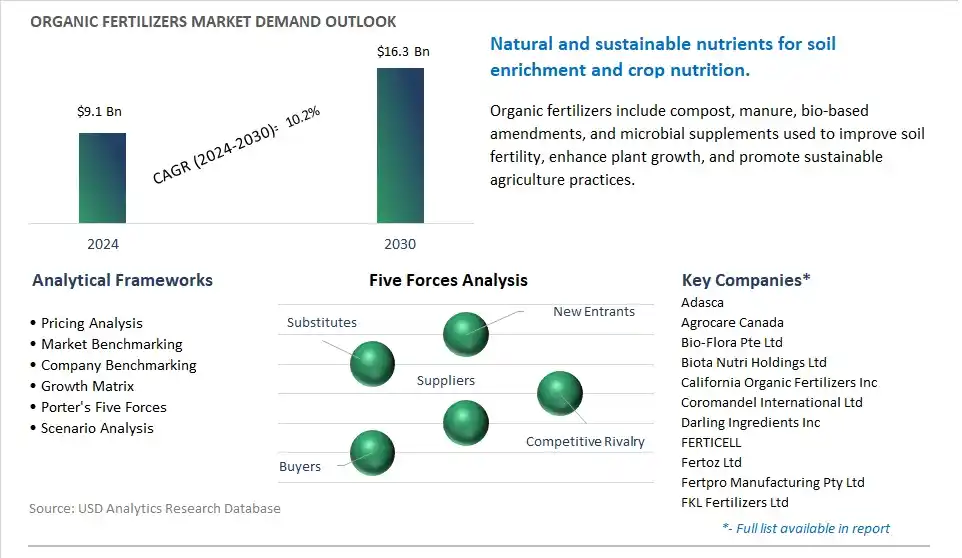
The global Organic Fertilizers Market is poised to register a 10.2% CAGR from $9.1 Billion in 2024 to $16.3 Billion in 2030.
The global Organic Fertilizers Market Study analyzes and forecasts the market size across 6 regions and 24 countries for diverse segments -By Source (Animal, Plant, Mineral), By Crop (Cereals & Grains, Oilseeds & Pulses, Fruits & Vegetables, Others), By Form (Dry, Liquid).
An Introduction to Global Organic Fertilizers Market in 2024
The key trend shaping the future of the organic fertilizers industry is the increasing demand for sustainable and environmentally friendly fertilization solutions to improve soil health, enhance crop yields, and reduce chemical inputs in agriculture. With growing concerns over soil degradation, nutrient depletion, and water pollution caused by conventional fertilizers, there is a rising interest in organic fertilizers derived from natural sources such as compost, animal manure, and plant-based materials. Manufacturers are developing innovative formulations and production methods to produce organic fertilizers that provide essential nutrients to plants while promoting soil microbial activity, nutrient cycling, and carbon sequestration, improving soil fertility and resilience to environmental stress. Additionally, the adoption of precision agriculture techniques and digital farming technologies is enabling farmers to optimize fertilizer application rates, timing, and placement, reducing nutrient runoff and minimizing environmental impact. Furthermore, the trend towards organic and regenerative agriculture is driving demand for certified organic fertilizers that meet strict standards for soil health, biodiversity conservation, and sustainable farming practices, supporting the growth of the organic farming sector and promoting a more sustainable food system. As consumer awareness of the environmental and health benefits of organic agriculture continues to grow, the demand for organic fertilizers is expected to increase, driving market expansion and innovation in the organic fertilizers industry.
Organic Fertilizers Market Competitive Landscape
The market report analyses the leading companies in the industry including Adasca, Agrocare Canada, Bio-Flora Pte Ltd, Biota Nutri Holdings Ltd, California Organic Fertilizers Inc, Coromandel International Ltd, Darling Ingredients Inc, FERTICELL, Fertoz Ltd, Fertpro Manufacturing Pty Ltd, FKL Fertilizers Ltd, ICL Group Ltd, K+S AG, Midwestern Bio Ag Holdings LLC, Multiplex Group Of Companies, NutriHarvest Pty Ltd, Perfect Blend Biotic Fertilizer, Queensland Organics, Safi Organics Ltd, Southern Petrochemical Industries Corp Ltd, Suståne Natural Fertilizer Inc, T. Stanes & Company Ltd, TerraLink Horticulture Inc, The Scotts Company LLC, Yara International ASA.
Organic Fertilizers Market Dynamics
Organic Fertilizers Market Trend: Growing Demand for Organic and Sustainable Agriculture
A prominent trend in the organic fertilizers market is the growing demand for organic and sustainable agriculture practices. With increasing awareness about the environmental and health benefits of organic farming, there is a rising trend towards the use of organic fertilizers made from natural and renewable sources such as compost, manure, bone meal, and seaweed extracts. Organic fertilizers promote soil health, enhance nutrient availability, and reduce chemical runoff and soil erosion, making them an attractive choice for farmers seeking to improve crop yields while minimizing environmental impact. This is driving the shift towards sustainable farming methods and consumer preferences for organic food products.
Organic Fertilizers Market Driver: Regulatory Support and Government Initiatives
A significant driver propelling the organic fertilizers market is regulatory support and government initiatives promoting organic farming practices. Governments worldwide are implementing policies, incentives, and subsidies to encourage the adoption of organic fertilizers and sustainable agriculture practices. These initiatives include organic certification programs, grants for organic farming conversion, tax incentives for organic inputs, and support for research and development in organic agriculture. Additionally, regulations limiting the use of synthetic fertilizers and pesticides in agriculture contribute to the growing demand for organic alternatives. This driver creates opportunities for manufacturers and suppliers of organic fertilizers to capitalize on government support and expand their market presence in the burgeoning organic agriculture sector.
Organic Fertilizers Market Opportunity: Innovation and Product Development
An opportunity for the organic fertilizers market lies in innovation and product development to address specific agricultural challenges and market needs. Manufacturers can invest in research and development to create advanced organic fertilizer formulations tailored to different crops, soil types, and climate conditions. This include specialty organic fertilizers enriched with beneficial microorganisms, bio-stimulants, and micronutrients to enhance plant growth, nutrient uptake, and stress tolerance. Additionally, there is potential to develop organic fertilizers with slow-release or controlled-release mechanisms to provide nutrients to plants over an extended period, reducing the frequency of application and optimizing nutrient utilization efficiency. By offering innovative and high-performance organic fertilizer solutions, manufacturers aim to gain market shares in the market, meet the evolving needs of organic farmers, and capitalize on the growing demand for sustainable agriculture inputs.
Organic Fertilizers Market Share Analysis: Plant source generated the highest revenue in 2024
The largest segment in the Organic Fertilizers Market is the Plant source segment. Plant-based organic fertilizers are derived from natural materials such as compost, crop residues, green manure, and seaweed, among others. Diverse factors contribute to the dominance of plant-based organic fertilizers in the market. plant-based fertilizers are readily available and widely used by organic and conventional farmers alike due to their effectiveness in enhancing soil fertility and promoting plant growth. These fertilizers contain essential nutrients such as nitrogen, phosphorus, potassium, and micronutrients, which are released slowly over time as they decompose, providing a sustained source of nutrition for crops. Additionally, plant-based fertilizers improve soil structure, water retention, and microbial activity, leading to improved soil health and productivity. Furthermore, plant-based organic fertilizers are renewable, biodegradable, and environmentally friendly, making them a preferred choice for eco-conscious consumers and farmers seeking sustainable agricultural practices. With the increasing demand for organic and sustainable food production methods, the plant-based organic fertilizers segment continues to grow steadily in the Organic Fertilizers Market.
Organic Fertilizers Market Share Analysis: Fruits & Vegetables segment is poised to register the fastest growth rate (CAGR) over the forecast period to 2030
The fastest-growing segment in the Organic Fertilizers Market is the Fruits & Vegetables crop segment. There is a growing global demand for organic fruits and vegetables due to increasing health consciousness and awareness of the benefits of organic farming practices. Consumers are increasingly seeking organic produce free from synthetic pesticides, herbicides, and chemical fertilizers, driving the demand for organic fertilizers in fruit and vegetable cultivation. Additionally, organic fruits and vegetables command premium prices in the market, providing farmers with a strong economic incentive to adopt organic farming methods and invest in organic fertilizers. Furthermore, organic fertilizers are well-suited for fruit and vegetable crops due to their ability to improve soil health, nutrient uptake, and crop yield without harmful environmental impacts. Accordingly, the fruits and vegetables segment presents significant growth opportunities for the Organic Fertilizers Market, fueled by the increasing demand for organic produce and sustainable agricultural practices in the horticulture sector.
Organic Fertilizers Market Share Analysis: Liquid segment is poised to register the fastest growth rate (CAGR) over the forecast period to 2030
The fastest-growing segment in the Organic Fertilizers Market is the Liquid form segment. liquid organic fertilizers offer potential advantages over dry formulations, including faster nutrient absorption by plants and easier application methods such as fertigation and foliar spraying. Liquid fertilizers can be easily blended with irrigation water or applied directly to plant leaves, providing a rapid and targeted delivery of nutrients to crops. This results in quicker nutrient uptake and utilization by plants, leading to enhanced growth, development, and yield. Additionally, liquid organic fertilizers are highly soluble and compatible with drip irrigation systems, allowing for precise nutrient management and efficient use of resources. Furthermore, liquid formulations offer greater flexibility in application rates and timing, allowing farmers to tailor their fertilization programs to meet the specific needs of different crops and growth stages. As a result of these advantages, the demand for liquid organic fertilizers is growing rapidly, driving the expansion of the Liquid segment in the Organic Fertilizers Market.
Organic Fertilizers Market Report Segmentation
By Source
Animal
Plant
Mineral
By Crop
Cereals & Grains
Oilseeds & Pulses
Fruits & Vegetables
Others
By Form
Dry
Liquid
Regions Included
North America (US, Canada, Mexico)
Europe (Germany, UK, France, Spain, Italy, Russia, Rest of Europe)
Asia Pacific (China, India, Japan, South Korea, Australia, South East Asia, Rest of Asia)
South America (Brazil, Argentina, Rest of South America)
Middle East and Africa (Saudi Arabia, UAE, Rest of Middle East, South Africa, Egypt, Rest of Africa)
Organic Fertilizers Companies Profiled in the Market Study
Adasca
Agrocare Canada
Bio-Flora Pte Ltd
Biota Nutri Holdings Ltd
California Organic Fertilizers Inc
Coromandel International Ltd
Darling Ingredients Inc
FERTICELL
Fertoz Ltd
Fertpro Manufacturing Pty Ltd
FKL Fertilizers Ltd
ICL Group Ltd
K+S AG
Midwestern Bio Ag Holdings LLC
Multiplex Group Of Companies
NutriHarvest Pty Ltd
Perfect Blend Biotic Fertilizer
Queensland Organics
Safi Organics Ltd
Southern Petrochemical Industries Corp Ltd
Suståne Natural Fertilizer Inc
T. Stanes & Company Ltd
TerraLink Horticulture Inc
The Scotts Company LLC
Yara International ASA
*- List Not Exhaustive
TABLE OF CONTENTS
1 Introduction to 2024 Organic Fertilizers Market
1.1 Market Overview
1.2 Quick Facts
1.3 Scope/Objective of the Study
1.4 Market Definition
1.5 Countries and Regions Covered
1.6 Units, Currency, and Conversions
1.7 Industry Value Chain
2 Research Methodology
2.1 Market Size Estimation
2.2 Sources and Research Methodology
2.3 Data Triangulation
2.4 Assumptions and Limitations
3 Executive Summary
3.1 Global Organic Fertilizers Market Size Outlook, $ Million, 2021 to 2030
3.2 Organic Fertilizers Market Outlook by Type, $ Million, 2021 to 2030
3.3 Organic Fertilizers Market Outlook by Product, $ Million, 2021 to 2030
3.4 Organic Fertilizers Market Outlook by Application, $ Million, 2021 to 2030
3.5 Organic Fertilizers Market Outlook by Key Countries, $ Million, 2021 to 2030
4 Market Dynamics
4.1 Key Driving Forces of Organic Fertilizers Industry
4.2 Key Market Trends in Organic Fertilizers Industry
4.3 Potential Opportunities in Organic Fertilizers Industry
4.4 Key Challenges in Organic Fertilizers Industry
5 Market Factor Analysis
5.1 Value Chain Analysis
5.2 Competitive Landscape
5.2.1 Global Organic Fertilizers Market Share by Company (%), 2023
5.2.2 Product Offerings by Company
5.3 Porter’s Five Forces Analysis
5.4 Pricing Analysis and Outlook
6 Growth Outlook Across Scenarios
6.1 Growth Analysis-Case Scenario Definitions
6.2 Low Growth Scenario Forecasts
6.3 Reference Growth Scenario Forecasts
6.4 High Growth Scenario Forecasts
7 Global Organic Fertilizers Market Outlook by Segments
7.1 Organic Fertilizers Market Outlook by Segments, $ Million, 2021- 2030
By Source
Animal
Plant
Mineral
By Crop
Cereals & Grains
Oilseeds & Pulses
Fruits & Vegetables
Others
By Form
Dry
Liquid
8 North America Organic Fertilizers Market Analysis and Outlook To 2030
8.1 Introduction to North America Organic Fertilizers Markets in 2024
8.2 North America Organic Fertilizers Market Size Outlook by Country, 2021-2030
8.2.1 United States
8.2.2 Canada
8.2.3 Mexico
8.3 North America Organic Fertilizers Market size Outlook by Segments, 2021-2030
By Source
Animal
Plant
Mineral
By Crop
Cereals & Grains
Oilseeds & Pulses
Fruits & Vegetables
Others
By Form
Dry
Liquid
9 Europe Organic Fertilizers Market Analysis and Outlook To 2030
9.1 Introduction to Europe Organic Fertilizers Markets in 2024
9.2 Europe Organic Fertilizers Market Size Outlook by Country, 2021-2030
9.2.1 Germany
9.2.2 France
9.2.3 Spain
9.2.4 United Kingdom
9.2.4 Italy
9.2.5 Russia
9.2.6 Norway
9.2.7 Rest of Europe
9.3 Europe Organic Fertilizers Market Size Outlook by Segments, 2021-2030
By Source
Animal
Plant
Mineral
By Crop
Cereals & Grains
Oilseeds & Pulses
Fruits & Vegetables
Others
By Form
Dry
Liquid
10 Asia Pacific Organic Fertilizers Market Analysis and Outlook To 2030
10.1 Introduction to Asia Pacific Organic Fertilizers Markets in 2024
10.2 Asia Pacific Organic Fertilizers Market Size Outlook by Country, 2021-2030
10.2.1 China
10.2.2 India
10.2.3 Japan
10.2.4 South Korea
10.2.5 Indonesia
10.2.6 Malaysia
10.2.7 Australia
10.2.8 Rest of Asia Pacific
10.3 Asia Pacific Organic Fertilizers Market size Outlook by Segments, 2021-2030
By Source
Animal
Plant
Mineral
By Crop
Cereals & Grains
Oilseeds & Pulses
Fruits & Vegetables
Others
By Form
Dry
Liquid
11 South America Organic Fertilizers Market Analysis and Outlook To 2030
11.1 Introduction to South America Organic Fertilizers Markets in 2024
11.2 South America Organic Fertilizers Market Size Outlook by Country, 2021-2030
11.2.1 Brazil
11.2.2 Argentina
11.2.3 Rest of South America
11.3 South America Organic Fertilizers Market size Outlook by Segments, 2021-2030
By Source
Animal
Plant
Mineral
By Crop
Cereals & Grains
Oilseeds & Pulses
Fruits & Vegetables
Others
By Form
Dry
Liquid
12 Middle East and Africa Organic Fertilizers Market Analysis and Outlook To 2030
12.1 Introduction to Middle East and Africa Organic Fertilizers Markets in 2024
12.2 Middle East and Africa Organic Fertilizers Market Size Outlook by Country, 2021-2030
12.2.1 Saudi Arabia
12.2.2 UAE
12.2.3 Oman
12.2.4 Rest of Middle East
12.2.5 Egypt
12.2.6 Nigeria
12.2.7 South Africa
12.2.8 Rest of Africa
12.3 Middle East and Africa Organic Fertilizers Market size Outlook by Segments, 2021-2030
By Source
Animal
Plant
Mineral
By Crop
Cereals & Grains
Oilseeds & Pulses
Fruits & Vegetables
Others
By Form
Dry
Liquid
13 Company Profiles
13.1 Company Snapshot
13.2 SWOT Profiles
13.3 Products and Services
13.4 Recent Developments
13.5 Financial Profile
Adasca
Agrocare Canada
Bio-Flora Pte Ltd
Biota Nutri Holdings Ltd
California Organic Fertilizers Inc
Coromandel International Ltd
Darling Ingredients Inc
FERTICELL
Fertoz Ltd
Fertpro Manufacturing Pty Ltd
FKL Fertilizers Ltd
ICL Group Ltd
K+S AG
Midwestern Bio Ag Holdings LLC
Multiplex Group Of Companies
NutriHarvest Pty Ltd
Perfect Blend Biotic Fertilizer
Queensland Organics
Safi Organics Ltd
Southern Petrochemical Industries Corp Ltd
Suståne Natural Fertilizer Inc
T. Stanes & Company Ltd
TerraLink Horticulture Inc
The Scotts Company LLC
Yara International ASA
14 Appendix
14.1 Customization Offerings
14.2 Subscription Services
14.3 Related Reports
14.4 Publisher Expertise
By Source
Animal
Plant
Mineral
By Crop
Cereals & Grains
Oilseeds & Pulses
Fruits & Vegetables
Others
By Form
Dry
Liquid
Countries Analyzed
North America (US, Canada, Mexico)
Europe (Germany, UK, France, Spain, Italy, Russia, Rest of Europe)
Asia Pacific (China, India, Japan, South Korea, Australia, South East Asia, Rest of Asia)
South America (Brazil, Argentina, Rest of South America)
Middle East and Africa (Saudi Arabia, UAE, Rest of Middle East, South Africa, Egypt, Rest of Africa)
