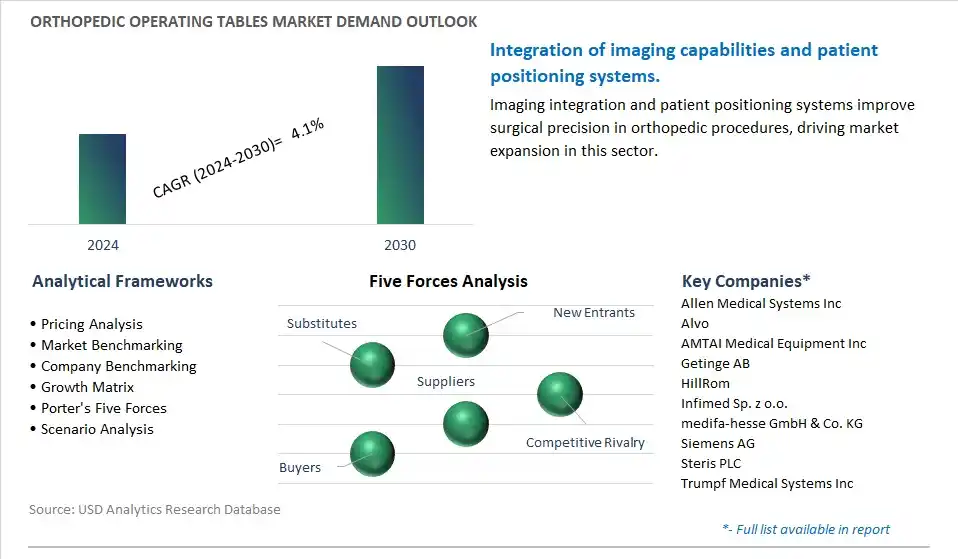
Orthopedic Operating Tables Market is estimated to increase at a growth rate of 4.1% CAGR over the forecast period from 2024 to 2030.
The global Orthopedic Operating Tables Market Study analyzes and forecasts the market size across 6 regions and 24 countries for diverse segments including By Technology (Non-powered Operating Tables, Powered Operating Tables), By End-User (Hospitals, Ambulatory Surgical Centers, Others).
An Introduction to Orthopedic Operating Tables Market in 2024
The Orthopedic Operating Tables Market in 2024 occupies a crucial position within the realm of surgical infrastructure, offering specialized surgical tables designed to accommodate the unique requirements of orthopedic procedures, optimize surgical ergonomics, and enhance patient safety and comfort. As orthopedic surgeries continue to witness exponential growth globally, driven by factors such as aging demographics, rising prevalence of musculoskeletal disorders, and advancements in surgical techniques, the demand for ergonomic and technologically advanced operating tables remains robust. From versatile general-purpose tables to specialized orthopedic tables equipped with radiolucent capabilities, traction systems, and intraoperative imaging integration, manufacturers are focused on delivering innovative solutions that cater to the diverse needs of orthopedic surgeons and enhance procedural efficiency, clinical outcomes, and patient satisfaction.
Orthopedic Operating Tables Market Competitive Landscape
The global Orthopedic Operating Tables Industry is highly competitive with a large number of companies focusing on niche market segments. Amidst intense competitive conditions, Orthopedic Operating Tables Companies are investing in new product launches and strengthening distribution channels. Key companies operating in the Orthopedic Operating Tables Industry include- Allen Medical Systems Inc, Alvo, AMTAI Medical Equipment Inc, Getinge AB, HillRom, Infimed Sp. z o.o., medifa-hesse GmbH & Co. KG, Siemens AG, Steris PLC, Trumpf Medical Systems Inc.
Orthopedic Operating Tables Market Trend: Integration of Advanced Features in Orthopedic Operating Tables
A prominent trend in the Orthopedic Operating Tables market is the integration of advanced features to enhance surgical precision, patient safety, and operating room efficiency. Orthopedic surgery often requires specialized positioning and access to facilitate optimal surgical outcomes. As such, manufacturers are incorporating advanced functionalities into orthopedic operating tables, such as motorized adjustments, radiolucent carbon fiber tabletops, multidirectional mobility, and compatibility with imaging and navigation systems. These features enable orthopedic surgeons to perform complex procedures with greater precision and flexibility while ensuring patient comfort and stability. Additionally, the integration of ergonomic design elements and infection control measures further enhances the usability and safety of orthopedic operating tables. The adoption of advanced operating table technologies improves surgical workflow efficiency, reduces procedure times, and contributes to better patient outcomes, driving market growth in the Orthopedic Operating Tables segment.
Orthopedic Operating Tables Market Driver: Rising Demand for Orthopedic Surgeries and Procedures
The primary market driver for Orthopedic Operating Tables is the rising demand for orthopedic surgeries and procedures worldwide. Orthopedic conditions such as osteoarthritis, fractures, and musculoskeletal injuries are becoming increasingly prevalent due to factors such as aging populations, sedentary lifestyles, and sports-related activities. Moreover, advancements in medical technology, surgical techniques, and implant materials have expanded the scope of orthopedic interventions, leading to a growing number of orthopedic procedures performed each year. As a result, there is a corresponding increase in demand for specialized surgical equipment and infrastructure, including orthopedic operating tables. Healthcare facilities are investing in modern operating room equipment to meet the needs of orthopedic surgeons and ensure optimal patient care. The growing volume of orthopedic surgeries and procedures drives market demand for Orthopedic Operating Tables, fueling market growth in this segment.
Orthopedic Operating Tables Market Opportunity: Development of Smart Operating Table Systems for Orthopedic Surgery
An emerging opportunity in the Orthopedic Operating Tables market is the development of smart operating table systems tailored specifically for orthopedic surgery. Smart operating tables integrate advanced technologies such as robotics, navigation, and real-time monitoring to enhance surgical precision, workflow automation, and patient outcomes. These intelligent systems can dynamically adjust table positions, angles, and settings based on surgical requirements and patient anatomy, allowing for optimal positioning and access during orthopedic procedures. Furthermore, smart operating table systems can interface with other surgical devices and imaging modalities, facilitating seamless integration and data exchange within the operating room environment. By investing in the development of smart operating table solutions for orthopedic surgery, manufacturers can address unmet needs in the market, differentiate their offerings, and capture a larger share of the Orthopedic Operating Tables segment. Additionally, smart operating table systems have the potential to revolutionize orthopedic surgical practice by enabling more precise and efficient procedures, ultimately improving patient outcomes and satisfaction.
Orthopedic Operating Tables Market Share Analysis: Powered Operating Tables is the fastest growing market segment over the forecast period to 2030
Among the various types of orthopedic operating tables, the segment experiencing the fastest growth is powered operating tables. Powered operating tables offer advanced features and functionalities compared to non-powered tables, providing greater flexibility and precision during orthopedic surgeries. These tables are equipped with motorized adjustments for height, tilt, lateral tilt, and Trendelenburg positions, allowing surgeons to optimize patient positioning for different procedures with ease. Powered tables also come with customizable accessories and attachments to accommodate specific surgical requirements, such as orthopedic extension devices and traction units. Additionally, powered operating tables enhance ergonomics for surgical teams, reducing physical strain and fatigue during lengthy procedures. The increasing adoption of minimally invasive orthopedic techniques and the demand for improved surgical outcomes are driving the growth of powered operating tables in both hospitals and ambulatory surgical centers. As a result, manufacturers are focusing on innovating and expanding their powered table offerings to meet the evolving needs of orthopedic surgeons, contributing to the rapid growth of this segment in the orthopedic operating tables market.
Orthopedic Operating Tables Market Segmentation
By Technology
Non-powered Operating Tables
Powered Operating Tables
By End-User
Hospitals
Ambulatory Surgical Centers
Others
Geographical Analysis
North America (United States, Canada, Mexico)
Europe (Germany, France, United Kingdom, Spain, Italy, Rest of Europe)
Asia Pacific (China, India, Japan, South Korea, Rest of Asia Pacific)
South America (Brazil, Argentina, Rest of South America)
Middle East and Africa (Saudi Arabia, UAE, Rest of Middle East, South Africa, Egypt, Rest of Africa)
Orthopedic Operating Tables Companies
Allen Medical Systems Inc
Alvo
AMTAI Medical Equipment Inc
Getinge AB
HillRom
Infimed Sp. z o.o.
medifa-hesse GmbH & Co. KG
Siemens AG
Steris PLC
Trumpf Medical Systems Inc
* List not Exhaustive
Reasons to Buy the Orthopedic Operating Tables Market Study
• Deepen your industry insights and navigate uncertainties for strategy formulation, CAPEX, and Operational decisions
• Gain access to detailed insights on the Orthopedic Operating Tables Market, encompassing current market size, growth trends, and forecasts till 2030.
• Access detailed competitor analysis, enabling competitive advantage through a thorough understanding of market players, strategies, and potential differentiation opportunities
• Stay ahead of the curve with insights on technological advancements, innovations, and upcoming trends
• Identify lucrative investment avenues and expansion opportunities within the Orthopedic Operating Tables Industry, guided by robust, data-backed analysis.
• Understand regional and global markets through country-wise analysis, regional market potential, regulatory nuances, and dynamics
• Execute strategies with confidence and speed through information, analytics, and insights on the industry value chain
• Corporate leaders, strategists, financial experts, shareholders, asset managers, and governmental representatives can make long-term planning scenarios and build an integrated and timely understanding of market dynamics
• Benefit from tailored solutions and expert consultation based on report insights, providing personalized strategies aligned with specific business needs.
TABLE OF CONTENTS
1 Introduction to 2024 Orthopedic Operating Tables Market
1.1 Market Overview
1.2 Quick Facts
1.3 Scope/Objective of the Study
1.4 Market Definition
1.5 Countries and Regions Analyzed
1.6 Units, Currency, and Conversions
1.7 Industry Value Chain
2 Research Methodology
2.1 Market Size Estimation
2.2 Sources and Research Methodology
2.3 Data Triangulation
2.4 Assumptions and Limitations
3 Executive Summary
3.1 Global Orthopedic Operating Tables Market Size Outlook, $ Million, 2021 to 2030
3.2 Orthopedic Operating Tables Market Outlook by Type, $ Million, 2021 to 2030
3.3 Orthopedic Operating Tables Market Outlook by Product, $ Million, 2021 to 2030
3.4 Orthopedic Operating Tables Market Outlook by Application, $ Million, 2021 to 2030
3.5 Orthopedic Operating Tables Market Outlook by Key Countries, $ Million, 2021 to 2030
4 Market Dynamics
4.1 Key Driving Forces of Orthopedic Operating Tables Industry
4.2 Key Market Trends in Orthopedic Operating Tables Industry
4.3 Potential Opportunities in Orthopedic Operating Tables Industry
4.4 Key Challenges in Orthopedic Operating Tables Industry
5 Market Factor Analysis
5.1 Value Chain Analysis
5.2 Competitive Landscape
5.2.1 Global Orthopedic Operating Tables Market Share by Company (%), 2023
5.2.2 Product Offerings by Company
5.3 Porter’s Five Forces Analysis
5.4 Pricing Analysis and Outlook
6 Growth Outlook Across Scenarios
6.1 Growth Analysis-Case Scenario Definitions
6.2 Low Growth Scenario Forecasts
6.3 Reference Growth Scenario Forecasts
6.4 High Growth Scenario Forecasts
7 Global Orthopedic Operating Tables Market Outlook by Segments
7.1 Orthopedic Operating Tables Market Outlook by Segments, $ Million, 2021- 2030
By Technology
Non-powered Operating Tables
Powered Operating Tables
By End-User
Hospitals
Ambulatory Surgical Centers
Others
8 North America Orthopedic Operating Tables Market Analysis and Outlook To 2030
8.1 Introduction to North America Orthopedic Operating Tables Markets in 2024
8.2 North America Orthopedic Operating Tables Market Size Outlook by Country, 2021-2030
8.2.1 United States
8.2.2 Canada
8.2.3 Mexico
8.3 North America Orthopedic Operating Tables Market size Outlook by Segments, 2021-2030
By Technology
Non-powered Operating Tables
Powered Operating Tables
By End-User
Hospitals
Ambulatory Surgical Centers
Others
9 Europe Orthopedic Operating Tables Market Analysis and Outlook To 2030
9.1 Introduction to Europe Orthopedic Operating Tables Markets in 2024
9.2 Europe Orthopedic Operating Tables Market Size Outlook by Country, 2021-2030
9.2.1 Germany
9.2.2 France
9.2.3 Spain
9.2.4 United Kingdom
9.2.4 Italy
9.2.5 Russia
9.2.6 Norway
9.2.7 Rest of Europe
9.3 Europe Orthopedic Operating Tables Market Size Outlook by Segments, 2021-2030
By Technology
Non-powered Operating Tables
Powered Operating Tables
By End-User
Hospitals
Ambulatory Surgical Centers
Others
10 Asia Pacific Orthopedic Operating Tables Market Analysis and Outlook To 2030
10.1 Introduction to Asia Pacific Orthopedic Operating Tables Markets in 2024
10.2 Asia Pacific Orthopedic Operating Tables Market Size Outlook by Country, 2021-2030
10.2.1 China
10.2.2 India
10.2.3 Japan
10.2.4 South Korea
10.2.5 Indonesia
10.2.6 Malaysia
10.2.7 Australia
10.2.8 Rest of Asia Pacific
10.3 Asia Pacific Orthopedic Operating Tables Market size Outlook by Segments, 2021-2030
By Technology
Non-powered Operating Tables
Powered Operating Tables
By End-User
Hospitals
Ambulatory Surgical Centers
Others
11 South America Orthopedic Operating Tables Market Analysis and Outlook To 2030
11.1 Introduction to South America Orthopedic Operating Tables Markets in 2024
11.2 South America Orthopedic Operating Tables Market Size Outlook by Country, 2021-2030
11.2.1 Brazil
11.2.2 Argentina
11.2.3 Rest of South America
11.3 South America Orthopedic Operating Tables Market size Outlook by Segments, 2021-2030
By Technology
Non-powered Operating Tables
Powered Operating Tables
By End-User
Hospitals
Ambulatory Surgical Centers
Others
12 Middle East and Africa Orthopedic Operating Tables Market Analysis and Outlook To 2030
12.1 Introduction to Middle East and Africa Orthopedic Operating Tables Markets in 2024
12.2 Middle East and Africa Orthopedic Operating Tables Market Size Outlook by Country, 2021-2030
12.2.1 Saudi Arabia
12.2.2 UAE
12.2.3 Oman
12.2.4 Rest of Middle East
12.2.5 Egypt
12.2.6 Nigeria
12.2.7 South Africa
12.2.8 Rest of Africa
12.3 Middle East and Africa Orthopedic Operating Tables Market size Outlook by Segments, 2021-2030
By Technology
Non-powered Operating Tables
Powered Operating Tables
By End-User
Hospitals
Ambulatory Surgical Centers
Others
13 Company Profiles
13.1 Company Snapshot
13.2 SWOT Profiles
13.3 Products and Services
13.4 Recent Developments
13.5 Financial Profile
List of Companies
Allen Medical Systems Inc
Alvo
AMTAI Medical Equipment Inc
Getinge AB
HillRom
Infimed Sp. z o.o.
medifa-hesse GmbH & Co. KG
Siemens AG
Steris PLC
Trumpf Medical Systems Inc
14 Appendix
14.1 Customization Offerings
14.2 Subscription Services
14.3 Related Reports
14.4 Publisher Expertise
