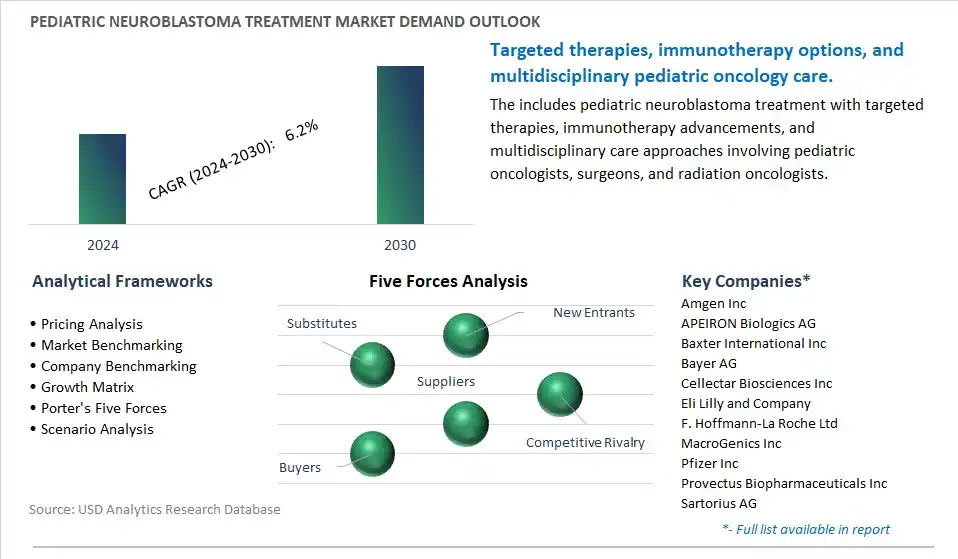
Pediatric Neuroblastoma Treatment Market is estimated to increase at a Compounded Annual Growth Rate of 6.2% CAGR over the forecast period from 2024 to 2030
The Pediatric Neuroblastoma Treatment Market study analyzes and forecasts the market size across 6 regions and 24 countries for diverse segments- By Treatment (Chemotherapy, Immunotherapy, Others), By End-User (Hospitals, Specialty Clinics, Others).
An Introduction to Pediatric Neuroblastoma Treatment Market in 2024
In 2024, the market for pediatric neuroblastoma treatment continues to evolve, driven by advancements in precision medicine, immunotherapy, and targeted therapy approaches aimed at improving outcomes for children with neuroblastoma, a rare and aggressive form of childhood cancer. Neuroblastoma is the most common extracranial solid tumor in childhood, arising from developing nerve cells in the sympathetic nervous system, and can manifest in various locations throughout the body, including the adrenal glands, abdomen, chest, and pelvis. The market for pediatric neuroblastoma treatment encompasses a multidisciplinary approach to care, including surgery, chemotherapy, radiation therapy, immunotherapy, and targeted therapy options, tailored to individual patient risk factors, tumor biology, and disease stage. Technological advancements in pediatric neuroblastoma treatment focus on identifying novel therapeutic targets, developing tumor-specific immunotherapies, and optimizing treatment regimens through molecular profiling, next-generation sequencing, and high-throughput screening techniques. Moreover, the integration of combination therapies, immunomodulatory agents, and adoptive cell therapy approaches such as chimeric antigen receptor (CAR) T-cell therapy holds promise for improving response rates and long-term survival outcomes in high-risk neuroblastoma patients. With the growing emphasis on collaborative research, international consortia, and patient advocacy initiatives in pediatric oncology, the market for pediatric neuroblastoma treatment is poised for continued innovation and progress, offering hope for improved survival and quality of life for children and families affected by this challenging disease.
Market Trend: Personalized and Targeted Therapies
A prominent trend in the Pediatric Neuroblastoma Treatment market is the shift towards personalized and targeted therapies. As our understanding of the molecular and genetic underpinnings of neuroblastoma advances, there is a growing emphasis on developing treatments that are tailored to the specific genetic profiles of individual patients. This trend encompasses targeted therapies that aim to disrupt the molecular pathways driving neuroblastoma growth, immunotherapies that harness the body's immune system to target cancer cells, and precision medicine approaches that identify biomarkers to guide treatment selection. By focusing on personalized and targeted therapies, healthcare providers can improve treatment outcomes, minimize adverse effects, and enhance the overall survival rates and quality of life for pediatric neuroblastoma patients.
Market Driver: High Incidence Rates and Unmet Medical Needs
A primary driver fueling the growth of the Pediatric Neuroblastoma Treatment market is the high incidence rates of neuroblastoma and the pressing unmet medical needs associated with this disease. Neuroblastoma is the most common extracranial solid tumor in children, accounting for a significant proportion of pediatric cancer cases. Despite advances in treatment modalities, including chemotherapy, surgery, radiation therapy, and stem cell transplantation, the prognosis for high-risk neuroblastoma remains poor, with a high rate of relapse and limited treatment options. This stark reality underscores the urgent need for innovative and effective treatment approaches that can improve long-term survival rates and reduce treatment-related toxicities in pediatric neuroblastoma patients, driving research, investment, and innovation in the field of pediatric oncology.
Market Opportunity: Development of Novel Immunotherapies and Targeted Agents
An emerging opportunity in the Pediatric Neuroblastoma Treatment market lies in the development of novel immunotherapies and targeted agents. Immunotherapy, particularly immune checkpoint inhibitors, chimeric antigen receptor (CAR) T-cell therapy, and antibody-based therapies, holds promise for enhancing the immune system's ability to recognize and destroy neuroblastoma cells. Additionally, targeted agents such as small molecule inhibitors and monoclonal antibodies that selectively target specific molecular pathways implicated in neuroblastoma growth and progression offer potential therapeutic options. By focusing on the development and clinical evaluation of novel immunotherapies and targeted agents, pharmaceutical companies, biotech firms, and research institutions can capitalize on the opportunity to address the unmet medical needs in pediatric neuroblastoma treatment, improve patient outcomes, and advance the field of pediatric oncology.
Pediatric Neuroblastoma Treatment Market Share Analysis: Immunotherapy
Among the various treatments and end-users in the pediatric neuroblastoma treatment market, immunotherapy for pediatric neuroblastoma is experiencing rapid growth. Immunotherapy, including monoclonal antibodies, checkpoint inhibitors, and chimeric antigen receptor (CAR) T-cell therapy, has emerged as a promising treatment modality for pediatric neuroblastoma, a rare and aggressive childhood cancer originating in immature nerve cells. Immunotherapy harnesses the body's immune system to target and destroy cancer cells, offering a targeted and potentially less toxic alternative to conventional chemotherapy. With recent advancements in immunotherapy research and clinical trials demonstrating promising results in pediatric neuroblastoma patients, there is increasing interest and investment in immunotherapeutic approaches for neuroblastoma treatment. Healthcare providers, including hospitals and specialty clinics, are expanding their capabilities to deliver immunotherapy and provide comprehensive care for pediatric patients with neuroblastoma. As the understanding of the immune landscape of neuroblastoma improves and new immunotherapeutic agents enter the market, the demand for immunotherapy in pediatric neuroblastoma treatment is expected to continue growing, driving significant advancements in the pediatric neuroblastoma treatment market.
Pediatric Neuroblastoma Treatment Competitive Analysis
The market research study provides in-depth insights into leading companies including the SWOT analyses, product profile, financial details, and recent developments acrossAmgen Inc, APEIRON Biologics AG, Baxter International Inc, Bayer AG, Cellectar Biosciences Inc, Eli Lilly and Company, F. Hoffmann-La Roche Ltd, MacroGenics Inc, Pfizer Inc, Provectus Biopharmaceuticals Inc, Sartorius AG, United Therapeutics Corp, Y-mAbs Therapeutics Inc
Pediatric Neuroblastoma Treatment Market Segmentation
By Treatment
Chemotherapy
Immunotherapy
Others
By End-User
Hospitals
Specialty Clinics
Others
Geographical Analysis
North America (United States, Canada, Mexico)
Europe (Germany, France, United Kingdom, Spain, Italy, Rest of Europe)
Asia Pacific (China, India, Japan, South Korea, Rest of Asia Pacific)
South America (Brazil, Argentina, Rest of South America)
Middle East and Africa (Saudi Arabia, UAE, Rest of Middle East, South Africa, Egypt, Rest of Africa)
Pediatric Neuroblastoma Treatment Market Companies
Amgen Inc
APEIRON Biologics AG
Baxter International Inc
Bayer AG
Cellectar Biosciences Inc
Eli Lilly and Company
F. Hoffmann-La Roche Ltd
MacroGenics Inc
Pfizer Inc
Provectus Biopharmaceuticals Inc
Sartorius AG
United Therapeutics Corp
Y-mAbs Therapeutics Inc
Reasons to Buy the Pediatric Neuroblastoma Treatment Market Study
• Deepen your industry insights and navigate uncertainties for strategy formulation, CAPEX, and Operational decisions
• Gain access to detailed insights on the Pediatric Neuroblastoma Treatment Market, encompassing current market size, growth trends, and forecasts till 2030.
• Access detailed competitor analysis, enabling competitive advantage through a thorough understanding of market players, strategies, and potential differentiation opportunities
• Stay ahead of the curve with insights on technological advancements, innovations, and upcoming trends
• Identify lucrative investment avenues and expansion opportunities within the Pediatric Neuroblastoma Treatment Market industry, guided by robust, data-backed analysis.
• Understand regional and global markets through country-wise analysis, regional market potential, regulatory nuances, and dynamics
• Execute strategies with confidence and speed through information, analytics, and insights on the industry value chain
• Corporate leaders, strategists, financial experts, shareholders, asset managers, and governmental representatives can make long-term planning scenarios and build an integrated and timely understanding of market dynamics
• Benefit from tailored solutions and expert consultation based on report insights, providing personalized strategies aligned with specific business needs.
TABLE OF CONTENTS
1 Introduction to 2024 Pediatric Neuroblastoma Treatment Market
1.1 Market Overview
1.2 Quick Facts
1.3 Scope/Objective of the Study
1.4 Market Definition
1.5 Countries and Regions Covered
1.6 Units, Currency, and Conversions
1.7 Industry Value Chain
2 Research Methodology
2.1 Market Size Estimation
2.2 Sources and Research Methodology
2.3 Data Triangulation
2.4 Assumptions and Limitations
3 Executive Summary
3.1 Global Pediatric Neuroblastoma Treatment Market Size Outlook, $ Million, 2021 to 2030
3.2 Pediatric Neuroblastoma Treatment Market Outlook by Type, $ Million, 2021 to 2030
3.3 Pediatric Neuroblastoma Treatment Market Outlook by Product, $ Million, 2021 to 2030
3.4 Pediatric Neuroblastoma Treatment Market Outlook by Application, $ Million, 2021 to 2030
3.5 Pediatric Neuroblastoma Treatment Market Outlook by Key Countries, $ Million, 2021 to 2030
4 Market Dynamics
4.1 Key Driving Forces of Pediatric Neuroblastoma Treatment Industry
4.2 Key Market Trends in Pediatric Neuroblastoma Treatment Industry
4.3 Potential Opportunities in Pediatric Neuroblastoma Treatment Industry
4.4 Key Challenges in Pediatric Neuroblastoma Treatment Industry
5 Market Factor Analysis
5.1 Value Chain Analysis
5.2 Competitive Landscape
5.2.1 Global Pediatric Neuroblastoma Treatment Market Share by Company (%), 2023
5.2.2 Product Offerings by Company
5.3 Porter’s Five Forces Analysis
5.4 Pricing Analysis and Outlook
6 Growth Outlook Across Scenarios
6.1 Growth Analysis-Case Scenario Definitions
6.2 Low Growth Scenario Forecasts
6.3 Reference Growth Scenario Forecasts
6.4 High Growth Scenario Forecasts
7 Global Pediatric Neuroblastoma Treatment Market Outlook by Segments
7.1 Pediatric Neuroblastoma Treatment Market Outlook by Segments, $ Million, 2021- 2030
By Treatment
Chemotherapy
Immunotherapy
Others
By End-User
Hospitals
Specialty Clinics
Others
8 North America Pediatric Neuroblastoma Treatment Market Analysis and Outlook To 2030
8.1 Introduction to North America Pediatric Neuroblastoma Treatment Markets in 2024
8.2 North America Pediatric Neuroblastoma Treatment Market Size Outlook by Country, 2021-2030
8.2.1 United States
8.2.2 Canada
8.2.3 Mexico
8.3 North America Pediatric Neuroblastoma Treatment Market size Outlook by Segments, 2021-2030
By Treatment
Chemotherapy
Immunotherapy
Others
By End-User
Hospitals
Specialty Clinics
Others
9 Europe Pediatric Neuroblastoma Treatment Market Analysis and Outlook To 2030
9.1 Introduction to Europe Pediatric Neuroblastoma Treatment Markets in 2024
9.2 Europe Pediatric Neuroblastoma Treatment Market Size Outlook by Country, 2021-2030
9.2.1 Germany
9.2.2 France
9.2.3 Spain
9.2.4 United Kingdom
9.2.4 Italy
9.2.5 Russia
9.2.6 Norway
9.2.7 Rest of Europe
9.3 Europe Pediatric Neuroblastoma Treatment Market Size Outlook by Segments, 2021-2030
By Treatment
Chemotherapy
Immunotherapy
Others
By End-User
Hospitals
Specialty Clinics
Others
10 Asia Pacific Pediatric Neuroblastoma Treatment Market Analysis and Outlook To 2030
10.1 Introduction to Asia Pacific Pediatric Neuroblastoma Treatment Markets in 2024
10.2 Asia Pacific Pediatric Neuroblastoma Treatment Market Size Outlook by Country, 2021-2030
10.2.1 China
10.2.2 India
10.2.3 Japan
10.2.4 South Korea
10.2.5 Indonesia
10.2.6 Malaysia
10.2.7 Australia
10.2.8 Rest of Asia Pacific
10.3 Asia Pacific Pediatric Neuroblastoma Treatment Market size Outlook by Segments, 2021-2030
By Treatment
Chemotherapy
Immunotherapy
Others
By End-User
Hospitals
Specialty Clinics
Others
11 South America Pediatric Neuroblastoma Treatment Market Analysis and Outlook To 2030
11.1 Introduction to South America Pediatric Neuroblastoma Treatment Markets in 2024
11.2 South America Pediatric Neuroblastoma Treatment Market Size Outlook by Country, 2021-2030
11.2.1 Brazil
11.2.2 Argentina
11.2.3 Rest of South America
11.3 South America Pediatric Neuroblastoma Treatment Market size Outlook by Segments, 2021-2030
By Treatment
Chemotherapy
Immunotherapy
Others
By End-User
Hospitals
Specialty Clinics
Others
12 Middle East and Africa Pediatric Neuroblastoma Treatment Market Analysis and Outlook To 2030
12.1 Introduction to Middle East and Africa Pediatric Neuroblastoma Treatment Markets in 2024
12.2 Middle East and Africa Pediatric Neuroblastoma Treatment Market Size Outlook by Country, 2021-2030
12.2.1 Saudi Arabia
12.2.2 UAE
12.2.3 Oman
12.2.4 Rest of Middle East
12.2.5 Egypt
12.2.6 Nigeria
12.2.7 South Africa
12.2.8 Rest of Africa
12.3 Middle East and Africa Pediatric Neuroblastoma Treatment Market size Outlook by Segments, 2021-2030
By Treatment
Chemotherapy
Immunotherapy
Others
By End-User
Hospitals
Specialty Clinics
Others
13 Company Profiles
13.1 Company Snapshot
13.2 SWOT Profiles
13.3 Products and Services
13.4 Recent Developments
13.5 Financial Profile
List of Companies
Amgen Inc
APEIRON Biologics AG
Baxter International Inc
Bayer AG
Cellectar Biosciences Inc
Eli Lilly and Company
F. Hoffmann-La Roche Ltd
MacroGenics Inc
Pfizer Inc
Provectus Biopharmaceuticals Inc
Sartorius AG
United Therapeutics Corp
Y-mAbs Therapeutics Inc
14 Appendix
14.1 Customization Offerings
14.2 Subscription Services
14.3 Related Reports
14.4 Publisher Expertise
By Treatment
Chemotherapy
Immunotherapy
Others
By End-User
Hospitals
Specialty Clinics
Others
Countries Analyzed
North America (United States, Canada, Mexico)
Europe (Germany, France, United Kingdom, Spain, Italy, Rest of Europe)
Asia Pacific (China, India, Japan, South Korea, Rest of Asia Pacific)
South America (Brazil, Argentina, Rest of South America)
Middle East and Africa (Saudi Arabia, UAE, Rest of Middle East, South Africa, Egypt, Rest of Africa)
