
The Peptide and Anticoagulant Drugs Market study analyzes and forecasts the market size across 6 regions and 24 countries for diverse segments- By Route of Administration (Parenteral, Oral, Mucosal, Others), By Application (Gastrointestinal Disorders, Neurological Disorders, Metabolic Disorders, Cancer, Atrial Fibrillation and Heart Attack, Stroke, Deep Vein Thrombosis (DVT), Pulmonary Embolism (PE), Others).
Peptide and anticoagulant drugs are pharmaceutical agents used in the prevention and treatment of various medical conditions, including cardiovascular diseases, thromboembolic disorders, and cancer. In 2024, the market for peptide and anticoagulant drugs continues to expand, driven by advancements in drug discovery, personalized medicine approaches, and the growing prevalence of chronic diseases that require long-term anticoagulation therapy. Peptide drugs are short chains of amino acids that mimic the actions of endogenous peptides and proteins in the body, exerting therapeutic effects by modulating signaling pathways, hormone levels, and cellular functions. Anticoagulant drugs, on the other hand, inhibit blood clotting processes by interfering with coagulation factors, platelet function, or fibrinolysis, thereby reducing the risk of thrombosis and embolism. These drugs play a crucial role in the prevention of stroke, myocardial infarction, venous thromboembolism, and other cardiovascular events, as well as in the management of conditions such as atrial fibrillation, deep vein thrombosis, and pulmonary embolism. With advancements in drug delivery technology, pharmacokinetics, and therapeutic targeting strategies, peptide and anticoagulant drugs offer improved efficacy, safety, and convenience for patients requiring long-term anticoagulation therapy or targeted peptide-based treatments for specific medical conditions. Moreover, the development of novel anticoagulant agents with better oral bioavailability, shorter half-lives, and reduced bleeding risk expands treatment options and improves adherence to anticoagulation therapy regimens. As researchers continue to explore the therapeutic potential of peptides and anticoagulants in various disease settings, these drugs hold promise for addressing unmet medical needs, improving patient outcomes, and advancing precision medicine approaches tailored to individual patient profiles and disease characteristics.
A significant market trend in peptide and anticoagulant drugs is the continuous advancements in drug delivery systems, enabling enhanced stability, bioavailability, and targeted delivery of peptide-based therapeutics. Innovations in nanotechnology, liposomal formulations, and polymer-based carriers facilitate the encapsulation of peptides and anticoagulants, protecting them from enzymatic degradation and improving their pharmacokinetic profiles. Additionally, site-specific delivery systems, such as implantable devices, microneedle patches, and inhalation formulations, offer precise control over drug release kinetics and tissue targeting, enhancing therapeutic efficacy while minimizing off-target effects. This trend reflects a strategic focus on overcoming the inherent challenges of peptide drug delivery, driving investments in innovative formulations and delivery platforms that optimize the clinical utility of peptide and anticoagulant therapies for a wide range of cardiovascular and thrombotic disorders.
A primary driver fueling the growth of the peptide and anticoagulant drugs market is the increasing incidence of cardiovascular diseases, thrombotic events, and related complications worldwide. With cardiovascular diseases remaining the leading cause of mortality globally, and thrombotic disorders, such as deep vein thrombosis, pulmonary embolism, and stroke, posing significant morbidity and mortality risks, there's a growing demand for effective anticoagulant therapies to prevent and treat thromboembolic events. Moreover, demographic shifts, sedentary lifestyles, and rising prevalence of risk factors, such as obesity, diabetes, and hypertension, contribute to the escalating burden of cardiovascular and thrombotic disorders, driving the need for innovative peptide and anticoagulant drugs that offer improved safety, efficacy, and convenience for patients across diverse clinical settings.
An enticing opportunity within the peptide and anticoagulant drugs market lies in the development of targeted anticoagulant therapies and reversal agents that offer personalized and precise management of thrombotic events while minimizing bleeding risks. By leveraging advances in molecular biology, pharmacogenomics, and precision medicine, researchers can identify novel targets, pathways, and biomarkers implicated in thrombosis and hemostasis, enabling the design of selective anticoagulants with improved efficacy and safety profiles. Furthermore, the development of reversal agents, antidotes, and neutralizing antibodies for direct oral anticoagulants (DOACs) and other novel anticoagulant agents addresses the need for rapid, specific reversal of anticoagulation in emergency situations, surgical procedures, and bleeding complications, offering new opportunities to enhance the clinical utility and adoption of peptide and anticoagulant drugs in routine clinical practice. Collaborations between pharmaceutical companies, academic research institutions, and regulatory agencies can drive innovation in targeted anticoagulant therapies and reversal strategies, advancing patient care and addressing unmet needs in the management of cardiovascular and thrombotic disorders.
Among the provided segments, the fastest growing appears to be Peptide Drugs administered orally. The oral route of administration for peptide drugs is witnessing rapid growth due to several factors. Firstly, advancements in drug delivery technologies have improved the bioavailability and stability of orally administered peptides, making them more efficacious and feasible for patients. Additionally, the convenience and patient compliance associated with oral administration contribute to the market's growth. Furthermore, the increasing prevalence of chronic diseases such as metabolic disorders, gastrointestinal disorders, and cancer, which often require long-term treatment with peptide drugs, is driving the demand for orally administered peptides. As a result, the Peptide Drugs market, particularly the oral route of administration, is experiencing significant expansion, meeting the needs of patients across various therapeutic areas efficiently and effectively.
The market research study provides in-depth insights into leading companies including the SWOT analyses, product profile, financial details, and recent developments acrossAmgen Inc, Bayer AG, Boehringer Ingelheim International GmbH, Bristol-Myers Squibb Company, Daiichi Sankyo Company Ltd, EVER Pharma Holding GmbH, Johnson & Johnson, Novartis AG, Novo Nordisk A/S, Pfizer Inc, Sanofi
By Route of Administration
Peptide Drugs
-Parenteral
-Oral
-Mucosal
-Others
Anticoagulant Drugs
-Oral
-Injectable
By Application
Peptide Drugs
-Gastrointestinal Disorders
-Neurological Disorders
-Metabolic Disorders
-Cancer
-Others
Anticoagulant Drugs
-Atrial Fibrillation and Heart Attack
-Stroke
-Deep Vein Thrombosis (DVT)
-Pulmonary Embolism (PE)
-Others
Geographical Analysis
North America (United States, Canada, Mexico)
Europe (Germany, France, United Kingdom, Spain, Italy, Rest of Europe)
Asia Pacific (China, India, Japan, South Korea, Rest of Asia Pacific)
South America (Brazil, Argentina, Rest of South America)
Middle East and Africa (Saudi Arabia, UAE, Rest of Middle East, South Africa, Egypt, Rest of Africa)
Amgen Inc
Bayer AG
Boehringer Ingelheim International GmbH
Bristol-Myers Squibb Company
Daiichi Sankyo Company Ltd
EVER Pharma Holding GmbH
Johnson & Johnson
Novartis AG
Novo Nordisk A/S
Pfizer Inc
Sanofi
• Deepen your industry insights and navigate uncertainties for strategy formulation, CAPEX, and Operational decisions
• Gain access to detailed insights on the Peptide and Anticoagulant Drugs Market, encompassing current market size, growth trends, and forecasts till 2030.
• Access detailed competitor analysis, enabling competitive advantage through a thorough understanding of market players, strategies, and potential differentiation opportunities
• Stay ahead of the curve with insights on technological advancements, innovations, and upcoming trends
• Identify lucrative investment avenues and expansion opportunities within the Peptide and Anticoagulant Drugs Market industry, guided by robust, data-backed analysis.
• Understand regional and global markets through country-wise analysis, regional market potential, regulatory nuances, and dynamics
• Execute strategies with confidence and speed through information, analytics, and insights on the industry value chain
• Corporate leaders, strategists, financial experts, shareholders, asset managers, and governmental representatives can make long-term planning scenarios and build an integrated and timely understanding of market dynamics
• Benefit from tailored solutions and expert consultation based on report insights, providing personalized strategies aligned with specific business needs.
TABLE OF CONTENTS
1 Introduction to 2024 Peptide and Anticoagulant Drugs Market
1.1 Market Overview
1.2 Quick Facts
1.3 Scope/Objective of the Study
1.4 Market Definition
1.5 Countries and Regions Covered
1.6 Units, Currency, and Conversions
1.7 Industry Value Chain
2 Research Methodology
2.1 Market Size Estimation
2.2 Sources and Research Methodology
2.3 Data Triangulation
2.4 Assumptions and Limitations
3 Executive Summary
3.1 Global Peptide and Anticoagulant Drugs Market Size Outlook, $ Million, 2021 to 2030
3.2 Peptide and Anticoagulant Drugs Market Outlook by Type, $ Million, 2021 to 2030
3.3 Peptide and Anticoagulant Drugs Market Outlook by Product, $ Million, 2021 to 2030
3.4 Peptide and Anticoagulant Drugs Market Outlook by Application, $ Million, 2021 to 2030
3.5 Peptide and Anticoagulant Drugs Market Outlook by Key Countries, $ Million, 2021 to 2030
4 Market Dynamics
4.1 Key Driving Forces of Peptide and Anticoagulant Drugs Industry
4.2 Key Market Trends in Peptide and Anticoagulant Drugs Industry
4.3 Potential Opportunities in Peptide and Anticoagulant Drugs Industry
4.4 Key Challenges in Peptide and Anticoagulant Drugs Industry
5 Market Factor Analysis
5.1 Value Chain Analysis
5.2 Competitive Landscape
5.2.1 Global Peptide and Anticoagulant Drugs Market Share by Company (%), 2023
5.2.2 Product Offerings by Company
5.3 Porter’s Five Forces Analysis
5.4 Pricing Analysis and Outlook
6 Growth Outlook Across Scenarios
6.1 Growth Analysis-Case Scenario Definitions
6.2 Low Growth Scenario Forecasts
6.3 Reference Growth Scenario Forecasts
6.4 High Growth Scenario Forecasts
7 Global Peptide and Anticoagulant Drugs Market Outlook by Segments
7.1 Peptide and Anticoagulant Drugs Market Outlook by Segments, $ Million, 2021- 2030
By Route of Administration
Peptide Drugs
-Parenteral
-Oral
-Mucosal
-Others
Anticoagulant Drugs
-Oral
-Injectable
By Application
Peptide Drugs
-Gastrointestinal Disorders
-Neurological Disorders
-Metabolic Disorders
-Cancer
-Others
Anticoagulant Drugs
-Atrial Fibrillation and Heart Attack
-Stroke
-Deep Vein Thrombosis (DVT)
-Pulmonary Embolism (PE)
-Others
8 North America Peptide and Anticoagulant Drugs Market Analysis and Outlook To 2030
8.1 Introduction to North America Peptide and Anticoagulant Drugs Markets in 2024
8.2 North America Peptide and Anticoagulant Drugs Market Size Outlook by Country, 2021-2030
8.2.1 United States
8.2.2 Canada
8.2.3 Mexico
8.3 North America Peptide and Anticoagulant Drugs Market size Outlook by Segments, 2021-2030
By Route of Administration
Peptide Drugs
-Parenteral
-Oral
-Mucosal
-Others
Anticoagulant Drugs
-Oral
-Injectable
By Application
Peptide Drugs
-Gastrointestinal Disorders
-Neurological Disorders
-Metabolic Disorders
-Cancer
-Others
Anticoagulant Drugs
-Atrial Fibrillation and Heart Attack
-Stroke
-Deep Vein Thrombosis (DVT)
-Pulmonary Embolism (PE)
-Others
9 Europe Peptide and Anticoagulant Drugs Market Analysis and Outlook To 2030
9.1 Introduction to Europe Peptide and Anticoagulant Drugs Markets in 2024
9.2 Europe Peptide and Anticoagulant Drugs Market Size Outlook by Country, 2021-2030
9.2.1 Germany
9.2.2 France
9.2.3 Spain
9.2.4 United Kingdom
9.2.4 Italy
9.2.5 Russia
9.2.6 Norway
9.2.7 Rest of Europe
9.3 Europe Peptide and Anticoagulant Drugs Market Size Outlook by Segments, 2021-2030
By Route of Administration
Peptide Drugs
-Parenteral
-Oral
-Mucosal
-Others
Anticoagulant Drugs
-Oral
-Injectable
By Application
Peptide Drugs
-Gastrointestinal Disorders
-Neurological Disorders
-Metabolic Disorders
-Cancer
-Others
Anticoagulant Drugs
-Atrial Fibrillation and Heart Attack
-Stroke
-Deep Vein Thrombosis (DVT)
-Pulmonary Embolism (PE)
-Others
10 Asia Pacific Peptide and Anticoagulant Drugs Market Analysis and Outlook To 2030
10.1 Introduction to Asia Pacific Peptide and Anticoagulant Drugs Markets in 2024
10.2 Asia Pacific Peptide and Anticoagulant Drugs Market Size Outlook by Country, 2021-2030
10.2.1 China
10.2.2 India
10.2.3 Japan
10.2.4 South Korea
10.2.5 Indonesia
10.2.6 Malaysia
10.2.7 Australia
10.2.8 Rest of Asia Pacific
10.3 Asia Pacific Peptide and Anticoagulant Drugs Market size Outlook by Segments, 2021-2030
By Route of Administration
Peptide Drugs
-Parenteral
-Oral
-Mucosal
-Others
Anticoagulant Drugs
-Oral
-Injectable
By Application
Peptide Drugs
-Gastrointestinal Disorders
-Neurological Disorders
-Metabolic Disorders
-Cancer
-Others
Anticoagulant Drugs
-Atrial Fibrillation and Heart Attack
-Stroke
-Deep Vein Thrombosis (DVT)
-Pulmonary Embolism (PE)
-Others
11 South America Peptide and Anticoagulant Drugs Market Analysis and Outlook To 2030
11.1 Introduction to South America Peptide and Anticoagulant Drugs Markets in 2024
11.2 South America Peptide and Anticoagulant Drugs Market Size Outlook by Country, 2021-2030
11.2.1 Brazil
11.2.2 Argentina
11.2.3 Rest of South America
11.3 South America Peptide and Anticoagulant Drugs Market size Outlook by Segments, 2021-2030
By Route of Administration
Peptide Drugs
-Parenteral
-Oral
-Mucosal
-Others
Anticoagulant Drugs
-Oral
-Injectable
By Application
Peptide Drugs
-Gastrointestinal Disorders
-Neurological Disorders
-Metabolic Disorders
-Cancer
-Others
Anticoagulant Drugs
-Atrial Fibrillation and Heart Attack
-Stroke
-Deep Vein Thrombosis (DVT)
-Pulmonary Embolism (PE)
-Others
12 Middle East and Africa Peptide and Anticoagulant Drugs Market Analysis and Outlook To 2030
12.1 Introduction to Middle East and Africa Peptide and Anticoagulant Drugs Markets in 2024
12.2 Middle East and Africa Peptide and Anticoagulant Drugs Market Size Outlook by Country, 2021-2030
12.2.1 Saudi Arabia
12.2.2 UAE
12.2.3 Oman
12.2.4 Rest of Middle East
12.2.5 Egypt
12.2.6 Nigeria
12.2.7 South Africa
12.2.8 Rest of Africa
12.3 Middle East and Africa Peptide and Anticoagulant Drugs Market size Outlook by Segments, 2021-2030
By Route of Administration
Peptide Drugs
-Parenteral
-Oral
-Mucosal
-Others
Anticoagulant Drugs
-Oral
-Injectable
By Application
Peptide Drugs
-Gastrointestinal Disorders
-Neurological Disorders
-Metabolic Disorders
-Cancer
-Others
Anticoagulant Drugs
-Atrial Fibrillation and Heart Attack
-Stroke
-Deep Vein Thrombosis (DVT)
-Pulmonary Embolism (PE)
-Others
13 Company Profiles
13.1 Company Snapshot
13.2 SWOT Profiles
13.3 Products and Services
13.4 Recent Developments
13.5 Financial Profile
List of Companies
Amgen Inc
Bayer AG
Boehringer Ingelheim International GmbH
Bristol-Myers Squibb Company
Daiichi Sankyo Company Ltd
EVER Pharma Holding GmbH
Johnson & Johnson
Novartis AG
Novo Nordisk A/S
Pfizer Inc
Sanofi
14 Appendix
14.1 Customization Offerings
14.2 Subscription Services
14.3 Related Reports
14.4 Publisher Expertise
By Route of Administration
Peptide Drugs
-Parenteral
-Oral
-Mucosal
-Others
Anticoagulant Drugs
-Oral
-Injectable
By Application
Peptide Drugs
-Gastrointestinal Disorders
-Neurological Disorders
-Metabolic Disorders
-Cancer
-Others
Anticoagulant Drugs
-Atrial Fibrillation and Heart Attack
-Stroke
-Deep Vein Thrombosis (DVT)
-Pulmonary Embolism (PE)
-Others
Countries Analyzed
North America (United States, Canada, Mexico)
Europe (Germany, France, United Kingdom, Spain, Italy, Rest of Europe)
Asia Pacific (China, India, Japan, South Korea, Rest of Asia Pacific)
South America (Brazil, Argentina, Rest of South America)
Middle East and Africa (Saudi Arabia, UAE, Rest of Middle East, South Africa, Egypt, Rest of Africa)
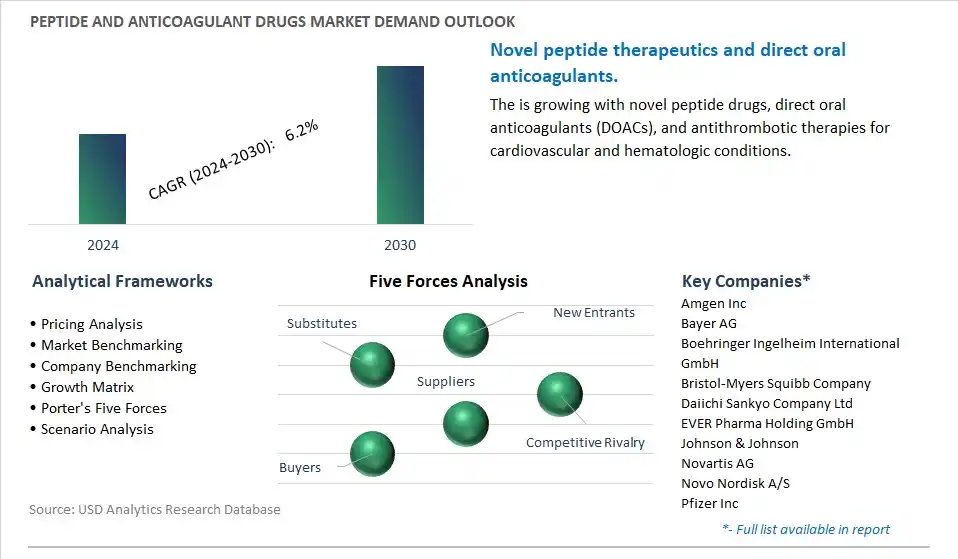
The global Peptide and Anticoagulant Drugs Market is one of the lucrative growth markets, poised to register a 6.2% growth (CAGR) between 2024 and 2030.
Emerging Markets across Asia Pacific, Europe, and Americas present robust growth prospects.
Amgen Inc, Bayer AG, Boehringer Ingelheim International GmbH, Bristol-Myers Squibb Company, Daiichi Sankyo Company Ltd, EVER Pharma Holding GmbH, Johnson & Johnson, Novartis AG, Novo Nordisk A/S, Pfizer Inc, Sanofi
Base Year- 2023; Estimated Year- 2024; Historic Period- 2018-2023; Forecast period- 2024 to 2030; Currency: USD; Volume