Global Performance Additives Market Size is valued at $95.6 Billion in 2024 and is forecast to register a growth rate (CAGR) of 8.1% to reach $178.3 Billion by 2032.
The global Performance Additives Market Study analyzes and forecasts the market size across 6 regions and 24 countries for diverse segments -By Type (Plastic Additives, Paint & Coatings Additives, Pigment Additives, Ink Additives, Rubber Additives), By End-User (Packaging, Household Goods, Construction, Automotive, Industrial, Wood & Furniture, Others).
An Introduction to Performance Additives Market in 2024
Performance additives are specialty chemicals added to various materials to enhance their properties and performance in specific applications. In 2024, the market for performance additives remains vital as industries seek innovative solutions to meet demanding performance requirements and address evolving market trends. These additives encompass a wide range of chemistries and functionalities, including antioxidants, UV stabilizers, flame retardants, plasticizers, and dispersants, among others. They are used in polymers, coatings, adhesives, plastics, and other materials to improve properties such as durability, weatherability, flame resistance, flexibility, and processing characteristics. For example, antioxidants and UV stabilizers protect polymers from degradation caused by exposure to heat, light, and oxygen, prolonging their service life. Flame retardants enhance the fire resistance of materials, ensuring compliance with safety standards and regulations. Plasticizers improve the flexibility and workability of plastics, while dispersants enhance pigment dispersion and color stability in coatings and inks. The demand for performance additives is driven by factors such as technological advancements in material science, increasing performance requirements in end-use industries, and regulatory mandates for sustainability and safety. Market trends include the development of bio-based and eco-friendly additives, the incorporation of smart functionalities such as self-healing and antimicrobial properties, and the customization of additives for specific applications and performance criteria.
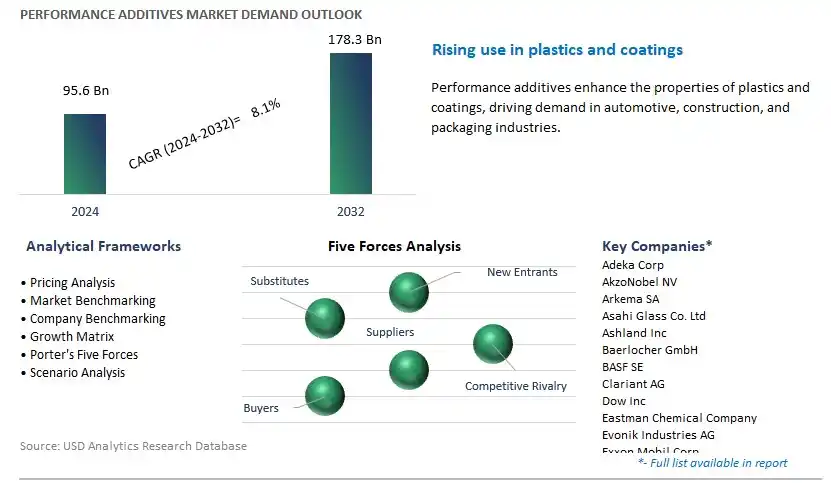
Performance Additives Market Competitive Landscape
The market report analyses the leading companies in the industry including Adeka Corp, AkzoNobel NV, Arkema SA, Asahi Glass Co. Ltd, Ashland Inc, Baerlocher GmbH, BASF SE, Clariant AG, Dow Inc, Eastman Chemical Company, Evonik Industries AG, Exxon Mobil Corp, Hexion Inc, Honeywell International Inc, Huntsman Corp, Lanxess AG, Mitsui Chemicals Inc, Performance Additives, Solvay SA, The Lubrizol Corp, and others.
Performance Additives Market Dynamics
Market Trend: Increasing Demand for High-Performance and Specialty Formulations
A prominent market trend in performance additives is the increasing demand for high-performance and specialty formulations across various industries. As manufacturers strive to enhance the properties and functionalities of their products, there is a growing need for additives that can impart specific performance benefits such as improved durability, functionality, and sustainability. Industries such as automotive, construction, packaging, and consumer goods are seeking performance additives that offer superior properties such as UV resistance, thermal stability, flame retardancy, and anti-corrosion capabilities. This trend towards high-performance formulations reflects the industry's pursuit of innovative solutions to meet evolving customer requirements and market demands.
Market Driver: Regulatory Compliance and Sustainability Initiatives
A key driver for the performance additives market is regulatory compliance and sustainability initiatives driving the adoption of environmentally friendly and compliant additives. With increasing environmental regulations and consumer awareness about sustainability, there is a growing demand for additives that meet stringent regulatory requirements and support sustainable product development. Manufacturers are seeking additives that are non-toxic, low in volatile organic compounds (VOCs), and free from hazardous substances such as heavy metals and phthalates. The drive for regulatory compliance and sustainability initiatives fuels the demand for performance additives as essential components in eco-friendly formulations across industries.
Market Opportunity: Development of Customized and Specialty Additives
A significant market opportunity for performance additives lies in the development of customized and specialty formulations tailored to meet specific application needs and performance requirements. Manufacturers have the opportunity to innovate and formulate additives with unique properties such as enhanced adhesion, improved dispersion, controlled release, and compatibility with various substrates and systems. Additionally, there is potential to offer specialty additives for niche applications such as advanced coatings, functional polymers, specialty chemicals, and composite materials, where specific performance criteria and functionality are essential. By leveraging the opportunity presented by customized and specialty additives, suppliers can differentiate their products, capture market share in specialized segments, and provide tailored solutions for customers seeking innovative and high-performance formulations.
Performance Additives Market Share Analysis: Plastic Additives generated the highest revenue in 2024
Within the Performance Additives market, the largest segment is Plastic Additives. The large revenue share is primarily driven by the widespread adoption of plastic additives across various industries. Plastic additives play a crucial role in enhancing the performance, processing, and durability of plastic materials, making them indispensable in the manufacturing of a wide range of products. Plastic additives encompass a diverse range of additives such as antioxidants, UV stabilizers, flame retardants, plasticizers, and colorants, each serving specific functions to improve the properties of plastics. Antioxidants and UV stabilizers protect plastics from degradation caused by exposure to heat, light, and oxygen, extending their service life and maintaining their appearance and mechanical properties. Flame retardants enhance the fire resistance of plastics, making them suitable for applications where fire safety is critical, such as in building construction and automotive interiors. Plasticizers increase the flexibility and workability of plastics, while colorants impart vibrant hues and aesthetic appeal to plastic products. Additionally, the growing demand for lightweight and durable materials, coupled with the increasing adoption of plastics in various end-use industries such as automotive, packaging, construction, and consumer goods, drives the demand for plastic additives. Furthermore, technological advancements in additive formulations and processing technologies continue to improve the performance and application versatility of plastic additives, further reinforcing their leading position in the Performance Additives market. Hence, with their essential role in enhancing the properties and functionality of plastic materials, Plastic Additives emerge as the largest and most significant segment in the Performance Additives market.
Performance Additives Market Share Analysis: Automotive Sector is poised to register the fastest CAGR over the forecast period
In the Performance Additives market, the Automotive sector is experiencing rapid growth. This growth is driven by increasing demand for performance additives in the automotive industry. In particular, the automotive sector is witnessing a significant shift towards lightweight materials to improve fuel efficiency and reduce emissions, driven by stringent regulatory standards and consumer preferences for eco-friendly vehicles. Performance additives play a crucial role in enhancing the performance, durability, and aesthetic appeal of lightweight materials such as plastics, composites, and elastomers used in automotive components and systems. Additives such as impact modifiers, flame retardants, and UV stabilizers improve the mechanical strength, fire resistance, and weatherability of automotive plastics, ensuring their long-term performance in harsh operating conditions. Additionally, the growing adoption of electric vehicles (EVs) and autonomous driving technologies further drives the demand for performance additives in advanced materials and components for battery enclosures, electronic housings, and sensor systems. Moreover, the increasing focus on vehicle electrification and connectivity, coupled with technological advancements in additive formulations and processing techniques, creates new opportunities for innovation and growth in the automotive segment of the Performance Additives market. Furthermore, the expansion of the global automotive market, particularly in emerging economies, fuels the demand for performance additives in the production of vehicles and aftermarket parts, further accelerating the growth of this segment. Hence, with its critical role in enabling lightweighting, performance enhancement, and sustainability in the automotive industry, the Automotive sector is the fastest-growing segment in the Performance Additives market.
Performance Additives Market
By Type
Plastic Additives
Paint & Coatings Additives
Pigment Additives
Ink Additives
Rubber Additives
By End-User
Packaging
Household Goods
Construction
Automotive
Industrial
Wood & Furniture
Others
Countries Analyzed
North America (US, Canada, Mexico)
Europe (Germany, UK, France, Spain, Italy, Russia, Rest of Europe)
Asia Pacific (China, India, Japan, South Korea, Australia, South East Asia, Rest of Asia)
South America (Brazil, Argentina, Rest of South America)
Middle East and Africa (Saudi Arabia, UAE, Rest of Middle East, South Africa, Egypt, Rest of Africa)
Performance Additives Companies Profiled in the Study
Adeka Corp
AkzoNobel NV
Arkema SA
Asahi Glass Co. Ltd
Ashland Inc
Baerlocher GmbH
BASF SE
Clariant AG
Dow Inc
Eastman Chemical Company
Evonik Industries AG
Exxon Mobil Corp
Hexion Inc
Honeywell International Inc
Huntsman Corp
Lanxess AG
Mitsui Chemicals Inc
Performance Additives
Solvay SA
The Lubrizol Corp
*- List Not Exhaustive
TABLE OF CONTENTS
1 Introduction to 2024 Performance Additives Market
1.1 Market Overview
1.2 Quick Facts
1.3 Scope/Objective of the Study
1.4 Market Definition
1.5 Countries and Regions Covered
1.6 Units, Currency, and Conversions
1.7 Industry Value Chain
2 Research Methodology
2.1 Market Size Estimation
2.2 Sources and Research Methodology
2.3 Data Triangulation
2.4 Assumptions and Limitations
3 Executive Summary
3.1 Global Performance Additives Market Size Outlook, $ Million, 2021 to 2032
3.2 Performance Additives Market Outlook by Type, $ Million, 2021 to 2032
3.3 Performance Additives Market Outlook by Product, $ Million, 2021 to 2032
3.4 Performance Additives Market Outlook by Application, $ Million, 2021 to 2032
3.5 Performance Additives Market Outlook by Key Countries, $ Million, 2021 to 2032
4 Market Dynamics
4.1 Key Driving Forces of Performance Additives Industry
4.2 Key Market Trends in Performance Additives Industry
4.3 Potential Opportunities in Performance Additives Industry
4.4 Key Challenges in Performance Additives Industry
5 Market Factor Analysis
5.1 Value Chain Analysis
5.2 Competitive Landscape
5.2.1 Global Performance Additives Market Share by Company (%), 2023
5.2.2 Product Offerings by Company
5.3 Porter’s Five Forces Analysis
5.4 Pricing Analysis and Outlook
6 Growth Outlook Across Scenarios
6.1 Growth Analysis-Case Scenario Definitions
6.2 Low Growth Scenario Forecasts
6.3 Reference Growth Scenario Forecasts
6.4 High Growth Scenario Forecasts
7 Global Performance Additives Market Outlook by Segments
7.1 Performance Additives Market Outlook by Segments, $ Million, 2021- 2032
By Type
Plastic Additives
Paint & Coatings Additives
Pigment Additives
Ink Additives
Rubber Additives
By End-User
Packaging
Household Goods
Construction
Automotive
Industrial
Wood & Furniture
Others
8 North America Performance Additives Market Analysis and Outlook To 2032
8.1 Introduction to North America Performance Additives Markets in 2024
8.2 North America Performance Additives Market Size Outlook by Country, 2021-2032
8.2.1 United States
8.2.2 Canada
8.2.3 Mexico
8.3 North America Performance Additives Market size Outlook by Segments, 2021-2032
By Type
Plastic Additives
Paint & Coatings Additives
Pigment Additives
Ink Additives
Rubber Additives
By End-User
Packaging
Household Goods
Construction
Automotive
Industrial
Wood & Furniture
Others
9 Europe Performance Additives Market Analysis and Outlook To 2032
9.1 Introduction to Europe Performance Additives Markets in 2024
9.2 Europe Performance Additives Market Size Outlook by Country, 2021-2032
9.2.1 Germany
9.2.2 France
9.2.3 Spain
9.2.4 United Kingdom
9.2.4 Italy
9.2.5 Russia
9.2.6 Norway
9.2.7 Rest of Europe
9.3 Europe Performance Additives Market Size Outlook by Segments, 2021-2032
By Type
Plastic Additives
Paint & Coatings Additives
Pigment Additives
Ink Additives
Rubber Additives
By End-User
Packaging
Household Goods
Construction
Automotive
Industrial
Wood & Furniture
Others
10 Asia Pacific Performance Additives Market Analysis and Outlook To 2032
10.1 Introduction to Asia Pacific Performance Additives Markets in 2024
10.2 Asia Pacific Performance Additives Market Size Outlook by Country, 2021-2032
10.2.1 China
10.2.2 India
10.2.3 Japan
10.2.4 South Korea
10.2.5 Indonesia
10.2.6 Malaysia
10.2.7 Australia
10.2.8 Rest of Asia Pacific
10.3 Asia Pacific Performance Additives Market size Outlook by Segments, 2021-2032
By Type
Plastic Additives
Paint & Coatings Additives
Pigment Additives
Ink Additives
Rubber Additives
By End-User
Packaging
Household Goods
Construction
Automotive
Industrial
Wood & Furniture
Others
11 South America Performance Additives Market Analysis and Outlook To 2032
11.1 Introduction to South America Performance Additives Markets in 2024
11.2 South America Performance Additives Market Size Outlook by Country, 2021-2032
11.2.1 Brazil
11.2.2 Argentina
11.2.3 Rest of South America
11.3 South America Performance Additives Market size Outlook by Segments, 2021-2032
By Type
Plastic Additives
Paint & Coatings Additives
Pigment Additives
Ink Additives
Rubber Additives
By End-User
Packaging
Household Goods
Construction
Automotive
Industrial
Wood & Furniture
Others
12 Middle East and Africa Performance Additives Market Analysis and Outlook To 2032
12.1 Introduction to Middle East and Africa Performance Additives Markets in 2024
12.2 Middle East and Africa Performance Additives Market Size Outlook by Country, 2021-2032
12.2.1 Saudi Arabia
12.2.2 UAE
12.2.3 Oman
12.2.4 Rest of Middle East
12.2.5 Egypt
12.2.6 Nigeria
12.2.7 South Africa
12.2.8 Rest of Africa
12.3 Middle East and Africa Performance Additives Market size Outlook by Segments, 2021-2032
By Type
Plastic Additives
Paint & Coatings Additives
Pigment Additives
Ink Additives
Rubber Additives
By End-User
Packaging
Household Goods
Construction
Automotive
Industrial
Wood & Furniture
Others
13 Company Profiles
13.1 Company Snapshot
13.2 SWOT Profiles
13.3 Products and Services
13.4 Recent Developments
13.5 Financial Profile
Adeka Corp
AkzoNobel NV
Arkema SA
Asahi Glass Co. Ltd
Ashland Inc
Baerlocher GmbH
BASF SE
Clariant AG
Dow Inc
Eastman Chemical Company
Evonik Industries AG
Exxon Mobil Corp
Hexion Inc
Honeywell International Inc
Huntsman Corp
Lanxess AG
Mitsui Chemicals Inc
Performance Additives
Solvay SA
The Lubrizol Corp
14 Appendix
14.1 Customization Offerings
14.2 Subscription Services
14.3 Related Reports
14.4 Publisher Expertise
By Type
Plastic Additives
Paint & Coatings Additives
Pigment Additives
Ink Additives
Rubber Additives
By End-User
Packaging
Household Goods
Construction
Automotive
Industrial
Wood & Furniture
Others
Countries Analyzed
North America (US, Canada, Mexico)
Europe (Germany, UK, France, Spain, Italy, Russia, Rest of Europe)
Asia Pacific (China, India, Japan, South Korea, Australia, South East Asia, Rest of Asia)
South America (Brazil, Argentina, Rest of South America)
Middle East and Africa (Saudi Arabia, UAE, Rest of Middle East, South Africa, Egypt, Rest of Africa)
