
The global Perfume Market Comprehensive Study analyzes and forecasts the market size across 6 regions and 24 countries for diverse segments -By Product (Mass, Premium), By End-User (Men, Women, Unisex), By Distribution Channel (Offline, Online)
In 2024, the perfume market remains a dynamic and vibrant industry driven by evolving consumer preferences, technological innovation, and creative branding strategies. Perfume, often considered a personal expression of identity and style, continues to captivate consumers with its ability to evoke emotions, memories, and sensory experiences. From classic floral and citrusy fragrances to bold oriental and woody scents, the market offers a diverse range of options to suit individual tastes and occasions. Furthermore, advancements in perfume formulation techniques, sustainable sourcing practices, and personalized fragrance experiences are shaping the future of the industry, creating new opportunities for brands to engage with consumers on a deeper level.
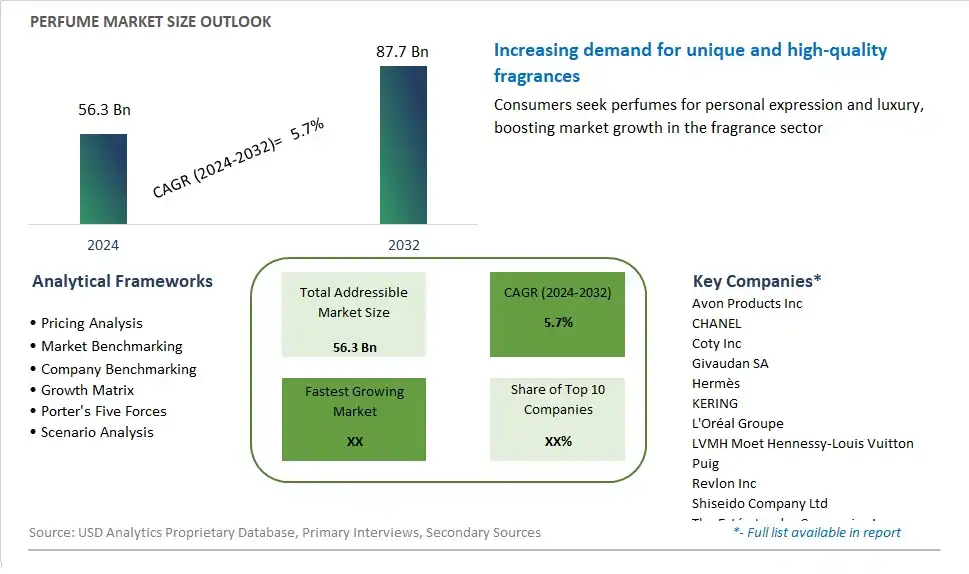
The market report analyses the leading companies in the industry including Avon Products Inc, CHANEL, Coty Inc, Givaudan SA, Hermès, KERING, L'Oréal Groupe, LVMH Moet Hennessy-Louis Vuitton, Puig, Revlon Inc, Shiseido Company Ltd, The Estée Lauder Companies Inc, and Others.
One prominent trend in the perfume market is the rise of niche and artisanal fragrances. Consumers are increasingly seeking unique and personalized scent experiences, moving away from mass-produced, mainstream perfumes in favor of more exclusive and niche offerings. Niche perfumes, often crafted in small batches using high-quality ingredients and innovative techniques, appeal to fragrance enthusiasts looking for distinctive scents that set them apart from the crowd. This trend is driven by the desire for individuality, authenticity, and exclusivity, as well as the influence of social media and online communities that celebrate niche fragrance brands and independent perfumers. As a result, the perfume market is witnessing a proliferation of boutique fragrance houses, online perfume retailers, and curated subscription services catering to the growing demand for niche and artisanal perfumes.
A key driver propelling the perfume market is the growing influence of celebrity and influencer endorsements. Celebrities, social media influencers, and fashion icons play a significant role in shaping consumer preferences and purchasing decisions when it comes to fragrances. Perfume brands often collaborate with celebrities and influencers to create signature scents, launch limited-edition collections, or promote existing fragrance lines through sponsored content and influencer marketing campaigns. This driver is fueled by the aspirational nature of celebrity culture, the desire for social validation and status associated with wearing prestigious brands, and the emotional connection consumers feel with their favorite celebrities. Celebrity and influencer endorsements help perfume brands reach wider audiences, build brand awareness, and drive sales by leveraging the power of celebrity endorsements and influencer marketing to enhance brand perception and credibility.
An opportunity for market expansion in the perfume segment lies in the expansion into sustainable and eco-friendly perfumes. With growing concerns about environmental sustainability and ethical sourcing practices, there is a rising demand for perfumes that are environmentally responsible and socially conscious. Perfume brands can capitalize on this opportunity by offering products made from natural, renewable, and ethically sourced ingredients, as well as eco-friendly packaging materials and sustainable production methods. Additionally, there is room for innovation in fragrance formulations that minimize environmental impact, such as water-based perfumes, biodegradable packaging, refillable bottles, and cruelty-free testing practices. By aligning with consumer values and addressing sustainability concerns, perfume brands can differentiate themselves in the market, attract eco-conscious consumers, and contribute to positive environmental change within the fragrance industry.
In the Perfume Market segmented by product, Mass Perfume is the largest segment. This dominance can be attributed to several factors. Firstly, mass-market perfumes are generally more affordable and widely accessible to consumers across various income levels. They are often available in supermarkets, drugstores, and discount retailers, making them convenient for everyday purchase. Additionally, mass perfumes cater to a broader audience by offering a diverse range of scents, from floral and fruity to woody and oriental, ensuring there is something for everyone's preferences. Further, mass perfumes often leverage extensive marketing campaigns and celebrity endorsements to appeal to a wide consumer base, further enhancing their popularity and sales volume. As a result of their affordability, accessibility, and broad appeal, mass perfumes emerge as the largest segment in the Perfume Market.
Among the segmented end-users in the Perfume Market, the Unisex segment is the fastest-growing segment. This growth is propelled by several factors. Firstly, there is a growing trend towards gender-neutral fragrances, driven by changing societal norms and preferences for inclusivity and diversity. Unisex perfumes offer versatility and appeal to individuals seeking fragrances that transcend traditional gender boundaries, allowing them to express their personal style and identity freely. Additionally, the rise of niche and indie perfume brands has contributed to the popularity of unisex fragrances, as these brands often focus on unique and innovative scent compositions that appeal to a wide audience. Further, the increasing demand for travel-friendly and minimalist lifestyles has led to a preference for multipurpose products, including unisex perfumes that can be shared among family members or used for various occasions. As consumers continue to seek individuality and authenticity in their fragrance choices, the Unisex segment is expected to experience rapid growth, solidifying its position as the fastest-growing segment in the Perfume Market.
In the Perfume Market segmented by distribution channel, Offline is the largest segment. This dominance can be attributed to several factors. Firstly, offline channels, including department stores, specialty perfume stores, and beauty retailers, have long been established as traditional avenues for purchasing perfumes. These brick-and-mortar stores offer consumers the opportunity to experience fragrances firsthand through sampling and testing, which is an essential aspect of the perfume-buying process. Additionally, offline retailers often provide personalized assistance from knowledgeable sales associates, helping consumers navigate the vast array of fragrance options and make informed purchasing decisions. Further, the allure of shopping in physical stores extends beyond the transaction itself, offering a sensory and social experience that online channels cannot replicate. As a result of their longstanding presence, immersive shopping experiences, and personalized service, offline distribution channels remain the preferred choice for many consumers when purchasing perfumes, solidifying their position as the largest segment in the Perfume Market.
By Product
Mass
Premium
By End-User
Men
Women
Unisex
By Distribution Channel
Offline
Online
Countries Analyzed
North America (US, Canada, Mexico)
Europe (Germany, UK, France, Spain, Italy, Russia, Rest of Europe)
Asia Pacific (China, India, Japan, South Korea, Australia, South East Asia, Rest of Asia)
South America (Brazil, Argentina, Rest of South America)
Middle East and Africa (Saudi Arabia, UAE, Rest of Middle East, South Africa, Egypt, Rest of Africa)
Avon Products Inc
CHANEL
Coty Inc
Givaudan SA
Hermès
KERING
L'Oréal Groupe
LVMH Moet Hennessy-Louis Vuitton
Puig
Revlon Inc
Shiseido Company Ltd
The Estée Lauder Companies Inc
*- List Not Exhaustive
Chapter 1. TABLE OF CONTENTS
Chapter 2. Introduction to Perfume Market
2.1. Market Overview
2.2. Key Statistics and Report Highlights
2.3. Scope of the Comprehensive Study
2.3.1. Market Definition
2.3.2 Countries and Regions Covered
2.3.3 Research Objective
2.3.4 Units, Currency, and Conversions
2.3.5 Industry Value Chain
2.4. Key Market Segments
2.5. Key Companies
2.6. Study Period
Chapter 3. Strategic Analysis Review
3.1. Perfume Pricing Analysis and Forecast
3.2. Porter’s Five Forces
3.3. Market Ecosystem
3.4. SWOT Analysis
3.5. Regulatory Scenario
3.3. Effects of Inflation, Russia-Ukraine War, moderating economic growth, and other macroeconomic factors
Chapter 4. Competitive Landscape
4.1. Market Share Analysis
4.1.1. Global Perfume Market Share by Company, 2023
4.1.2. Product Offerings of Leading Perfume Companies
4.2. Market Entropy
4.2.1. New Product Launches in the Industry
4.2.2. Mergers, Acquisitions, Joint ventures, and Partnerships
4.3. Key Strategies and Best Practices
Chapter 5. Global Market Projections: Best, Reference, and Low Case Scenarios
5.1. Growth Analysis- Case Scenario Definitions
5.2. Low Growth Case Scenario Forecasts
5.3. Reference Growth Case Scenario Forecasts
5.4. High Growth Case Scenario Forecasts
Chapter 6. Market Dynamics
6.1. Perfume Market Drivers
6.2. Perfume Market Challenges
6.6. Perfume Market Opportunities
6.4. Perfume Market Trends
Chapter 7. Global Perfume Market Outlook Trends
7.1. Global Perfume Revenue (USD Million) and CAGR (%) by Type (2021-2032)
7.2. Global Perfume Revenue (USD Million) and CAGR (%) by Application (2021-2032)
7.3. Global Perfume Revenue (USD Million) and CAGR (%) by Product (2021-2032)
By Product
Mass
Premium
By End-User
Men
Women
Unisex
By Distribution Channel
Offline
Online
Chapter 8. Global Perfume Regional Analysis and Outlook
8.1. Global Perfume Revenue (USD Million) By Regions (2021- 2032)
8.2. North America Perfume Revenue (USD Million) by Country (2021-2032)
8.2.1. United States Perfume Regional Analysis and Outlook
8.2.2. Canada Perfume Regional Analysis and Outlook
8.2.3. Mexico Perfume Regional Analysis and Outlook
8.3. Europe Perfume Revenue (USD Million), by Country (2021-2032)
8.3.1. Germany Perfume Regional Analysis and Outlook
8.3.2. France Perfume Regional Analysis and Outlook
8.3.3. United Kingdom Perfume Regional Analysis and Outlook
8.3.4. Spain Perfume Regional Analysis and Outlook
8.3.5. Italy Perfume Regional Analysis and Outlook
8.3.6. Russia Perfume Regional Analysis and Outlook
8.3.7. Rest of Europe Perfume Regional Analysis and Outlook
8.4. Asia Pacific Perfume Revenue (USD Million) by Country (2021-2032)
8.4.1. China Perfume Regional Analysis and Outlook
8.4.2. Japan Perfume Regional Analysis and Outlook
8.4.3. India Perfume Regional Analysis and Outlook
8.4.4. South Korea Perfume Regional Analysis and Outlook
8.4.5. Australia Perfume Regional Analysis and Outlook
8.4.6. South East Asia Perfume Regional Analysis and Outlook
8.4.7. Rest of Asia Pacific Perfume Regional Analysis and Outlook
8.5. South America Perfume Revenue (USD Million), by Country (2021-2032)
8.5.1. Brazil Perfume Regional Analysis and Outlook
8.5.2. Argentina Perfume Regional Analysis and Outlook
8.5.3. Rest of South America Perfume Regional Analysis and Outlook
8.6. Middle East and Africa Perfume Revenue (USD Million) by Country (2021-2032)
8.6.1. Middle East Perfume Regional Analysis and Outlook
8.6.2. Africa Perfume Regional Analysis and Outlook
Chapter 9. North America Perfume Analysis and Outlook
9.1. North America Perfume Revenue (USD Million) by Segments (2021-2032)
9.1.1. North America Perfume Revenue (USD Million) by Type (2021-2032)
9.1.2. North America Perfume Revenue (USD Million) by Application (2021-2032)
9.1.3. North America Perfume Revenue (USD Million) by Product (2021-2032)
By Product
Mass
Premium
By End-User
Men
Women
Unisex
By Distribution Channel
Offline
Online
Chapter 10. Europe Perfume Analysis and Outlook
10.1. Europe Perfume Revenue (USD Million), by Segments (USD Million) (2021-2032)
10.1.1. Europe Perfume Revenue (USD Million) by Type (2021-2032)
10.1.2. Europe Perfume Revenue (USD Million) by Application (2021-2032)
10.1.3. Europe Perfume Revenue (USD Million) by Product (2021-2032)
By Product
Mass
Premium
By End-User
Men
Women
Unisex
By Distribution Channel
Offline
Online
Chapter 11. Asia Pacific Perfume Analysis and Outlook
11.1. Asia Pacific Perfume Revenue (USD Million), and Revenue (USD Million) by Segments (2021-2032)
11.1.1. Asia Pacific Perfume Revenue (USD Million) by Type (2021-2032)
11.1.2. Asia Pacific Perfume Revenue (USD Million) by Application (2021-2032)
11.1.3. Asia Pacific Perfume Revenue (USD Million) by Product (2021-2032)
By Product
Mass
Premium
By End-User
Men
Women
Unisex
By Distribution Channel
Offline
Online
Chapter 12. South America Perfume Analysis and Outlook
12.1. South America Perfume Revenue (USD Million), by Segments (2021-2032)
12.1.1. South America Perfume Revenue (USD Million) by Type (2021-2032)
12.1.2. South America Perfume Revenue (USD Million) by Application (2021-2032)
12.1.3. South America Perfume Revenue (USD Million) by Product (2021-2032)
By Product
Mass
Premium
By End-User
Men
Women
Unisex
By Distribution Channel
Offline
Online
Chapter 13. Middle East and Africa Perfume Analysis and Outlook
13.1. Middle East and Africa Perfume Revenue (USD Million), by Segments (2021-2032)
13.1.1. Middle East and Africa Perfume Revenue (USD Million) by Type (2021-2032)
13.1.2. Middle East and Africa Perfume Revenue (USD Million) by Application (2021-2032)
13.1.3. Middle East and Africa Perfume Revenue (USD Million) by Product (2021-2032)
By Product
Mass
Premium
By End-User
Men
Women
Unisex
By Distribution Channel
Offline
Online
Chapter 14. Perfume Company Profiles
14.1 Business Overview
14.2 Product Profiles
14.3 SWOT Profiles
14.5 Recent Developments
14.6 Financial Profile
List of Companies
Avon Products Inc
CHANEL
Coty Inc
Givaudan SA
Hermès
KERING
L'Oréal Groupe
LVMH Moet Hennessy-Louis Vuitton
Puig
Revlon Inc
Shiseido Company Ltd
The Estée Lauder Companies Inc
15. Methodology and Data Sources
15.1 Customization Offerings
15.2 Subscription Services
15.3 Related Reports
15.4 Publisher Expertise
LIST OF TABLES
Table 1 Market Segmentation Analysis
Table 2 Global Perfume Market Share of Leading Companies, 2023
Table 3 Product Offerings of Leading Companies
Table 4 Low Growth Scenario Forecasts
Table 5 Reference Case Growth Scenario
Table 6 High Growth Case Scenario
Table 7 Global Perfume Revenue (USD Million) And CAGR (%) By Type (2021-2032)
Table 8 Global Perfume Revenue (USD Million) And CAGR (%) By Application (2021-2032)
Table 9 Global Perfume Revenue (USD Million) And CAGR (%) By Product (2021-2032)
Table 10 Global Perfume Market Revenue (USD Million) By Regions (2021-2032)
Table 11 Global Perfume Market Share (%) By Regions (2021-2032)
Table 12 North America Perfume Revenue (USD Million) By Country (2021-2032)
Table 13 Europe Perfume Revenue (USD Million) By Country (2021-2032)
Table 14 Asia Pacific Perfume Revenue (USD Million) By Country (2021-2032)
Table 15 South America Perfume Revenue (USD Million) By Country (2021-2032)
Table 16 Middle East and Africa Perfume Revenue (USD Million) By Region (2021-2032)
Table 17 North America Perfume Revenue (USD Million) By Type (2021-2032)
Table 18 North America Perfume Revenue (USD Million) By Application (2021-2032)
Table 19 North America Perfume Revenue (USD Million) By Product (2021-2032)
Table 20 Europe Perfume Revenue (USD Million) By Type (2021-2032)
Table 21 Europe Perfume Revenue (USD Million) By Application (2021-2032)
Table 22 Europe Perfume Revenue (USD Million) By Product (2021-2032)
Table 23 Asia Pacific Perfume Revenue (USD Million) By Type (2021-2032)
Table 24 Asia Pacific Perfume Revenue (USD Million) By Application (2021-2032)
Table 25 Asia Pacific Perfume Revenue (USD Million) By Product (2021-2032)
Table 26 South America Perfume Revenue (USD Million) By Type (2021-2032)
Table 27 South America Perfume Revenue (USD Million) By Application (2021-2032)
Table 28 South America Perfume Revenue (USD Million) By Product (2021-2032)
Table 29 Middle East and Africa Perfume Revenue (USD Million) By Type (2021-2032)
Table 30 Middle East and Africa Perfume Revenue (USD Million) By Application (2021-2032)
Table 31 Middle East and Africa Perfume Revenue (USD Million) By Product (2021-2032)
LIST OF FIGURES
Figure 1. Market Scope
Figure 2. Pricing Forecasts Per Unit, 2023- 2032
Figure 3. Porter’s Five Forces
Figure 4. Global Perfume Market Revenue (USD Million) By Regions (2021-2032)
Figure 5. Global Perfume Market Share (%) By Regions (2023)
Figure 6. North America Perfume Revenue (USD Million) By Country (2021-2032)
Figure 7. United States Perfume Revenue (USD Million) By Country (2021-2032)
Figure 8. Canada Perfume Revenue (USD Million) By Country (2021-2032)
Figure 9. Mexico Perfume Revenue (USD Million) By Country (2021-2032)
Figure 10. Europe Perfume Revenue (USD Million) By Country (2021-2032)
Figure 11. Germany Perfume Revenue (USD Million) By Country (2021-2032)
Figure 12. France Perfume Revenue (USD Million) By Country (2021-2032)
Figure 13. United Kingdom Perfume Revenue (USD Million) By Country (2021-2032)
Figure 14. Spain Perfume Revenue (USD Million) By Country (2021-2032)
Figure 15. Italy Perfume Revenue (USD Million) By Country (2021-2032)
Figure 16. Russia Perfume Revenue (USD Million) By Country (2021-2032)
Figure 17. Rest of Europe Perfume Revenue (USD Million) By Country (2021-2032)
Figure 11. Asia Pacific Perfume Revenue (USD Million) By Country (2021-2032)
Figure 12. China Perfume Revenue (USD Million) By Country (2021-2032)
Figure 13. Japan Perfume Revenue (USD Million) By Country (2021-2032)
Figure 14. India Perfume Revenue (USD Million) By Country (2021-2032)
Figure 15. South Korea Perfume Revenue (USD Million) By Country (2021-2032)
Figure 16. Australia Perfume Revenue (USD Million) By Country (2021-2032)
Figure 17. South East Asia Perfume Revenue (USD Million) By Country (2021-2032)
Figure 18. South America Perfume Revenue (USD Million) By Country (2021-2032)
Figure 19. Brazil Perfume Revenue (USD Million) By Country (2021-2032)
Figure 20. Argentina Perfume Revenue (USD Million) By Country (2021-2032)
Figure 21. Rest of Asia Pacific Perfume Revenue (USD Million) By Country (2021-2032)
Figure 22. Middle East and Africa Perfume Revenue (USD Million) By Region (2021-2032)
Figure 23. Saudi Arabia Perfume Revenue (USD Million) By Region (2021-2032)
Figure 24. The UAE Perfume Revenue (USD Million) By Region (2021-2032)
Figure 25. Rest of Middle East Perfume Revenue (USD Million) By Region (2021-2032)
Figure 26. South Africa Perfume Revenue (USD Million) By Region (2021-2032)
Figure 27. Africa Perfume Revenue (USD Million) By Region (2021-2032)
Figure 28. North America Perfume Revenue (USD Million) By Type (2021-2032)
Figure 29. North America Perfume Revenue (USD Million) By Application (2021-2032)
Figure 30. North America Perfume Revenue (USD Million) By Product (2021-2032)
Figure 31. Europe Perfume Revenue (USD Million) By Type (2021-2032)
Figure 32. Europe Perfume Revenue (USD Million) By Application (2021-2032)
Figure 33. Europe Perfume Revenue (USD Million) By Product (2021-2032)
Figure 34. Asia Pacific Perfume Revenue (USD Million) By Type (2021-2032)
Figure 35. Asia Pacific Perfume Revenue (USD Million) By Application (2021-2032)
Figure 36. Asia Pacific Perfume Revenue (USD Million) By Product (2021-2032)
Figure 37. South America Perfume Revenue (USD Million) By Type (2021-2032)
Figure 38. South America Perfume Revenue (USD Million) By Application (2021-2032)
Figure 39. South America Perfume Revenue (USD Million) By Product (2021-2032)
Figure 40. Middle East and Africa Perfume Revenue (USD Million) By Type (2021-2032)
Figure 41. Middle East and Africa Perfume Revenue (USD Million) By Application (2021-2032)
Figure 42. Middle East and Africa Perfume Revenue (USD Million) By Product (2021-2032)
By Product
Mass
Premium
By End-User
Men
Women
Unisex
By Distribution Channel
Offline
Online
Countries Analyzed
North America (US, Canada, Mexico)
Europe (Germany, UK, France, Spain, Italy, Russia, Rest of Europe)
Asia Pacific (China, India, Japan, South Korea, Australia, South East Asia, Rest of Asia)
South America (Brazil, Argentina, Rest of South America)
Middle East and Africa (Saudi Arabia, UAE, Rest of Middle East, South Africa, Egypt, Rest of Africa)
Global Perfume Market Size is valued at $56.3 Billion in 2024 and is forecast to register a growth rate (CAGR) of 5.7% to reach $87.7 Billion by 2032.
Emerging Markets across Asia Pacific, Europe, and Americas present robust growth prospects.
Avon Products Inc, CHANEL, Coty Inc, Givaudan SA, Hermès, KERING, L'Oréal Groupe, LVMH Moet Hennessy-Louis Vuitton, Puig, Revlon Inc, Shiseido Company Ltd, The Estée Lauder Companies Inc
Base Year- 2023; Estimated Year- 2024; Historic Period- 2018-2023; Forecast period- 2024 to 2032; Currency: Revenue (USD); Volume