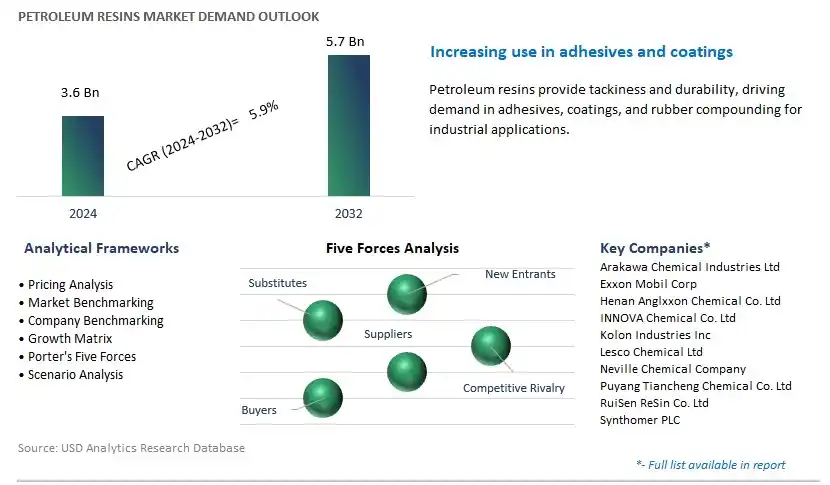
Global Petroleum Resins Market Size is valued at $3.6 Billion in 2024 and is forecast to register a growth rate (CAGR) of 5.9% to reach $5.7 Billion by 2032.
The global Petroleum Resins Market Study analyzes and forecasts the market size across 6 regions and 24 countries for diverse segments -By Type (C5 Resins, C9 Resins, Hydrogenated Hydrocarbon Resins, C5/C9 Resins), By Application (Adhesives & Sealants, Printing Inks, Paints & Coatings, Rubber Compounding, Tapes & Labels, Others), By End-User (Building & Construction, Tire Industry, Personal Hygiene, Consumer Goods, Automotive, Others).
An Introduction to Petroleum Resins Market in 2024
Petroleum resins are thermoplastic polymers derived from the distillation of crude oil or petroleum byproducts, widely used as additives in various applications such as adhesives, coatings, inks, and rubber compounding. In 2024, the market for petroleum resins remains significant as industries seek versatile and cost-effective solutions to enhance the performance and properties of their products. Petroleum resins are classified into several types based on their chemical composition and properties, including aliphatic resins, aromatic resins, and hydrogenated resins, each offering specific functionalities such as tackiness, adhesion, compatibility, and heat resistance. These resins act as binders, tackifiers, and modifiers in formulations, improving characteristics such as cohesion, viscosity, drying time, and durability. In adhesives, petroleum resins enhance tack and peel strength, ensuring strong and reliable bonds in applications such as packaging, construction, and automotive assembly. In coatings and inks, petroleum resins improve adhesion, gloss, and color stability, providing high-quality finishes for substrates such as wood, metal, and paper. The demand for petroleum resins is driven by factors such as the growth of end-use industries such as construction, automotive, and packaging, increasing demand for high-performance and specialty formulations, and the expansion of manufacturing activities in emerging markets. Market trends include the development of low-VOC and eco-friendly resins, the customization of resins for specific application requirements and performance criteria, and the integration of petroleum resins with other additives and polymers for enhanced functionality and compatibility.
Petroleum Resins Market Competitive Landscape
The market report analyses the leading companies in the industry including Arakawa Chemical Industries Ltd, Exxon Mobil Corp, Henan Anglxxon Chemical Co. Ltd, INNOVA Chemical Co. Ltd, Kolon Industries Inc, Lesco Chemical Ltd, Neville Chemical Company, Puyang Tiancheng Chemical Co. Ltd, RuiSen ReSin Co. Ltd, Synthomer PLC, and others.
Petroleum Resins Market Dynamics
Market Trend: Growing Demand for Adhesives and Sealants in Construction Industry
A prominent market trend in petroleum resins is the growing demand for adhesives and sealants in the construction industry. As construction activities continue to rise globally, there is an increasing need for high-performance adhesives and sealants for bonding, sealing, and caulking applications in building and infrastructure projects. Petroleum resins, with their excellent adhesive properties, tackiness, and compatibility with various substrates, are widely used as key ingredients in construction adhesives and sealants. This trend towards the use of petroleum resins in construction applications reflects the industry's emphasis on enhancing building durability, efficiency, and sustainability through innovative adhesive solutions.
Market Driver: Expansion of Packaging and Printing Industries
A key driver for the petroleum resins market is the expansion of packaging and printing industries worldwide. With the growing consumer demand for packaged goods and printed materials, there is an increasing need for adhesives, inks, and coatings that provide strong bonding, excellent printability, and surface protection properties. Petroleum resins, due to their versatility, compatibility with various substrates, and ability to enhance adhesion and gloss, are extensively used in packaging adhesives, hot melt adhesives, flexographic and gravure inks, and protective coatings for packaging materials. The expanding packaging and printing sectors drive the demand for petroleum resins as essential components in the formulation of high-quality adhesives, inks, and coatings.
Market Opportunity: Development of Specialty Resins for Advanced Applications
A significant market opportunity for petroleum resins lies in the development of specialty resins tailored to meet the demands of advanced applications and emerging trends. Manufacturers have the opportunity to innovate and formulate petroleum resins with enhanced properties such as heat resistance, UV stability, low odor, and compatibility with food contact regulations. Additionally, there is potential to offer specialty resins for niche applications such as automotive adhesives, electronic encapsulants, pressure-sensitive tapes, and specialty coatings, where specific performance criteria and functionality are crucial. By capitalizing on the opportunity presented by specialty resins, suppliers can diversify their product portfolio, enter new market segments, and provide customized solutions for customers seeking advanced adhesive and coating solutions.
Petroleum Resins Market Share Analysis: C9 Resins generated the highest revenue in 2024
In the Petroleum Resins Market, the largest segment is C9 Resins. The large revenue share is primarily driven by the widespread use and demand for C9 resins across various industries. C9 resins, also known as aromatic hydrocarbon resins, are derived from petroleum feedstocks and are widely used as tackifiers and binders in the manufacturing of adhesives, sealants, coatings, and printing inks. These resins offer excellent compatibility with a variety of polymers, including natural rubber, synthetic rubber, and thermoplastic elastomers, enhancing the adhesion, cohesion, and performance of formulated products. Additionally, C9 resins provide desirable characteristics such as high softening point, good thermal stability, and resistance to oxidation and UV degradation, making them suitable for applications requiring durability and long-term performance. Moreover, C9 resins offer cost-effective alternatives to natural resins and synthetic polymers, contributing to their widespread adoption in various end-use industries. Furthermore, the versatility and flexibility of C9 resins in formulating a wide range of products further drive their dominance as the largest segment in the Petroleum Resins Market. Hence, with their broad applicability, performance benefits, and cost-effectiveness, C9 resins emerge as the largest and most significant segment in the Petroleum Resins Market.
Petroleum Resins Market Share Analysis: Adhesives & Sealants is poised to register the fastest CAGR over the forecast period
In the Petroleum Resins Market, the fastest-growing segment is Adhesives & Sealants. The market growth is driven by increasing demand for petroleum resins in the adhesives and sealants industry. Petroleum resins are widely used as tackifiers, binders, and modifiers in the formulation of adhesives and sealants to improve their performance characteristics such as adhesion, cohesion, tack, and viscosity. With the growing demand for adhesives and sealants across various end-use industries including automotive, construction, packaging, and electronics, there is a corresponding increase in the consumption of petroleum resins. Additionally, the shift towards high-performance adhesives and sealants with enhanced durability, flexibility, and resistance to harsh environmental conditions further drives the demand for petroleum resins. Moreover, petroleum resins offer advantages such as excellent compatibility with a wide range of polymers, good thermal stability, and cost-effectiveness, making them preferred additives in adhesive and sealant formulations. Furthermore, technological advancements in petroleum resin production processes and formulations continue to expand their application possibilities and improve their performance characteristics, further fuelling their adoption in the adhesives and sealants industry. Hence, with the increasing demand for high-performance adhesives and sealants in various applications, the Adhesives & Sealants segment is the fastest-growing segment in the Petroleum Resins Market.
Petroleum Resins Market Share Analysis: Tire Industry generated the highest revenue in 2024
In the Petroleum Resins Market, the largest segment is the Tire Industry. The large revenue share is primarily driven by the extensive use and demand for petroleum resins in tire manufacturing. Petroleum resins are essential additives in tire compounds, where they serve as tackifiers, reinforcing agents, and processing aids. They play a crucial role in improving the adhesion between rubber compounds and reinforcing materials such as carbon black and silica, enhancing the durability, strength, and performance of tires. Additionally, petroleum resins contribute to the optimization of tire manufacturing processes by facilitating uniform dispersion of fillers and additives, improving batch-to-batch consistency, and reducing production costs. The tire industry is one of the largest consumers of petroleum resins due to the significant global demand for tires driven by the automotive sector, infrastructure development, and growing transportation activities. Moreover, advancements in tire technology and increasing consumer expectations for performance, safety, and fuel efficiency further drive the demand for high-quality petroleum resins in tire formulations. Furthermore, the tire industry's continuous focus on innovation and sustainability drives the adoption of petroleum resins with eco-friendly formulations, reinforcing their position as the largest segment in the Petroleum Resins Market. Hence, with their indispensable role in tire manufacturing and the continuous growth of the automotive sector, the Tire Industry segment is the largest and most significant segment in the Petroleum Resins Market.
Petroleum Resins Market
By Type
C5 Resins
C9 Resins
Hydrogenated Hydrocarbon Resins
C5/C9 Resins
By Application
Adhesives & Sealants
Printing Inks
Paints & Coatings
Rubber Compounding
Tapes & Labels
Others
By End-User
Building & Construction
Tire Industry
Personal Hygiene
Consumer Goods
Automotive
Others
Countries Analyzed
North America (US, Canada, Mexico)
Europe (Germany, UK, France, Spain, Italy, Russia, Rest of Europe)
Asia Pacific (China, India, Japan, South Korea, Australia, South East Asia, Rest of Asia)
South America (Brazil, Argentina, Rest of South America)
Middle East and Africa (Saudi Arabia, UAE, Rest of Middle East, South Africa, Egypt, Rest of Africa)
Petroleum Resins Companies Profiled in the Study
Arakawa Chemical Industries Ltd
Exxon Mobil Corp
Henan Anglxxon Chemical Co. Ltd
INNOVA Chemical Co. Ltd
Kolon Industries Inc
Lesco Chemical Ltd
Neville Chemical Company
Puyang Tiancheng Chemical Co. Ltd
RuiSen ReSin Co. Ltd
Synthomer PLC
*- List Not Exhaustive
TABLE OF CONTENTS
1 Introduction to 2024 Petroleum Resins Market
1.1 Market Overview
1.2 Quick Facts
1.3 Scope/Objective of the Study
1.4 Market Definition
1.5 Countries and Regions Covered
1.6 Units, Currency, and Conversions
1.7 Industry Value Chain
2 Research Methodology
2.1 Market Size Estimation
2.2 Sources and Research Methodology
2.3 Data Triangulation
2.4 Assumptions and Limitations
3 Executive Summary
3.1 Global Petroleum Resins Market Size Outlook, $ Million, 2021 to 2032
3.2 Petroleum Resins Market Outlook by Type, $ Million, 2021 to 2032
3.3 Petroleum Resins Market Outlook by Product, $ Million, 2021 to 2032
3.4 Petroleum Resins Market Outlook by Application, $ Million, 2021 to 2032
3.5 Petroleum Resins Market Outlook by Key Countries, $ Million, 2021 to 2032
4 Market Dynamics
4.1 Key Driving Forces of Petroleum Resins Industry
4.2 Key Market Trends in Petroleum Resins Industry
4.3 Potential Opportunities in Petroleum Resins Industry
4.4 Key Challenges in Petroleum Resins Industry
5 Market Factor Analysis
5.1 Value Chain Analysis
5.2 Competitive Landscape
5.2.1 Global Petroleum Resins Market Share by Company (%), 2023
5.2.2 Product Offerings by Company
5.3 Porter’s Five Forces Analysis
5.4 Pricing Analysis and Outlook
6 Growth Outlook Across Scenarios
6.1 Growth Analysis-Case Scenario Definitions
6.2 Low Growth Scenario Forecasts
6.3 Reference Growth Scenario Forecasts
6.4 High Growth Scenario Forecasts
7 Global Petroleum Resins Market Outlook by Segments
7.1 Petroleum Resins Market Outlook by Segments, $ Million, 2021- 2032
By Type
C5 Resins
C9 Resins
Hydrogenated Hydrocarbon Resins
C5/C9 Resins
By Application
Adhesives & Sealants
Printing Inks
Paints & Coatings
Rubber Compounding
Tapes & Labels
Others
By End-User
Building & Construction
Tire Industry
Personal Hygiene
Consumer Goods
Automotive
Others
8 North America Petroleum Resins Market Analysis and Outlook To 2032
8.1 Introduction to North America Petroleum Resins Markets in 2024
8.2 North America Petroleum Resins Market Size Outlook by Country, 2021-2032
8.2.1 United States
8.2.2 Canada
8.2.3 Mexico
8.3 North America Petroleum Resins Market size Outlook by Segments, 2021-2032
By Type
C5 Resins
C9 Resins
Hydrogenated Hydrocarbon Resins
C5/C9 Resins
By Application
Adhesives & Sealants
Printing Inks
Paints & Coatings
Rubber Compounding
Tapes & Labels
Others
By End-User
Building & Construction
Tire Industry
Personal Hygiene
Consumer Goods
Automotive
Others
9 Europe Petroleum Resins Market Analysis and Outlook To 2032
9.1 Introduction to Europe Petroleum Resins Markets in 2024
9.2 Europe Petroleum Resins Market Size Outlook by Country, 2021-2032
9.2.1 Germany
9.2.2 France
9.2.3 Spain
9.2.4 United Kingdom
9.2.4 Italy
9.2.5 Russia
9.2.6 Norway
9.2.7 Rest of Europe
9.3 Europe Petroleum Resins Market Size Outlook by Segments, 2021-2032
By Type
C5 Resins
C9 Resins
Hydrogenated Hydrocarbon Resins
C5/C9 Resins
By Application
Adhesives & Sealants
Printing Inks
Paints & Coatings
Rubber Compounding
Tapes & Labels
Others
By End-User
Building & Construction
Tire Industry
Personal Hygiene
Consumer Goods
Automotive
Others
10 Asia Pacific Petroleum Resins Market Analysis and Outlook To 2032
10.1 Introduction to Asia Pacific Petroleum Resins Markets in 2024
10.2 Asia Pacific Petroleum Resins Market Size Outlook by Country, 2021-2032
10.2.1 China
10.2.2 India
10.2.3 Japan
10.2.4 South Korea
10.2.5 Indonesia
10.2.6 Malaysia
10.2.7 Australia
10.2.8 Rest of Asia Pacific
10.3 Asia Pacific Petroleum Resins Market size Outlook by Segments, 2021-2032
By Type
C5 Resins
C9 Resins
Hydrogenated Hydrocarbon Resins
C5/C9 Resins
By Application
Adhesives & Sealants
Printing Inks
Paints & Coatings
Rubber Compounding
Tapes & Labels
Others
By End-User
Building & Construction
Tire Industry
Personal Hygiene
Consumer Goods
Automotive
Others
11 South America Petroleum Resins Market Analysis and Outlook To 2032
11.1 Introduction to South America Petroleum Resins Markets in 2024
11.2 South America Petroleum Resins Market Size Outlook by Country, 2021-2032
11.2.1 Brazil
11.2.2 Argentina
11.2.3 Rest of South America
11.3 South America Petroleum Resins Market size Outlook by Segments, 2021-2032
By Type
C5 Resins
C9 Resins
Hydrogenated Hydrocarbon Resins
C5/C9 Resins
By Application
Adhesives & Sealants
Printing Inks
Paints & Coatings
Rubber Compounding
Tapes & Labels
Others
By End-User
Building & Construction
Tire Industry
Personal Hygiene
Consumer Goods
Automotive
Others
12 Middle East and Africa Petroleum Resins Market Analysis and Outlook To 2032
12.1 Introduction to Middle East and Africa Petroleum Resins Markets in 2024
12.2 Middle East and Africa Petroleum Resins Market Size Outlook by Country, 2021-2032
12.2.1 Saudi Arabia
12.2.2 UAE
12.2.3 Oman
12.2.4 Rest of Middle East
12.2.5 Egypt
12.2.6 Nigeria
12.2.7 South Africa
12.2.8 Rest of Africa
12.3 Middle East and Africa Petroleum Resins Market size Outlook by Segments, 2021-2032
By Type
C5 Resins
C9 Resins
Hydrogenated Hydrocarbon Resins
C5/C9 Resins
By Application
Adhesives & Sealants
Printing Inks
Paints & Coatings
Rubber Compounding
Tapes & Labels
Others
By End-User
Building & Construction
Tire Industry
Personal Hygiene
Consumer Goods
Automotive
Others
13 Company Profiles
13.1 Company Snapshot
13.2 SWOT Profiles
13.3 Products and Services
13.4 Recent Developments
13.5 Financial Profile
Arakawa Chemical Industries Ltd
Exxon Mobil Corp
Henan Anglxxon Chemical Co. Ltd
INNOVA Chemical Co. Ltd
Kolon Industries Inc
Lesco Chemical Ltd
Neville Chemical Company
Puyang Tiancheng Chemical Co. Ltd
RuiSen ReSin Co. Ltd
Synthomer PLC
14 Appendix
14.1 Customization Offerings
14.2 Subscription Services
14.3 Related Reports
14.4 Publisher Expertise
By Type
C5 Resins
C9 Resins
Hydrogenated Hydrocarbon Resins
C5/C9 Resins
By Application
Adhesives & Sealants
Printing Inks
Paints & Coatings
Rubber Compounding
Tapes & Labels
Others
By End-User
Building & Construction
Tire Industry
Personal Hygiene
Consumer Goods
Automotive
Others
Countries Analyzed
North America (US, Canada, Mexico)
Europe (Germany, UK, France, Spain, Italy, Russia, Rest of Europe)
Asia Pacific (China, India, Japan, South Korea, Australia, South East Asia, Rest of Asia)
South America (Brazil, Argentina, Rest of South America)
Middle East and Africa (Saudi Arabia, UAE, Rest of Middle East, South Africa, Egypt, Rest of Africa)
