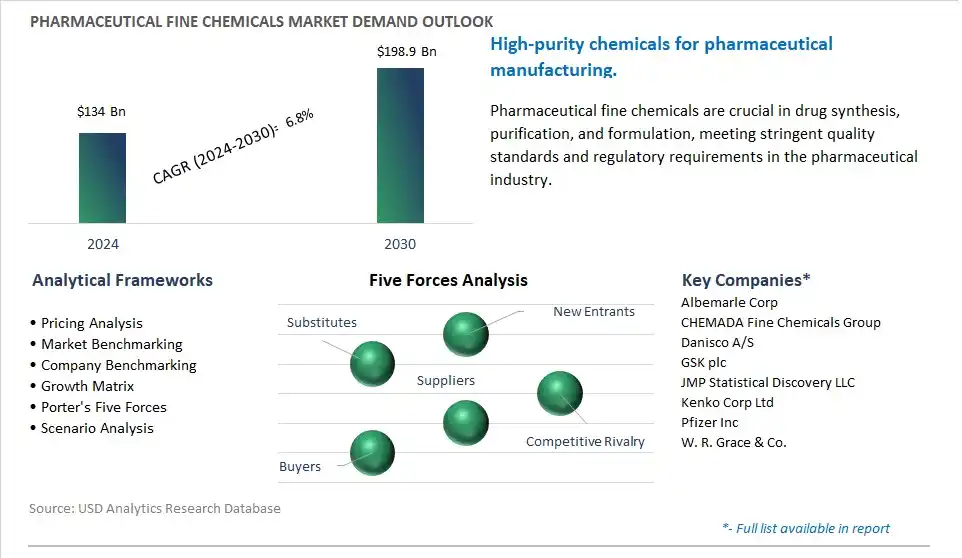
The global Pharmaceutical Fine Chemicals Market is poised to register a 6.8% CAGR from $134 Billion in 2024 to $198.9 Billion in 2030.
The global Pharmaceutical Fine Chemicals Market Study analyzes and forecasts the market size across 6 regions and 24 countries for diverse segments -By Type (Proprietary, Non-Proprietary), By Product (Basic Building Blocks, Advanced Intermediates, Active Ingredients), By Chemical (Small Molecules, Big Molecules), By Application (Cardiovascular, Oncological, Respiratory, Mucoskeletal, Others).
An Introduction to Global Pharmaceutical Fine Chemicals Market in 2024
The key trend shaping the future of pharmaceutical fine chemicals is the increasing demand for high-purity, specialty chemicals and intermediates used in the synthesis of active pharmaceutical ingredients (APIs) and pharmaceutical formulations. Pharmaceutical fine chemicals, also known as specialty or fine chemicals, play a critical role in the pharmaceutical industry by providing essential building blocks, reagents, and catalysts for drug development and manufacturing processes. With the growing complexity of drug molecules, stringent regulatory requirements, and increasing competition, there is a rising need for fine chemicals that offer superior quality, consistency, and reliability in pharmaceutical applications. Manufacturers are investing in the development of advanced synthesis routes, purification techniques, and analytical methods to produce fine chemicals with high levels of purity, stability, and safety, meeting the stringent standards of pharmaceutical manufacturing and regulatory agencies. Additionally, there is a trend towards the use of green chemistry principles and sustainable manufacturing practices in the production of pharmaceutical fine chemicals, minimizing waste generation, reducing environmental impact, and improving process efficiency. Furthermore, with the rise of personalized medicine and targeted therapies, there is a growing demand for fine chemicals that enable the synthesis of complex APIs and drug conjugates for precision medicine applications. As pharmaceutical companies continue to innovate and expand their drug pipelines, the demand for high-quality pharmaceutical fine chemicals is expected to grow, driving market expansion and technological innovation in the specialty chemicals sector.
Pharmaceutical Fine Chemicals Market Competitive Landscape
The market report analyses the leading companies in the industry including Albemarle Corp, CHEMADA Fine Chemicals Group, Danisco A/S, GSK plc, JMP Statistical Discovery LLC, Kenko Corp Ltd, Pfizer Inc, W. R. Grace & Co..
Pharmaceutical Fine Chemicals Market Dynamics
Pharmaceutical Fine Chemicals Market Trend: Increasing Outsourcing of Pharmaceutical Fine Chemical Manufacturing
A prominent trend in the pharmaceutical fine chemicals market is the increasing outsourcing of manufacturing processes by pharmaceutical companies. As pharmaceutical manufacturers focus on core competencies such as drug discovery and development, there is a growing reliance on contract development and manufacturing organizations (CDMOs) for the production of fine chemicals used in drug synthesis and formulation. Outsourcing allows pharmaceutical companies to access specialized expertise, state-of-the-art infrastructure, and flexible manufacturing capacities without heavy capital investments. Additionally, CDMOs offer cost-effective solutions, streamlined processes, and regulatory compliance, driving the outsourcing trend in the pharmaceutical fine chemicals market.
Pharmaceutical Fine Chemicals Market Driver: Growing Demand for High-Quality Active Pharmaceutical Ingredients (APIs)
A significant driver fueling the pharmaceutical fine chemicals market is the growing demand for high-quality active pharmaceutical ingredients (APIs). With the increasing prevalence of chronic diseases, expanding aging population, and rising healthcare expenditures worldwide, there is a continuous demand for innovative and effective pharmaceutical products. Fine chemicals play a crucial role in the synthesis and production of APIs, which form the therapeutic backbone of pharmaceutical formulations. The demand for APIs with high purity, potency, and consistency drives pharmaceutical companies to seek reliable sources of pharmaceutical fine chemicals that adhere to stringent quality standards, regulatory requirements, and sustainability practices.
Pharmaceutical Fine Chemicals Market Opportunity: Expansion into Green Chemistry and Sustainable Processes
An opportunity for the pharmaceutical fine chemicals market lies in the expansion into green chemistry and sustainable manufacturing processes. With growing environmental concerns, regulatory pressures, and consumer awareness, there is an increasing emphasis on sustainability across industries, including pharmaceuticals. Green chemistry principles focus on minimizing the environmental impact of chemical processes by reducing waste, energy consumption, and hazardous materials while maximizing efficiency and product quality. Pharmaceutical fine chemicals manufacturers aim to capitalize on this opportunity by adopting green chemistry practices, such as solvent-free reactions, catalytic processes, and renewable feedstocks, to produce APIs and intermediates with reduced environmental footprint and improved sustainability profiles. By aligning with the sustainability goals of pharmaceutical companies and offering eco-friendly fine chemical solutions, manufacturers aim to gain market shares in the market and meet the evolving needs of the pharmaceutical industry.
Pharmaceutical Fine Chemicals Market Share Analysis: Non-Proprietary segment generated the highest revenue in 2024
The largest segment in the Pharmaceutical Fine Chemicals Market is the Non-Proprietary segment. Non-proprietary fine chemicals refer to those that are widely available and not protected by exclusive intellectual property rights or patents. Diverse factors contribute to the dominance of the non-proprietary segment in the pharmaceutical fine chemicals market. non-proprietary fine chemicals are often essential raw materials or intermediates used in the synthesis of pharmaceutical active ingredients (APIs) and drug formulations. They serve as building blocks for the manufacturing of a wide range of pharmaceutical products, including generic drugs and off-patent formulations. Additionally, non-proprietary fine chemicals are produced in large volumes and offer competitive pricing compared to proprietary or specialty chemicals, making them economically attractive for pharmaceutical manufacturers. Further, the availability of non-proprietary fine chemicals from multiple suppliers fosters competition and ensures a steady supply chain, reducing dependency and mitigating risks associated with sole-source suppliers. Over the forecast period, the widespread use, cost-effectiveness, and reliability of non-proprietary fine chemicals contribute to their dominance as the largest segment in the Pharmaceutical Fine Chemicals Market.
Pharmaceutical Fine Chemicals Market Share Analysis: Active Ingredients segment is poised to register the fastest growth rate (CAGR) over the forecast period to 2030
The fastest-growing segment in the Pharmaceutical Fine Chemicals Market is the Active Ingredients segment. Active ingredients (APIs) are the key components responsible for the therapeutic effects of pharmaceutical products, making them essential in drug development and manufacturing. Diverse factors contribute to the rapid growth of the active ingredients segment in the pharmaceutical fine chemicals market. The increasing prevalence of chronic diseases, aging populations, and rising healthcare expenditures worldwide drive the demand for innovative and effective pharmaceutical treatments. Consequently, there is a growing pipeline of new drug candidates and formulations requiring active pharmaceutical ingredients. Additionally, advancements in drug discovery, process chemistry, and manufacturing technologies enable the development of complex APIs with enhanced therapeutic efficacy and safety profiles. Further, the trend towards personalized medicine and targeted therapies further accelerates the demand for specialized active ingredients tailored to specific patient populations and disease indications. Furthermore, stringent regulatory requirements and quality standards mandate the use of high-quality and reliable active ingredients in pharmaceutical manufacturing, driving the need for advanced intermediates and basic building blocks to produce these critical components. Over the forecast period, the increasing demand for novel therapies, coupled with advancements in pharmaceutical science and technology, fuels the rapid growth of the active ingredients segment in the Pharmaceutical Fine Chemicals Market.
Pharmaceutical Fine Chemicals Market Share Analysis: Big Molecules segment is poised to register the fastest growth rate (CAGR) over the forecast period to 2030
The fastest-growing segment in the Pharmaceutical Fine Chemicals Market is the Big Molecules or biologics segment. Biologics, also known as large molecules, refer to complex molecules derived from living organisms or produced using biotechnological processes. Diverse factors contribute to the rapid growth of the big molecules segment in the pharmaceutical fine chemicals market. There is a growing demand for biologics due to their ability to target specific disease pathways with high precision, leading to improved treatment outcomes and fewer side effects compared to traditional small molecule drugs. Additionally, advancements in biotechnology and recombinant DNA technology have revolutionized the development and manufacturing of biologics, enabling the production of monoclonal antibodies, therapeutic proteins, vaccines, and gene therapies. Further, the expanding pipeline of biologics-based therapies for a wide range of diseases, including cancer, autoimmune disorders, and infectious diseases, drives the demand for large molecule fine chemicals. Furthermore, the patent expiry of Diverse blockbuster biologics has paved the way for biosimilars and biobetters, further fueling the growth of the big molecules segment as manufacturers seek cost-effective alternatives to branded biologics. Over the forecast period, the increasing demand for innovative and targeted therapies, coupled with advancements in biotechnology, drives the rapid growth of the big molecules segment in the Pharmaceutical Fine Chemicals Market.
Pharmaceutical Fine Chemicals Market Report Segmentation
By Type
Proprietary
Non-Proprietary
By Product
Basic Building Blocks
Advanced Intermediates
Active Ingredients
By Chemical
Small Molecules
Big Molecules
By Application
Cardiovascular
Oncological
Respiratory
Mucoskeletal
Others
Regions Included
North America (US, Canada, Mexico)
Europe (Germany, UK, France, Spain, Italy, Russia, Rest of Europe)
Asia Pacific (China, India, Japan, South Korea, Australia, South East Asia, Rest of Asia)
South America (Brazil, Argentina, Rest of South America)
Middle East and Africa (Saudi Arabia, UAE, Rest of Middle East, South Africa, Egypt, Rest of Africa)
Pharmaceutical Fine Chemicals Companies Profiled in the Market Study
Albemarle Corp
CHEMADA Fine Chemicals Group
Danisco A/S
GSK plc
JMP Statistical Discovery LLC
Kenko Corp Ltd
Pfizer Inc
W. R. Grace & Co.
*- List Not Exhaustive
TABLE OF CONTENTS
1 Introduction to 2024 Pharmaceutical Fine Chemicals Market
1.1 Market Overview
1.2 Quick Facts
1.3 Scope/Objective of the Study
1.4 Market Definition
1.5 Countries and Regions Covered
1.6 Units, Currency, and Conversions
1.7 Industry Value Chain
2 Research Methodology
2.1 Market Size Estimation
2.2 Sources and Research Methodology
2.3 Data Triangulation
2.4 Assumptions and Limitations
3 Executive Summary
3.1 Global Pharmaceutical Fine Chemicals Market Size Outlook, $ Million, 2021 to 2030
3.2 Pharmaceutical Fine Chemicals Market Outlook by Type, $ Million, 2021 to 2030
3.3 Pharmaceutical Fine Chemicals Market Outlook by Product, $ Million, 2021 to 2030
3.4 Pharmaceutical Fine Chemicals Market Outlook by Application, $ Million, 2021 to 2030
3.5 Pharmaceutical Fine Chemicals Market Outlook by Key Countries, $ Million, 2021 to 2030
4 Market Dynamics
4.1 Key Driving Forces of Pharmaceutical Fine Chemicals Industry
4.2 Key Market Trends in Pharmaceutical Fine Chemicals Industry
4.3 Potential Opportunities in Pharmaceutical Fine Chemicals Industry
4.4 Key Challenges in Pharmaceutical Fine Chemicals Industry
5 Market Factor Analysis
5.1 Value Chain Analysis
5.2 Competitive Landscape
5.2.1 Global Pharmaceutical Fine Chemicals Market Share by Company (%), 2023
5.2.2 Product Offerings by Company
5.3 Porter’s Five Forces Analysis
5.4 Pricing Analysis and Outlook
6 Growth Outlook Across Scenarios
6.1 Growth Analysis-Case Scenario Definitions
6.2 Low Growth Scenario Forecasts
6.3 Reference Growth Scenario Forecasts
6.4 High Growth Scenario Forecasts
7 Global Pharmaceutical Fine Chemicals Market Outlook by Segments
7.1 Pharmaceutical Fine Chemicals Market Outlook by Segments, $ Million, 2021- 2030
By Type
Proprietary
Non-Proprietary
By Product
Basic Building Blocks
Advanced Intermediates
Active Ingredients
By Chemical
Small Molecules
Big Molecules
By Application
Cardiovascular
Oncological
Respiratory
Mucoskeletal
Others
8 North America Pharmaceutical Fine Chemicals Market Analysis and Outlook To 2030
8.1 Introduction to North America Pharmaceutical Fine Chemicals Markets in 2024
8.2 North America Pharmaceutical Fine Chemicals Market Size Outlook by Country, 2021-2030
8.2.1 United States
8.2.2 Canada
8.2.3 Mexico
8.3 North America Pharmaceutical Fine Chemicals Market size Outlook by Segments, 2021-2030
By Type
Proprietary
Non-Proprietary
By Product
Basic Building Blocks
Advanced Intermediates
Active Ingredients
By Chemical
Small Molecules
Big Molecules
By Application
Cardiovascular
Oncological
Respiratory
Mucoskeletal
Others
9 Europe Pharmaceutical Fine Chemicals Market Analysis and Outlook To 2030
9.1 Introduction to Europe Pharmaceutical Fine Chemicals Markets in 2024
9.2 Europe Pharmaceutical Fine Chemicals Market Size Outlook by Country, 2021-2030
9.2.1 Germany
9.2.2 France
9.2.3 Spain
9.2.4 United Kingdom
9.2.4 Italy
9.2.5 Russia
9.2.6 Norway
9.2.7 Rest of Europe
9.3 Europe Pharmaceutical Fine Chemicals Market Size Outlook by Segments, 2021-2030
By Type
Proprietary
Non-Proprietary
By Product
Basic Building Blocks
Advanced Intermediates
Active Ingredients
By Chemical
Small Molecules
Big Molecules
By Application
Cardiovascular
Oncological
Respiratory
Mucoskeletal
Others
10 Asia Pacific Pharmaceutical Fine Chemicals Market Analysis and Outlook To 2030
10.1 Introduction to Asia Pacific Pharmaceutical Fine Chemicals Markets in 2024
10.2 Asia Pacific Pharmaceutical Fine Chemicals Market Size Outlook by Country, 2021-2030
10.2.1 China
10.2.2 India
10.2.3 Japan
10.2.4 South Korea
10.2.5 Indonesia
10.2.6 Malaysia
10.2.7 Australia
10.2.8 Rest of Asia Pacific
10.3 Asia Pacific Pharmaceutical Fine Chemicals Market size Outlook by Segments, 2021-2030
By Type
Proprietary
Non-Proprietary
By Product
Basic Building Blocks
Advanced Intermediates
Active Ingredients
By Chemical
Small Molecules
Big Molecules
By Application
Cardiovascular
Oncological
Respiratory
Mucoskeletal
Others
11 South America Pharmaceutical Fine Chemicals Market Analysis and Outlook To 2030
11.1 Introduction to South America Pharmaceutical Fine Chemicals Markets in 2024
11.2 South America Pharmaceutical Fine Chemicals Market Size Outlook by Country, 2021-2030
11.2.1 Brazil
11.2.2 Argentina
11.2.3 Rest of South America
11.3 South America Pharmaceutical Fine Chemicals Market size Outlook by Segments, 2021-2030
By Type
Proprietary
Non-Proprietary
By Product
Basic Building Blocks
Advanced Intermediates
Active Ingredients
By Chemical
Small Molecules
Big Molecules
By Application
Cardiovascular
Oncological
Respiratory
Mucoskeletal
Others
12 Middle East and Africa Pharmaceutical Fine Chemicals Market Analysis and Outlook To 2030
12.1 Introduction to Middle East and Africa Pharmaceutical Fine Chemicals Markets in 2024
12.2 Middle East and Africa Pharmaceutical Fine Chemicals Market Size Outlook by Country, 2021-2030
12.2.1 Saudi Arabia
12.2.2 UAE
12.2.3 Oman
12.2.4 Rest of Middle East
12.2.5 Egypt
12.2.6 Nigeria
12.2.7 South Africa
12.2.8 Rest of Africa
12.3 Middle East and Africa Pharmaceutical Fine Chemicals Market size Outlook by Segments, 2021-2030
By Type
Proprietary
Non-Proprietary
By Product
Basic Building Blocks
Advanced Intermediates
Active Ingredients
By Chemical
Small Molecules
Big Molecules
By Application
Cardiovascular
Oncological
Respiratory
Mucoskeletal
Others
13 Company Profiles
13.1 Company Snapshot
13.2 SWOT Profiles
13.3 Products and Services
13.4 Recent Developments
13.5 Financial Profile
Albemarle Corp
CHEMADA Fine Chemicals Group
Danisco A/S
GSK plc
JMP Statistical Discovery LLC
Kenko Corp Ltd
Pfizer Inc
W. R. Grace & Co.
14 Appendix
14.1 Customization Offerings
14.2 Subscription Services
14.3 Related Reports
14.4 Publisher Expertise
By Type
Proprietary
Non-Proprietary
By Product
Basic Building Blocks
Advanced Intermediates
Active Ingredients
By Chemical
Small Molecules
Big Molecules
By Application
Cardiovascular
Oncological
Respiratory
Mucoskeletal
Others
Countries Analyzed
North America (US, Canada, Mexico)
Europe (Germany, UK, France, Spain, Italy, Russia, Rest of Europe)
Asia Pacific (China, India, Japan, South Korea, Australia, South East Asia, Rest of Asia)
South America (Brazil, Argentina, Rest of South America)
Middle East and Africa (Saudi Arabia, UAE, Rest of Middle East, South Africa, Egypt, Rest of Africa)
