The global Pharmaceutical Grade Silica Gel Market is poised to register a 3.9% CAGR from $85.3 Million in 2024 to $107.3 Million in 2030.
The global Pharmaceutical Grade Silica Gel Market Study analyzes and forecasts the market size across 6 regions and 24 countries for diverse segments -By Type (Solid, Liquid), By Gel Breads (White Silica Gel Breads, Orange Silica Gel Breads, Blue Silica Gel Breads), By Form (Fillers & Diluents, Binders, Disintegrants, Lubricants & Glidants, Colorants, Flavoring Agents, Preservatives, Solvents, Capsules, Viscosity Agents, Suspension, Coatings), By Packaging (Pouches, Sachets, Packets, Cannisters, Containers, Bottles, Others), By Chromatography (Analytical Chromatography, Preparative Chromatography, Process Chromatography).
An Introduction to Global Pharmaceutical Grade Silica Gel Market in 2024
The key trend shaping the future of the pharmaceutical grade silica gel industry is the increasing demand for high-purity, inert, and adsorbent silica gel materials used in pharmaceutical manufacturing processes and drug delivery systems. Pharmaceutical grade silica gel is commonly used as a desiccant, adsorbent, and flow aid in various pharmaceutical applications, including moisture protection, stabilization of sensitive drugs, and controlled release formulations. With growing concerns over drug stability, solubility, and bioavailability, there is a rising need for silica gel products that offer exceptional adsorption capacity, uniform particle size distribution, and compatibility with pharmaceutical ingredients. Manufacturers are investing in the development of advanced silica gel production technologies, surface modification techniques, and quality control measures to ensure the safety, purity, and performance of pharmaceutical grade silica gel, meeting the stringent standards of pharmaceutical manufacturers and regulatory agencies. Additionally, there is a trend towards the use of silica gel in novel drug delivery systems such as silica-based nanoparticles, microparticles, and mesoporous materials, enabling targeted drug delivery, sustained release, and enhanced therapeutic efficacy. Furthermore, with increasing demand for specialty formulations such as oral disintegrating tablets, transdermal patches, and long-acting injectables, there is a growing interest in silica gel-based excipients and carriers that offer improved drug delivery performance and patient compliance. As pharmaceutical companies continue to innovate and develop new drug products, the demand for high-quality pharmaceutical grade silica gel is expected to grow, driving market expansion and technological innovation in the pharmaceutical excipients sector.
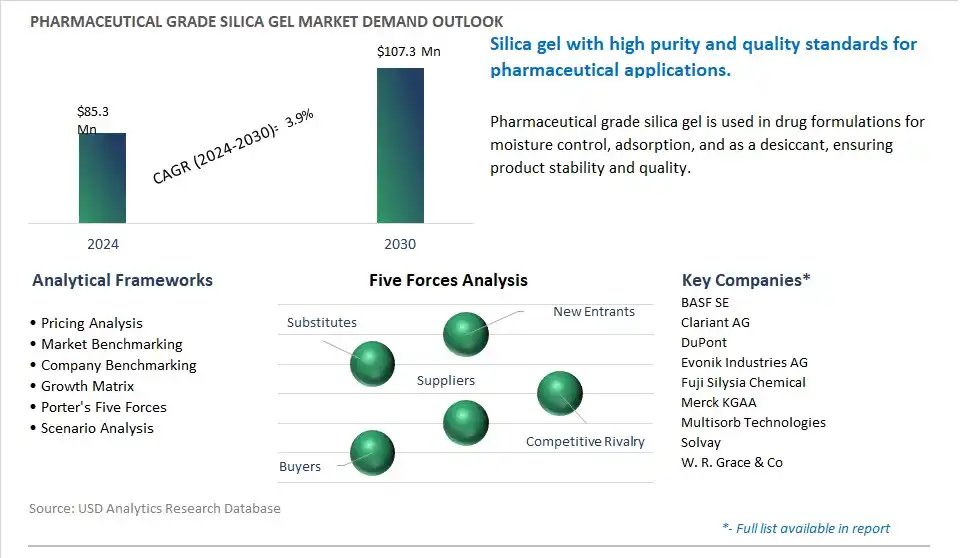
Pharmaceutical Grade Silica Gel Market Competitive Landscape
The market report analyses the leading companies in the industry including BASF SE, Clariant AG, DuPont, Evonik Industries AG, Fuji Silysia Chemical, Merck KGAA, Multisorb Technologies, Solvay, W. R. Grace & Co.
Pharmaceutical Grade Silica Gel Market Dynamics
Pharmaceutical Grade Silica Gel Market Trend: Increasing Demand for Desiccants in Pharmaceutical Packaging
A significant trend in the pharmaceutical grade silica gel market is the rising demand for desiccants in pharmaceutical packaging. As pharmaceutical products become more sensitive to moisture, there is a growing need to ensure the stability and shelf-life of medications by controlling humidity levels during storage and transportation. Pharmaceutical grade silica gel, known for its excellent moisture adsorption properties and chemical inertness, is increasingly utilized as a desiccant in various forms such as sachets, canisters, and packets within pharmaceutical packaging to prevent moisture-related degradation and maintain product quality.
Pharmaceutical Grade Silica Gel Market Driver: Stringent Regulatory Requirements for Drug Stability
A key driver propelling the pharmaceutical grade silica gel market is the stringent regulatory requirements for drug stability imposed by regulatory authorities worldwide. Regulatory agencies such as the FDA and EMA mandate pharmaceutical manufacturers to adhere to strict guidelines regarding the stability of drug products throughout their shelf life. Moisture-induced degradation can significantly impact the efficacy, safety, and quality of pharmaceuticals, leading to product recalls and regulatory non-compliance. Pharmaceutical grade silica gel serves as a critical tool in meeting these regulatory requirements by effectively controlling moisture levels in pharmaceutical packaging, thus ensuring the stability and integrity of drug formulations.
Pharmaceutical Grade Silica Gel Market Opportunity: Expansion into Novel Drug Delivery Systems
An opportunity for the pharmaceutical grade silica gel market lies in the expansion into novel drug delivery systems. As the pharmaceutical industry continues to innovate and develop new drug delivery technologies to improve patient outcomes and compliance, there is a growing demand for excipients that can accommodate these advanced formulations. Pharmaceutical grade silica gel possesses unique properties such as high surface area, porosity, and biocompatibility, making it suitable for incorporation into novel drug delivery systems such as controlled-release formulations, oral dispersible tablets, and transdermal patches. By collaborating with pharmaceutical companies and leveraging its properties to enhance the performance of novel drug delivery systems, pharmaceutical grade silica gel manufacturers aim to capitalize on this opportunity to expand their product portfolio and tap into emerging market segments.
Pharmaceutical Grade Silica Gel Market Share Analysis: Solid Silica Gel generated the highest revenue in 2024
The largest segment in the Pharmaceutical Grade Silica Gel Market is the Solid segment. Solid silica gel holds prominence in pharmaceutical applications. solid silica gel is widely used as a desiccant or moisture adsorbent in pharmaceutical packaging to maintain the stability and efficacy of moisture-sensitive drugs and formulations. Its high surface area and porous structure enable efficient adsorption of moisture, preventing degradation, clumping, or microbial growth in pharmaceutical products. Additionally, solid silica gel is inert, non-toxic, and chemically stable, ensuring compatibility with a wide range of pharmaceutical ingredients and formulations. Furthermore, solid silica gel is available in various particle sizes, shapes, and pore structures to meet specific application requirements, providing flexibility and versatility in pharmaceutical manufacturing processes. Further, solid silica gel can be regenerated and reused multiple times, offering cost-effectiveness and sustainability benefits to pharmaceutical manufacturers. Over the forecast period, these attributes make the solid silica gel segment the largest in the Pharmaceutical Grade Silica Gel Market, serving as an essential component in ensuring the quality, stability, and shelf life of pharmaceutical products.
Pharmaceutical Grade Silica Gel Market Share Analysis: Blue Silica Gel Beads segment is poised to register the fastest growth rate (CAGR) over the forecast period to 2030
The fastest-growing segment in the Pharmaceutical Grade Silica Gel Market is the Blue Silica Gel Beads segment. Blue silica gel beads are experiencing rapid growth. blue silica gel beads contain cobalt chloride, which changes color from blue to pink as it adsorbs moisture, providing a visual indication of moisture saturation. This color-changing property makes blue silica gel beads particularly suitable for moisture-sensitive pharmaceutical products, where precise control over humidity levels is essential to maintain product quality and stability. Additionally, blue silica gel beads offer higher moisture adsorption capacity compared to white or orange silica gel beads, making them more effective in protecting pharmaceutical formulations from degradation due to moisture exposure. Furthermore, blue silica gel beads are chemically inert, non-toxic, and safe for use in pharmaceutical applications, ensuring product integrity and compliance with regulatory requirements. Further, advancements in manufacturing technologies have led to the development of blue silica gel beads with enhanced properties such as uniform particle size distribution, high surface area, and improved moisture adsorption kinetics, further driving their adoption in the pharmaceutical industry. Over the forecast period, the unique moisture-indicating properties and superior performance of blue silica gel beads contribute to their rapid growth in the Pharmaceutical Grade Silica Gel Market.
Pharmaceutical Grade Silica Gel Market Share Analysis: Fillers & Diluents segment is poised to register the fastest growth rate (CAGR) over the forecast period to 2030
The fastest-growing segment in the Pharmaceutical Grade Silica Gel Market is the Fillers & Diluents segment. Diverse factors contribute to the rapid growth of fillers and diluents made from pharmaceutical-grade silica gel. fillers and diluents play a critical role in pharmaceutical formulations by improving the flow properties, compressibility, and content uniformity of tablets, capsules, and powders. Silica gel-based fillers and diluents offer advantages such as high surface area, porous structure, and inertness, making them ideal for enhancing the manufacturability and performance of pharmaceutical products. Additionally, pharmaceutical-grade silica gel fillers and diluents exhibit excellent compatibility with a wide range of active pharmaceutical ingredients (APIs) and excipients, ensuring formulation stability and efficacy. Furthermore, the increasing demand for oral solid dosage forms, including tablets and capsules, in the pharmaceutical industry drives the need for high-quality fillers and diluents to optimize drug delivery and patient compliance. Further, advancements in silica gel manufacturing technologies have led to the development of specialized grades with tailored particle size distributions, surface properties, and moisture adsorption capacities, further enhancing their suitability for pharmaceutical applications. Over the forecast period, the versatility, efficacy, and compatibility of silica gel-based fillers and diluents contribute to their rapid growth in the Pharmaceutical Grade Silica Gel Market.
Pharmaceutical Grade Silica Gel Market Report Segmentation
By Type
Solid
Liquid
By Gel Breads
White Silica Gel Breads
Orange Silica Gel Breads
Blue Silica Gel Breads
By Form
Fillers & Diluents
Binders
Disintegrants
Lubricants & Glidants
Colorants
Flavoring Agents
Preservatives
Solvents
Capsules
Viscosity Agents
Suspension
Coatings
By Packaging
Pouches
Sachets
Packets
Cannisters
Containers
Bottles
Others
By Chromatography
Analytical Chromatography
Preparative Chromatography
Process Chromatography
Regions Included
North America (US, Canada, Mexico)
Europe (Germany, UK, France, Spain, Italy, Russia, Rest of Europe)
Asia Pacific (China, India, Japan, South Korea, Australia, South East Asia, Rest of Asia)
South America (Brazil, Argentina, Rest of South America)
Middle East and Africa (Saudi Arabia, UAE, Rest of Middle East, South Africa, Egypt, Rest of Africa)
Pharmaceutical Grade Silica Gel Companies Profiled in the Market Study
BASF SE
Clariant AG
DuPont
Evonik Industries AG
Fuji Silysia Chemical
Merck KGAA
Multisorb Technologies
Solvay
W. R. Grace & Co
*- List Not Exhaustive
TABLE OF CONTENTS
1 Introduction to 2024 Pharmaceutical Grade Silica Gel Market
1.1 Market Overview
1.2 Quick Facts
1.3 Scope/Objective of the Study
1.4 Market Definition
1.5 Countries and Regions Covered
1.6 Units, Currency, and Conversions
1.7 Industry Value Chain
2 Research Methodology
2.1 Market Size Estimation
2.2 Sources and Research Methodology
2.3 Data Triangulation
2.4 Assumptions and Limitations
3 Executive Summary
3.1 Global Pharmaceutical Grade Silica Gel Market Size Outlook, $ Million, 2021 to 2030
3.2 Pharmaceutical Grade Silica Gel Market Outlook by Type, $ Million, 2021 to 2030
3.3 Pharmaceutical Grade Silica Gel Market Outlook by Product, $ Million, 2021 to 2030
3.4 Pharmaceutical Grade Silica Gel Market Outlook by Application, $ Million, 2021 to 2030
3.5 Pharmaceutical Grade Silica Gel Market Outlook by Key Countries, $ Million, 2021 to 2030
4 Market Dynamics
4.1 Key Driving Forces of Pharmaceutical Grade Silica Gel Industry
4.2 Key Market Trends in Pharmaceutical Grade Silica Gel Industry
4.3 Potential Opportunities in Pharmaceutical Grade Silica Gel Industry
4.4 Key Challenges in Pharmaceutical Grade Silica Gel Industry
5 Market Factor Analysis
5.1 Value Chain Analysis
5.2 Competitive Landscape
5.2.1 Global Pharmaceutical Grade Silica Gel Market Share by Company (%), 2023
5.2.2 Product Offerings by Company
5.3 Porter’s Five Forces Analysis
5.4 Pricing Analysis and Outlook
6 Growth Outlook Across Scenarios
6.1 Growth Analysis-Case Scenario Definitions
6.2 Low Growth Scenario Forecasts
6.3 Reference Growth Scenario Forecasts
6.4 High Growth Scenario Forecasts
7 Global Pharmaceutical Grade Silica Gel Market Outlook by Segments
7.1 Pharmaceutical Grade Silica Gel Market Outlook by Segments, $ Million, 2021- 2030
By Type
Solid
Liquid
By Gel Breads
White Silica Gel Breads
Orange Silica Gel Breads
Blue Silica Gel Breads
By Form
Fillers & Diluents
Binders
Disintegrants
Lubricants & Glidants
Colorants
Flavoring Agents
Preservatives
Solvents
Capsules
Viscosity Agents
Suspension
Coatings
By Packaging
Pouches
Sachets
Packets
Cannisters
Containers
Bottles
Others
By Chromatography
Analytical Chromatography
Preparative Chromatography
Process Chromatography
8 North America Pharmaceutical Grade Silica Gel Market Analysis and Outlook To 2030
8.1 Introduction to North America Pharmaceutical Grade Silica Gel Markets in 2024
8.2 North America Pharmaceutical Grade Silica Gel Market Size Outlook by Country, 2021-2030
8.2.1 United States
8.2.2 Canada
8.2.3 Mexico
8.3 North America Pharmaceutical Grade Silica Gel Market size Outlook by Segments, 2021-2030
By Type
Solid
Liquid
By Gel Breads
White Silica Gel Breads
Orange Silica Gel Breads
Blue Silica Gel Breads
By Form
Fillers & Diluents
Binders
Disintegrants
Lubricants & Glidants
Colorants
Flavoring Agents
Preservatives
Solvents
Capsules
Viscosity Agents
Suspension
Coatings
By Packaging
Pouches
Sachets
Packets
Cannisters
Containers
Bottles
Others
By Chromatography
Analytical Chromatography
Preparative Chromatography
Process Chromatography
9 Europe Pharmaceutical Grade Silica Gel Market Analysis and Outlook To 2030
9.1 Introduction to Europe Pharmaceutical Grade Silica Gel Markets in 2024
9.2 Europe Pharmaceutical Grade Silica Gel Market Size Outlook by Country, 2021-2030
9.2.1 Germany
9.2.2 France
9.2.3 Spain
9.2.4 United Kingdom
9.2.4 Italy
9.2.5 Russia
9.2.6 Norway
9.2.7 Rest of Europe
9.3 Europe Pharmaceutical Grade Silica Gel Market Size Outlook by Segments, 2021-2030
By Type
Solid
Liquid
By Gel Breads
White Silica Gel Breads
Orange Silica Gel Breads
Blue Silica Gel Breads
By Form
Fillers & Diluents
Binders
Disintegrants
Lubricants & Glidants
Colorants
Flavoring Agents
Preservatives
Solvents
Capsules
Viscosity Agents
Suspension
Coatings
By Packaging
Pouches
Sachets
Packets
Cannisters
Containers
Bottles
Others
By Chromatography
Analytical Chromatography
Preparative Chromatography
Process Chromatography
10 Asia Pacific Pharmaceutical Grade Silica Gel Market Analysis and Outlook To 2030
10.1 Introduction to Asia Pacific Pharmaceutical Grade Silica Gel Markets in 2024
10.2 Asia Pacific Pharmaceutical Grade Silica Gel Market Size Outlook by Country, 2021-2030
10.2.1 China
10.2.2 India
10.2.3 Japan
10.2.4 South Korea
10.2.5 Indonesia
10.2.6 Malaysia
10.2.7 Australia
10.2.8 Rest of Asia Pacific
10.3 Asia Pacific Pharmaceutical Grade Silica Gel Market size Outlook by Segments, 2021-2030
By Type
Solid
Liquid
By Gel Breads
White Silica Gel Breads
Orange Silica Gel Breads
Blue Silica Gel Breads
By Form
Fillers & Diluents
Binders
Disintegrants
Lubricants & Glidants
Colorants
Flavoring Agents
Preservatives
Solvents
Capsules
Viscosity Agents
Suspension
Coatings
By Packaging
Pouches
Sachets
Packets
Cannisters
Containers
Bottles
Others
By Chromatography
Analytical Chromatography
Preparative Chromatography
Process Chromatography
11 South America Pharmaceutical Grade Silica Gel Market Analysis and Outlook To 2030
11.1 Introduction to South America Pharmaceutical Grade Silica Gel Markets in 2024
11.2 South America Pharmaceutical Grade Silica Gel Market Size Outlook by Country, 2021-2030
11.2.1 Brazil
11.2.2 Argentina
11.2.3 Rest of South America
11.3 South America Pharmaceutical Grade Silica Gel Market size Outlook by Segments, 2021-2030
By Type
Solid
Liquid
By Gel Breads
White Silica Gel Breads
Orange Silica Gel Breads
Blue Silica Gel Breads
By Form
Fillers & Diluents
Binders
Disintegrants
Lubricants & Glidants
Colorants
Flavoring Agents
Preservatives
Solvents
Capsules
Viscosity Agents
Suspension
Coatings
By Packaging
Pouches
Sachets
Packets
Cannisters
Containers
Bottles
Others
By Chromatography
Analytical Chromatography
Preparative Chromatography
Process Chromatography
12 Middle East and Africa Pharmaceutical Grade Silica Gel Market Analysis and Outlook To 2030
12.1 Introduction to Middle East and Africa Pharmaceutical Grade Silica Gel Markets in 2024
12.2 Middle East and Africa Pharmaceutical Grade Silica Gel Market Size Outlook by Country, 2021-2030
12.2.1 Saudi Arabia
12.2.2 UAE
12.2.3 Oman
12.2.4 Rest of Middle East
12.2.5 Egypt
12.2.6 Nigeria
12.2.7 South Africa
12.2.8 Rest of Africa
12.3 Middle East and Africa Pharmaceutical Grade Silica Gel Market size Outlook by Segments, 2021-2030
By Type
Solid
Liquid
By Gel Breads
White Silica Gel Breads
Orange Silica Gel Breads
Blue Silica Gel Breads
By Form
Fillers & Diluents
Binders
Disintegrants
Lubricants & Glidants
Colorants
Flavoring Agents
Preservatives
Solvents
Capsules
Viscosity Agents
Suspension
Coatings
By Packaging
Pouches
Sachets
Packets
Cannisters
Containers
Bottles
Others
By Chromatography
Analytical Chromatography
Preparative Chromatography
Process Chromatography
13 Company Profiles
13.1 Company Snapshot
13.2 SWOT Profiles
13.3 Products and Services
13.4 Recent Developments
13.5 Financial Profile
BASF SE
Clariant AG
DuPont
Evonik Industries AG
Fuji Silysia Chemical
Merck KGAA
Multisorb Technologies
Solvay
W. R. Grace & Co
14 Appendix
14.1 Customization Offerings
14.2 Subscription Services
14.3 Related Reports
14.4 Publisher Expertise
By Type
Solid
Liquid
By Gel Breads
White Silica Gel Breads
Orange Silica Gel Breads
Blue Silica Gel Breads
By Form
Fillers & Diluents
Binders
Disintegrants
Lubricants & Glidants
Colorants
Flavoring Agents
Preservatives
Solvents
Capsules
Viscosity Agents
Suspension
Coatings
By Packaging
Pouches
Sachets
Packets
Cannisters
Containers
Bottles
Others
By Chromatography
Analytical Chromatography
Preparative Chromatography
Process Chromatography
Countries Analyzed
North America (US, Canada, Mexico)
Europe (Germany, UK, France, Spain, Italy, Russia, Rest of Europe)
Asia Pacific (China, India, Japan, South Korea, Australia, South East Asia, Rest of Asia)
South America (Brazil, Argentina, Rest of South America)
Middle East and Africa (Saudi Arabia, UAE, Rest of Middle East, South Africa, Egypt, Rest of Africa)
