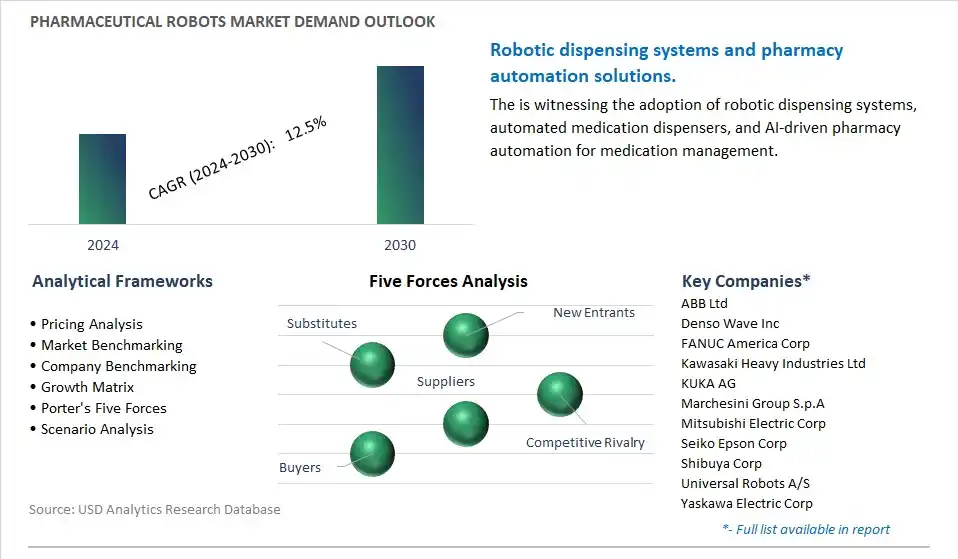
Pharmaceutical Robots Market is estimated to increase at a Compounded Annual Growth Rate of 12.5% CAGR over the forecast period from 2024 to 2030
The Pharmaceutical Robots Market study analyzes and forecasts the market size across 6 regions and 24 countries for diverse segments- By Product (Traditional Robots (Articulated Robots, SCARA Robots, Delta/Parallel Robots, Cartesian Robots, Dual-arm Robots), Collaborative Pharmaceutical Robots), By Application (Picking and Packaging, Inspection of Pharmaceutical Drugs, Laboratory Applications), By End-User (Pharmaceutical Companies, Research Laboratories).
An Introduction to Pharmaceutical Robots Market in 2024
Pharmaceutical Robots are automated systems designed to perform various tasks in pharmaceutical manufacturing, laboratory research, and drug dispensing operations with high precision, efficiency, and reliability. These robots are equipped with advanced robotics, artificial intelligence, and machine vision technologies to execute complex tasks, such as drug compounding, vial filling, labeling, and packaging, with minimal human intervention. Pharmaceutical robots enhance manufacturing throughput, reduce production costs, and improve product quality by minimizing errors and contamination risks associated with manual handling. Moreover, robotic automation enables flexible production schedules, rapid changeovers, and scalability to meet fluctuating market demands. As pharmaceutical companies strive to optimize efficiency and compliance with regulatory standards, pharmaceutical robots play a pivotal role in driving innovation and competitiveness in the pharmaceutical industry.
Market Trend: Automation and Robotics Integration in Pharmaceutical Manufacturing
A significant trend in the pharmaceutical robots market is the increasing integration of automation and robotics in pharmaceutical manufacturing processes. Pharmaceutical companies are embracing robotic technologies to enhance efficiency, accuracy, and safety in various aspects of drug production, including drug formulation, packaging, labeling, and quality control. Robotic systems offer advantages such as precision dosing, consistent product handling, and reduced risk of contamination, leading to improved product quality and compliance with regulatory standards. This trend reflects a growing demand for innovative automation solutions that optimize manufacturing workflows, reduce production costs, and accelerate time-to-market for pharmaceutical products in an increasingly competitive industry.
Market Driver: Demand for Increased Production Efficiency and Cost Reduction
A key driver for the pharmaceutical robots market is the demand for increased production efficiency and cost reduction in pharmaceutical manufacturing operations. With the growing global demand for pharmaceutical products, manufacturers face pressure to scale up production capacity, improve operational efficiency, and minimize production costs while maintaining product quality and regulatory compliance. Pharmaceutical robots enable companies to automate repetitive tasks, streamline production processes, and reduce human errors, leading to higher throughput, lower labor costs, and reduced waste. As pharmaceutical companies seek ways to enhance productivity and competitiveness, there is a growing need for robotic solutions that offer scalability, flexibility, and integration with existing manufacturing systems to meet evolving production requirements and market demands.
Market Opportunity: Development of Collaborative and Flexible Robotic Systems
An emerging opportunity within the pharmaceutical robots market lies in the development of collaborative and flexible robotic systems. Traditional industrial robots are often designed for specific tasks and operate within confined spaces, limiting their adaptability and interaction with human workers. Collaborative robots, also known as cobots, offer a safer and more flexible approach to automation by working alongside human operators in shared workspaces. By developing collaborative robotic systems tailored to pharmaceutical manufacturing environments, manufacturers can improve operational agility, facilitate human-robot collaboration, and address dynamic production needs. Additionally, flexible robotic systems equipped with interchangeable end-effectors, vision systems, and software programming enable rapid reconfiguration and customization of production lines, supporting the efficient production of diverse pharmaceutical products and dosage forms. This presents an opportunity to innovate in robotic design, control algorithms, and human-machine interfaces to create versatile automation solutions that enhance manufacturing flexibility, productivity, and adaptability in the pharmaceutical industry.
Pharmaceutical Robots Market Share Analysis: Collaborative Pharmaceutical Robots is the fastest growing segment over the forecast period to 2030
Collaborative pharmaceutical robots are experiencing the fastest growth within the pharmaceutical robots market. This growth is primarily attributed to the increasing adoption of automation and robotics in pharmaceutical manufacturing processes. Collaborative robots, also known as cobots, are designed to work alongside humans in a shared workspace safely. They offer advantages such as enhanced efficiency, flexibility, and improved safety in pharmaceutical manufacturing environments. These robots can perform various tasks, including picking and packaging, inspection of pharmaceutical drugs, and laboratory applications, thereby streamlining production processes and reducing the risk of errors. Additionally, collaborative robots are relatively easy to install and integrate into existing manufacturing setups, making them an attractive option for pharmaceutical companies and research laboratories seeking to optimize their operations and stay competitive in the market. As the demand for efficient and cost-effective solutions in pharmaceutical manufacturing continues to rise, the adoption of collaborative robots is expected to further accelerate, driving the growth of this segment.
Pharmaceutical Robots Competitive Analysis
The market research study provides in-depth insights into leading companies including the SWOT analyses, product profile, financial details, and recent developments acrossABB Ltd, Denso Wave Inc, FANUC America Corp, Kawasaki Heavy Industries Ltd, KUKA AG, Marchesini Group S.p.A, Mitsubishi Electric Corp, Seiko Epson Corp, Shibuya Corp, Universal Robots A/S, Yaskawa Electric Corp
Pharmaceutical Robots Market Segmentation
By Product
Traditional Robots
-Articulated Robots
-SCARA Robots
-Delta/Parallel Robots
-Cartesian Robots
-Dual-arm Robots
Collaborative Pharmaceutical Robots
By Application
Picking and Packaging
Inspection of Pharmaceutical Drugs
Laboratory Applications
By End-User
Pharmaceutical Companies
Research Laboratories
Geographical Analysis
North America (United States, Canada, Mexico)
Europe (Germany, France, United Kingdom, Spain, Italy, Rest of Europe)
Asia Pacific (China, India, Japan, South Korea, Rest of Asia Pacific)
South America (Brazil, Argentina, Rest of South America)
Middle East and Africa (Saudi Arabia, UAE, Rest of Middle East, South Africa, Egypt, Rest of Africa)
Pharmaceutical Robots Market Companies
ABB Ltd
Denso Wave Inc
FANUC America Corp
Kawasaki Heavy Industries Ltd
KUKA AG
Marchesini Group S.p.A
Mitsubishi Electric Corp
Seiko Epson Corp
Shibuya Corp
Universal Robots A/S
Yaskawa Electric Corp
Reasons to Buy the Pharmaceutical Robots Market Study
• Deepen your industry insights and navigate uncertainties for strategy formulation, CAPEX, and Operational decisions
• Gain access to detailed insights on the Pharmaceutical Robots Market, encompassing current market size, growth trends, and forecasts till 2030.
• Access detailed competitor analysis, enabling competitive advantage through a thorough understanding of market players, strategies, and potential differentiation opportunities
• Stay ahead of the curve with insights on technological advancements, innovations, and upcoming trends
• Identify lucrative investment avenues and expansion opportunities within the Pharmaceutical Robots Market industry, guided by robust, data-backed analysis.
• Understand regional and global markets through country-wise analysis, regional market potential, regulatory nuances, and dynamics
• Execute strategies with confidence and speed through information, analytics, and insights on the industry value chain
• Corporate leaders, strategists, financial experts, shareholders, asset managers, and governmental representatives can make long-term planning scenarios and build an integrated and timely understanding of market dynamics
• Benefit from tailored solutions and expert consultation based on report insights, providing personalized strategies aligned with specific business needs.
TABLE OF CONTENTS
1 Introduction to 2024 Pharmaceutical Robots Market
1.1 Market Overview
1.2 Quick Facts
1.3 Scope/Objective of the Study
1.4 Market Definition
1.5 Countries and Regions Covered
1.6 Units, Currency, and Conversions
1.7 Industry Value Chain
2 Research Methodology
2.1 Market Size Estimation
2.2 Sources and Research Methodology
2.3 Data Triangulation
2.4 Assumptions and Limitations
3 Executive Summary
3.1 Global Pharmaceutical Robots Market Size Outlook, $ Million, 2021 to 2030
3.2 Pharmaceutical Robots Market Outlook by Type, $ Million, 2021 to 2030
3.3 Pharmaceutical Robots Market Outlook by Product, $ Million, 2021 to 2030
3.4 Pharmaceutical Robots Market Outlook by Application, $ Million, 2021 to 2030
3.5 Pharmaceutical Robots Market Outlook by Key Countries, $ Million, 2021 to 2030
4 Market Dynamics
4.1 Key Driving Forces of Pharmaceutical Robots Industry
4.2 Key Market Trends in Pharmaceutical Robots Industry
4.3 Potential Opportunities in Pharmaceutical Robots Industry
4.4 Key Challenges in Pharmaceutical Robots Industry
5 Market Factor Analysis
5.1 Value Chain Analysis
5.2 Competitive Landscape
5.2.1 Global Pharmaceutical Robots Market Share by Company (%), 2023
5.2.2 Product Offerings by Company
5.3 Porter’s Five Forces Analysis
5.4 Pricing Analysis and Outlook
6 Growth Outlook Across Scenarios
6.1 Growth Analysis-Case Scenario Definitions
6.2 Low Growth Scenario Forecasts
6.3 Reference Growth Scenario Forecasts
6.4 High Growth Scenario Forecasts
7 Global Pharmaceutical Robots Market Outlook by Segments
7.1 Pharmaceutical Robots Market Outlook by Segments, $ Million, 2021- 2030
By Product
Traditional Robots
-Articulated Robots
-SCARA Robots
-Delta/Parallel Robots
-Cartesian Robots
-Dual-arm Robots
Collaborative Pharmaceutical Robots
By Application
Picking and Packaging
Inspection of Pharmaceutical Drugs
Laboratory Applications
By End-User
Pharmaceutical Companies
Research Laboratories
8 North America Pharmaceutical Robots Market Analysis and Outlook To 2030
8.1 Introduction to North America Pharmaceutical Robots Markets in 2024
8.2 North America Pharmaceutical Robots Market Size Outlook by Country, 2021-2030
8.2.1 United States
8.2.2 Canada
8.2.3 Mexico
8.3 North America Pharmaceutical Robots Market size Outlook by Segments, 2021-2030
By Product
Traditional Robots
-Articulated Robots
-SCARA Robots
-Delta/Parallel Robots
-Cartesian Robots
-Dual-arm Robots
Collaborative Pharmaceutical Robots
By Application
Picking and Packaging
Inspection of Pharmaceutical Drugs
Laboratory Applications
By End-User
Pharmaceutical Companies
Research Laboratories
9 Europe Pharmaceutical Robots Market Analysis and Outlook To 2030
9.1 Introduction to Europe Pharmaceutical Robots Markets in 2024
9.2 Europe Pharmaceutical Robots Market Size Outlook by Country, 2021-2030
9.2.1 Germany
9.2.2 France
9.2.3 Spain
9.2.4 United Kingdom
9.2.4 Italy
9.2.5 Russia
9.2.6 Norway
9.2.7 Rest of Europe
9.3 Europe Pharmaceutical Robots Market Size Outlook by Segments, 2021-2030
By Product
Traditional Robots
-Articulated Robots
-SCARA Robots
-Delta/Parallel Robots
-Cartesian Robots
-Dual-arm Robots
Collaborative Pharmaceutical Robots
By Application
Picking and Packaging
Inspection of Pharmaceutical Drugs
Laboratory Applications
By End-User
Pharmaceutical Companies
Research Laboratories
10 Asia Pacific Pharmaceutical Robots Market Analysis and Outlook To 2030
10.1 Introduction to Asia Pacific Pharmaceutical Robots Markets in 2024
10.2 Asia Pacific Pharmaceutical Robots Market Size Outlook by Country, 2021-2030
10.2.1 China
10.2.2 India
10.2.3 Japan
10.2.4 South Korea
10.2.5 Indonesia
10.2.6 Malaysia
10.2.7 Australia
10.2.8 Rest of Asia Pacific
10.3 Asia Pacific Pharmaceutical Robots Market size Outlook by Segments, 2021-2030
By Product
Traditional Robots
-Articulated Robots
-SCARA Robots
-Delta/Parallel Robots
-Cartesian Robots
-Dual-arm Robots
Collaborative Pharmaceutical Robots
By Application
Picking and Packaging
Inspection of Pharmaceutical Drugs
Laboratory Applications
By End-User
Pharmaceutical Companies
Research Laboratories
11 South America Pharmaceutical Robots Market Analysis and Outlook To 2030
11.1 Introduction to South America Pharmaceutical Robots Markets in 2024
11.2 South America Pharmaceutical Robots Market Size Outlook by Country, 2021-2030
11.2.1 Brazil
11.2.2 Argentina
11.2.3 Rest of South America
11.3 South America Pharmaceutical Robots Market size Outlook by Segments, 2021-2030
By Product
Traditional Robots
-Articulated Robots
-SCARA Robots
-Delta/Parallel Robots
-Cartesian Robots
-Dual-arm Robots
Collaborative Pharmaceutical Robots
By Application
Picking and Packaging
Inspection of Pharmaceutical Drugs
Laboratory Applications
By End-User
Pharmaceutical Companies
Research Laboratories
12 Middle East and Africa Pharmaceutical Robots Market Analysis and Outlook To 2030
12.1 Introduction to Middle East and Africa Pharmaceutical Robots Markets in 2024
12.2 Middle East and Africa Pharmaceutical Robots Market Size Outlook by Country, 2021-2030
12.2.1 Saudi Arabia
12.2.2 UAE
12.2.3 Oman
12.2.4 Rest of Middle East
12.2.5 Egypt
12.2.6 Nigeria
12.2.7 South Africa
12.2.8 Rest of Africa
12.3 Middle East and Africa Pharmaceutical Robots Market size Outlook by Segments, 2021-2030
By Product
Traditional Robots
-Articulated Robots
-SCARA Robots
-Delta/Parallel Robots
-Cartesian Robots
-Dual-arm Robots
Collaborative Pharmaceutical Robots
By Application
Picking and Packaging
Inspection of Pharmaceutical Drugs
Laboratory Applications
By End-User
Pharmaceutical Companies
Research Laboratories
13 Company Profiles
13.1 Company Snapshot
13.2 SWOT Profiles
13.3 Products and Services
13.4 Recent Developments
13.5 Financial Profile
List of Companies
ABB Ltd
Denso Wave Inc
FANUC America Corp
Kawasaki Heavy Industries Ltd
KUKA AG
Marchesini Group S.p.A
Mitsubishi Electric Corp
Seiko Epson Corp
Shibuya Corp
Universal Robots A/S
Yaskawa Electric Corp
14 Appendix
14.1 Customization Offerings
14.2 Subscription Services
14.3 Related Reports
14.4 Publisher Expertise
By Product
Traditional Robots
-Articulated Robots
-SCARA Robots
-Delta/Parallel Robots
-Cartesian Robots
-Dual-arm Robots
Collaborative Pharmaceutical Robots
By Application
Picking and Packaging
Inspection of Pharmaceutical Drugs
Laboratory Applications
By End-User
Pharmaceutical Companies
Research Laboratories
Countries Analyzed
North America (United States, Canada, Mexico)
Europe (Germany, France, United Kingdom, Spain, Italy, Rest of Europe)
Asia Pacific (China, India, Japan, South Korea, Rest of Asia Pacific)
South America (Brazil, Argentina, Rest of South America)
Middle East and Africa (Saudi Arabia, UAE, Rest of Middle East, South Africa, Egypt, Rest of Africa)
