
The Pharmacy Automation Market study analyzes and forecasts the market size across 6 regions and 24 countries for diverse segments- By Product (Automated Medication Dispensing and Storage Systems, Automated Packaging and Labelling Systems, Automated Tabletop Counters, Automated Medication Compounding Systems, Others), By End-User (Inpatient Pharmacies, Outpatient Pharmacies, Retail Pharmacies, Pharmacy Benefit Management Organizations).
Pharmacy automation refers to the use of technology and automated systems to streamline pharmacy operations, improve medication management, and enhance patient safety in healthcare settings. In 2025, the market for pharmacy automation continues to grow, driven by the increasing volume of prescriptions, the need to reduce medication errors, and the demand for efficient medication distribution systems in hospitals, retail pharmacies, and long-term care facilities. Pharmacy automation solutions encompass a variety of technologies, including robotic dispensing systems, automated medication storage and retrieval systems, barcode scanning systems, and medication packaging and labeling machines. These automation systems automate repetitive tasks such as medication dispensing, labeling, and inventory management, enabling pharmacy staff to focus on patient care activities, medication counseling, and clinical services. With advancements in robotics, artificial intelligence, and machine learning, pharmacy automation offers improved accuracy, efficiency, and medication safety, reducing the risk of medication errors, adverse drug events, and patient harm. Moreover, the integration of electronic health record (EHR) systems, medication management software, and interoperability standards enhances medication reconciliation, drug utilization monitoring, and adherence to medication therapy protocols, improving overall patient outcomes and satisfaction. As healthcare systems strive to deliver high-quality care while optimizing resource utilization and reducing costs, pharmacy automation emerges as a critical tool in improving medication management processes, enhancing patient safety, and ensuring timely access to medications for patients across the continuum of care.
A significant market trend in pharmacy automation is the integration of artificial intelligence (AI) and robotics to streamline medication dispensing, inventory management, and prescription fulfillment processes in pharmacies. AI-powered algorithms analyze prescription orders, patient data, and inventory levels to optimize medication workflows, reduce errors, and enhance operational efficiency. Additionally, robotics technologies automate dispensing tasks, such as pill counting, labeling, and packaging, improving accuracy, throughput, and medication adherence. This trend reflects a strategic shift towards autonomous pharmacy operations that leverage AI-driven decision-making and robotic automation to enhance patient safety, optimize resource utilization, and meet the growing demand for pharmaceutical services.
A primary driver fueling the growth of the pharmacy automation market is the rising prescription volume and the increasing prevalence of medication errors in traditional pharmacy settings. With the aging population, expanding access to healthcare services, and the prevalence of chronic diseases, pharmacies face growing demands for prescription dispensing and medication management services. Moreover, medication errors, including dispensing errors, drug interactions, and dosage mistakes, pose significant risks to patient safety and can result in adverse drug events and hospitalizations. The need to mitigate medication errors, improve medication adherence, and optimize workflow efficiency drives investments in pharmacy automation solutions that standardize processes, reduce manual interventions, and enhance medication safety through barcode verification, electronic prescriptions, and automated drug dispensing systems.
An enticing opportunity within the pharmacy automation market lies in the expansion into tele pharmacy and remote dispensing solutions to address the challenges of healthcare access, medication adherence, and medication management in underserved communities and remote areas. Telepharmacy platforms enable pharmacists to remotely verify prescriptions, provide medication counseling, and monitor patient adherence through virtual consultations and telecommunication technologies. Additionally, remote dispensing systems, such as automated prescription kiosks and medication vending machines, extend pharmacy services to non-traditional settings, such as clinics, long-term care facilities, and rural communities, improving access to essential medications and pharmacy services. Collaborations between telehealth providers, pharmacy chains, and technology vendors can drive innovation in telepharmacy and remote dispensing solutions, expanding market reach and improving healthcare outcomes for underserved populations.
Among the provided segments, Automated Medication Dispensing and Storage Systems are the fastest growing in the Pharmacy Automation Market. This growth can be attributed to several factors. Firstly, the increasing demand for improved efficiency, accuracy, and safety in medication management within healthcare facilities drives the adoption of automated dispensing and storage systems. These systems, including robots/robotic automated dispensing systems, carousels, and automated dispensing cabinets, streamline medication distribution processes, reduce medication errors, and optimize inventory management. Additionally, the growing prevalence of chronic diseases and the aging population worldwide are increasing the medication volume handled by pharmacies, necessitating automated solutions to cope with the rising workload. Furthermore, regulatory mandates emphasizing medication safety and inventory control in healthcare facilities further propel the adoption of automated dispensing and storage systems. As a result, Automated Medication Dispensing and Storage Systems emerge as the fastest growing segment in the Pharmacy Automation Market, catering to the evolving needs of inpatient pharmacies, outpatient pharmacies, retail pharmacies, and pharmacy benefit management organizations effectively.
The market research study provides in-depth insights into leading companies including the SWOT analyses, product profile, financial details, and recent developments acrossARxIUM Inc, Baxter International Inc, Becton, Dickinson and Company, Capsa Healthcare, Cerner Corp, KUKA AG, Omnicell Inc, Parata Systems LLC, RxSafe LLC, ScriptPro LLC, Yuyama Co. Ltd
By Product
Automated Medication Dispensing and Storage Systems
-Robots/Robotic Automated Dispensing Systems
-Carousels
-Automated Dispensing Cabinets
Automated Packaging and Labelling Systems
Automated Tabletop Counters
Automated Medication Compounding Systems
Others
By End-User
Inpatient Pharmacies
Outpatient Pharmacies
Retail Pharmacies
Pharmacy Benefit Management Organizations
Geographical Analysis
North America (United States, Canada, Mexico)
Europe (Germany, France, United Kingdom, Spain, Italy, Rest of Europe)
Asia Pacific (China, India, Japan, South Korea, Rest of Asia Pacific)
South America (Brazil, Argentina, Rest of South America)
Middle East and Africa (Saudi Arabia, UAE, Rest of Middle East, South Africa, Egypt, Rest of Africa)
ARxIUM Inc
Baxter International Inc
Becton, Dickinson and Company
Capsa Healthcare
Cerner Corp
KUKA AG
Omnicell Inc
Parata Systems LLC
RxSafe LLC
ScriptPro LLC
Yuyama Co. Ltd
• Deepen your industry insights and navigate uncertainties for strategy formulation, CAPEX, and Operational decisions
• Gain access to detailed insights on the Pharmacy Automation Market, encompassing current market size, growth trends, and forecasts till 2030.
• Access detailed competitor analysis, enabling competitive advantage through a thorough understanding of market players, strategies, and potential differentiation opportunities
• Stay ahead of the curve with insights on technological advancements, innovations, and upcoming trends
• Identify lucrative investment avenues and expansion opportunities within the Pharmacy Automation Market industry, guided by robust, data-backed analysis.
• Understand regional and global markets through country-wise analysis, regional market potential, regulatory nuances, and dynamics
• Execute strategies with confidence and speed through information, analytics, and insights on the industry value chain
• Corporate leaders, strategists, financial experts, shareholders, asset managers, and governmental representatives can make long-term planning scenarios and build an integrated and timely understanding of market dynamics
• Benefit from tailored solutions and expert consultation based on report insights, providing personalized strategies aligned with specific business needs.
TABLE OF CONTENTS
1 Introduction to 2025 Pharmacy Automation Market
1.1 Market Overview
1.2 Quick Facts
1.3 Scope/Objective of the Study
1.4 Market Definition
1.5 Countries and Regions Covered
1.6 Units, Currency, and Conversions
1.7 Industry Value Chain
2 Research Methodology
2.1 Market Size Estimation
2.2 Sources and Research Methodology
2.3 Data Triangulation
2.4 Assumptions and Limitations
3 Executive Summary
3.1 Global Pharmacy Automation Market Size Outlook, $ Million, 2021 to 2034
3.2 Pharmacy Automation Market Outlook by Type, $ Million, 2021 to 2034
3.3 Pharmacy Automation Market Outlook by Product, $ Million, 2021 to 2034
3.4 Pharmacy Automation Market Outlook by Application, $ Million, 2021 to 2034
3.5 Pharmacy Automation Market Outlook by Key Countries, $ Million, 2021 to 2034
4 Market Dynamics
4.1 Key Driving Forces of Pharmacy Automation Industry
4.2 Key Market Trends in Pharmacy Automation Industry
4.3 Potential Opportunities in Pharmacy Automation Industry
4.4 Key Challenges in Pharmacy Automation Industry
5 Market Factor Analysis
5.1 Value Chain Analysis
5.2 Competitive Landscape
5.2.1 Global Pharmacy Automation Market Share by Company (%), 2025
5.2.2 Product Offerings by Company
5.3 Porter’s Five Forces Analysis
5.4 Pricing Analysis and Outlook
6 Growth Outlook Across Scenarios
6.1 Growth Analysis-Case Scenario Definitions
6.2 Low Growth Scenario Forecasts
6.3 Reference Growth Scenario Forecasts
6.4 High Growth Scenario Forecasts
7 Global Pharmacy Automation Market Outlook by Segments
7.1 Pharmacy Automation Market Outlook by Segments, $ Million, 2021- 2034
By Product
Automated Medication Dispensing and Storage Systems
-Robots/Robotic Automated Dispensing Systems
-Carousels
-Automated Dispensing Cabinets
Automated Packaging and Labelling Systems
Automated Tabletop Counters
Automated Medication Compounding Systems
Others
By End-User
Inpatient Pharmacies
Outpatient Pharmacies
Retail Pharmacies
Pharmacy Benefit Management Organizations
8 North America Pharmacy Automation Market Analysis and Outlook To 2030
8.1 Introduction to North America Pharmacy Automation Markets in 2024
8.2 North America Pharmacy Automation Market Size Outlook by Country, 2021-2034
8.2.1 United States
8.2.2 Canada
8.2.3 Mexico
8.3 North America Pharmacy Automation Market size Outlook by Segments, 2021-2034
By Product
Automated Medication Dispensing and Storage Systems
-Robots/Robotic Automated Dispensing Systems
-Carousels
-Automated Dispensing Cabinets
Automated Packaging and Labelling Systems
Automated Tabletop Counters
Automated Medication Compounding Systems
Others
By End-User
Inpatient Pharmacies
Outpatient Pharmacies
Retail Pharmacies
Pharmacy Benefit Management Organizations
9 Europe Pharmacy Automation Market Analysis and Outlook To 2030
9.1 Introduction to Europe Pharmacy Automation Markets in 2024
9.2 Europe Pharmacy Automation Market Size Outlook by Country, 2021-2034
9.2.1 Germany
9.2.2 France
9.2.3 Spain
9.2.4 United Kingdom
9.2.4 Italy
9.2.5 Russia
9.2.6 Norway
9.2.7 Rest of Europe
9.3 Europe Pharmacy Automation Market Size Outlook by Segments, 2021-2034
By Product
Automated Medication Dispensing and Storage Systems
-Robots/Robotic Automated Dispensing Systems
-Carousels
-Automated Dispensing Cabinets
Automated Packaging and Labelling Systems
Automated Tabletop Counters
Automated Medication Compounding Systems
Others
By End-User
Inpatient Pharmacies
Outpatient Pharmacies
Retail Pharmacies
Pharmacy Benefit Management Organizations
10 Asia Pacific Pharmacy Automation Market Analysis and Outlook To 2030
10.1 Introduction to Asia Pacific Pharmacy Automation Markets in 2024
10.2 Asia Pacific Pharmacy Automation Market Size Outlook by Country, 2021-2034
10.2.1 China
10.2.2 India
10.2.3 Japan
10.2.4 South Korea
10.2.5 Indonesia
10.2.6 Malaysia
10.2.7 Australia
10.2.8 Rest of Asia Pacific
10.3 Asia Pacific Pharmacy Automation Market size Outlook by Segments, 2021-2034
By Product
Automated Medication Dispensing and Storage Systems
-Robots/Robotic Automated Dispensing Systems
-Carousels
-Automated Dispensing Cabinets
Automated Packaging and Labelling Systems
Automated Tabletop Counters
Automated Medication Compounding Systems
Others
By End-User
Inpatient Pharmacies
Outpatient Pharmacies
Retail Pharmacies
Pharmacy Benefit Management Organizations
11 South America Pharmacy Automation Market Analysis and Outlook To 2030
11.1 Introduction to South America Pharmacy Automation Markets in 2024
11.2 South America Pharmacy Automation Market Size Outlook by Country, 2021-2034
11.2.1 Brazil
11.2.2 Argentina
11.2.3 Rest of South America
11.3 South America Pharmacy Automation Market size Outlook by Segments, 2021-2034
By Product
Automated Medication Dispensing and Storage Systems
-Robots/Robotic Automated Dispensing Systems
-Carousels
-Automated Dispensing Cabinets
Automated Packaging and Labelling Systems
Automated Tabletop Counters
Automated Medication Compounding Systems
Others
By End-User
Inpatient Pharmacies
Outpatient Pharmacies
Retail Pharmacies
Pharmacy Benefit Management Organizations
12 Middle East and Africa Pharmacy Automation Market Analysis and Outlook To 2030
12.1 Introduction to Middle East and Africa Pharmacy Automation Markets in 2024
12.2 Middle East and Africa Pharmacy Automation Market Size Outlook by Country, 2021-2034
12.2.1 Saudi Arabia
12.2.2 UAE
12.2.3 Oman
12.2.4 Rest of Middle East
12.2.5 Egypt
12.2.6 Nigeria
12.2.7 South Africa
12.2.8 Rest of Africa
12.3 Middle East and Africa Pharmacy Automation Market size Outlook by Segments, 2021-2034
By Product
Automated Medication Dispensing and Storage Systems
-Robots/Robotic Automated Dispensing Systems
-Carousels
-Automated Dispensing Cabinets
Automated Packaging and Labelling Systems
Automated Tabletop Counters
Automated Medication Compounding Systems
Others
By End-User
Inpatient Pharmacies
Outpatient Pharmacies
Retail Pharmacies
Pharmacy Benefit Management Organizations
13 Company Profiles
13.1 Company Snapshot
13.2 SWOT Profiles
13.3 Products and Services
13.4 Recent Developments
13.5 Financial Profile
List of Companies
ARxIUM Inc
Baxter International Inc
Becton, Dickinson and Company
Capsa Healthcare
Cerner Corp
KUKA AG
Omnicell Inc
Parata Systems LLC
RxSafe LLC
ScriptPro LLC
Yuyama Co. Ltd
14 Appendix
14.1 Customization Offerings
14.2 Subscription Services
14.3 Related Reports
14.4 Publisher Expertise
By Product
Automated Medication Dispensing and Storage Systems
-Robots/Robotic Automated Dispensing Systems
-Carousels
-Automated Dispensing Cabinets
Automated Packaging and Labelling Systems
Automated Tabletop Counters
Automated Medication Compounding Systems
Others
By End-User
Inpatient Pharmacies
Outpatient Pharmacies
Retail Pharmacies
Pharmacy Benefit Management Organizations
Countries Analyzed
North America (United States, Canada, Mexico)
Europe (Germany, France, United Kingdom, Spain, Italy, Rest of Europe)
Asia Pacific (China, India, Japan, South Korea, Rest of Asia Pacific)
South America (Brazil, Argentina, Rest of South America)
Middle East and Africa (Saudi Arabia, UAE, Rest of Middle East, South Africa, Egypt, Rest of Africa)
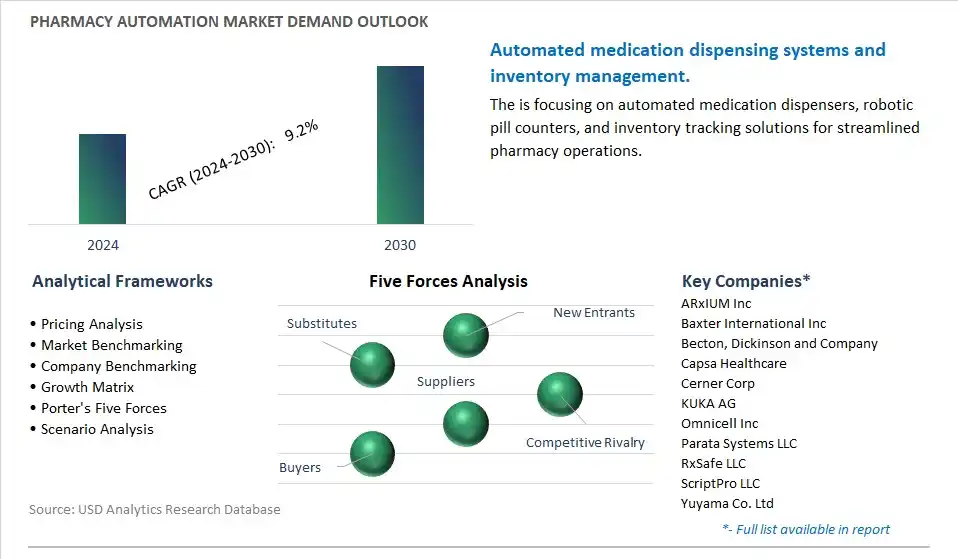
According to USD Analytics the Global Pharmacy Automation is projected to register a 9.2% CAGR from 2025 to 2034.
Emerging Markets across Asia Pacific, Europe, and Americas present robust growth prospects.
ARxIUM Inc, Baxter International Inc, Becton, Dickinson and Company, Capsa Healthcare, Cerner Corp, KUKA AG, Omnicell Inc, Parata Systems LLC, RxSafe LLC, ScriptPro LLC, Yuyama Co. Ltd
Base Year- 2024; Estimated Year- 2025; Historic Period- 2019-2024; Forecast period- 2025 to 2034; Currency: Revenue (USD); Volume