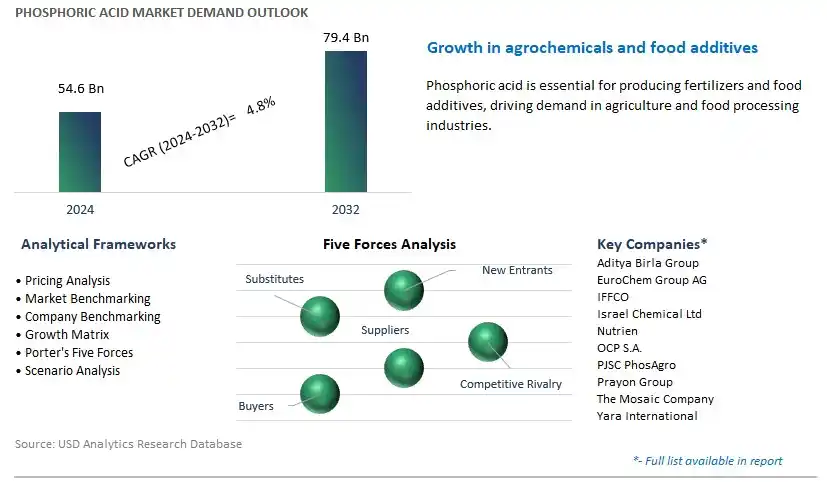
Global Phosphoric Acid Market Size is valued at $54.6 Billion in 2024 and is forecast to register a growth rate (CAGR) of 4.8% to reach $79.4 Billion by 2032.
The global Phosphoric Acid Market Study analyzes and forecasts the market size across 6 regions and 24 countries for diverse segments -By Source (Wet Process, Thermal Process), By End-User (Fertilizers, Feed & Food Additives, Detergents, Water Treatment Chemicals, Metal Treatment, Industrial Use, Others), By Application (Diamonium Hydrogenphosphate (DAP), Monoammonium Dihydrogenphosphate (MAP), Triple Superphosphate (TSP), Others).
An Introduction to Phosphoric Acid Market in 2024
Phosphoric acid is an inorganic acid with the chemical formula H3PO4, widely used in various industrial applications such as fertilizer production, metal surface treatment, food and beverage processing, and pharmaceutical manufacturing. In 2024, the market for phosphoric acid remains significant as industries rely on its versatile properties and functionalities. Phosphoric acid is produced through the wet process or thermal process by reacting phosphate rock with sulfuric acid, yielding a solution containing phosphoric acid and calcium sulfate (gypsum). Phosphoric acid serves as a key ingredient in the production of phosphate fertilizers such as diammonium phosphate (DAP) and triple superphosphate (TSP), providing plants with essential phosphorus for growth and development. It is also used as a pH adjuster and acidulant in food and beverage products such as cola drinks, processed meats, and bakery goods. In addition, phosphoric acid finds applications in metal treatment processes such as rust removal, metal cleaning, and surface finishing, as well as in pharmaceutical formulations and water treatment chemicals. The demand for phosphoric acid is driven by factors such as the growth of agriculture and food industries, increasing demand for industrial chemicals, and the expansion of manufacturing activities in emerging economies. Market trends include the development of green and sustainable production methods for phosphoric acid, the optimization of purification and concentration processes for higher purity grades, and the exploration of new applications such as energy storage and electrochemistry.
Phosphoric Acid Market Competitive Landscape
The market report analyses the leading companies in the industry including Aditya Birla Group, EuroChem Group AG, IFFCO, Israel Chemical Ltd, Nutrien, OCP S.A., PJSC PhosAgro, Prayon Group, The Mosaic Company, Yara International, and others.
Phosphoric Acid Market Dynamics
Market Trend: Growing Demand for Food-Grade Phosphoric Acid
A prominent market trend in phosphoric acid is the growing demand for food-grade phosphoric acid, driven by the expanding food and beverage industry. With increasing consumer demand for processed and convenience foods, there is a rising need for phosphoric acid as a food additive and acidulant in various food and beverage products. Phosphoric acid is commonly used in the production of carbonated beverages, processed meats, bakery goods, and dairy products to impart acidity, enhance flavor, and act as a preservative. This trend towards the use of food-grade phosphoric acid reflects the industry's focus on meeting consumer preferences for convenient and flavorful food options, driving growth in the phosphoric acid market.
Market Driver: Expansion of the Agricultural Sector
A key driver for the phosphoric acid market is the expansion of the agricultural sector and the increasing demand for phosphate fertilizers. Phosphoric acid is a vital ingredient in the production of phosphate-based fertilizers, which are essential for providing crops with the necessary phosphorus nutrients required for optimal growth and yield. As global population growth and dietary changes drive higher demand for agricultural products, there is a corresponding increase in the use of phosphate fertilizers to improve soil fertility and enhance agricultural productivity. The agriculture sector's reliance on phosphoric acid as a primary input for fertilizer production fuels the demand for phosphoric acid, supporting growth in the market.
Market Opportunity: Diversification into Industrial Applications
A significant market opportunity for phosphoric acid lies in diversifying into industrial applications beyond agriculture and food processing. Manufacturers have the opportunity to explore new markets and applications for phosphoric acid, such as water treatment, metal surface treatment, detergent production, and pharmaceutical manufacturing. Phosphoric acid's properties, including its acidity, corrosion inhibition, and buffering capabilities, make it suitable for various industrial processes and applications. By expanding the use of phosphoric acid into non-traditional sectors, companies can tap into new revenue streams, mitigate market volatility, and maximize the utilization of phosphoric acid production capacity, presenting a compelling opportunity for market growth and diversification.
Phosphoric Acid Market Share Analysis: Wet Process segment generated the highest revenue in 2024
Among the two segments in the phosphoric acid market, the Wet Process segment is experiencing notable growth. In particular, the wet process method offers potential advantages over thermal process, including lower production costs, higher purity of the resulting phosphoric acid, and greater flexibility in the choice of phosphate rock sources. These advantages make the wet process increasingly preferable for phosphoric acid production, especially in regions where cost efficiency and product quality are paramount. Additionally, the wet process is more environmentally friendly, as it generates fewer hazardous by-products compared to thermal process. As industries worldwide prioritize sustainability and environmental responsibility, the demand for phosphoric acid produced through the wet process is expected to continue its upward trajectory. Furthermore, technological advancements and innovations in the wet process are further driving its growth by improving efficiency and reducing energy consumption. Consequently, the Wet Process segment is the fastest-growing segment in the phosphoric acid market, poised to maintain its momentum in the foreseeable future.
Phosphoric Acid Market Share Analysis: Water Treatment Chemicals is poised to register the fastest CAGR over the forecast period
The Water Treatment Chemicals segment is the fastest-growing segment in the phosphoric acid market. With increasing concerns about water quality and scarcity worldwide, the demand for effective water treatment solutions is on the rise. Phosphoric acid plays a vital role in water treatment processes, particularly in the removal of impurities and adjusting pH levels. Its ability to efficiently remove contaminants such as heavy metals and scale deposits from water makes it indispensable in various industrial and municipal water treatment applications. Moreover, stringent regulations regarding water quality standards further propel the adoption of phosphoric acid-based treatment solutions. As industries and municipalities invest in upgrading and expanding their water treatment infrastructure to meet regulatory requirements and address environmental concerns, the demand for phosphoric acid in water treatment chemicals is experiencing rapid growth. Additionally, ongoing research and development efforts aimed at enhancing the efficacy and sustainability of water treatment processes are expected to further boost the demand for phosphoric acid in this segment, solidifying its position as the fastest-growing segment in the phosphoric acid market.
Phosphoric Acid Market Share Analysis: Diammonium Hydrogenphosphate (DAP) segment generated the highest revenue in 2024
Among the various applications of phosphoric acid, Diammonium Hydrogenphosphate (DAP) is the largest segment in the market. DAP is widely used as a fertilizer due to its high nutrient content, providing plants with readily available phosphorus and nitrogen, essential for healthy growth and increased yields. Its versatility and effectiveness make it a popular choice among farmers and agricultural professionals globally. Additionally, DAP offers convenience in application, as it can be easily blended with other fertilizers and applied through various methods such as broadcasting, banding, or fertigation. The increasing global demand for agricultural products, driven by population growth and changing dietary preferences, fuels the demand for DAP as farmers strive to optimize crop production. Moreover, technological advancements in fertilizer manufacturing processes and distribution networks further support the growth of this segment. As agriculture continues to evolve towards sustainable and efficient practices, the demand for DAP is expected to remain robust, consolidating its position as the largest segment in the phosphoric acid market.
Phosphoric Acid Market
By Source
Wet Process
Thermal Process
By End-User
Fertilizers
Feed & Food Additives
Detergents
Water Treatment Chemicals
Metal Treatment
Industrial Use
Others
By Application
Diamonium Hydrogenphosphate (DAP)
Monoammonium Dihydrogenphosphate (MAP)
Triple Superphosphate (TSP)
Others
Countries Analyzed
North America (US, Canada, Mexico)
Europe (Germany, UK, France, Spain, Italy, Russia, Rest of Europe)
Asia Pacific (China, India, Japan, South Korea, Australia, South East Asia, Rest of Asia)
South America (Brazil, Argentina, Rest of South America)
Middle East and Africa (Saudi Arabia, UAE, Rest of Middle East, South Africa, Egypt, Rest of Africa)
Phosphoric Acid Companies Profiled in the Study
Aditya Birla Group
EuroChem Group AG
IFFCO
Israel Chemical Ltd
Nutrien
OCP S.A.
PJSC PhosAgro
Prayon Group
The Mosaic Company
Yara International
*- List Not Exhaustive
TABLE OF CONTENTS
1 Introduction to 2024 Phosphoric Acid Market
1.1 Market Overview
1.2 Quick Facts
1.3 Scope/Objective of the Study
1.4 Market Definition
1.5 Countries and Regions Covered
1.6 Units, Currency, and Conversions
1.7 Industry Value Chain
2 Research Methodology
2.1 Market Size Estimation
2.2 Sources and Research Methodology
2.3 Data Triangulation
2.4 Assumptions and Limitations
3 Executive Summary
3.1 Global Phosphoric Acid Market Size Outlook, $ Million, 2021 to 2032
3.2 Phosphoric Acid Market Outlook by Type, $ Million, 2021 to 2032
3.3 Phosphoric Acid Market Outlook by Product, $ Million, 2021 to 2032
3.4 Phosphoric Acid Market Outlook by Application, $ Million, 2021 to 2032
3.5 Phosphoric Acid Market Outlook by Key Countries, $ Million, 2021 to 2032
4 Market Dynamics
4.1 Key Driving Forces of Phosphoric Acid Industry
4.2 Key Market Trends in Phosphoric Acid Industry
4.3 Potential Opportunities in Phosphoric Acid Industry
4.4 Key Challenges in Phosphoric Acid Industry
5 Market Factor Analysis
5.1 Value Chain Analysis
5.2 Competitive Landscape
5.2.1 Global Phosphoric Acid Market Share by Company (%), 2023
5.2.2 Product Offerings by Company
5.3 Porter’s Five Forces Analysis
5.4 Pricing Analysis and Outlook
6 Growth Outlook Across Scenarios
6.1 Growth Analysis-Case Scenario Definitions
6.2 Low Growth Scenario Forecasts
6.3 Reference Growth Scenario Forecasts
6.4 High Growth Scenario Forecasts
7 Global Phosphoric Acid Market Outlook by Segments
7.1 Phosphoric Acid Market Outlook by Segments, $ Million, 2021- 2032
By Source
Wet Process
Thermal Process
By End-User
Fertilizers
Feed & Food Additives
Detergents
Water Treatment Chemicals
Metal Treatment
Industrial Use
Others
By Application
Diamonium Hydrogenphosphate (DAP)
Monoammonium Dihydrogenphosphate (MAP)
Triple Superphosphate (TSP)
Others
8 North America Phosphoric Acid Market Analysis and Outlook To 2032
8.1 Introduction to North America Phosphoric Acid Markets in 2024
8.2 North America Phosphoric Acid Market Size Outlook by Country, 2021-2032
8.2.1 United States
8.2.2 Canada
8.2.3 Mexico
8.3 North America Phosphoric Acid Market size Outlook by Segments, 2021-2032
By Source
Wet Process
Thermal Process
By End-User
Fertilizers
Feed & Food Additives
Detergents
Water Treatment Chemicals
Metal Treatment
Industrial Use
Others
By Application
Diamonium Hydrogenphosphate (DAP)
Monoammonium Dihydrogenphosphate (MAP)
Triple Superphosphate (TSP)
Others
9 Europe Phosphoric Acid Market Analysis and Outlook To 2032
9.1 Introduction to Europe Phosphoric Acid Markets in 2024
9.2 Europe Phosphoric Acid Market Size Outlook by Country, 2021-2032
9.2.1 Germany
9.2.2 France
9.2.3 Spain
9.2.4 United Kingdom
9.2.4 Italy
9.2.5 Russia
9.2.6 Norway
9.2.7 Rest of Europe
9.3 Europe Phosphoric Acid Market Size Outlook by Segments, 2021-2032
By Source
Wet Process
Thermal Process
By End-User
Fertilizers
Feed & Food Additives
Detergents
Water Treatment Chemicals
Metal Treatment
Industrial Use
Others
By Application
Diamonium Hydrogenphosphate (DAP)
Monoammonium Dihydrogenphosphate (MAP)
Triple Superphosphate (TSP)
Others
10 Asia Pacific Phosphoric Acid Market Analysis and Outlook To 2032
10.1 Introduction to Asia Pacific Phosphoric Acid Markets in 2024
10.2 Asia Pacific Phosphoric Acid Market Size Outlook by Country, 2021-2032
10.2.1 China
10.2.2 India
10.2.3 Japan
10.2.4 South Korea
10.2.5 Indonesia
10.2.6 Malaysia
10.2.7 Australia
10.2.8 Rest of Asia Pacific
10.3 Asia Pacific Phosphoric Acid Market size Outlook by Segments, 2021-2032
By Source
Wet Process
Thermal Process
By End-User
Fertilizers
Feed & Food Additives
Detergents
Water Treatment Chemicals
Metal Treatment
Industrial Use
Others
By Application
Diamonium Hydrogenphosphate (DAP)
Monoammonium Dihydrogenphosphate (MAP)
Triple Superphosphate (TSP)
Others
11 South America Phosphoric Acid Market Analysis and Outlook To 2032
11.1 Introduction to South America Phosphoric Acid Markets in 2024
11.2 South America Phosphoric Acid Market Size Outlook by Country, 2021-2032
11.2.1 Brazil
11.2.2 Argentina
11.2.3 Rest of South America
11.3 South America Phosphoric Acid Market size Outlook by Segments, 2021-2032
By Source
Wet Process
Thermal Process
By End-User
Fertilizers
Feed & Food Additives
Detergents
Water Treatment Chemicals
Metal Treatment
Industrial Use
Others
By Application
Diamonium Hydrogenphosphate (DAP)
Monoammonium Dihydrogenphosphate (MAP)
Triple Superphosphate (TSP)
Others
12 Middle East and Africa Phosphoric Acid Market Analysis and Outlook To 2032
12.1 Introduction to Middle East and Africa Phosphoric Acid Markets in 2024
12.2 Middle East and Africa Phosphoric Acid Market Size Outlook by Country, 2021-2032
12.2.1 Saudi Arabia
12.2.2 UAE
12.2.3 Oman
12.2.4 Rest of Middle East
12.2.5 Egypt
12.2.6 Nigeria
12.2.7 South Africa
12.2.8 Rest of Africa
12.3 Middle East and Africa Phosphoric Acid Market size Outlook by Segments, 2021-2032
By Source
Wet Process
Thermal Process
By End-User
Fertilizers
Feed & Food Additives
Detergents
Water Treatment Chemicals
Metal Treatment
Industrial Use
Others
By Application
Diamonium Hydrogenphosphate (DAP)
Monoammonium Dihydrogenphosphate (MAP)
Triple Superphosphate (TSP)
Others
13 Company Profiles
13.1 Company Snapshot
13.2 SWOT Profiles
13.3 Products and Services
13.4 Recent Developments
13.5 Financial Profile
Aditya Birla Group
EuroChem Group AG
IFFCO
Israel Chemical Ltd
Nutrien
OCP S.A.
PJSC PhosAgro
Prayon Group
The Mosaic Company
Yara International
14 Appendix
14.1 Customization Offerings
14.2 Subscription Services
14.3 Related Reports
14.4 Publisher Expertise
By Source
Wet Process
Thermal Process
By End-User
Fertilizers
Feed & Food Additives
Detergents
Water Treatment Chemicals
Metal Treatment
Industrial Use
Others
By Application
Diamonium Hydrogenphosphate (DAP)
Monoammonium Dihydrogenphosphate (MAP)
Triple Superphosphate (TSP)
Others
Countries Analyzed
North America (US, Canada, Mexico)
Europe (Germany, UK, France, Spain, Italy, Russia, Rest of Europe)
Asia Pacific (China, India, Japan, South Korea, Australia, South East Asia, Rest of Asia)
South America (Brazil, Argentina, Rest of South America)
Middle East and Africa (Saudi Arabia, UAE, Rest of Middle East, South Africa, Egypt, Rest of Africa)
