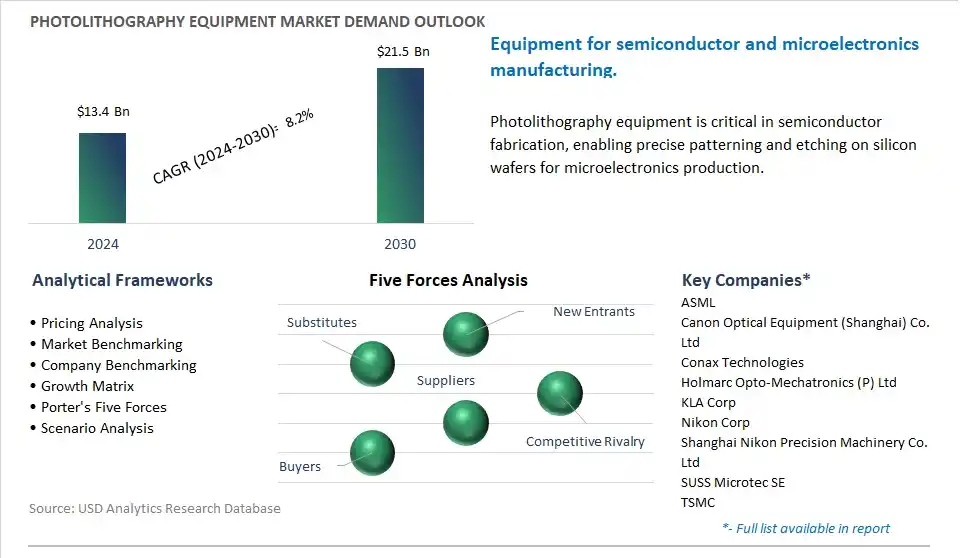
The global Photolithography Equipment Market is poised to register a 8.2% CAGR from $13.4 Billion in 2024 to $21.5 Billion in 2030.
The global Photolithography Equipment Market Study analyzes and forecasts the market size across 6 regions and 24 countries for diverse segments -By Process (Ultraviolet UV, Deep Ultraviolet (DUV), Extreme Ultraviolet (EUV), Others), By Light Source (Mercury Lamp, Fluorine Laser, Excimer Laser, Others), By Wave Length (370 nm -270 nm, 270 nm – 170 nm, 70 nm – 1 nm), By End-User (Integrated Device Manufacturer (IDMs), Foundries).
An Introduction to Global Photolithography Equipment Market in 2024
The key trend shaping the future of the photolithography equipment industry is the ongoing development of advanced semiconductor manufacturing technologies and the demand for smaller, faster, and more energy-efficient electronic devices. Photolithography is a critical process used in semiconductor fabrication to pattern features onto silicon wafers, enabling the production of integrated circuits (ICs), microprocessors, memory chips, and other electronic components. With the continuous miniaturization of semiconductor devices and the transition to advanced technology nodes such as 7nm, 5nm, and beyond, there is a growing need for photolithography equipment that offers higher resolution, improved overlay accuracy, and increased throughput. Manufacturers are investing in the development of next-generation lithography systems such as extreme ultraviolet (EUV) lithography, multi-beam maskless lithography (MBML), and directed self-assembly (DSA) techniques to overcome the limitations of conventional optical lithography and enable the continued scaling of semiconductor devices. Additionally, there is a trend towards the integration of artificial intelligence (AI), machine learning (ML), and advanced process control (APC) algorithms into photolithography equipment to optimize process parameters, reduce defectivity, and enhance yield in semiconductor manufacturing. Furthermore, with the growing demand for heterogeneous integration, 3D packaging, and emerging applications such as artificial intelligence (AI), Internet of Things (IoT), and 5G connectivity, there is a need for photolithography equipment that supports diverse materials, substrates, and device architectures, driving innovation and collaboration across the semiconductor supply chain. As the semiconductor industry continues to push the boundaries of technology and innovation, the demand for advanced photolithography equipment is expected to grow, driving market expansion and technological advancement in semiconductor manufacturing.
Photolithography Equipment Market Competitive Landscape
The market report analyses the leading companies in the industry including ASML, Canon Optical Equipment (Shanghai) Co. Ltd, Conax Technologies, Holmarc Opto-Mechatronics (P) Ltd, KLA Corp, Nikon Corp, Shanghai Nikon Precision Machinery Co. Ltd, SUSS Microtec SE, TSMC, Veeco Instruments Inc.
Photolithography Equipment Market Dynamics
Photolithography Equipment Market Trend: Advancements in Nanotechnology and Semiconductor Manufacturing
One prominent trend in the photolithography equipment market is the continuous advancements in nanotechnology and semiconductor manufacturing processes. As the demand for smaller and more powerful electronic devices increases, there is a growing need for photolithography equipment capable of achieving higher resolution and finer feature sizes. Manufacturers are investing in research and development to enhance the performance of photolithography tools, such as optical lithography systems and electron beam lithography systems, to meet the evolving requirements of semiconductor fabrication and nanofabrication applications.
Photolithography Equipment Market Driver: Increasing Demand for Advanced Semiconductor Devices
A significant driver propelling the photolithography equipment market is the increasing demand for advanced semiconductor devices. With the proliferation of technologies such as artificial intelligence, Internet of Things, 5G communication, and autonomous vehicles, there is a growing need for semiconductors with higher processing power, improved energy efficiency, and enhanced functionality. Photolithography equipment plays a crucial role in the fabrication of semiconductor chips by enabling the precise patterning of integrated circuits on silicon wafers. The rising demand for advanced semiconductor devices fuels the adoption of cutting-edge photolithography tools and drives market growth.
Photolithography Equipment Market Opportunity: Development of EUV Lithography Systems
An opportunity for the photolithography equipment market lies in the development and commercialization of extreme ultraviolet (EUV) lithography systems. EUV lithography offers significant advantages over traditional optical lithography techniques, such as higher resolution, improved patterning accuracy, and the ability to print smaller feature sizes. While EUV lithography has been in development for several years, recent technological advancements have made it increasingly viable for high-volume semiconductor manufacturing. Manufacturers investing in the development of EUV lithography systems stand to capitalize on the growing demand for next-generation semiconductor fabrication technology and establish a strong foothold in the market.
Photolithography Equipment Market Share Analysis: Deep Ultraviolet (DUV) generated the highest revenue in 2024
The largest segment in the Photolithography Equipment Market is the Deep Ultraviolet (DUV) segment. deep ultraviolet (DUV) lithography has been widely adopted in semiconductor manufacturing for Diverse decades and remains the dominant photolithography process for high-volume production of integrated circuits (ICs). DUV lithography uses light with wavelengths ranging from 248 nanometers (nm) to 193 nm to pattern photoresist materials on silicon wafers, enabling the fabrication of increasingly smaller and more complex semiconductor devices with higher resolution and precision. Additionally, DUV lithography equipment has undergone continuous advancements in optical and mechanical design, precision control systems, and imaging technologies to meet the evolving requirements of semiconductor manufacturers for advanced node scaling and semiconductor process integration. Further, the maturity, reliability, and proven performance of DUV lithography equipment make it the preferred choice for manufacturing a wide range of semiconductor products, including memory chips, logic devices, and microprocessors. Furthermore, while extreme ultraviolet (EUV) lithography technology offers the potential for further resolution improvements and increased manufacturing efficiency, its widespread adoption has been limited by technical challenges, including source power, mask defects, and infrastructure readiness. Accordingly, DUV lithography remains the workhorse technology in semiconductor fabrication facilities, supporting high-volume production with proven performance, cost-effectiveness, and scalability. Over the forecast period, the established market presence, technological maturity, and ongoing advancements in DUV lithography equipment position it as the largest segment in the Photolithography Equipment Market.
Photolithography Equipment Market Share Analysis: Excimer Laser segment is poised to register the fastest growth rate (CAGR) over the forecast period to 2030
The fastest-growing segment in the Photolithography Equipment Market is the Excimer Laser segment. Diverse factors contribute to the rapid growth of excimer laser-based photolithography equipment. excimer lasers offer potential advantages over other light sources in terms of wavelength precision, pulse energy, and beam quality, making them well-suited for high-resolution patterning in semiconductor manufacturing. Excimer lasers emit short pulses of ultraviolet (UV) light at wavelengths that match the absorption spectra of photoresist materials used in photolithography processes, enabling precise and efficient pattern transfer onto silicon wafers. Additionally, excimer lasers provide excellent beam stability, spatial coherence, and uniformity, ensuring consistent and reliable lithography performance across large areas of semiconductor wafers. Further, advancements in excimer laser technology, such as higher pulse repetition rates, improved beam delivery systems, and enhanced control mechanisms, enable increased throughput and productivity in semiconductor fabrication facilities. Furthermore, the ongoing trend towards miniaturization and integration of semiconductor devices drives the demand for higher resolution lithography equipment capable of printing smaller feature sizes with tighter tolerances. Excimer laser-based photolithography equipment offers the potential for submicron resolution and nanometer-scale patterning, making it indispensable for advanced semiconductor manufacturing nodes, such as 7nm, 5nm, and beyond. Over the forecast period, the superior performance, precision, and scalability of excimer laser-based photolithography equipment, coupled with the increasing demand for high-resolution semiconductor devices, contribute to its rapid growth as the fastest-growing segment in the Photolithography Equipment Market.
Photolithography Equipment Market Share Analysis: 70 nm – 1 nm wavelength segment is poised to register the fastest growth rate (CAGR) over the forecast period to 2030
The fastest-growing segment in the Photolithography Equipment Market is the 70 nm – 1 nm wavelength range. This segment corresponds to extreme ultraviolet (EUV) lithography, which utilizes light with wavelengths ranging from 70 nanometers (nm) to 1 nm. Diverse factors contribute to the rapid growth of EUV lithography equipment. EUV lithography enables semiconductor manufacturers to achieve higher resolution patterning and smaller feature sizes compared to traditional deep ultraviolet (DUV) lithography techniques. With the semiconductor industry's continuous drive towards smaller transistor sizes and higher integration densities, EUV lithography has become essential for advancing to advanced technology nodes such as 7nm, 5nm, and beyond. Additionally, EUV lithography offers advantages in terms of simplified patterning processes, reduced multi-patterning steps, and improved pattern fidelity, leading to increased manufacturing efficiency and yield. Further, advancements in EUV light source technology, optical components, and mask materials have addressed previous technical challenges, such as source power and mask defects, enabling the scalability and reliability of EUV lithography for high-volume semiconductor production. Furthermore, the growing adoption of EUV lithography by leading semiconductor manufacturers for critical layers in advanced chip designs drives the demand for EUV photolithography equipment. As semiconductor nodes continue to shrink and device complexity increases, EUV lithography is expected to play an increasingly prominent role in semiconductor manufacturing, leading to the rapid growth of the 70 nm – 1 nm wavelength range segment in the Photolithography Equipment Market.
Photolithography Equipment Market Report Segmentation
By Process
Ultraviolet UV
Deep Ultraviolet (DUV)
Extreme Ultraviolet (EUV)
Others
By Light Source
Mercury Lamp
Fluorine Laser
Excimer Laser
Others
By Wave Length
370 nm -270 nm
270 nm – 170 nm
70 nm – 1 nm
By End-User
Integrated Device Manufacturer (IDMs)
Foundries
Regions Included
North America (US, Canada, Mexico)
Europe (Germany, UK, France, Spain, Italy, Russia, Rest of Europe)
Asia Pacific (China, India, Japan, South Korea, Australia, South East Asia, Rest of Asia)
South America (Brazil, Argentina, Rest of South America)
Middle East and Africa (Saudi Arabia, UAE, Rest of Middle East, South Africa, Egypt, Rest of Africa)
Photolithography Equipment Companies Profiled in the Market Study
ASML
Canon Optical Equipment (Shanghai) Co. Ltd
Conax Technologies
Holmarc Opto-Mechatronics (P) Ltd
KLA Corp
Nikon Corp
Shanghai Nikon Precision Machinery Co. Ltd
SUSS Microtec SE
TSMC
Veeco Instruments Inc
*- List Not Exhaustive
TABLE OF CONTENTS
1 Introduction to 2024 Photolithography Equipment Market
1.1 Market Overview
1.2 Quick Facts
1.3 Scope/Objective of the Study
1.4 Market Definition
1.5 Countries and Regions Covered
1.6 Units, Currency, and Conversions
1.7 Industry Value Chain
2 Research Methodology
2.1 Market Size Estimation
2.2 Sources and Research Methodology
2.3 Data Triangulation
2.4 Assumptions and Limitations
3 Executive Summary
3.1 Global Photolithography Equipment Market Size Outlook, $ Million, 2021 to 2030
3.2 Photolithography Equipment Market Outlook by Type, $ Million, 2021 to 2030
3.3 Photolithography Equipment Market Outlook by Product, $ Million, 2021 to 2030
3.4 Photolithography Equipment Market Outlook by Application, $ Million, 2021 to 2030
3.5 Photolithography Equipment Market Outlook by Key Countries, $ Million, 2021 to 2030
4 Market Dynamics
4.1 Key Driving Forces of Photolithography Equipment Industry
4.2 Key Market Trends in Photolithography Equipment Industry
4.3 Potential Opportunities in Photolithography Equipment Industry
4.4 Key Challenges in Photolithography Equipment Industry
5 Market Factor Analysis
5.1 Value Chain Analysis
5.2 Competitive Landscape
5.2.1 Global Photolithography Equipment Market Share by Company (%), 2023
5.2.2 Product Offerings by Company
5.3 Porter’s Five Forces Analysis
5.4 Pricing Analysis and Outlook
6 Growth Outlook Across Scenarios
6.1 Growth Analysis-Case Scenario Definitions
6.2 Low Growth Scenario Forecasts
6.3 Reference Growth Scenario Forecasts
6.4 High Growth Scenario Forecasts
7 Global Photolithography Equipment Market Outlook by Segments
7.1 Photolithography Equipment Market Outlook by Segments, $ Million, 2021- 2030
By Process
Ultraviolet UV
Deep Ultraviolet (DUV)
Extreme Ultraviolet (EUV)
Others
By Light Source
Mercury Lamp
Fluorine Laser
Excimer Laser
Others
By Wave Length
370 nm -270 nm
270 nm – 170 nm
70 nm – 1 nm
By End-User
Integrated Device Manufacturer (IDMs)
Foundries
8 North America Photolithography Equipment Market Analysis and Outlook To 2030
8.1 Introduction to North America Photolithography Equipment Markets in 2024
8.2 North America Photolithography Equipment Market Size Outlook by Country, 2021-2030
8.2.1 United States
8.2.2 Canada
8.2.3 Mexico
8.3 North America Photolithography Equipment Market size Outlook by Segments, 2021-2030
By Process
Ultraviolet UV
Deep Ultraviolet (DUV)
Extreme Ultraviolet (EUV)
Others
By Light Source
Mercury Lamp
Fluorine Laser
Excimer Laser
Others
By Wave Length
370 nm -270 nm
270 nm – 170 nm
70 nm – 1 nm
By End-User
Integrated Device Manufacturer (IDMs)
Foundries
9 Europe Photolithography Equipment Market Analysis and Outlook To 2030
9.1 Introduction to Europe Photolithography Equipment Markets in 2024
9.2 Europe Photolithography Equipment Market Size Outlook by Country, 2021-2030
9.2.1 Germany
9.2.2 France
9.2.3 Spain
9.2.4 United Kingdom
9.2.4 Italy
9.2.5 Russia
9.2.6 Norway
9.2.7 Rest of Europe
9.3 Europe Photolithography Equipment Market Size Outlook by Segments, 2021-2030
By Process
Ultraviolet UV
Deep Ultraviolet (DUV)
Extreme Ultraviolet (EUV)
Others
By Light Source
Mercury Lamp
Fluorine Laser
Excimer Laser
Others
By Wave Length
370 nm -270 nm
270 nm – 170 nm
70 nm – 1 nm
By End-User
Integrated Device Manufacturer (IDMs)
Foundries
10 Asia Pacific Photolithography Equipment Market Analysis and Outlook To 2030
10.1 Introduction to Asia Pacific Photolithography Equipment Markets in 2024
10.2 Asia Pacific Photolithography Equipment Market Size Outlook by Country, 2021-2030
10.2.1 China
10.2.2 India
10.2.3 Japan
10.2.4 South Korea
10.2.5 Indonesia
10.2.6 Malaysia
10.2.7 Australia
10.2.8 Rest of Asia Pacific
10.3 Asia Pacific Photolithography Equipment Market size Outlook by Segments, 2021-2030
By Process
Ultraviolet UV
Deep Ultraviolet (DUV)
Extreme Ultraviolet (EUV)
Others
By Light Source
Mercury Lamp
Fluorine Laser
Excimer Laser
Others
By Wave Length
370 nm -270 nm
270 nm – 170 nm
70 nm – 1 nm
By End-User
Integrated Device Manufacturer (IDMs)
Foundries
11 South America Photolithography Equipment Market Analysis and Outlook To 2030
11.1 Introduction to South America Photolithography Equipment Markets in 2024
11.2 South America Photolithography Equipment Market Size Outlook by Country, 2021-2030
11.2.1 Brazil
11.2.2 Argentina
11.2.3 Rest of South America
11.3 South America Photolithography Equipment Market size Outlook by Segments, 2021-2030
By Process
Ultraviolet UV
Deep Ultraviolet (DUV)
Extreme Ultraviolet (EUV)
Others
By Light Source
Mercury Lamp
Fluorine Laser
Excimer Laser
Others
By Wave Length
370 nm -270 nm
270 nm – 170 nm
70 nm – 1 nm
By End-User
Integrated Device Manufacturer (IDMs)
Foundries
12 Middle East and Africa Photolithography Equipment Market Analysis and Outlook To 2030
12.1 Introduction to Middle East and Africa Photolithography Equipment Markets in 2024
12.2 Middle East and Africa Photolithography Equipment Market Size Outlook by Country, 2021-2030
12.2.1 Saudi Arabia
12.2.2 UAE
12.2.3 Oman
12.2.4 Rest of Middle East
12.2.5 Egypt
12.2.6 Nigeria
12.2.7 South Africa
12.2.8 Rest of Africa
12.3 Middle East and Africa Photolithography Equipment Market size Outlook by Segments, 2021-2030
By Process
Ultraviolet UV
Deep Ultraviolet (DUV)
Extreme Ultraviolet (EUV)
Others
By Light Source
Mercury Lamp
Fluorine Laser
Excimer Laser
Others
By Wave Length
370 nm -270 nm
270 nm – 170 nm
70 nm – 1 nm
By End-User
Integrated Device Manufacturer (IDMs)
Foundries
13 Company Profiles
13.1 Company Snapshot
13.2 SWOT Profiles
13.3 Products and Services
13.4 Recent Developments
13.5 Financial Profile
ASML
Canon Optical Equipment (Shanghai) Co. Ltd
Conax Technologies
Holmarc Opto-Mechatronics (P) Ltd
KLA Corp
Nikon Corp
Shanghai Nikon Precision Machinery Co. Ltd
SUSS Microtec SE
TSMC
Veeco Instruments Inc
14 Appendix
14.1 Customization Offerings
14.2 Subscription Services
14.3 Related Reports
14.4 Publisher Expertise
By Process
Ultraviolet UV
Deep Ultraviolet (DUV)
Extreme Ultraviolet (EUV)
Others
By Light Source
Mercury Lamp
Fluorine Laser
Excimer Laser
Others
By Wave Length
370 nm -270 nm
270 nm – 170 nm
70 nm – 1 nm
By End-User
Integrated Device Manufacturer (IDMs)
Foundries
Countries Analyzed
North America (US, Canada, Mexico)
Europe (Germany, UK, France, Spain, Italy, Russia, Rest of Europe)
Asia Pacific (China, India, Japan, South Korea, Australia, South East Asia, Rest of Asia)
South America (Brazil, Argentina, Rest of South America)
Middle East and Africa (Saudi Arabia, UAE, Rest of Middle East, South Africa, Egypt, Rest of Africa)
