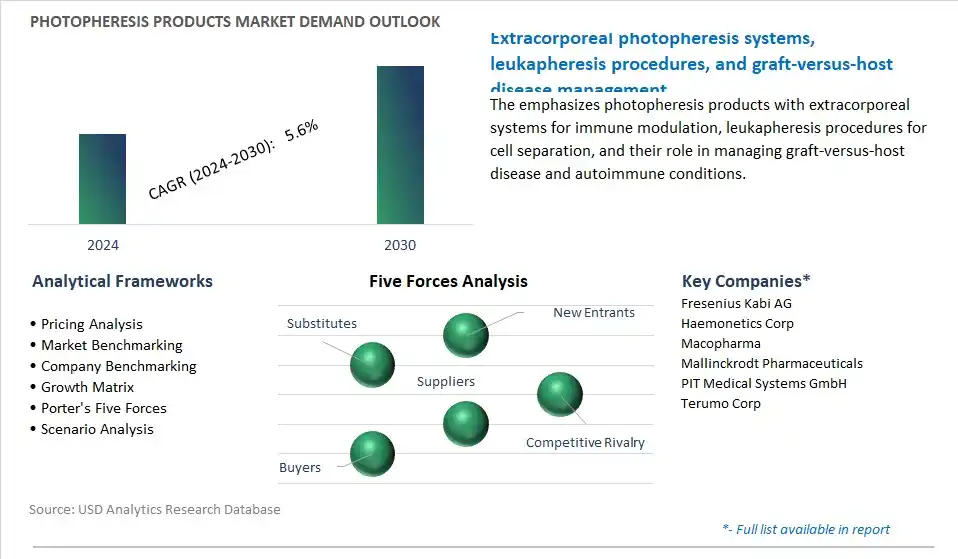
Photopheresis Products Market is estimated to increase at a Compounded Annual Growth Rate of 5.6% CAGR over the forecast period from 2024 to 2030
The Photopheresis Products Market study analyzes and forecasts the market size across 6 regions and 24 countries for diverse segments- By Product (Open System, Closed System), By Application (Graft versus Host Disease, Cutaneous T-Cell Lymphoma, Transplant Rejections, Autoimmune Diseases), By End-User (Hospitals, Ambulatory Centers, Others).
An Introduction to Photopheresis Products Market in 2024
In 2024, the market for photopheresis products continues to play a significant role in the treatment of various immune-mediated diseases and malignancies, offering patients targeted immunomodulatory therapy to manage their conditions effectively. Photopheresis, also known as extracorporeal photopheresis (ECP), is a therapeutic procedure that involves the collection of a patient's blood, separation of white blood cells, exposure of these cells to a photosensitizing agent, and subsequent UV-A irradiation before reinfusion into the patient's bloodstream. This process activates immune cells, induces apoptosis of pathogenic cells, and modulates immune responses, making photopheresis a valuable treatment option for conditions such as graft-versus-host disease (GVHD), cutaneous T-cell lymphoma (CTCL), and organ transplant rejection. The market for photopheresis products encompasses a range of devices, consumables, and accessories used in the photopheresis procedure, including apheresis machines, disposable kits, and UV irradiation chambers, each designed to ensure safe and efficient treatment delivery. Technological advancements in photopheresis products focus on improving device performance, automation capabilities, and treatment efficiency, enabling healthcare providers to deliver photopheresis therapy with greater precision, consistency, and patient comfort. Moreover, the development of novel photosensitizing agents, phototherapy protocols, and treatment algorithms expands the therapeutic applications of photopheresis, offering new hope for patients with refractory or debilitating immune-mediated diseases. With the increasing recognition of photopheresis as a valuable treatment modality and the ongoing research into its mechanisms of action and clinical applications, the market for photopheresis products is poised for continued growth and innovation, offering healthcare providers and patients effective solutions for managing immune-related disorders and improving patient outcomes.
Market Trend: Increasing Adoption in Immune-Mediated Disorders
A prominent trend in the Photopheresis Products market is the increasing adoption of photopheresis therapy in the treatment of immune-mediated disorders. With advancements in understanding the immune system and the role of immune dysregulation in various diseases, there is growing interest in photopheresis as a therapeutic option for conditions such as graft-versus-host disease (GVHD), cutaneous T-cell lymphoma (CTCL), and autoimmune diseases. Photopheresis involves the extracorporeal exposure of blood components to ultraviolet A (UVA) light after treatment with a photosensitizing agent, leading to immunomodulatory effects and the suppression of aberrant immune responses. The trend towards personalized medicine and targeted immunotherapy drives the adoption of photopheresis products as a safe and effective treatment modality for immune-mediated disorders, offering new hope for patients with difficult-to-treat conditions.
Market Driver: Growing Demand for Transplantation and Oncology Therapies
A primary driver fueling the growth of the Photopheresis Products market is the growing demand for transplantation and oncology therapies. Photopheresis therapy plays a crucial role in the management of complications following solid organ transplantation, particularly in preventing and treating acute and chronic GVHD, a serious complication of allogeneic hematopoietic stem cell transplantation (HSCT). Additionally, photopheresis is used as a treatment option for CTCL, a rare form of non-Hodgkin's lymphoma, and other lymphoproliferative disorders. The increasing prevalence of hematologic malignancies, the rising number of solid organ transplants, and the expansion of stem cell transplantation programs contribute to the growing demand for photopheresis products in transplantation and oncology settings. The need for effective therapies to improve patient outcomes and reduce transplant-related complications drives the adoption of photopheresis as a standard of care in transplantation and oncology therapies.
Market Opportunity: Expansion into Autoimmune and Inflammatory Diseases
An emerging opportunity in the Photopheresis Products market lies in the expansion into autoimmune and inflammatory diseases beyond transplantation and oncology indications. While photopheresis has demonstrated efficacy in GVHD, CTCL, and certain lymphoproliferative disorders, there is potential for its application in treating autoimmune conditions such as systemic sclerosis, rheumatoid arthritis, and Crohn's disease, as well as inflammatory skin disorders like psoriasis and atopic dermatitis. Photopheresis therapy offers immunomodulatory effects that may help rebalance dysregulated immune responses and reduce inflammation in autoimmune and inflammatory diseases. By expanding the indications for photopheresis products and conducting clinical trials to evaluate their efficacy and safety in new therapeutic areas, manufacturers can unlock new markets, address unmet medical needs, and diversify their product portfolios, positioning themselves as leaders in photopheresis therapy across a broader range of diseases and conditions.
Photopheresis Products Market Share Analysis: Closed System Photopheresis Products for Graft versus Host Disease (GVHD)
Among the various products, applications, and end-users in the photopheresis products market, closed system photopheresis products for graft versus host disease (GVHD) are experiencing rapid growth. Closed system photopheresis involves the extracorporeal treatment of blood or leukocytes with ultraviolet A (UVA) light after sensitization with a photosensitizing agent such as 8-methoxypsoralen (8-MOP). This process is used in the management of GVHD, a potentially life-threatening complication that can occur after allogeneic hematopoietic stem cell transplantation (HSCT). Closed system photopheresis offers several advantages over open system photopheresis, including improved safety, reduced risk of contamination, and enhanced patient comfort. In GVHD treatment, closed system photopheresis is considered a standard of care and has demonstrated efficacy in inducing immune tolerance and reducing the severity of GVHD symptoms. Hospitals and ambulatory centers are the primary end-users of closed system photopheresis products for GVHD treatment, providing specialized care and access to photopheresis therapy for patients undergoing HSCT or suffering from GVHD. Additionally, as research continues to uncover new applications for photopheresis in the treatment of cutaneous T-cell lymphoma, transplant rejections, and autoimmune diseases, the demand for closed system photopheresis products is expected to expand further. As healthcare providers increasingly recognize the benefits of closed system photopheresis in improving patient outcomes and quality of life in GVHD management, the market for closed system photopheresis products for GVHD is poised for significant growth in the photopheresis products market.
Photopheresis Products Competitive Analysis
The market research study provides in-depth insights into leading companies including the SWOT analyses, product profile, financial details, and recent developments acrossFresenius Kabi AG, Haemonetics Corp, Macopharma, Mallinckrodt Pharmaceuticals, PIT Medical Systems GmbH, Terumo Corp
Photopheresis Products Market Segmentation
By Product
Open System
Closed System
By Application
Graft versus Host Disease
Cutaneous T-Cell Lymphoma
Transplant Rejections
Autoimmune Diseases
By End-User
Hospitals
Ambulatory Centers
Others
Geographical Analysis
North America (United States, Canada, Mexico)
Europe (Germany, France, United Kingdom, Spain, Italy, Rest of Europe)
Asia Pacific (China, India, Japan, South Korea, Rest of Asia Pacific)
South America (Brazil, Argentina, Rest of South America)
Middle East and Africa (Saudi Arabia, UAE, Rest of Middle East, South Africa, Egypt, Rest of Africa)
Photopheresis Products Market Companies
Fresenius Kabi AG
Haemonetics Corp
Macopharma
Mallinckrodt Pharmaceuticals
PIT Medical Systems GmbH
Terumo Corp
Reasons to Buy the Photopheresis Products Market Study
• Deepen your industry insights and navigate uncertainties for strategy formulation, CAPEX, and Operational decisions
• Gain access to detailed insights on the Photopheresis Products Market, encompassing current market size, growth trends, and forecasts till 2030.
• Access detailed competitor analysis, enabling competitive advantage through a thorough understanding of market players, strategies, and potential differentiation opportunities
• Stay ahead of the curve with insights on technological advancements, innovations, and upcoming trends
• Identify lucrative investment avenues and expansion opportunities within the Photopheresis Products Market industry, guided by robust, data-backed analysis.
• Understand regional and global markets through country-wise analysis, regional market potential, regulatory nuances, and dynamics
• Execute strategies with confidence and speed through information, analytics, and insights on the industry value chain
• Corporate leaders, strategists, financial experts, shareholders, asset managers, and governmental representatives can make long-term planning scenarios and build an integrated and timely understanding of market dynamics
• Benefit from tailored solutions and expert consultation based on report insights, providing personalized strategies aligned with specific business needs.
TABLE OF CONTENTS
1 Introduction to 2024 Photopheresis Products Market
1.1 Market Overview
1.2 Quick Facts
1.3 Scope/Objective of the Study
1.4 Market Definition
1.5 Countries and Regions Covered
1.6 Units, Currency, and Conversions
1.7 Industry Value Chain
2 Research Methodology
2.1 Market Size Estimation
2.2 Sources and Research Methodology
2.3 Data Triangulation
2.4 Assumptions and Limitations
3 Executive Summary
3.1 Global Photopheresis Products Market Size Outlook, $ Million, 2021 to 2030
3.2 Photopheresis Products Market Outlook by Type, $ Million, 2021 to 2030
3.3 Photopheresis Products Market Outlook by Product, $ Million, 2021 to 2030
3.4 Photopheresis Products Market Outlook by Application, $ Million, 2021 to 2030
3.5 Photopheresis Products Market Outlook by Key Countries, $ Million, 2021 to 2030
4 Market Dynamics
4.1 Key Driving Forces of Photopheresis Products Industry
4.2 Key Market Trends in Photopheresis Products Industry
4.3 Potential Opportunities in Photopheresis Products Industry
4.4 Key Challenges in Photopheresis Products Industry
5 Market Factor Analysis
5.1 Value Chain Analysis
5.2 Competitive Landscape
5.2.1 Global Photopheresis Products Market Share by Company (%), 2023
5.2.2 Product Offerings by Company
5.3 Porter’s Five Forces Analysis
5.4 Pricing Analysis and Outlook
6 Growth Outlook Across Scenarios
6.1 Growth Analysis-Case Scenario Definitions
6.2 Low Growth Scenario Forecasts
6.3 Reference Growth Scenario Forecasts
6.4 High Growth Scenario Forecasts
7 Global Photopheresis Products Market Outlook by Segments
7.1 Photopheresis Products Market Outlook by Segments, $ Million, 2021- 2030
By Product
Open System
Closed System
By Application
Graft versus Host Disease
Cutaneous T-Cell Lymphoma
Transplant Rejections
Autoimmune Diseases
By End-User
Hospitals
Ambulatory Centers
Others
8 North America Photopheresis Products Market Analysis and Outlook To 2030
8.1 Introduction to North America Photopheresis Products Markets in 2024
8.2 North America Photopheresis Products Market Size Outlook by Country, 2021-2030
8.2.1 United States
8.2.2 Canada
8.2.3 Mexico
8.3 North America Photopheresis Products Market size Outlook by Segments, 2021-2030
By Product
Open System
Closed System
By Application
Graft versus Host Disease
Cutaneous T-Cell Lymphoma
Transplant Rejections
Autoimmune Diseases
By End-User
Hospitals
Ambulatory Centers
Others
9 Europe Photopheresis Products Market Analysis and Outlook To 2030
9.1 Introduction to Europe Photopheresis Products Markets in 2024
9.2 Europe Photopheresis Products Market Size Outlook by Country, 2021-2030
9.2.1 Germany
9.2.2 France
9.2.3 Spain
9.2.4 United Kingdom
9.2.4 Italy
9.2.5 Russia
9.2.6 Norway
9.2.7 Rest of Europe
9.3 Europe Photopheresis Products Market Size Outlook by Segments, 2021-2030
By Product
Open System
Closed System
By Application
Graft versus Host Disease
Cutaneous T-Cell Lymphoma
Transplant Rejections
Autoimmune Diseases
By End-User
Hospitals
Ambulatory Centers
Others
10 Asia Pacific Photopheresis Products Market Analysis and Outlook To 2030
10.1 Introduction to Asia Pacific Photopheresis Products Markets in 2024
10.2 Asia Pacific Photopheresis Products Market Size Outlook by Country, 2021-2030
10.2.1 China
10.2.2 India
10.2.3 Japan
10.2.4 South Korea
10.2.5 Indonesia
10.2.6 Malaysia
10.2.7 Australia
10.2.8 Rest of Asia Pacific
10.3 Asia Pacific Photopheresis Products Market size Outlook by Segments, 2021-2030
By Product
Open System
Closed System
By Application
Graft versus Host Disease
Cutaneous T-Cell Lymphoma
Transplant Rejections
Autoimmune Diseases
By End-User
Hospitals
Ambulatory Centers
Others
11 South America Photopheresis Products Market Analysis and Outlook To 2030
11.1 Introduction to South America Photopheresis Products Markets in 2024
11.2 South America Photopheresis Products Market Size Outlook by Country, 2021-2030
11.2.1 Brazil
11.2.2 Argentina
11.2.3 Rest of South America
11.3 South America Photopheresis Products Market size Outlook by Segments, 2021-2030
By Product
Open System
Closed System
By Application
Graft versus Host Disease
Cutaneous T-Cell Lymphoma
Transplant Rejections
Autoimmune Diseases
By End-User
Hospitals
Ambulatory Centers
Others
12 Middle East and Africa Photopheresis Products Market Analysis and Outlook To 2030
12.1 Introduction to Middle East and Africa Photopheresis Products Markets in 2024
12.2 Middle East and Africa Photopheresis Products Market Size Outlook by Country, 2021-2030
12.2.1 Saudi Arabia
12.2.2 UAE
12.2.3 Oman
12.2.4 Rest of Middle East
12.2.5 Egypt
12.2.6 Nigeria
12.2.7 South Africa
12.2.8 Rest of Africa
12.3 Middle East and Africa Photopheresis Products Market size Outlook by Segments, 2021-2030
By Product
Open System
Closed System
By Application
Graft versus Host Disease
Cutaneous T-Cell Lymphoma
Transplant Rejections
Autoimmune Diseases
By End-User
Hospitals
Ambulatory Centers
Others
13 Company Profiles
13.1 Company Snapshot
13.2 SWOT Profiles
13.3 Products and Services
13.4 Recent Developments
13.5 Financial Profile
List of Companies
Fresenius Kabi AG
Haemonetics Corp
Macopharma
Mallinckrodt Pharmaceuticals
PIT Medical Systems GmbH
Terumo Corp
14 Appendix
14.1 Customization Offerings
14.2 Subscription Services
14.3 Related Reports
14.4 Publisher Expertise
By Product
Open System
Closed System
By Application
Graft versus Host Disease
Cutaneous T-Cell Lymphoma
Transplant Rejections
Autoimmune Diseases
By End-User
Hospitals
Ambulatory Centers
Others
Countries Analyzed
North America (United States, Canada, Mexico)
Europe (Germany, France, United Kingdom, Spain, Italy, Rest of Europe)
Asia Pacific (China, India, Japan, South Korea, Rest of Asia Pacific)
South America (Brazil, Argentina, Rest of South America)
Middle East and Africa (Saudi Arabia, UAE, Rest of Middle East, South Africa, Egypt, Rest of Africa)
