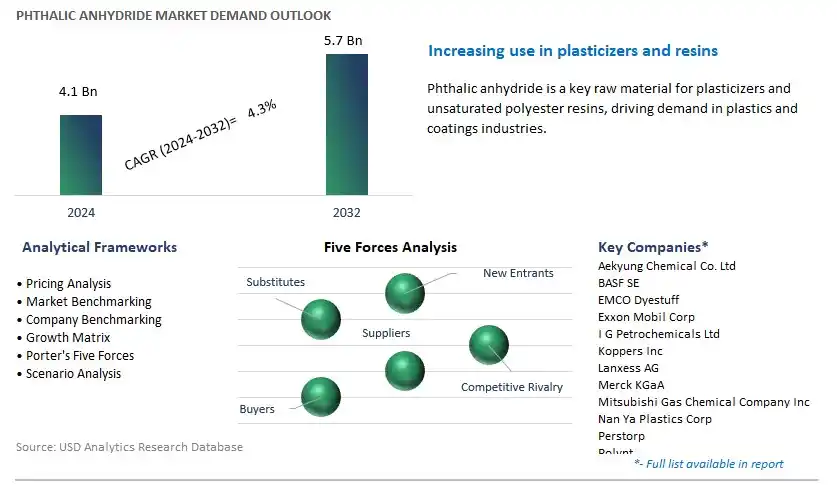
Global Phthalic Anhydride Market Size is valued at $4.1 Billion in 2024 and is forecast to register a growth rate (CAGR) of 4.3% to reach $5.7 Billion by 2032.
The global Phthalic Anhydride Market Study analyzes and forecasts the market size across 6 regions and 24 countries for diverse segments -By Application (Plasticizers, Alkyd Resins, Unsaturated Polyester Resins, Others), By End-User (Automotive, Electrical and Electronics, Paints and Coatings, Plastics, Others).
An Introduction to Phthalic Anhydride Market in 2024
Phthalic anhydride is an organic compound used primarily as a chemical intermediate in the production of plasticizers, polyester resins, and dyes, as well as in various applications such as coatings, lubricants, and pharmaceuticals. In 2024, the market for phthalic anhydride remains significant as industries rely on its versatile properties and functionalities. Phthalic anhydride is produced through the oxidation of ortho-xylene or naphthalene, yielding a white crystalline solid that is then used in the synthesis of phthalate esters, which serve as plasticizers in polyvinyl chloride (PVC) products such as cables, pipes, and flooring. It is also employed as a precursor in the production of unsaturated polyester resins used in fiberglass-reinforced plastics, automotive parts, and construction materials. In addition, phthalic anhydride finds applications in the manufacture of alkyd resins for coatings, as a curing agent for epoxy resins, and as a precursor for agricultural chemicals and pharmaceuticals. The demand for phthalic anhydride is driven by factors such as the growth of end-use industries such as construction, automotive, and consumer goods, increasing demand for high-performance materials and specialty chemicals, and the expansion of manufacturing activities in emerging markets. Market trends include the development of bio-based and eco-friendly production methods for phthalic anhydride, the optimization of process technologies for improved efficiency and environmental sustainability, and the exploration of new applications such as renewable energy and advanced materials.
Phthalic Anhydride Market Competitive Landscape
The market report analyses the leading companies in the industry including Aekyung Chemical Co. Ltd, BASF SE, EMCO Dyestuff, Exxon Mobil Corp, I G Petrochemicals Ltd, Koppers Inc, Lanxess AG, Merck KGaA, Mitsubishi Gas Chemical Company Inc, Nan Ya Plastics Corp, Perstorp, Polynt, Stepan Company, Thirumalai Chemicals Ltd, and others.
Phthalic Anhydride Market Dynamics
Market Trend: Shift Towards Bio-Based and Sustainable Production Methods
A prominent market trend in phthalic anhydride is the industry's shift towards bio-based and sustainable production methods. With increasing environmental concerns and regulatory pressure on conventional petrochemical processes, there is a growing interest in developing alternative routes for phthalic anhydride production that utilize renewable feedstocks and employ greener chemistry. Bio-based routes, such as oxidation of renewable precursors like naphthalene derived from biomass sources, offer potential advantages in terms of reduced carbon footprint, resource conservation, and decreased dependency on fossil fuels. This trend reflects the industry's commitment to sustainability and the adoption of eco-friendly practices in chemical manufacturing, driving innovation and market growth in bio-based phthalic anhydride production.
Market Driver: Growing Demand from End-Use Industries
A key driver for the phthalic anhydride market is the growing demand from end-use industries such as plastics, paints and coatings, and automotive. Phthalic anhydride is a versatile chemical intermediate used in the production of phthalate plasticizers, unsaturated polyester resins, alkyd resins, and dyes, among other applications. These products find extensive use in manufacturing PVC products, architectural coatings, automotive coatings, and consumer goods. As sectors like construction, automotive, and consumer goods continue to expand globally, there is an increasing need for phthalic anhydride to meet the demand for these downstream products. The robust growth in end-use industries drives the demand for phthalic anhydride, supporting market growth and development.
Market Opportunity: Development of Specialty Phthalic Anhydride Derivatives
A significant market opportunity for phthalic anhydride lies in the development of specialty derivatives tailored to meet specific industry requirements and emerging market trends. Manufacturers have the opportunity to innovate and produce phthalic anhydride derivatives with enhanced properties, such as improved thermal stability, color fastness, and compatibility with specific formulations and processes. Specialty derivatives may include modified phthalate plasticizers, high-performance resins for specialty coatings, and specialty intermediates for pharmaceuticals and agrochemicals. By leveraging the opportunity presented by specialty phthalic anhydride derivatives, suppliers can differentiate their product offerings, enter new market segments, and provide customized solutions for customers seeking advanced chemical solutions, presenting a compelling opportunity for market expansion and diversification.
Phthalic Anhydride Market Share Analysis: Plasticizers segment generated the highest revenue in 2024
Within the Phthalic Anhydride market, the Plasticizers segment is the largest. Plasticizers are chemicals added to polymers to improve flexibility, durability, and other mechanical properties, making them indispensable in various industries such as construction, automotive, and consumer goods. Phthalic anhydride is a primary raw material used in the production of plasticizers, particularly dioctyl phthalate (DOP) and diisononyl phthalate (DINP), which are extensively used in PVC applications. The widespread use of PVC in the manufacturing of pipes, cables, flooring, and packaging materials fuels the demand for plasticizers derived from phthalic anhydride. Moreover, the construction boom, urbanization trends, and increasing disposable incomes in emerging economies drive the demand for PVC-based products, further bolstering the demand for phthalic anhydride in the plasticizers segment. Additionally, stringent regulations regarding the use of phthalates in consumer products and the growing awareness of environmental and health concerns are driving innovations in phthalate-free plasticizers, which utilize alternatives to phthalic anhydride. However, despite these challenges, the Plasticizers segment remains the largest in the Phthalic Anhydride market, owing to its extensive application scope and indispensable role in various industries.
Phthalic Anhydride Market Share Analysis: Electrical and Electronics is poised to register the fastest CAGR over the forecast period
Among the end-user segments in the Phthalic Anhydride market, the Electrical and Electronics sector is the fastest-growing. The increasing demand for electronic devices and appliances, driven by technological advancements, rising disposable incomes, and changing consumer lifestyles, fuels the growth of this segment. Phthalic anhydride finds extensive application in the production of various electronic components, such as cables, wires, circuit boards, and insulation materials, due to its properties as a plasticizer and a precursor in polymer synthesis. Moreover, the expanding automotive electronics sector, driven by the adoption of electric vehicles (EVs), autonomous driving technologies, and in-car connectivity systems, further boosts the demand for phthalic anhydride-based materials in the Electrical and Electronics industry. Additionally, the ongoing digitalization of industries, smart home trends, and the proliferation of electronic gadgets contribute to the robust growth of this segment. As the world increasingly relies on electronic devices for communication, entertainment, and productivity, the demand for phthalic anhydride in the Electrical and Electronics sector is expected to continue surging, making it the fastest-growing segment in the Phthalic Anhydride market.
Phthalic Anhydride Market
By Application
Plasticizers
Alkyd Resins
Unsaturated Polyester Resins
Others
By End-User
Automotive
Electrical and Electronics
Paints and Coatings
Plastics
Others
Countries Analyzed
North America (US, Canada, Mexico)
Europe (Germany, UK, France, Spain, Italy, Russia, Rest of Europe)
Asia Pacific (China, India, Japan, South Korea, Australia, South East Asia, Rest of Asia)
South America (Brazil, Argentina, Rest of South America)
Middle East and Africa (Saudi Arabia, UAE, Rest of Middle East, South Africa, Egypt, Rest of Africa)
Phthalic Anhydride Companies Profiled in the Study
Aekyung Chemical Co. Ltd
BASF SE
EMCO Dyestuff
Exxon Mobil Corp
I G Petrochemicals Ltd
Koppers Inc
Lanxess AG
Merck KGaA
Mitsubishi Gas Chemical Company Inc
Nan Ya Plastics Corp
Perstorp
Polynt
Stepan Company
Thirumalai Chemicals Ltd
*- List Not Exhaustive
TABLE OF CONTENTS
1 Introduction to 2024 Phthalic Anhydride Market
1.1 Market Overview
1.2 Quick Facts
1.3 Scope/Objective of the Study
1.4 Market Definition
1.5 Countries and Regions Covered
1.6 Units, Currency, and Conversions
1.7 Industry Value Chain
2 Research Methodology
2.1 Market Size Estimation
2.2 Sources and Research Methodology
2.3 Data Triangulation
2.4 Assumptions and Limitations
3 Executive Summary
3.1 Global Phthalic Anhydride Market Size Outlook, $ Million, 2021 to 2032
3.2 Phthalic Anhydride Market Outlook by Type, $ Million, 2021 to 2032
3.3 Phthalic Anhydride Market Outlook by Product, $ Million, 2021 to 2032
3.4 Phthalic Anhydride Market Outlook by Application, $ Million, 2021 to 2032
3.5 Phthalic Anhydride Market Outlook by Key Countries, $ Million, 2021 to 2032
4 Market Dynamics
4.1 Key Driving Forces of Phthalic Anhydride Industry
4.2 Key Market Trends in Phthalic Anhydride Industry
4.3 Potential Opportunities in Phthalic Anhydride Industry
4.4 Key Challenges in Phthalic Anhydride Industry
5 Market Factor Analysis
5.1 Value Chain Analysis
5.2 Competitive Landscape
5.2.1 Global Phthalic Anhydride Market Share by Company (%), 2023
5.2.2 Product Offerings by Company
5.3 Porter’s Five Forces Analysis
5.4 Pricing Analysis and Outlook
6 Growth Outlook Across Scenarios
6.1 Growth Analysis-Case Scenario Definitions
6.2 Low Growth Scenario Forecasts
6.3 Reference Growth Scenario Forecasts
6.4 High Growth Scenario Forecasts
7 Global Phthalic Anhydride Market Outlook by Segments
7.1 Phthalic Anhydride Market Outlook by Segments, $ Million, 2021- 2032
By Application
Plasticizers
Alkyd Resins
Unsaturated Polyester Resins
Others
By End-User
Automotive
Electrical and Electronics
Paints and Coatings
Plastics
Others
8 North America Phthalic Anhydride Market Analysis and Outlook To 2032
8.1 Introduction to North America Phthalic Anhydride Markets in 2024
8.2 North America Phthalic Anhydride Market Size Outlook by Country, 2021-2032
8.2.1 United States
8.2.2 Canada
8.2.3 Mexico
8.3 North America Phthalic Anhydride Market size Outlook by Segments, 2021-2032
By Application
Plasticizers
Alkyd Resins
Unsaturated Polyester Resins
Others
By End-User
Automotive
Electrical and Electronics
Paints and Coatings
Plastics
Others
9 Europe Phthalic Anhydride Market Analysis and Outlook To 2032
9.1 Introduction to Europe Phthalic Anhydride Markets in 2024
9.2 Europe Phthalic Anhydride Market Size Outlook by Country, 2021-2032
9.2.1 Germany
9.2.2 France
9.2.3 Spain
9.2.4 United Kingdom
9.2.4 Italy
9.2.5 Russia
9.2.6 Norway
9.2.7 Rest of Europe
9.3 Europe Phthalic Anhydride Market Size Outlook by Segments, 2021-2032
By Application
Plasticizers
Alkyd Resins
Unsaturated Polyester Resins
Others
By End-User
Automotive
Electrical and Electronics
Paints and Coatings
Plastics
Others
10 Asia Pacific Phthalic Anhydride Market Analysis and Outlook To 2032
10.1 Introduction to Asia Pacific Phthalic Anhydride Markets in 2024
10.2 Asia Pacific Phthalic Anhydride Market Size Outlook by Country, 2021-2032
10.2.1 China
10.2.2 India
10.2.3 Japan
10.2.4 South Korea
10.2.5 Indonesia
10.2.6 Malaysia
10.2.7 Australia
10.2.8 Rest of Asia Pacific
10.3 Asia Pacific Phthalic Anhydride Market size Outlook by Segments, 2021-2032
By Application
Plasticizers
Alkyd Resins
Unsaturated Polyester Resins
Others
By End-User
Automotive
Electrical and Electronics
Paints and Coatings
Plastics
Others
11 South America Phthalic Anhydride Market Analysis and Outlook To 2032
11.1 Introduction to South America Phthalic Anhydride Markets in 2024
11.2 South America Phthalic Anhydride Market Size Outlook by Country, 2021-2032
11.2.1 Brazil
11.2.2 Argentina
11.2.3 Rest of South America
11.3 South America Phthalic Anhydride Market size Outlook by Segments, 2021-2032
By Application
Plasticizers
Alkyd Resins
Unsaturated Polyester Resins
Others
By End-User
Automotive
Electrical and Electronics
Paints and Coatings
Plastics
Others
12 Middle East and Africa Phthalic Anhydride Market Analysis and Outlook To 2032
12.1 Introduction to Middle East and Africa Phthalic Anhydride Markets in 2024
12.2 Middle East and Africa Phthalic Anhydride Market Size Outlook by Country, 2021-2032
12.2.1 Saudi Arabia
12.2.2 UAE
12.2.3 Oman
12.2.4 Rest of Middle East
12.2.5 Egypt
12.2.6 Nigeria
12.2.7 South Africa
12.2.8 Rest of Africa
12.3 Middle East and Africa Phthalic Anhydride Market size Outlook by Segments, 2021-2032
By Application
Plasticizers
Alkyd Resins
Unsaturated Polyester Resins
Others
By End-User
Automotive
Electrical and Electronics
Paints and Coatings
Plastics
Others
13 Company Profiles
13.1 Company Snapshot
13.2 SWOT Profiles
13.3 Products and Services
13.4 Recent Developments
13.5 Financial Profile
Aekyung Chemical Co. Ltd
BASF SE
EMCO Dyestuff
Exxon Mobil Corp
I G Petrochemicals Ltd
Koppers Inc
Lanxess AG
Merck KGaA
Mitsubishi Gas Chemical Company Inc
Nan Ya Plastics Corp
Perstorp
Polynt
Stepan Company
Thirumalai Chemicals Ltd
14 Appendix
14.1 Customization Offerings
14.2 Subscription Services
14.3 Related Reports
14.4 Publisher Expertise
By Application
Plasticizers
Alkyd Resins
Unsaturated Polyester Resins
Others
By End-User
Automotive
Electrical and Electronics
Paints and Coatings
Plastics
Others
Countries Analyzed
North America (US, Canada, Mexico)
Europe (Germany, UK, France, Spain, Italy, Russia, Rest of Europe)
Asia Pacific (China, India, Japan, South Korea, Australia, South East Asia, Rest of Asia)
South America (Brazil, Argentina, Rest of South America)
Middle East and Africa (Saudi Arabia, UAE, Rest of Middle East, South Africa, Egypt, Rest of Africa)
