Plant Protein Market is estimated to increase at a growth rate of 6.9% CAGR over the forecast period from 2024 to 2030.
The Plant Protein Market Study forecasts the market size across 6 regions and 24 countries for diverse segments including-Type (Soy Protein, Pea Protein, Tofu Protein, Lentils Protein, Wheat Protein, Others), Application (Nutritional Supplements, Animal Feed, Beverages, Snacks, Pharmaceuticals, Personal Care, Others), Form (Protein Isolates, Textured Proteins, Protein Concentrates), Distribution Channel (Supermarkets and Hypermarkets, Convenience Stores, Online, Others).
An Introduction to Plant Protein Market, 2024
Plant Protein: The market for plant protein is driven by the increasing popularity of vegetarian, vegan, and flexitarian diets, along with the demand for sustainable protein sources. Drivers include the adoption of plant-based protein sources like pea, soy, hemp, or quinoa to meet the protein requirements of consumers seeking meat alternatives or protein supplements. The growth of the plant protein market is influenced by the shift towards environmentally friendly and ethically sourced protein options.
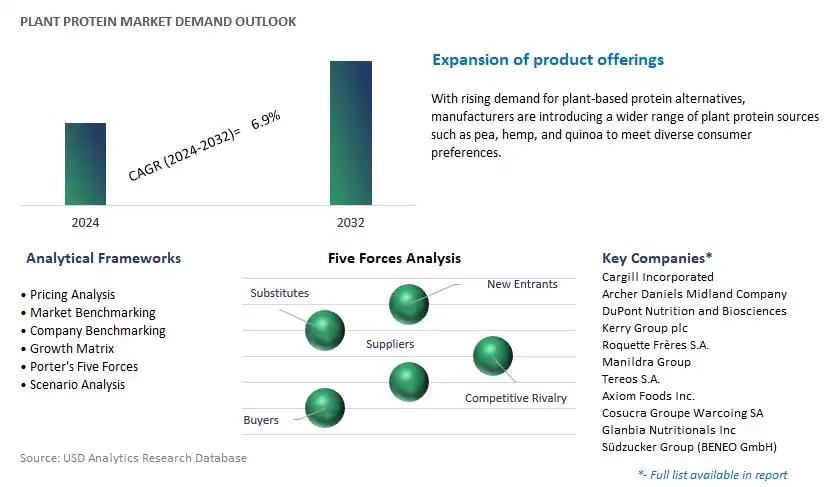
Plant Protein Market Trend: Surge in Demand for Plant-Based Diets and Alternatives
The plant protein market is witnessing a prominent trend driven by the surge in demand for plant-based diets and alternatives. As consumers increasingly prioritize health, sustainability, and ethical considerations, there is a growing shift away from animal-derived proteins. Plant protein, derived from sources like peas, soy, and hemp, is gaining popularity as a viable and sustainable alternative. This trend is evident in the expanding range of plant-based products in the market, from plant protein powders to meat substitutes, reflecting a fundamental change in dietary preferences and lifestyle choices.
Plant Protein Market Driver: Health and Environmental Consciousness Among Consumers
A key driver for the plant protein market is the heightened consciousness among consumers regarding health and the environment. With concerns about climate change and the environmental impact of animal agriculture, individuals are opting for plant-based proteins as a more sustainable and eco-friendly choice. Additionally, plant proteins are often perceived as healthier alternatives, as they are generally lower in saturated fats and can offer various health benefits. This dual focus on personal well-being and environmental responsibility is propelling the demand for plant protein products, driving innovation in the food industry to meet these evolving consumer preferences.
Opportunity: Innovation in Plant Protein-Based Functional FoodsAn exciting opportunity within the plant protein market lies in the innovation of plant protein-based functional foods. Beyond traditional protein supplements and meat alternatives, there is potential to develop a diverse range of functional foods incorporating plant proteins. This includes snacks, beverages, and other convenience foods that not only provide essential amino acids but also offer additional health benefits. The market can explore collaborations with food scientists and nutrition experts to create appealing and nutritious plant protein formulations, addressing the demand for convenient, tasty, and health-promoting products within the broader plant-based food industry.
Plant Protein Market Segmentation
Type
Soy Protein
Pea Protein
Tofu Protein
Lentils Protein
Wheat Protein
Others
Application
Nutritional Supplements
Animal Feed
Beverages
Snacks
Pharmaceuticals
Personal Care
Others
Form
Protein Isolates
Textured Proteins
Protein Concentrates
Distribution Channels
Supermarkets and Hypermarkets
Convenience Stores
Online
Others
Geographical Segmentation
• North America (US, Canada, Mexico)
• Europe (Germany, UK, France, Spain, Italy, Russia, Rest of Europe)
• Asia Pacific (China, India, Japan, South Korea, South East Asia, Rest of Asia Pacific)
• South America (Brazil, Argentina, Rest of South America)
• Middle East and Africa (Saudi Arabia, UAE, Rest of Middle East, Egypt, South Africa, Nigeria, Rest of Africa)
Plant Protein Companies Profiled in the Study-
Cargill Incorporated
Archer Daniels Midland Company
DuPont Nutrition and Biosciences
Kerry Group plc
Roquette Frères S.A.
Manildra Group
Tereos S.A.
Axiom Foods, Inc.
Cosucra Groupe Warcoing SA
Glanbia Nutritionals Inc
Südzucker Group (BENEO GmbH)
Reasons to Buy the Plant Protein Market Study
• Deepen your industry insights and navigate uncertainties for strategy formulation, CAPEX, and Operational decisions
• Gain access to detailed insights on the Plant Protein Market, encompassing current market size, growth trends, and forecasts till 2030.
• Access detailed competitor analysis, enabling competitive advantage through a thorough understanding of market players, strategies, and potential differentiation opportunities
• Stay ahead of the curve with insights on technological advancements, innovations, and upcoming trends
• Identify lucrative investment avenues and expansion opportunities within the Plant Protein Market industry, guided by robust, data-backed analysis.
• Understand regional and global markets through country-wise analysis, regional market potential, regulatory nuances, and dynamics
• Execute strategies with confidence and speed through information, analytics, and insights on the industry value chain
• Corporate leaders, strategists, financial experts, shareholders, asset managers, and governmental representatives can make long-term planning scenarios and build an integrated and timely understanding of market dynamics
• Benefit from tailored solutions and expert consultation based on report insights, providing personalized strategies aligned with specific business needs.
TABLE OF CONTENTS
1 Introduction To 2024 Plant Protein Markets
1.1 Market Overview
1.2 Quick Facts
1.3 Scope/Objective of the Study
1.4 Market Definition
1.5 Countries and Regions Included
1.6 Units, Currency, and Conversions
1.7 Industry Value Chain
2 Research Methodology
2.1 Market Size Estimation
2.2 Sources and Research Methodology
2.3 Data Triangulation
2.4 Assumptions and Limitations
3 Executive Summary
3.1 Global Plant Protein Market Size Outlook, $ Million, 2021 to 2030
3.2 Plant Protein Market Outlook by Type, $ Million, 2021 to 2030
3.3 Plant Protein Market Outlook by Product, $ Million, 2021 to 2030
3.4 Plant Protein Market Outlook by Application, $ Million, 2021 to 2030
3.5 Plant Protein Market Outlook by Key Countries, $ Million, 2021 to 2030
4 Market Dynamics
4.1 Key Driving Forces of Plant Protein Industry
4.2 Key Market Trends in Plant Protein Industry
4.3 Potential Opportunities in Plant Protein Industry
4.4 Key Challenges in Plant Protein Industry
5 Market Factor Analysis
5.1 Competitive Landscape
5.1.1 Global Plant Protein Market Share by Company
5.1.2 Product Offerings by Company
5.2 Porter’s Five Forces Analysis
6 Growth Outlook Across Scenarios
6.1 Growth Analysis-Case Scenario Definitions
6.2 Low Growth Scenario Forecasts
6.3 Reference Growth Scenario Forecasts
6.4 High Growth Scenario Forecasts
7 Global Plant Protein Market Outlook by Segments
7.1 Plant Protein Market Outlook by Segments
Type
Soy Protein
Pea Protein
Tofu Protein
Lentils Protein
Wheat Protein
Others
Application
Nutritional Supplements
Animal Feed
Beverages
Snacks
Pharmaceuticals
Personal Care
Others
Form
Protein Isolates
Textured Proteins
Protein Concentrates
Distribution Channels
Supermarkets and Hypermarkets
Convenience Stores
Online
Others
8 North America Plant Protein Market Analysis and Outlook To 2030
8.1 Introduction to North America Plant Protein Markets in 2024
8.2 North America Plant Protein Market Size Outlook by Country, 2021-2030
8.2.1 United States
8.2.2 Canada
8.2.3 Mexico
8.3 North America Plant Protein Market size Outlook by Segments, 2021-2030
Type
Soy Protein
Pea Protein
Tofu Protein
Lentils Protein
Wheat Protein
Others
Application
Nutritional Supplements
Animal Feed
Beverages
Snacks
Pharmaceuticals
Personal Care
Others
Form
Protein Isolates
Textured Proteins
Protein Concentrates
Distribution Channels
Supermarkets and Hypermarkets
Convenience Stores
Online
Others
9 Europe Plant Protein Market Analysis and Outlook To 2030
9.1 Introduction to Europe Plant Protein Markets in 2024
9.2 Europe Plant Protein Market Size Outlook by Country, 2021-2030
9.2.1 Germany
9.2.2 France
9.2.3 Spain
9.2.4 United Kingdom
9.2.4 Italy
9.2.5 Russia
9.2.6 Norway
9.2.7 Rest of Europe
9.3 Europe Plant Protein Market size Outlook by Segments, 2021-2030
Type
Soy Protein
Pea Protein
Tofu Protein
Lentils Protein
Wheat Protein
Others
Application
Nutritional Supplements
Animal Feed
Beverages
Snacks
Pharmaceuticals
Personal Care
Others
Form
Protein Isolates
Textured Proteins
Protein Concentrates
Distribution Channels
Supermarkets and Hypermarkets
Convenience Stores
Online
Others
10 Asia Pacific Plant Protein Market Analysis and Outlook To 2030
10.1 Introduction to Asia Pacific Plant Protein Markets in 2024
10.2 Asia Pacific Plant Protein Market Size Outlook by Country, 2021-2030
10.2.1 China
10.2.2 India
10.2.3 Japan
10.2.4 South Korea
10.2.5 Indonesia
10.2.6 Malaysia
10.2.7 Australia
10.2.8 Rest of Asia Pacific
10.3 Asia Pacific Plant Protein Market size Outlook by Segments, 2021-2030
Type
Soy Protein
Pea Protein
Tofu Protein
Lentils Protein
Wheat Protein
Others
Application
Nutritional Supplements
Animal Feed
Beverages
Snacks
Pharmaceuticals
Personal Care
Others
Form
Protein Isolates
Textured Proteins
Protein Concentrates
Distribution Channels
Supermarkets and Hypermarkets
Convenience Stores
Online
Others
11 South America Plant Protein Market Analysis and Outlook To 2030
11.1 Introduction to South America Plant Protein Markets in 2024
11.2 South America Plant Protein Market Size Outlook by Country, 2021-2030
11.2.1 Brazil
11.2.2 Argentina
11.2.3 Rest of South America
11.3 South America Plant Protein Market size Outlook by Segments, 2021-2030
Type
Soy Protein
Pea Protein
Tofu Protein
Lentils Protein
Wheat Protein
Others
Application
Nutritional Supplements
Animal Feed
Beverages
Snacks
Pharmaceuticals
Personal Care
Others
Form
Protein Isolates
Textured Proteins
Protein Concentrates
Distribution Channels
Supermarkets and Hypermarkets
Convenience Stores
Online
Others
12 Middle East and Africa Plant Protein Market Analysis and Outlook To 2030
12.1 Introduction to Middle East and Africa Plant Protein Markets in 2024
12.2 Middle East and Africa Plant Protein Market Size Outlook by Country, 2021-2030
12.2.1 Saudi Arabia
12.2.2 UAE
12.2.3 Oman
12.2.4 Rest of Middle East
12.2.5 Egypt
12.2.6 Nigeria
12.2.7 South Africa
12.2.8 Rest of Africa
12.3 Middle East and Africa Plant Protein Market size Outlook by Segments, 2021-2030
Type
Soy Protein
Pea Protein
Tofu Protein
Lentils Protein
Wheat Protein
Others
Application
Nutritional Supplements
Animal Feed
Beverages
Snacks
Pharmaceuticals
Personal Care
Others
Form
Protein Isolates
Textured Proteins
Protein Concentrates
Distribution Channels
Supermarkets and Hypermarkets
Convenience Stores
Online
Others
List of Companies
Cargill Incorporated
Archer Daniels Midland Company
DuPont Nutrition and Biosciences
Kerry Group plc
Roquette Frères S.A.
Manildra Group
Tereos S.A.
Axiom Foods, Inc.
Cosucra Groupe Warcoing SA
Glanbia Nutritionals Inc
Südzucker Group (BENEO GmbH)
13 Company Profiles
13.1 Company Snapshot
13.2 SWOT Profiles
13.3 Products and Services
13.4 Recent Developments
13.5 Financial Profile
14 Appendix
14.1 Customization Offerings
14.2 Subscription Services
14.3 Related Reports
14.4 Publisher Expertise
Type/brSoy Protein/brPea Protein /brTofu Protein /brLentils Protein /brWheat Protein /brOthers /br/brApplication/brNutritional Supplements /brAnimal Feed /brBeverages /brSnacks /brPharmaceuticals /brPersonal Care /brOthers /br/brForm/brProtein Isolates /brTextured Proteins /brProtein Concentrates /br/brDistribution Channels /brSupermarkets and Hypermarkets /brConvenience Stores /brOnline/brOthers
