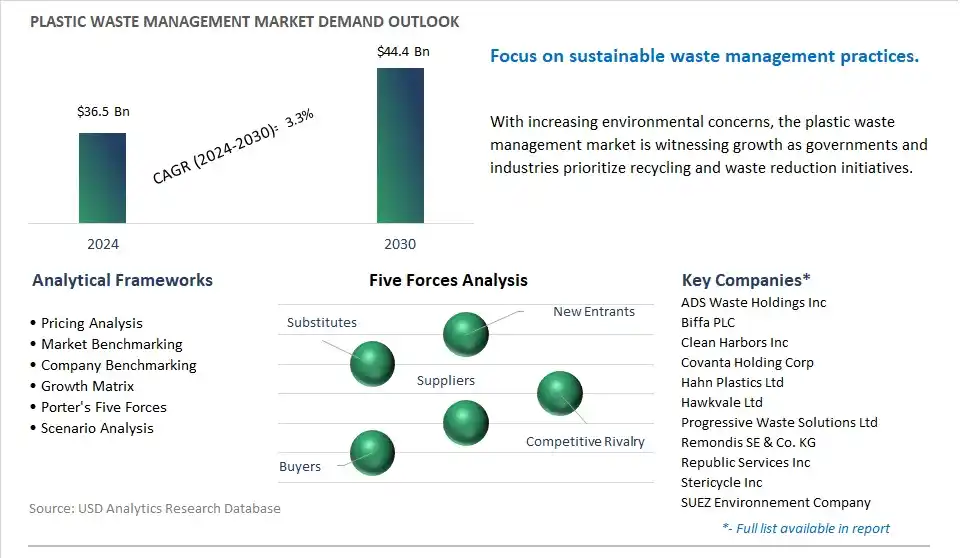
The global Plastic Waste Management Market is poised to register a 3.3% CAGR from $36.5 Billion in 2024 to $44.4 Billion in 2030.
The global Plastic Waste Management Market Study analyzes and forecasts the market size across 6 regions and 24 countries for diverse segments -By Service (Collection, Recycling, Incineration, Landfills), By Polymer (Polypropylene (PP), Low-density polyethylene (LDPE), High-density polyethylene (HDPE), Polyvinyl chloride (PVC), Polyurethane (PUR), Terephthalate (PET), Others), By Source (Residential, Commercial, Industrial), By End-User (Packaging, Textile, Consumer Product, Transportation, Building & Construction, Electrical & Electronics, Others).
An Introduction to Global Plastic Waste Management Market in 2024
The key trend shaping the future of the plastic waste management industry is the increasing focus on circular economy principles, sustainability, and environmental stewardship to address the global challenge of plastic pollution and waste. Plastic waste management involves the collection, sorting, recycling, and disposal of plastic materials to minimize environmental impact, conserve resources, and promote responsible consumption and production practices. With growing public awareness, regulatory pressures, and corporate commitments to reduce plastic waste, there is a rising need for comprehensive waste management solutions that integrate waste prevention, recycling, and recovery strategies across the plastics value chain. Stakeholders are investing in the development of innovative technologies and infrastructure for plastic waste collection, sorting, and recycling, including advanced sorting technologies, mechanical and chemical recycling processes, and waste-to-energy conversion systems to maximize resource recovery and minimize landfilling. Additionally, there is a trend towards the implementation of extended producer responsibility (EPR) schemes, deposit-return systems, and plastic waste reduction targets by governments, industries, and communities to incentivize waste reduction, promote recycling, and shift towards a more sustainable and circular plastics economy. Furthermore, with increasing emphasis on plastic pollution prevention and ocean conservation, there is a growing interest in solutions such as biodegradable plastics, compostable packaging, and marine litter cleanup initiatives to mitigate the environmental impact of plastic waste on ecosystems and marine life. As stakeholders collaborate to address the complex challenges of plastic waste management through innovation, policy intervention, and public engagement, the demand for effective and sustainable solutions to manage plastic waste is expected to grow, driving market expansion and technological advancement in the waste management and recycling sectors.
Plastic Waste Management Market Competitive Landscape
The market report analyses the leading companies in the industry including ADS Waste Holdings Inc, Biffa PLC, Clean Harbors Inc, Covanta Holding Corp, Hahn Plastics Ltd, Hawkvale Ltd, Progressive Waste Solutions Ltd, Remondis SE & Co. KG, Republic Services Inc, Stericycle Inc, SUEZ Environnement Company, United Plastic Recycling Inc, Veolia Environnement S.A., Waste Connections Inc, Waste Management Inc, .
Plastic Waste Management Market Dynamics
Plastic Waste Management Market Trend: Shift Towards Circular Economy Models
A prominent trend in the plastic waste management market is the global shift towards circular economy models, emphasizing resource efficiency, waste reduction, and material recycling. With increasing awareness of environmental issues related to plastic pollution and mounting regulatory pressure to address waste management challenges, governments, businesses, and consumers are increasingly embracing circular economy principles. The trend involves redesigning products, materials, and processes to minimize waste generation, promote reuse and recycling, and maximize resource recovery. In the context of plastic waste management, initiatives such as extended producer responsibility (EPR), plastic waste collection and segregation programs, and investments in recycling infrastructure are gaining traction as stakeholders seek to create closed-loop systems where plastics are recycled, remanufactured, and reintegrated into the production cycle, driving market growth and innovation in sustainable waste management solutions.
Plastic Waste Management Market Driver: Regulatory Initiatives and Environmental Policies
The primary driver fueling the plastic waste management market is the implementation of regulatory initiatives and environmental policies aimed at addressing plastic pollution, promoting recycling, and reducing landfilling. Governments around the world are enacting legislation, imposing taxes, and introducing regulatory frameworks to tackle the growing problem of plastic waste and marine litter. These measures include bans on single-use plastics, mandates for recycled content in products, landfill levies, and extended producer responsibility schemes, among others. Additionally, international agreements such as the Basel Convention and the Paris Agreement are setting targets and guidelines for waste management and pollution reduction, driving policy action at the national and regional levels. The stringent regulatory environment and increasing public awareness of environmental issues are compelling industries, municipalities, and waste management companies to invest in advanced technologies and infrastructure for plastic waste collection, sorting, recycling, and disposal, thereby stimulating market demand and driving industry growth.
Plastic Waste Management Market Opportunity: Innovation in Advanced Recycling Technologies
An opportunity for players in the plastic waste management market lies in the innovation and adoption of advanced recycling technologies to address challenges associated with traditional mechanical and chemical recycling methods. Advanced recycling technologies, such as pyrolysis, depolymerization, gasification, and chemical conversion, offer alternative pathways for converting mixed, contaminated, or difficult-to-recycle plastics into valuable feedstocks, chemicals, fuels, and materials. These technologies enable the recovery of high-quality polymers from complex plastic waste streams, including multi-layer packaging, mixed plastics, and contaminated materials, which are not easily recyclable through conventional methods. By investing in research and development, pilot projects, and commercial-scale deployments of advanced recycling facilities, stakeholders in the plastic waste management ecosystem can unlock new opportunities for diverting plastics from landfills, reducing greenhouse gas emissions, and creating value from waste streams. Collaboration between technology developers, waste management companies, policymakers, and investors is essential to drive innovation, scale up deployment, and capitalize on the potential of advanced recycling solutions to transform the plastic waste management landscape.
Plastic Waste Management Market Share Analysis: Recycling generated the highest revenue in 2024
Recycling is the largest segment in the Plastic Waste Management Market. Recycling plays a pivotal role in the sustainable management of plastic waste by diverting it from landfills and incineration facilities, thereby reducing environmental pollution and conserving valuable resources. Plastic recycling involves the collection, sorting, processing, and reprocessing of discarded plastic materials into new products or raw materials. The growing global awareness of environmental issues, coupled with stringent regulations and sustainability initiatives, drives the demand for plastic recycling services. Further, advancements in recycling technologies and processes improve efficiency, increase the range of recyclable plastics, and enhance the quality of recycled materials, further bolstering the growth of the recycling segment. Additionally, the rising consumer preference for eco-friendly products and packaging drives demand for recycled plastics among manufacturers, further stimulating the recycling market. Furthermore, collaborations between governments, industries, and non-profit organizations to promote recycling infrastructure development and awareness campaigns contribute to the expansion of the recycling segment in the Plastic Waste Management Market. As the world increasingly focuses on circular economy principles and sustainable waste management practices, the recycling segment is poised for continued growth and dominance in the market.
Plastic Waste Management Market Share Analysis: Polyethylene Terephthalate (PET) segment is poised to register the fastest growth rate (CAGR) over the forecast period to 2030
Polyethylene Terephthalate (PET) is the fastest-growing segment in the Plastic Waste Management Market. PET is widely used in the packaging industry for beverages, food, personal care products, and pharmaceuticals due to its lightweight, transparent, and recyclable properties. The increasing consumption of packaged goods, particularly in emerging economies, drives the demand for PET packaging, resulting in higher volumes of PET waste generated. Further, PET recycling has gained momentum globally due to its economic and environmental benefits. Recycled PET, known as rPET, is in high demand for the production of new PET packaging, textiles, and other products. The circular economy approach, coupled with regulatory initiatives and corporate sustainability commitments, further boosts the recycling of PET plastics. Additionally, technological advancements in PET recycling processes, such as bottle-to-bottle recycling and chemical recycling, improve efficiency and quality, driving the growth of PET recycling rates. Furthermore, consumer awareness campaigns promoting the importance of recycling and the environmental impact of PET waste contribute to the rising demand for PET waste management solutions. As the push for sustainable packaging and waste reduction intensifies, PET is expected to continue its rapid growth trajectory in the Plastic Waste Management Market.
Plastic Waste Management Market Share Analysis: Commercial segment is poised to register the fastest growth rate (CAGR) over the forecast period to 2030
Commercial is the fastest-growing segment in the Plastic Waste Management Market. Commercial establishments, including retail stores, restaurants, hotels, offices, and shopping malls, generate substantial volumes of plastic waste from packaging, disposable products, and operational activities. The proliferation of single-use plastics in the commercial sector, coupled with the increasing consumer demand for convenience and on-the-go products, contributes to the escalating generation of plastic waste. Further, stringent regulations and corporate sustainability initiatives compel businesses to adopt effective waste management practices, including recycling and waste reduction strategies, to minimize their environmental footprint and comply with regulations. Additionally, the growing awareness among businesses and consumers about the detrimental effects of plastic pollution on the environment and public health accelerates the adoption of sustainable waste management solutions in the commercial sector. Furthermore, technological advancements in waste sorting, recycling, and disposal technologies cater to the specific needs of commercial waste streams, further driving the growth of the commercial segment in the Plastic Waste Management Market. As businesses increasingly prioritize sustainability and waste reduction, the demand for commercial plastic waste management services is expected to continue surging, positioning it as the fastest-growing segment in the market.
Plastic Waste Management Market Report Segmentation
By Service
Collection
Recycling
Incineration
Landfills
By Polymer
Polypropylene (PP)
Low-density polyethylene (LDPE)
High-density polyethylene (HDPE)
Polyvinyl chloride (PVC)
Polyurethane (PUR)
Terephthalate (PET)
Others
By Source
Residential
Commercial
Industrial
By End-User
Packaging
Textile
Consumer Product
Transportation
Building & Construction
Electrical & Electronics
Others
Regions Included
North America (US, Canada, Mexico)
Europe (Germany, UK, France, Spain, Italy, Russia, Rest of Europe)
Asia Pacific (China, India, Japan, South Korea, Australia, South East Asia, Rest of Asia)
South America (Brazil, Argentina, Rest of South America)
Middle East and Africa (Saudi Arabia, UAE, Rest of Middle East, South Africa, Egypt, Rest of Africa)
Plastic Waste Management Companies Profiled in the Market Study
ADS Waste Holdings Inc
Biffa PLC
Clean Harbors Inc
Covanta Holding Corp
Hahn Plastics Ltd
Hawkvale Ltd
Progressive Waste Solutions Ltd
Remondis SE & Co. KG
Republic Services Inc
Stericycle Inc
SUEZ Environnement Company
United Plastic Recycling Inc
Veolia Environnement S.A.
Waste Connections Inc
Waste Management Inc
*- List Not Exhaustive
TABLE OF CONTENTS
1 Introduction to 2024 Plastic Waste Management Market
1.1 Market Overview
1.2 Quick Facts
1.3 Scope/Objective of the Study
1.4 Market Definition
1.5 Countries and Regions Covered
1.6 Units, Currency, and Conversions
1.7 Industry Value Chain
2 Research Methodology
2.1 Market Size Estimation
2.2 Sources and Research Methodology
2.3 Data Triangulation
2.4 Assumptions and Limitations
3 Executive Summary
3.1 Global Plastic Waste Management Market Size Outlook, $ Million, 2021 to 2030
3.2 Plastic Waste Management Market Outlook by Type, $ Million, 2021 to 2030
3.3 Plastic Waste Management Market Outlook by Product, $ Million, 2021 to 2030
3.4 Plastic Waste Management Market Outlook by Application, $ Million, 2021 to 2030
3.5 Plastic Waste Management Market Outlook by Key Countries, $ Million, 2021 to 2030
4 Market Dynamics
4.1 Key Driving Forces of Plastic Waste Management Industry
4.2 Key Market Trends in Plastic Waste Management Industry
4.3 Potential Opportunities in Plastic Waste Management Industry
4.4 Key Challenges in Plastic Waste Management Industry
5 Market Factor Analysis
5.1 Value Chain Analysis
5.2 Competitive Landscape
5.2.1 Global Plastic Waste Management Market Share by Company (%), 2023
5.2.2 Product Offerings by Company
5.3 Porter’s Five Forces Analysis
5.4 Pricing Analysis and Outlook
6 Growth Outlook Across Scenarios
6.1 Growth Analysis-Case Scenario Definitions
6.2 Low Growth Scenario Forecasts
6.3 Reference Growth Scenario Forecasts
6.4 High Growth Scenario Forecasts
7 Global Plastic Waste Management Market Outlook by Segments
7.1 Plastic Waste Management Market Outlook by Segments, $ Million, 2021- 2030
By Service
Collection
Recycling
Incineration
Landfills
By Polymer
Polypropylene (PP)
Low-density polyethylene (LDPE)
High-density polyethylene (HDPE)
Polyvinyl chloride (PVC)
Polyurethane (PUR)
Terephthalate (PET)
Others
By Source
Residential
Commercial
Industrial
By End-User
Packaging
Textile
Consumer Product
Transportation
Building & Construction
Electrical & Electronics
Others
8 North America Plastic Waste Management Market Analysis and Outlook To 2030
8.1 Introduction to North America Plastic Waste Management Markets in 2024
8.2 North America Plastic Waste Management Market Size Outlook by Country, 2021-2030
8.2.1 United States
8.2.2 Canada
8.2.3 Mexico
8.3 North America Plastic Waste Management Market size Outlook by Segments, 2021-2030
By Service
Collection
Recycling
Incineration
Landfills
By Polymer
Polypropylene (PP)
Low-density polyethylene (LDPE)
High-density polyethylene (HDPE)
Polyvinyl chloride (PVC)
Polyurethane (PUR)
Terephthalate (PET)
Others
By Source
Residential
Commercial
Industrial
By End-User
Packaging
Textile
Consumer Product
Transportation
Building & Construction
Electrical & Electronics
Others
9 Europe Plastic Waste Management Market Analysis and Outlook To 2030
9.1 Introduction to Europe Plastic Waste Management Markets in 2024
9.2 Europe Plastic Waste Management Market Size Outlook by Country, 2021-2030
9.2.1 Germany
9.2.2 France
9.2.3 Spain
9.2.4 United Kingdom
9.2.4 Italy
9.2.5 Russia
9.2.6 Norway
9.2.7 Rest of Europe
9.3 Europe Plastic Waste Management Market Size Outlook by Segments, 2021-2030
By Service
Collection
Recycling
Incineration
Landfills
By Polymer
Polypropylene (PP)
Low-density polyethylene (LDPE)
High-density polyethylene (HDPE)
Polyvinyl chloride (PVC)
Polyurethane (PUR)
Terephthalate (PET)
Others
By Source
Residential
Commercial
Industrial
By End-User
Packaging
Textile
Consumer Product
Transportation
Building & Construction
Electrical & Electronics
Others
10 Asia Pacific Plastic Waste Management Market Analysis and Outlook To 2030
10.1 Introduction to Asia Pacific Plastic Waste Management Markets in 2024
10.2 Asia Pacific Plastic Waste Management Market Size Outlook by Country, 2021-2030
10.2.1 China
10.2.2 India
10.2.3 Japan
10.2.4 South Korea
10.2.5 Indonesia
10.2.6 Malaysia
10.2.7 Australia
10.2.8 Rest of Asia Pacific
10.3 Asia Pacific Plastic Waste Management Market size Outlook by Segments, 2021-2030
By Service
Collection
Recycling
Incineration
Landfills
By Polymer
Polypropylene (PP)
Low-density polyethylene (LDPE)
High-density polyethylene (HDPE)
Polyvinyl chloride (PVC)
Polyurethane (PUR)
Terephthalate (PET)
Others
By Source
Residential
Commercial
Industrial
By End-User
Packaging
Textile
Consumer Product
Transportation
Building & Construction
Electrical & Electronics
Others
11 South America Plastic Waste Management Market Analysis and Outlook To 2030
11.1 Introduction to South America Plastic Waste Management Markets in 2024
11.2 South America Plastic Waste Management Market Size Outlook by Country, 2021-2030
11.2.1 Brazil
11.2.2 Argentina
11.2.3 Rest of South America
11.3 South America Plastic Waste Management Market size Outlook by Segments, 2021-2030
By Service
Collection
Recycling
Incineration
Landfills
By Polymer
Polypropylene (PP)
Low-density polyethylene (LDPE)
High-density polyethylene (HDPE)
Polyvinyl chloride (PVC)
Polyurethane (PUR)
Terephthalate (PET)
Others
By Source
Residential
Commercial
Industrial
By End-User
Packaging
Textile
Consumer Product
Transportation
Building & Construction
Electrical & Electronics
Others
12 Middle East and Africa Plastic Waste Management Market Analysis and Outlook To 2030
12.1 Introduction to Middle East and Africa Plastic Waste Management Markets in 2024
12.2 Middle East and Africa Plastic Waste Management Market Size Outlook by Country, 2021-2030
12.2.1 Saudi Arabia
12.2.2 UAE
12.2.3 Oman
12.2.4 Rest of Middle East
12.2.5 Egypt
12.2.6 Nigeria
12.2.7 South Africa
12.2.8 Rest of Africa
12.3 Middle East and Africa Plastic Waste Management Market size Outlook by Segments, 2021-2030
By Service
Collection
Recycling
Incineration
Landfills
By Polymer
Polypropylene (PP)
Low-density polyethylene (LDPE)
High-density polyethylene (HDPE)
Polyvinyl chloride (PVC)
Polyurethane (PUR)
Terephthalate (PET)
Others
By Source
Residential
Commercial
Industrial
By End-User
Packaging
Textile
Consumer Product
Transportation
Building & Construction
Electrical & Electronics
Others
13 Company Profiles
13.1 Company Snapshot
13.2 SWOT Profiles
13.3 Products and Services
13.4 Recent Developments
13.5 Financial Profile
ADS Waste Holdings Inc
Biffa PLC
Clean Harbors Inc
Covanta Holding Corp
Hahn Plastics Ltd
Hawkvale Ltd
Progressive Waste Solutions Ltd
Remondis SE & Co. KG
Republic Services Inc
Stericycle Inc
SUEZ Environnement Company
United Plastic Recycling Inc
Veolia Environnement S.A.
Waste Connections Inc
Waste Management Inc
14 Appendix
14.1 Customization Offerings
14.2 Subscription Services
14.3 Related Reports
14.4 Publisher Expertise
