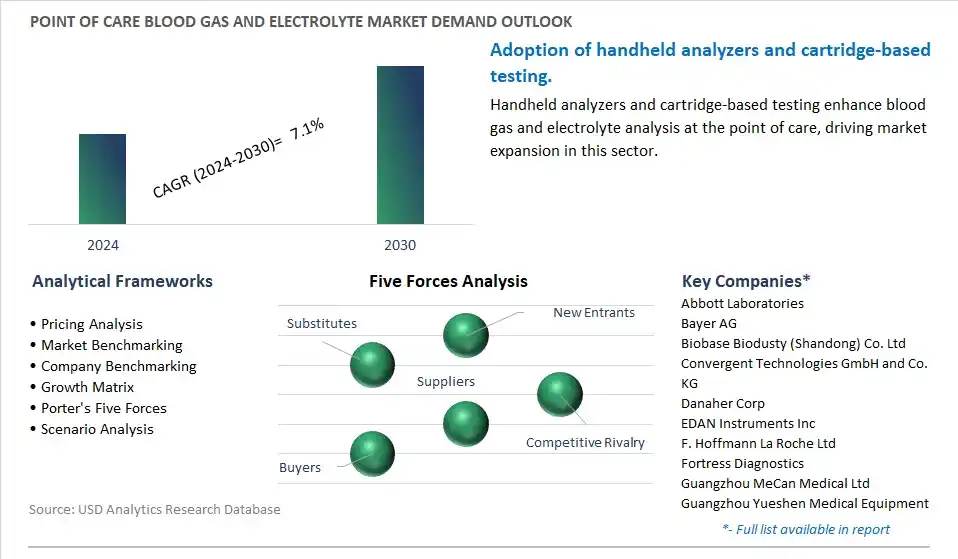
Point of Care (POC) Blood Gas and Electrolyte Market is estimated to increase at a growth rate of 7.1% CAGR over the forecast period from 2024 to 2030.
The global Point of Care (POC) Blood Gas and Electrolyte Market Study analyzes and forecasts the market size across 6 regions and 24 countries for diverse segments including By Product (Consumables, Instruments), By Application (Hospitals, Clinics, Diagnostic Laboratories, Others).
An Introduction to Point of Care (POC) Blood Gas and Electrolyte Market in 2024
The Point-of-Care (POC) Blood Gas and Electrolyte Market in 2024 serves as a cornerstone of critical care medicine, offering rapid and comprehensive testing solutions for the assessment of acid-base balance, oxygenation status, and electrolyte disturbances in critically ill patients at the bedside or in point-of-care settings. POC blood gas and electrolyte analyzers enable healthcare providers to perform real-time monitoring of arterial blood gases (ABGs), electrolyte concentrations, and metabolic parameters, thus facilitating timely diagnosis, treatment optimization, and patient management strategies in emergency departments, intensive care units (ICUs), and operating rooms. With critical care patients facing complex pathophysiological challenges and requiring prompt intervention to prevent life-threatening complications, the POC blood gas and electrolyte market witnesses continuous innovation and technological advancements, driven by factors such as miniaturization of testing platforms, integration of multi-parameter analysis, and advancements in sensor technology. Moreover, as healthcare providers emphasize early recognition of patient deterioration, goal-directed therapies, and quality improvement initiatives in critical care practice, stakeholders in the POC blood gas and electrolyte market collaborate to develop reliable, user-friendly, and cost-effective solutions that enhance clinical decision-making, patient safety, and outcomes in acutely ill patients.
Point of Care (POC) Blood Gas and Electrolyte Market Competitive Landscape
The global Point of Care (POC) Blood Gas and Electrolyte Industry is highly competitive with a large number of companies focusing on niche market segments. Amidst intense competitive conditions, Point of Care (POC) Blood Gas and Electrolyte Companies are investing in new product launches and strengthening distribution channels. Key companies operating in the Point of Care (POC) Blood Gas and Electrolyte Industry include- Abbott Laboratories, Bayer AG, Biobase Biodusty (Shandong) Co. Ltd, Convergent Technologies GmbH and Co. KG, Danaher Corp, EDAN Instruments Inc, F. Hoffmann La Roche Ltd, Fortress Diagnostics, Guangzhou MeCan Medical Ltd, Guangzhou Yueshen Medical Equipment Co. Ltd, IDEXX Laboratories Inc, JOKOH CO. Ltd, LIFEHEALTH LLC, Medica Corpo., Nova Biomedical Corp, Radiometer Medical ApS, Shinova Medical Co. Ltd, Siemens AG, TECOM Analytical Systems, Werfenlife SA.
Point of Care Blood Gas and Electrolyte Market Trend: Integration of Multifunctional Point-of-Care (POC) Testing Devices
The integration of multifunctional Point-of-Care (POC) testing devices is a prominent trend shaping the Point of Care Blood Gas and Electrolyte market. Healthcare facilities are increasingly adopting POC testing devices that combine blood gas and electrolyte analysis capabilities with other critical parameters, such as lactate, glucose, and hemoglobin. These multifunctional devices offer advantages such as streamlined workflows, reduced turnaround times, and comprehensive patient assessment at the point of care. By consolidating multiple tests into a single platform, healthcare providers can improve efficiency, conserve resources, and enhance patient care delivery. This trend reflects the market's focus on optimizing POC testing solutions for diverse clinical needs, driving innovation and adoption of multifunctional POC devices for blood gas and electrolyte analysis.
Point of Care Blood Gas and Electrolyte Market Driver: Growing Demand for Rapid and Accurate Critical Care Testing
The growing demand for rapid and accurate critical care testing is a significant driver fueling the demand for Point of Care Blood Gas and Electrolyte devices. Blood gas and electrolyte analysis play a crucial role in the management of critically ill patients, providing valuable insights into acid-base balance, respiratory function, and electrolyte imbalances. Timely and accurate measurement of these parameters is essential for making rapid treatment decisions, optimizing patient outcomes, and reducing the risk of complications in acute care settings such as emergency departments, intensive care units, and operating rooms. With the increasing prevalence of acute and chronic conditions requiring intensive monitoring and intervention, there is a rising demand for POC testing devices that offer fast turnaround times, minimal sample volumes, and high analytical performance for blood gas and electrolyte analysis. As healthcare providers prioritize strategies to enhance critical care delivery and patient safety, the demand for Point of Care Blood Gas and Electrolyte devices is expected to grow, driving market expansion and investment in POC testing technologies.
Point of Care Blood Gas and Electrolyte Market Opportunity: Expansion into Remote Monitoring and Home Healthcare Settings
The Market Opportunity for Point of Care Blood Gas and Electrolyte devices lies in their expansion into remote monitoring and home healthcare settings. Remote monitoring technologies and home-based diagnostic devices offer opportunities to extend critical care testing beyond traditional clinical settings, improve patient access to diagnostics, and enhance disease management outcomes. POC testing devices equipped with wireless connectivity, smartphone integration, and cloud-based data analytics capabilities enable patients to perform self-testing, track their blood gas and electrolyte parameters, and share data with healthcare providers remotely. Additionally, digital health platforms and telemedicine services offer features such as virtual consultations, symptom monitoring, and personalized treatment recommendations to support patients in managing their critical care needs effectively. By leveraging remote monitoring and home healthcare solutions, manufacturers of Point of Care Blood Gas and Electrolyte devices can address unmet patient needs, improve care coordination, and enhance patient engagement, driving market growth and innovation in critical care diagnostics.
Point of Care Blood Gas and Electrolyte Market Share Analysis: Instruments is the fastest growing market segment over the forecast period to 2030
Point of Care Blood Gas and Electrolyte Instruments emerge as the rapidly advancing product within the market. This growth is propelled by several key factors. Firstly, the increasing demand for immediate and accurate blood gas and electrolyte testing in critical care settings such as hospitals and clinics drives the adoption of point-of-care instruments. These instruments offer real-time results, enabling timely clinical decisions and interventions for patients in critical conditions. Additionally, advancements in instrument technology have led to the development of compact and user-friendly devices, enhancing their usability across various healthcare settings. Moreover, the growing trend towards decentralized testing and the need for rapid diagnostic capabilities further contribute to the expansion of point-of-care instrument usage. With their ability to provide rapid and reliable analysis of blood gas and electrolyte levels, point-of-care instruments represent a critical component in patient care, offering opportunities for improved clinical outcomes and healthcare efficiency.
Point of Care (POC) Blood Gas and Electrolyte Market Segmentation
By Product
Consumables
Instruments
By Application
Hospitals
Clinics
Diagnostic Laboratories
Others
Geographical Analysis
North America (United States, Canada, Mexico)
Europe (Germany, France, United Kingdom, Spain, Italy, Rest of Europe)
Asia Pacific (China, India, Japan, South Korea, Rest of Asia Pacific)
South America (Brazil, Argentina, Rest of South America)
Middle East and Africa (Saudi Arabia, UAE, Rest of Middle East, South Africa, Egypt, Rest of Africa)
Point of Care (POC) Blood Gas and Electrolyte Companies
Abbott Laboratories
Bayer AG
Biobase Biodusty (Shandong) Co. Ltd
Convergent Technologies GmbH and Co. KG
Danaher Corp
EDAN Instruments Inc
F. Hoffmann La Roche Ltd
Fortress Diagnostics
Guangzhou MeCan Medical Ltd
Guangzhou Yueshen Medical Equipment Co. Ltd
IDEXX Laboratories Inc
JOKOH CO. Ltd
LIFEHEALTH LLC
Medica Corpo.
Nova Biomedical Corp
Radiometer Medical ApS
Shinova Medical Co. Ltd
Siemens AG
TECOM Analytical Systems
Werfenlife SA
* List not Exhaustive
Reasons to Buy the Point of Care (POC) Blood Gas and Electrolyte Market Study
• Deepen your industry insights and navigate uncertainties for strategy formulation, CAPEX, and Operational decisions
• Gain access to detailed insights on the Point of Care (POC) Blood Gas and Electrolyte Market, encompassing current market size, growth trends, and forecasts till 2030.
• Access detailed competitor analysis, enabling competitive advantage through a thorough understanding of market players, strategies, and potential differentiation opportunities
• Stay ahead of the curve with insights on technological advancements, innovations, and upcoming trends
• Identify lucrative investment avenues and expansion opportunities within the Point of Care (POC) Blood Gas and Electrolyte Industry, guided by robust, data-backed analysis.
• Understand regional and global markets through country-wise analysis, regional market potential, regulatory nuances, and dynamics
• Execute strategies with confidence and speed through information, analytics, and insights on the industry value chain
• Corporate leaders, strategists, financial experts, shareholders, asset managers, and governmental representatives can make long-term planning scenarios and build an integrated and timely understanding of market dynamics
• Benefit from tailored solutions and expert consultation based on report insights, providing personalized strategies aligned with specific business needs.
TABLE OF CONTENTS
1 Introduction to 2024 Point of Care (POC) Blood Gas and Electrolyte Market
1.1 Market Overview
1.2 Quick Facts
1.3 Scope/Objective of the Study
1.4 Market Definition
1.5 Countries and Regions Analyzed
1.6 Units, Currency, and Conversions
1.7 Industry Value Chain
2 Research Methodology
2.1 Market Size Estimation
2.2 Sources and Research Methodology
2.3 Data Triangulation
2.4 Assumptions and Limitations
3 Executive Summary
3.1 Global Point of Care (POC) Blood Gas and Electrolyte Market Size Outlook, $ Million, 2021 to 2030
3.2 Point of Care (POC) Blood Gas and Electrolyte Market Outlook by Type, $ Million, 2021 to 2030
3.3 Point of Care (POC) Blood Gas and Electrolyte Market Outlook by Product, $ Million, 2021 to 2030
3.4 Point of Care (POC) Blood Gas and Electrolyte Market Outlook by Application, $ Million, 2021 to 2030
3.5 Point of Care (POC) Blood Gas and Electrolyte Market Outlook by Key Countries, $ Million, 2021 to 2030
4 Market Dynamics
4.1 Key Driving Forces of Point of Care (POC) Blood Gas and Electrolyte Industry
4.2 Key Market Trends in Point of Care (POC) Blood Gas and Electrolyte Industry
4.3 Potential Opportunities in Point of Care (POC) Blood Gas and Electrolyte Industry
4.4 Key Challenges in Point of Care (POC) Blood Gas and Electrolyte Industry
5 Market Factor Analysis
5.1 Value Chain Analysis
5.2 Competitive Landscape
5.2.1 Global Point of Care (POC) Blood Gas and Electrolyte Market Share by Company (%), 2023
5.2.2 Product Offerings by Company
5.3 Porter’s Five Forces Analysis
5.4 Pricing Analysis and Outlook
6 Growth Outlook Across Scenarios
6.1 Growth Analysis-Case Scenario Definitions
6.2 Low Growth Scenario Forecasts
6.3 Reference Growth Scenario Forecasts
6.4 High Growth Scenario Forecasts
7 Global Point of Care (POC) Blood Gas and Electrolyte Market Outlook by Segments
7.1 Point of Care (POC) Blood Gas and Electrolyte Market Outlook by Segments, $ Million, 2021- 2030
By Product
Consumables
Instruments
By Application
Hospitals
Clinics
Diagnostic Laboratories
Others
8 North America Point of Care (POC) Blood Gas and Electrolyte Market Analysis and Outlook To 2030
8.1 Introduction to North America Point of Care (POC) Blood Gas and Electrolyte Markets in 2024
8.2 North America Point of Care (POC) Blood Gas and Electrolyte Market Size Outlook by Country, 2021-2030
8.2.1 United States
8.2.2 Canada
8.2.3 Mexico
8.3 North America Point of Care (POC) Blood Gas and Electrolyte Market size Outlook by Segments, 2021-2030
By Product
Consumables
Instruments
By Application
Hospitals
Clinics
Diagnostic Laboratories
Others
9 Europe Point of Care (POC) Blood Gas and Electrolyte Market Analysis and Outlook To 2030
9.1 Introduction to Europe Point of Care (POC) Blood Gas and Electrolyte Markets in 2024
9.2 Europe Point of Care (POC) Blood Gas and Electrolyte Market Size Outlook by Country, 2021-2030
9.2.1 Germany
9.2.2 France
9.2.3 Spain
9.2.4 United Kingdom
9.2.4 Italy
9.2.5 Russia
9.2.6 Norway
9.2.7 Rest of Europe
9.3 Europe Point of Care (POC) Blood Gas and Electrolyte Market Size Outlook by Segments, 2021-2030
By Product
Consumables
Instruments
By Application
Hospitals
Clinics
Diagnostic Laboratories
Others
10 Asia Pacific Point of Care (POC) Blood Gas and Electrolyte Market Analysis and Outlook To 2030
10.1 Introduction to Asia Pacific Point of Care (POC) Blood Gas and Electrolyte Markets in 2024
10.2 Asia Pacific Point of Care (POC) Blood Gas and Electrolyte Market Size Outlook by Country, 2021-2030
10.2.1 China
10.2.2 India
10.2.3 Japan
10.2.4 South Korea
10.2.5 Indonesia
10.2.6 Malaysia
10.2.7 Australia
10.2.8 Rest of Asia Pacific
10.3 Asia Pacific Point of Care (POC) Blood Gas and Electrolyte Market size Outlook by Segments, 2021-2030
By Product
Consumables
Instruments
By Application
Hospitals
Clinics
Diagnostic Laboratories
Others
11 South America Point of Care (POC) Blood Gas and Electrolyte Market Analysis and Outlook To 2030
11.1 Introduction to South America Point of Care (POC) Blood Gas and Electrolyte Markets in 2024
11.2 South America Point of Care (POC) Blood Gas and Electrolyte Market Size Outlook by Country, 2021-2030
11.2.1 Brazil
11.2.2 Argentina
11.2.3 Rest of South America
11.3 South America Point of Care (POC) Blood Gas and Electrolyte Market size Outlook by Segments, 2021-2030
By Product
Consumables
Instruments
By Application
Hospitals
Clinics
Diagnostic Laboratories
Others
12 Middle East and Africa Point of Care (POC) Blood Gas and Electrolyte Market Analysis and Outlook To 2030
12.1 Introduction to Middle East and Africa Point of Care (POC) Blood Gas and Electrolyte Markets in 2024
12.2 Middle East and Africa Point of Care (POC) Blood Gas and Electrolyte Market Size Outlook by Country, 2021-2030
12.2.1 Saudi Arabia
12.2.2 UAE
12.2.3 Oman
12.2.4 Rest of Middle East
12.2.5 Egypt
12.2.6 Nigeria
12.2.7 South Africa
12.2.8 Rest of Africa
12.3 Middle East and Africa Point of Care (POC) Blood Gas and Electrolyte Market size Outlook by Segments, 2021-2030
By Product
Consumables
Instruments
By Application
Hospitals
Clinics
Diagnostic Laboratories
Others
13 Company Profiles
13.1 Company Snapshot
13.2 SWOT Profiles
13.3 Products and Services
13.4 Recent Developments
13.5 Financial Profile
List of Companies
Abbott Laboratories
Bayer AG
Biobase Biodusty (Shandong) Co. Ltd
Convergent Technologies GmbH and Co. KG
Danaher Corp
EDAN Instruments Inc
F. Hoffmann La Roche Ltd
Fortress Diagnostics
Guangzhou MeCan Medical Ltd
Guangzhou Yueshen Medical Equipment Co. Ltd
IDEXX Laboratories Inc
JOKOH CO. Ltd
LIFEHEALTH LLC
Medica Corpo.
Nova Biomedical Corp
Radiometer Medical ApS
Shinova Medical Co. Ltd
Siemens AG
TECOM Analytical Systems
Werfenlife SA
14 Appendix
14.1 Customization Offerings
14.2 Subscription Services
14.3 Related Reports
14.4 Publisher Expertise
