The global Poly Alpha Olefin Market is poised to register a 4.6% CAGR from $1.4 Billion in 2024 to $1.8 Billion in 2030.
The global Poly Alpha Olefin Market Study analyzes and forecasts the market size across 6 regions and 24 countries for diverse segments -By End-User (Industrial, Automobile), By Application (Lubricant, Industrial Oil, Hydraulic Fluids, Greases, Compressor Oil, Engine Oil, Gear Oil, Others), By Type (Low Viscosity Polyalphaolefin (PAO), Medium Viscosity Polyalphaolefin (PAO), High Viscosity Polyalphaolefin (PAO)).
An Introduction to Global Poly Alpha Olefin Market in 2024
The key trend shaping the future of the poly alpha olefin (PAO) industry is the increasing demand for synthetic lubricants and functional fluids with superior performance, stability, and environmental compatibility across various applications such as automotive, industrial machinery, marine, and aerospace. PAOs are a class of synthetic hydrocarbon polymers derived from alpha olefins, known for their excellent thermal stability, oxidative resistance, and low volatility, making them ideal base oils for formulating high-performance lubricants, hydraulic fluids, gear oils, and compressor oils. With growing requirements for extended equipment life, energy efficiency, and operational reliability, there is a rising need for PAO-based lubricants that offer enhanced wear protection, shear stability, and temperature resistance while minimizing friction, heat generation, and component wear. Manufacturers are investing in the development of advanced PAO formulations, additive packages, and viscosity modifiers to meet the evolving performance demands and specifications of modern machinery and equipment across diverse industries. Additionally, there is a trend towards the use of sustainable and renewable feedstocks, such as bio-based alpha olefins derived from plant oils or biomass, in PAO production to reduce carbon footprint, mitigate environmental impact, and support circular economy initiatives in the lubricants industry. Furthermore, with increasing emphasis on regulatory compliance, sustainability certifications, and environmental stewardship, there is a growing interest in PAO-based lubricants that offer biodegradability, low toxicity, and minimal environmental impact throughout their lifecycle. As industries continue to prioritize equipment reliability, energy efficiency, and environmental sustainability, the demand for innovative PAO-based lubricants and functional fluids with advanced performance attributes and eco-friendly characteristics is expected to grow, driving market expansion and technological innovation in the synthetic lubricants sector.
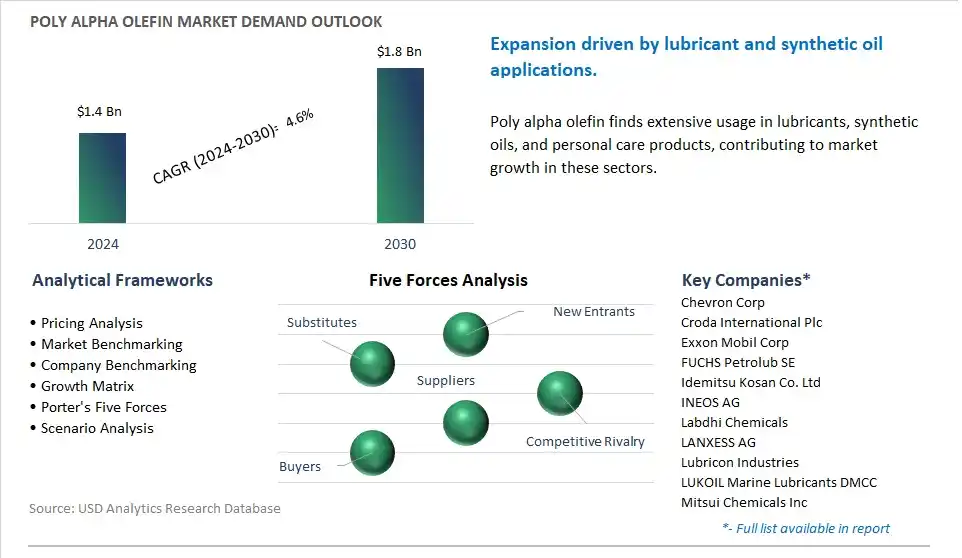
Poly Alpha Olefin Market Competitive Landscape
The market report analyses the leading companies in the industry including Chevron Corp, Croda International Plc, Exxon Mobil Corp, FUCHS Petrolub SE, Idemitsu Kosan Co. Ltd, INEOS AG, Labdhi Chemicals, LANXESS AG, Lubricon Industries, LUKOIL Marine Lubricants DMCC, Mitsui Chemicals Inc, NACO Corp, Novvi LLC, Phillips 66, RB PRODUCTS Inc, Royal Dutch Shell plc, Sasol Ltd, Tulstar Products Inc, Valero Energy Corp.
Poly Alpha Olefin Market Dynamics
Poly Alpha Olefin Market Trend: Shift Towards Synthetic Lubricants
A prominent trend in the poly alpha olefin (PAO) market is the increasing shift towards synthetic lubricants. PAO, being a key component of synthetic lubricants, is witnessing rising demand due to its superior properties such as high viscosity index, excellent thermal stability, and low pour point. With growing awareness about the benefits of synthetic lubricants, including improved engine performance, fuel efficiency, and extended equipment lifespan, there is a gradual transition from mineral-based lubricants to synthetic alternatives. This is driven by various industries, including automotive, industrial machinery, and aerospace, seeking high-performance lubrication solutions to enhance equipment reliability and efficiency.
Poly Alpha Olefin Market Driver: Growing Automotive Industry
The primary driver propelling the PAO market is the continuous growth of the automotive industry worldwide. PAO is extensively used in automotive lubricants, including engine oils, transmission fluids, and gear oils, due to its exceptional lubricating properties and compatibility with modern engine designs. With increasing vehicle production, stringent emission regulations, and the need for improved fuel efficiency, there is a rising demand for high-quality lubricants containing PAO. The automotive sector's expansion, coupled with the ongoing trend towards synthetic lubricants, creates significant opportunities for PAO manufacturers to cater to the automotive industry's lubrication requirements and capitalize on the growing market demand.
Poly Alpha Olefin Market Opportunity: Development of High-Performance Lubricant Formulations
An opportunity for stakeholders in the PAO market lies in the development of high-performance lubricant formulations tailored to specific applications and performance requirements. As industries demand lubricants with advanced properties such as extended drain intervals, enhanced wear protection, and compatibility with alternative fuels, there is a need for innovative lubricant solutions incorporating PAO. Manufacturers aim to capitalize on this opportunity by investing in research and development to formulate lubricants with optimized PAO content and additive packages to meet evolving industry needs. By offering differentiated lubricant formulations with superior performance characteristics, companies can strengthen their market position and attract customers looking for premium lubrication solutions.
Poly Alpha Olefin (PAO) Market Share Analysis: Industrial Segment generated the highest revenue in 2024
In the Poly Alpha Olefin (PAO) Market, the Industrial segment is the largest category, owing to the extensive use of PAO-based lubricants and fluids across a diverse range of industrial applications. PAO-based lubricants are renowned for their superior thermal stability, oxidative resistance, and lubricity, making them ideal for demanding industrial environments where high temperatures, heavy loads, and extreme operating conditions are prevalent. Industries such as manufacturing, metalworking, power generation, and chemical processing rely on PAO lubricants to ensure smooth and efficient machinery operation, minimize friction, and prevent equipment wear and tear. Additionally, the versatility of PAO formulations allows for customization to meet specific performance requirements, further enhancing their appeal to industrial users seeking tailored lubrication solutions. As industrial sectors continue to prioritize equipment reliability, energy efficiency, and operational cost savings, the demand for PAO-based lubricants is poised to remain robust, solidifying the Industrial segment's position as the largest in the PAO Market.
Poly Alpha Olefin (PAO) Market Share Analysis: Lubricant Segment is poised to register the fastest growth rate (CAGR) over the forecast period to 2030
Among the segments delineated in the Poly Alpha Olefin (PAO) Market, the Lubricant segment is the fastest-growing category, propelled by the demand for high-performance lubrication solutions across diverse industries. PAO-based lubricants offer exceptional thermal stability, oxidative resistance, and viscosity index, making them well-suited for a wide range of applications spanning automotive, industrial, marine, and aerospace sectors. As industries strive for improved efficiency, equipment reliability, and sustainability, the need for advanced lubricants capable of withstanding extreme operating conditions and extending machinery lifespan becomes paramount. Further, stringent regulatory standards and environmental concerns prompt the adoption of PAO lubricants, which boast low volatility, minimal emissions, and superior lubrication properties compared to conventional mineral oils. Additionally, advancements in PAO formulations, including the development of bio-based and synthetic blends, further enhance lubricant performance while reducing environmental impact, driving the rapid growth of the Lubricant segment in the PAO Market. As industries continue to prioritize lubrication efficiency, performance, and sustainability, the demand for PAO-based lubricants is expected to escalate, consolidating the Lubricant segment's position as the fastest-growing category in the PAO Market.
Poly Alpha Olefin (PAO) Market Share Analysis: Medium Viscosity Polyalphaolefin (PAO) Segment is poised to register the fastest growth rate (CAGR) over the forecast period to 2030
In the Poly Alpha Olefin (PAO) Market, the Medium Viscosity Polyalphaolefin (PAO) segment is the fastest-growing category, driven by its versatility and widespread applications across various industries. Medium viscosity PAOs strike a balance between low and high viscosity variants, offering optimal flow properties and lubricating performance suitable for a diverse range of applications. These PAOs are extensively utilized in automotive lubricants, industrial fluids, hydraulic oils, and compressor oils, where precise viscosity control is essential for achieving optimal equipment performance and reliability. Further, medium viscosity PAOs exhibit excellent thermal stability, oxidative resistance, and shear stability, making them ideal for use in high-temperature and high-pressure operating environments. Additionally, advancements in medium viscosity PAO formulations, such as improved additive packages and compatibility with other base oils, further enhance their performance characteristics, driving their rapid adoption across industries. As manufacturers seek lubrication solutions that deliver superior performance, efficiency, and longevity, the demand for medium viscosity PAOs is expected to continue its upward trajectory, positioning the segment as the fastest-growing category in the PAO Market.
Poly Alpha Olefin Market Report Segmentation
By End-User
Industrial
Automobile
By Application
Lubricant
Industrial Oil
Hydraulic Fluids
Greases
Compressor Oil
Engine Oil
Gear Oil
Others
By Type
Low Viscosity Polyalphaolefin (PAO)
Medium Viscosity Polyalphaolefin (PAO)
High Viscosity Polyalphaolefin (PAO)
Regions Included
North America (US, Canada, Mexico)
Europe (Germany, UK, France, Spain, Italy, Russia, Rest of Europe)
Asia Pacific (China, India, Japan, South Korea, Australia, South East Asia, Rest of Asia)
South America (Brazil, Argentina, Rest of South America)
Middle East and Africa (Saudi Arabia, UAE, Rest of Middle East, South Africa, Egypt, Rest of Africa)
Poly Alpha Olefin Companies Profiled in the Market Study
Chevron Corp
Croda International Plc
Exxon Mobil Corp
FUCHS Petrolub SE
Idemitsu Kosan Co. Ltd
INEOS AG
Labdhi Chemicals
LANXESS AG
Lubricon Industries
LUKOIL Marine Lubricants DMCC
Mitsui Chemicals Inc
NACO Corp
Novvi LLC
Phillips 66
RB PRODUCTS Inc
Royal Dutch Shell plc
Sasol Ltd
Tulstar Products Inc
Valero Energy Corp
*- List Not Exhaustive
TABLE OF CONTENTS
1 Introduction to 2024 Poly Alpha Olefin Market
1.1 Market Overview
1.2 Quick Facts
1.3 Scope/Objective of the Study
1.4 Market Definition
1.5 Countries and Regions Covered
1.6 Units, Currency, and Conversions
1.7 Industry Value Chain
2 Research Methodology
2.1 Market Size Estimation
2.2 Sources and Research Methodology
2.3 Data Triangulation
2.4 Assumptions and Limitations
3 Executive Summary
3.1 Global Poly Alpha Olefin Market Size Outlook, $ Million, 2021 to 2030
3.2 Poly Alpha Olefin Market Outlook by Type, $ Million, 2021 to 2030
3.3 Poly Alpha Olefin Market Outlook by Product, $ Million, 2021 to 2030
3.4 Poly Alpha Olefin Market Outlook by Application, $ Million, 2021 to 2030
3.5 Poly Alpha Olefin Market Outlook by Key Countries, $ Million, 2021 to 2030
4 Market Dynamics
4.1 Key Driving Forces of Poly Alpha Olefin Industry
4.2 Key Market Trends in Poly Alpha Olefin Industry
4.3 Potential Opportunities in Poly Alpha Olefin Industry
4.4 Key Challenges in Poly Alpha Olefin Industry
5 Market Factor Analysis
5.1 Value Chain Analysis
5.2 Competitive Landscape
5.2.1 Global Poly Alpha Olefin Market Share by Company (%), 2023
5.2.2 Product Offerings by Company
5.3 Porter’s Five Forces Analysis
5.4 Pricing Analysis and Outlook
6 Growth Outlook Across Scenarios
6.1 Growth Analysis-Case Scenario Definitions
6.2 Low Growth Scenario Forecasts
6.3 Reference Growth Scenario Forecasts
6.4 High Growth Scenario Forecasts
7 Global Poly Alpha Olefin Market Outlook by Segments
7.1 Poly Alpha Olefin Market Outlook by Segments, $ Million, 2021- 2030
By End-User
Industrial
Automobile
By Application
Lubricant
Industrial Oil
Hydraulic Fluids
Greases
Compressor Oil
Engine Oil
Gear Oil
Others
By Type
Low Viscosity Polyalphaolefin (PAO)
Medium Viscosity Polyalphaolefin (PAO)
High Viscosity Polyalphaolefin (PAO)
8 North America Poly Alpha Olefin Market Analysis and Outlook To 2030
8.1 Introduction to North America Poly Alpha Olefin Markets in 2024
8.2 North America Poly Alpha Olefin Market Size Outlook by Country, 2021-2030
8.2.1 United States
8.2.2 Canada
8.2.3 Mexico
8.3 North America Poly Alpha Olefin Market size Outlook by Segments, 2021-2030
By End-User
Industrial
Automobile
By Application
Lubricant
Industrial Oil
Hydraulic Fluids
Greases
Compressor Oil
Engine Oil
Gear Oil
Others
By Type
Low Viscosity Polyalphaolefin (PAO)
Medium Viscosity Polyalphaolefin (PAO)
High Viscosity Polyalphaolefin (PAO)
9 Europe Poly Alpha Olefin Market Analysis and Outlook To 2030
9.1 Introduction to Europe Poly Alpha Olefin Markets in 2024
9.2 Europe Poly Alpha Olefin Market Size Outlook by Country, 2021-2030
9.2.1 Germany
9.2.2 France
9.2.3 Spain
9.2.4 United Kingdom
9.2.4 Italy
9.2.5 Russia
9.2.6 Norway
9.2.7 Rest of Europe
9.3 Europe Poly Alpha Olefin Market Size Outlook by Segments, 2021-2030
By End-User
Industrial
Automobile
By Application
Lubricant
Industrial Oil
Hydraulic Fluids
Greases
Compressor Oil
Engine Oil
Gear Oil
Others
By Type
Low Viscosity Polyalphaolefin (PAO)
Medium Viscosity Polyalphaolefin (PAO)
High Viscosity Polyalphaolefin (PAO)
10 Asia Pacific Poly Alpha Olefin Market Analysis and Outlook To 2030
10.1 Introduction to Asia Pacific Poly Alpha Olefin Markets in 2024
10.2 Asia Pacific Poly Alpha Olefin Market Size Outlook by Country, 2021-2030
10.2.1 China
10.2.2 India
10.2.3 Japan
10.2.4 South Korea
10.2.5 Indonesia
10.2.6 Malaysia
10.2.7 Australia
10.2.8 Rest of Asia Pacific
10.3 Asia Pacific Poly Alpha Olefin Market size Outlook by Segments, 2021-2030
By End-User
Industrial
Automobile
By Application
Lubricant
Industrial Oil
Hydraulic Fluids
Greases
Compressor Oil
Engine Oil
Gear Oil
Others
By Type
Low Viscosity Polyalphaolefin (PAO)
Medium Viscosity Polyalphaolefin (PAO)
High Viscosity Polyalphaolefin (PAO)
11 South America Poly Alpha Olefin Market Analysis and Outlook To 2030
11.1 Introduction to South America Poly Alpha Olefin Markets in 2024
11.2 South America Poly Alpha Olefin Market Size Outlook by Country, 2021-2030
11.2.1 Brazil
11.2.2 Argentina
11.2.3 Rest of South America
11.3 South America Poly Alpha Olefin Market size Outlook by Segments, 2021-2030
By End-User
Industrial
Automobile
By Application
Lubricant
Industrial Oil
Hydraulic Fluids
Greases
Compressor Oil
Engine Oil
Gear Oil
Others
By Type
Low Viscosity Polyalphaolefin (PAO)
Medium Viscosity Polyalphaolefin (PAO)
High Viscosity Polyalphaolefin (PAO)
12 Middle East and Africa Poly Alpha Olefin Market Analysis and Outlook To 2030
12.1 Introduction to Middle East and Africa Poly Alpha Olefin Markets in 2024
12.2 Middle East and Africa Poly Alpha Olefin Market Size Outlook by Country, 2021-2030
12.2.1 Saudi Arabia
12.2.2 UAE
12.2.3 Oman
12.2.4 Rest of Middle East
12.2.5 Egypt
12.2.6 Nigeria
12.2.7 South Africa
12.2.8 Rest of Africa
12.3 Middle East and Africa Poly Alpha Olefin Market size Outlook by Segments, 2021-2030
By End-User
Industrial
Automobile
By Application
Lubricant
Industrial Oil
Hydraulic Fluids
Greases
Compressor Oil
Engine Oil
Gear Oil
Others
By Type
Low Viscosity Polyalphaolefin (PAO)
Medium Viscosity Polyalphaolefin (PAO)
High Viscosity Polyalphaolefin (PAO)
13 Company Profiles
13.1 Company Snapshot
13.2 SWOT Profiles
13.3 Products and Services
13.4 Recent Developments
13.5 Financial Profile
Chevron Corp
Croda International Plc
Exxon Mobil Corp
FUCHS Petrolub SE
Idemitsu Kosan Co. Ltd
INEOS AG
Labdhi Chemicals
LANXESS AG
Lubricon Industries
LUKOIL Marine Lubricants DMCC
Mitsui Chemicals Inc
NACO Corp
Novvi LLC
Phillips 66
RB PRODUCTS Inc
Royal Dutch Shell plc
Sasol Ltd
Tulstar Products Inc
Valero Energy Corp
14 Appendix
14.1 Customization Offerings
14.2 Subscription Services
14.3 Related Reports
14.4 Publisher Expertise
By End-User
Industrial
Automobile
By Application
Lubricant
Industrial Oil
Hydraulic Fluids
Greases
Compressor Oil
Engine Oil
Gear Oil
Others
By Type
Low Viscosity Polyalphaolefin (PAO)
Medium Viscosity Polyalphaolefin (PAO)
High Viscosity Polyalphaolefin (PAO)
Countries Analyzed
North America (US, Canada, Mexico)
Europe (Germany, UK, France, Spain, Italy, Russia, Rest of Europe)
Asia Pacific (China, India, Japan, South Korea, Australia, South East Asia, Rest of Asia)
South America (Brazil, Argentina, Rest of South America)
Middle East and Africa (Saudi Arabia, UAE, Rest of Middle East, South Africa, Egypt, Rest of Africa)
