The global Polyacrylic Acid Market is poised to register a 5.2% CAGR from $4.8 Billion in 2024 to $6.5 Billion in 2030.
The global Polyacrylic Acid Market Study analyzes and forecasts the market size across 6 regions and 24 countries for diverse segments -By Type (Co-polymer, Homo-polymer, Ter-polymer), By Grade (Industrial, Cosmetic, Pharmaceutical), By Application (Thickeners, Dispersing Agents, Conditioners and Emulsifiers, Anti-Scaling, Ion-Exchangers, Clarifying agents), By End-User (Water Treatment, Personal Care, Detergents, Cleaners, Others).
An Introduction to Global Polyacrylic Acid Market in 2024
The key trend shaping the future of the polyacrylic acid industry is the increasing demand for water treatment, personal care, and industrial applications requiring effective water-soluble polymers with superior thickening, dispersing, and chelating properties. Polyacrylic acid (PAA) is a synthetic polymer derived from acrylic acid monomers, known for its ability to absorb and retain large amounts of water, form transparent gels, and provide rheological control in various formulations. With growing concerns over water scarcity, environmental pollution, and product performance, there is a rising need for PAA-based products that offer efficient water treatment, enhanced fluid viscosity, and improved product stability in diverse applications such as wastewater treatment, detergents, adhesives, coatings, and personal care products. Manufacturers are investing in the development of novel PAA formulations, copolymers, and crosslinking agents to optimize performance characteristics such as solubility, pH tolerance, and shear stability for specific application requirements. Additionally, there is a trend towards the use of eco-friendly and biodegradable PAA derivatives, such as partially neutralized salts or bio-based polymers, to reduce environmental impact, promote sustainability, and meet regulatory requirements governing wastewater discharge and product safety. Furthermore, with increasing demand for specialty chemicals, functional additives, and performance enhancers in various industries, there is a growing interest in customized PAA-based formulations and application-specific solutions tailored to meet the evolving needs and challenges of end-users. As industries continue to seek innovative solutions for water management, product formulation, and process optimization, the demand for versatile and effective polyacrylic acid-based polymers and additives is expected to grow, driving market expansion and technological innovation in the specialty chemicals and water treatment sectors.
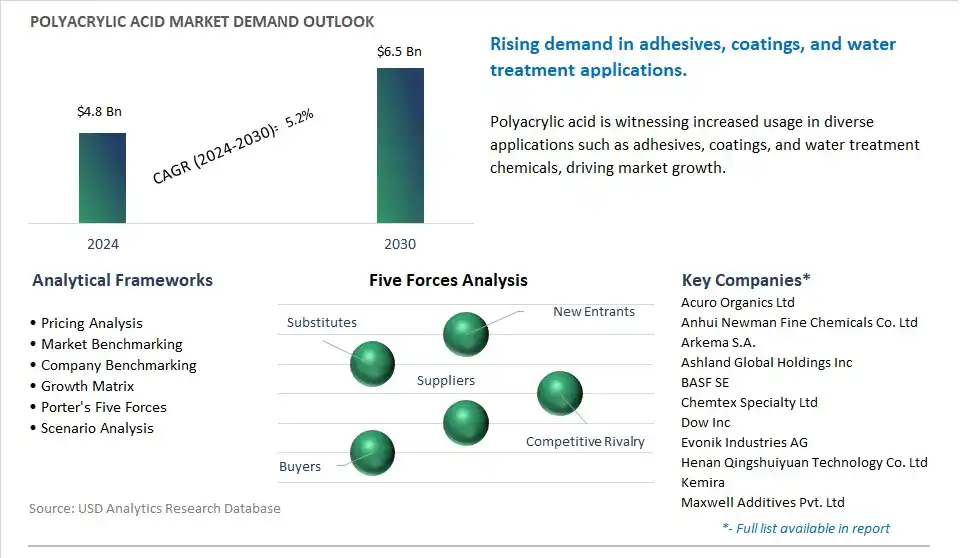
Polyacrylic Acid Market Competitive Landscape
The market report analyses the leading companies in the industry including Acuro Organics Ltd, Anhui Newman Fine Chemicals Co. Ltd, Arkema S.A., Ashland Global Holdings Inc, BASF SE, Chemtex Specialty Ltd, Dow Inc, Evonik Industries AG, Henan Qingshuiyuan Technology Co. Ltd, Kemira, Maxwell Additives Pvt. Ltd, MercK KGaA, MKS DevO, Nippon Shokubai Co. Ltd, Polysciences Inc, Protex International, Sumitomo Seika Chemicals, The Lubrizol Corp, Zouping Dongfang Chemical Co. Ltd.
Polyacrylic Acid Market Dynamics
Polyacrylic Acid Market Trend: Growing Demand for Superabsorbent Polymers
A significant trend in the polyacrylic acid (PAA) market is the increasing demand for superabsorbent polymers (SAPs), of which PAA is a key component. SAPs, derived from PAA and its derivatives, are extensively used in various applications such as hygiene products (diapers, feminine hygiene products), agriculture (soil moisture retention), and construction (waterproofing materials). The growing awareness about water conservation, coupled with the rising adoption of disposable hygiene products, drives the demand for SAPs globally. Accordingly, the PAA market is witnessing growth due to its crucial role in SAP production and its versatile applications across different industries.
Polyacrylic Acid Market Driver: Rising Demand for Water Retention Agents
The primary driver fueling the PAA market is the increasing demand for water retention agents in various sectors such as agriculture, personal care, and construction. PAA, known for its water-absorbing and retaining properties, is widely used as a water retention agent in agricultural formulations, hydrogels for personal care products, and coatings for construction materials. With growing concerns over water scarcity and the need for efficient water management practices, there is a rising demand for materials that can improve water retention in soil, enhance crop productivity, and ensure effective moisture control in consumer products. This drives the demand for PAA-based products as essential additives in formulations aimed at addressing water-related challenges across different industries.
Polyacrylic Acid Market Opportunity: Expansion of Personal Care Applications
An opportunity for stakeholders in the PAA market lies in the expansion of applications in the personal care industry. PAA and its derivatives are key ingredients in the formulation of superabsorbent polymers used in disposable hygiene products such as diapers, adult incontinence products, and feminine hygiene items. With the growing global population, increasing awareness about hygiene, and evolving consumer preferences for convenience and comfort, the demand for disposable hygiene products is expected to rise. Manufacturers aim to capitalize on this opportunity by developing innovative PAA-based formulations that offer superior absorption, leakage prevention, and comfort properties in personal care products. By expanding their product offerings and catering to the evolving needs of the personal care market, companies can tap into new growth opportunities and strengthen their position in the PAA industry.
Polyacrylic Acid Market Share Analysis: Co-polymer Segment generated the highest revenue in 2024
In the Polyacrylic Acid Market, the Co-polymer segment is the largest category, driven by its versatility and wide-ranging applications across various industries. Co-polymers of polyacrylic acid offer unique properties that make them suitable for diverse uses, including water treatment, personal care products, adhesives, coatings, and textile processing. These co-polymers are formed by the copolymerization of acrylic acid with other monomers, allowing for the customization of properties such as solubility, viscosity, and compatibility with different substrates. This versatility makes co-polymers of polyacrylic acid highly sought after in industries where multifunctional additives or binders are required. Additionally, co-polymers of polyacrylic acid exhibit excellent adhesion, film-forming ability, and water retention properties, making them indispensable in various formulations for industrial and consumer applications. With ongoing innovations in polymer chemistry and increasing demand for sustainable and high-performance materials, the Co-polymer segment maintains its dominance as the largest segment in the Polyacrylic Acid Market.
Polyacrylic Acid Market Share Analysis: Pharmaceutical Grade Segment is poised to register the fastest growth rate (CAGR) over the forecast period to 2030
In the Polyacrylic Acid Market, the Pharmaceutical Grade segment is the fastest-growing category, fueled by increasing demand for high-quality polyacrylic acid formulations in the pharmaceutical and healthcare sectors. Pharmaceutical-grade polyacrylic acid finds extensive applications in drug delivery systems, wound care products, oral care formulations, and medical adhesives due to its biocompatibility, safety, and controlled release properties. As pharmaceutical companies prioritize innovation and the development of advanced drug delivery technologies, there is a growing reliance on polyacrylic acid-based materials for enhancing drug efficacy, patient compliance, and therapeutic outcomes. Further, stringent regulatory standards governing pharmaceutical formulations drive the demand for pharmaceutical-grade polyacrylic acid, which meets strict quality and purity requirements for use in medical and pharmaceutical applications. Additionally, the increasing prevalence of chronic diseases, rising healthcare expenditures, and expanding geriatric population further propel the demand for pharmaceutical-grade polyacrylic acid, positioning it as the fastest-growing segment in the Polyacrylic Acid Market.
Polyacrylic Acid Market Share Analysis: Thickeners Segment is poised to register the fastest growth rate (CAGR) over the forecast period to 2030
In the Polyacrylic Acid Market, the Thickeners segment is the fastest-growing category, driven by the increasing demand for rheology modifiers and viscosity enhancers across various industries. Polyacrylic acid-based thickeners are extensively used in applications such as personal care products, household cleaners, paints and coatings, and industrial formulations, where precise viscosity control is crucial for product performance and stability. As industries evolve and consumer preferences shift towards products with improved texture, consistency, and sensory attributes, the demand for polyacrylic acid thickeners surges. Further, the versatility of polyacrylic acid allows for the development of thickeners with customizable rheological properties, catering to specific formulation requirements and end-user preferences. Additionally, stringent regulations on the use of toxic or environmentally harmful thickening agents further drive the adoption of polyacrylic acid-based thickeners, which offer eco-friendly and safe alternatives. As industries continue to prioritize product differentiation, performance, and sustainability, the Thickeners segment is poised for rapid growth in the Polyacrylic Acid Market.
Polyacrylic Acid Market Report Segmentation
By Type
Co-polymer
Homo-polymer
Ter-polymer
By Grade
Industrial
Cosmetic
Pharmaceutical
By Application
Thickeners
Dispersing Agents
Conditioners and Emulsifiers
Anti-Scaling
Ion-Exchangers
Clarifying agents
By End-User
Water Treatment
Personal Care
Detergents
Cleaners
Others
Regions Included
North America (US, Canada, Mexico)
Europe (Germany, UK, France, Spain, Italy, Russia, Rest of Europe)
Asia Pacific (China, India, Japan, South Korea, Australia, South East Asia, Rest of Asia)
South America (Brazil, Argentina, Rest of South America)
Middle East and Africa (Saudi Arabia, UAE, Rest of Middle East, South Africa, Egypt, Rest of Africa)
Polyacrylic Acid Companies Profiled in the Market Study
Acuro Organics Ltd
Anhui Newman Fine Chemicals Co. Ltd
Arkema S.A.
Ashland Global Holdings Inc
BASF SE
Chemtex Specialty Ltd
Dow Inc
Evonik Industries AG
Henan Qingshuiyuan Technology Co. Ltd
Kemira
Maxwell Additives Pvt. Ltd
MercK KGaA
MKS DevO
Nippon Shokubai Co. Ltd
Polysciences Inc
Protex International
Sumitomo Seika Chemicals
The Lubrizol Corp
Zouping Dongfang Chemical Co. Ltd
*- List Not Exhaustive
TABLE OF CONTENTS
1 Introduction to 2024 Polyacrylic Acid Market
1.1 Market Overview
1.2 Quick Facts
1.3 Scope/Objective of the Study
1.4 Market Definition
1.5 Countries and Regions Covered
1.6 Units, Currency, and Conversions
1.7 Industry Value Chain
2 Research Methodology
2.1 Market Size Estimation
2.2 Sources and Research Methodology
2.3 Data Triangulation
2.4 Assumptions and Limitations
3 Executive Summary
3.1 Global Polyacrylic Acid Market Size Outlook, $ Million, 2021 to 2030
3.2 Polyacrylic Acid Market Outlook by Type, $ Million, 2021 to 2030
3.3 Polyacrylic Acid Market Outlook by Product, $ Million, 2021 to 2030
3.4 Polyacrylic Acid Market Outlook by Application, $ Million, 2021 to 2030
3.5 Polyacrylic Acid Market Outlook by Key Countries, $ Million, 2021 to 2030
4 Market Dynamics
4.1 Key Driving Forces of Polyacrylic Acid Industry
4.2 Key Market Trends in Polyacrylic Acid Industry
4.3 Potential Opportunities in Polyacrylic Acid Industry
4.4 Key Challenges in Polyacrylic Acid Industry
5 Market Factor Analysis
5.1 Value Chain Analysis
5.2 Competitive Landscape
5.2.1 Global Polyacrylic Acid Market Share by Company (%), 2023
5.2.2 Product Offerings by Company
5.3 Porter’s Five Forces Analysis
5.4 Pricing Analysis and Outlook
6 Growth Outlook Across Scenarios
6.1 Growth Analysis-Case Scenario Definitions
6.2 Low Growth Scenario Forecasts
6.3 Reference Growth Scenario Forecasts
6.4 High Growth Scenario Forecasts
7 Global Polyacrylic Acid Market Outlook by Segments
7.1 Polyacrylic Acid Market Outlook by Segments, $ Million, 2021- 2030
By Type
Co-polymer
Homo-polymer
Ter-polymer
By Grade
Industrial
Cosmetic
Pharmaceutical
By Application
Thickeners
Dispersing Agents
Conditioners and Emulsifiers
Anti-Scaling
Ion-Exchangers
Clarifying agents
By End-User
Water Treatment
Personal Care
Detergents
Cleaners
Others
8 North America Polyacrylic Acid Market Analysis and Outlook To 2030
8.1 Introduction to North America Polyacrylic Acid Markets in 2024
8.2 North America Polyacrylic Acid Market Size Outlook by Country, 2021-2030
8.2.1 United States
8.2.2 Canada
8.2.3 Mexico
8.3 North America Polyacrylic Acid Market size Outlook by Segments, 2021-2030
By Type
Co-polymer
Homo-polymer
Ter-polymer
By Grade
Industrial
Cosmetic
Pharmaceutical
By Application
Thickeners
Dispersing Agents
Conditioners and Emulsifiers
Anti-Scaling
Ion-Exchangers
Clarifying agents
By End-User
Water Treatment
Personal Care
Detergents
Cleaners
Others
9 Europe Polyacrylic Acid Market Analysis and Outlook To 2030
9.1 Introduction to Europe Polyacrylic Acid Markets in 2024
9.2 Europe Polyacrylic Acid Market Size Outlook by Country, 2021-2030
9.2.1 Germany
9.2.2 France
9.2.3 Spain
9.2.4 United Kingdom
9.2.4 Italy
9.2.5 Russia
9.2.6 Norway
9.2.7 Rest of Europe
9.3 Europe Polyacrylic Acid Market Size Outlook by Segments, 2021-2030
By Type
Co-polymer
Homo-polymer
Ter-polymer
By Grade
Industrial
Cosmetic
Pharmaceutical
By Application
Thickeners
Dispersing Agents
Conditioners and Emulsifiers
Anti-Scaling
Ion-Exchangers
Clarifying agents
By End-User
Water Treatment
Personal Care
Detergents
Cleaners
Others
10 Asia Pacific Polyacrylic Acid Market Analysis and Outlook To 2030
10.1 Introduction to Asia Pacific Polyacrylic Acid Markets in 2024
10.2 Asia Pacific Polyacrylic Acid Market Size Outlook by Country, 2021-2030
10.2.1 China
10.2.2 India
10.2.3 Japan
10.2.4 South Korea
10.2.5 Indonesia
10.2.6 Malaysia
10.2.7 Australia
10.2.8 Rest of Asia Pacific
10.3 Asia Pacific Polyacrylic Acid Market size Outlook by Segments, 2021-2030
By Type
Co-polymer
Homo-polymer
Ter-polymer
By Grade
Industrial
Cosmetic
Pharmaceutical
By Application
Thickeners
Dispersing Agents
Conditioners and Emulsifiers
Anti-Scaling
Ion-Exchangers
Clarifying agents
By End-User
Water Treatment
Personal Care
Detergents
Cleaners
Others
11 South America Polyacrylic Acid Market Analysis and Outlook To 2030
11.1 Introduction to South America Polyacrylic Acid Markets in 2024
11.2 South America Polyacrylic Acid Market Size Outlook by Country, 2021-2030
11.2.1 Brazil
11.2.2 Argentina
11.2.3 Rest of South America
11.3 South America Polyacrylic Acid Market size Outlook by Segments, 2021-2030
By Type
Co-polymer
Homo-polymer
Ter-polymer
By Grade
Industrial
Cosmetic
Pharmaceutical
By Application
Thickeners
Dispersing Agents
Conditioners and Emulsifiers
Anti-Scaling
Ion-Exchangers
Clarifying agents
By End-User
Water Treatment
Personal Care
Detergents
Cleaners
Others
12 Middle East and Africa Polyacrylic Acid Market Analysis and Outlook To 2030
12.1 Introduction to Middle East and Africa Polyacrylic Acid Markets in 2024
12.2 Middle East and Africa Polyacrylic Acid Market Size Outlook by Country, 2021-2030
12.2.1 Saudi Arabia
12.2.2 UAE
12.2.3 Oman
12.2.4 Rest of Middle East
12.2.5 Egypt
12.2.6 Nigeria
12.2.7 South Africa
12.2.8 Rest of Africa
12.3 Middle East and Africa Polyacrylic Acid Market size Outlook by Segments, 2021-2030
By Type
Co-polymer
Homo-polymer
Ter-polymer
By Grade
Industrial
Cosmetic
Pharmaceutical
By Application
Thickeners
Dispersing Agents
Conditioners and Emulsifiers
Anti-Scaling
Ion-Exchangers
Clarifying agents
By End-User
Water Treatment
Personal Care
Detergents
Cleaners
Others
13 Company Profiles
13.1 Company Snapshot
13.2 SWOT Profiles
13.3 Products and Services
13.4 Recent Developments
13.5 Financial Profile
Acuro Organics Ltd
Anhui Newman Fine Chemicals Co. Ltd
Arkema S.A.
Ashland Global Holdings Inc
BASF SE
Chemtex Specialty Ltd
Dow Inc
Evonik Industries AG
Henan Qingshuiyuan Technology Co. Ltd
Kemira
Maxwell Additives Pvt. Ltd
MercK KGaA
MKS DevO
Nippon Shokubai Co. Ltd
Polysciences Inc
Protex International
Sumitomo Seika Chemicals
The Lubrizol Corp
Zouping Dongfang Chemical Co. Ltd
14 Appendix
14.1 Customization Offerings
14.2 Subscription Services
14.3 Related Reports
14.4 Publisher Expertise
By Type
Co-polymer
Homo-polymer
Ter-polymer
By Grade
Industrial
Cosmetic
Pharmaceutical
By Application
Thickeners
Dispersing Agents
Conditioners and Emulsifiers
Anti-Scaling
Ion-Exchangers
Clarifying agents
By End-User
Water Treatment
Personal Care
Detergents
Cleaners
Others
Countries Analyzed
North America (US, Canada, Mexico)
Europe (Germany, UK, France, Spain, Italy, Russia, Rest of Europe)
Asia Pacific (China, India, Japan, South Korea, Australia, South East Asia, Rest of Asia)
South America (Brazil, Argentina, Rest of South America)
Middle East and Africa (Saudi Arabia, UAE, Rest of Middle East, South Africa, Egypt, Rest of Africa)
