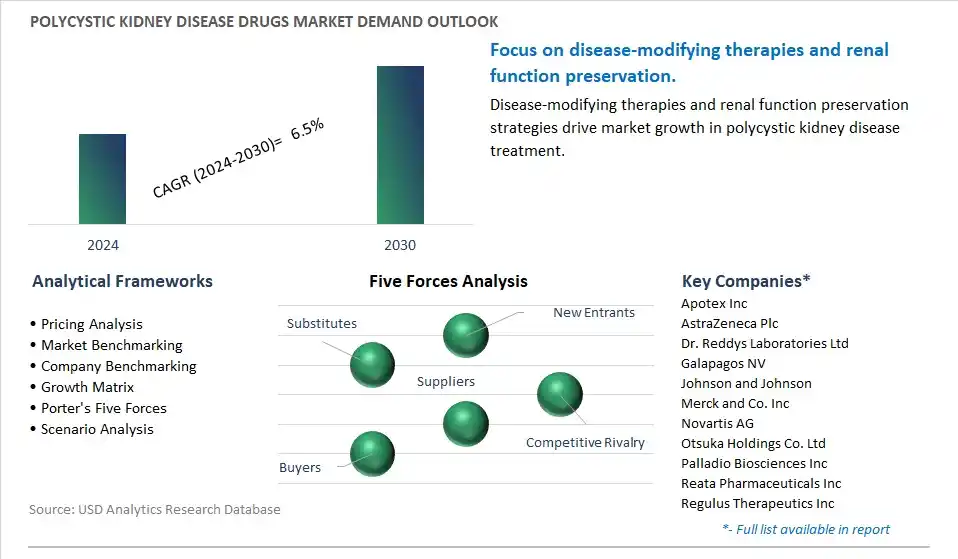
Polycystic Kidney Disease Drugs Market is estimated to increase at a growth rate of 6.5% CAGR over the forecast period from 2024 to 2030.
The global Polycystic Kidney Disease Drugs Market Study analyzes and forecasts the market size across 6 regions and 24 countries for diverse segments including By Type (ADPKD (Autosomal Dominant Polycystic Kidney Disease), ARPKD (Autosomal Recessive Polycystic Kidney Disease)).
An Introduction to Polycystic Kidney Disease Drugs Market in 2024
The Polycystic Kidney Disease (PKD) Drugs Market in 2024 addresses the management of polycystic kidney disease, a genetic disorder characterized by the formation of fluid-filled cysts in the kidneys, leading to progressive renal impairment, hypertension, and other complications. PKD drugs target various pathophysiological mechanisms involved in cyst formation, fluid secretion, and fibrosis, aiming to slow disease progression, preserve renal function, and alleviate symptoms such as pain and hypertension. With PKD representing a leading cause of end-stage renal disease (ESRD) and a significant burden on healthcare systems worldwide, the PKD drugs market witnesses ongoing research and development efforts focused on identifying novel therapeutic targets, biomarkers, and disease-modifying treatments. Moreover, as stakeholders in nephrology research, patient advocacy, and regulatory agencies collaborate to advance clinical trials, expedite drug approvals, and improve access to innovative therapies, the PKD drugs market plays a vital role in improving the quality of life and prognosis for individuals living with this genetic kidney disorder.
Polycystic Kidney Disease Drugs Market Competitive Landscape
The global Polycystic Kidney Disease Drugs Industry is highly competitive with a large number of companies focusing on niche market segments. Amidst intense competitive conditions, Polycystic Kidney Disease Drugs Companies are investing in new product launches and strengthening distribution channels. Key companies operating in the Polycystic Kidney Disease Drugs Industry include- Apotex Inc, AstraZeneca Plc, Dr. Reddys Laboratories Ltd, Galapagos NV, Johnson and Johnson, Merck and Co. Inc, Novartis AG, Otsuka Holdings Co. Ltd, Palladio Biosciences Inc, Reata Pharmaceuticals Inc, Regulus Therapeutics Inc, Sanofi SA, Teva Pharmaceutical Industries Ltd, XORTX Therapeutics Inc.
Polycystic Kidney Disease Drugs Market Trend: Advancements in Drug Discovery and Therapeutic Approaches
Advancements in drug discovery and therapeutic approaches are prominent trends in the Polycystic Kidney Disease Drugs market. Researchers and pharmaceutical companies are investing in the development of novel therapies targeting the underlying mechanisms of polycystic kidney disease (PKD), including cystogenesis, fluid secretion, and renal fibrosis. Emerging treatment modalities such as gene therapy, RNA interference, and targeted molecular inhibitors show promising results in preclinical and clinical studies, offering potential disease-modifying effects and improved patient outcomes. This trend reflects the market's focus on innovation and personalized medicine approaches to address the unmet medical needs of PKD patients, driving investment and development of next-generation PKD drugs.
Polycystic Kidney Disease Drugs Market Driver: Increasing Disease Burden and Unmet Medical Needs
The increasing disease burden and unmet medical needs are significant drivers fueling the demand for Polycystic Kidney Disease Drugs. PKD is a progressive and debilitating condition characterized by the formation of fluid-filled cysts in the kidneys, leading to renal dysfunction, hypertension, and other complications. With an estimated prevalence of 1 in 500 to 1 in 1,000 individuals worldwide, PKD represents a significant healthcare burden, contributing to morbidity, mortality, and healthcare costs. Current treatment options for PKD focus on symptom management and slowing disease progression, but there is a lack of disease-modifying therapies that can halt or reverse cyst growth and preserve renal function. As the prevalence of PKD continues to rise and awareness of the disease grows, there is a growing demand for effective and targeted therapies that address the underlying pathophysiology of PKD, driving market demand and investment in PKD drug development.
Polycystic Kidney Disease Drugs Market Opportunity: Collaboration and Partnerships for Clinical Development
The Market Opportunity for Polycystic Kidney Disease Drugs lies in collaboration and partnerships for clinical development. Given the complexity of PKD pathogenesis and the challenges associated with drug discovery and development, collaboration between academia, industry, and patient advocacy groups offers opportunities to accelerate the translation of scientific discoveries into novel therapies. Collaborative initiatives such as research consortia, precompetitive partnerships, and patient-driven consortia facilitate knowledge sharing, resource pooling, and access to patient populations for clinical trials. By leveraging collective expertise, infrastructure, and resources, stakeholders can overcome barriers to drug development, streamline clinical trial recruitment, and expedite regulatory approval of PKD therapies. Investing in collaborative research and development efforts not only enhances the pipeline of PKD drugs but also fosters innovation, efficiency, and patient-centered approaches in the Polycystic Kidney Disease Drugs market.
Polycystic Kidney Disease Drugs Market Share Analysis: ADPKD (Autosomal Dominant Polycystic Kidney Disease) is the fastest growing market segment over the forecast period to 2030
ADPKD drugs are experiencing significant growth owing to several factors. Firstly, ADPKD is the most common form of polycystic kidney disease, affecting millions worldwide, thereby creating a substantial market demand for effective treatments. Secondly, advancements in research and drug development have led to the emergence of novel therapies targeting specific molecular pathways implicated in ADPKD pathogenesis, such as vasopressin V2 receptor antagonists and mTOR inhibitors. These innovative treatments aim to slow disease progression, reduce cyst growth, and preserve renal function, offering new hope to patients with ADPKD. Additionally, increased awareness and early diagnosis efforts have facilitated the identification of more individuals with ADPKD, further driving the demand for pharmaceutical interventions. With ongoing clinical trials and promising pipeline candidates, the ADPKD drug market is poised for continued growth in the foreseeable future.
Polycystic Kidney Disease Drugs Market Segmentation
By Type
ADPKD (Autosomal Dominant Polycystic Kidney Disease)
ARPKD (Autosomal Recessive Polycystic Kidney Disease)
Geographical Analysis
North America (United States, Canada, Mexico)
Europe (Germany, France, United Kingdom, Spain, Italy, Rest of Europe)
Asia Pacific (China, India, Japan, South Korea, Rest of Asia Pacific)
South America (Brazil, Argentina, Rest of South America)
Middle East and Africa (Saudi Arabia, UAE, Rest of Middle East, South Africa, Egypt, Rest of Africa)
Polycystic Kidney Disease Drugs Companies
Apotex Inc
AstraZeneca Plc
Dr. Reddys Laboratories Ltd
Galapagos NV
Johnson and Johnson
Merck and Co. Inc
Novartis AG
Otsuka Holdings Co. Ltd
Palladio Biosciences Inc
Reata Pharmaceuticals Inc
Regulus Therapeutics Inc
Sanofi SA
Teva Pharmaceutical Industries Ltd
XORTX Therapeutics Inc
* List not Exhaustive
Reasons to Buy the Polycystic Kidney Disease Drugs Market Study
• Deepen your industry insights and navigate uncertainties for strategy formulation, CAPEX, and Operational decisions
• Gain access to detailed insights on the Polycystic Kidney Disease Drugs Market, encompassing current market size, growth trends, and forecasts till 2030.
• Access detailed competitor analysis, enabling competitive advantage through a thorough understanding of market players, strategies, and potential differentiation opportunities
• Stay ahead of the curve with insights on technological advancements, innovations, and upcoming trends
• Identify lucrative investment avenues and expansion opportunities within the Polycystic Kidney Disease Drugs Industry, guided by robust, data-backed analysis.
• Understand regional and global markets through country-wise analysis, regional market potential, regulatory nuances, and dynamics
• Execute strategies with confidence and speed through information, analytics, and insights on the industry value chain
• Corporate leaders, strategists, financial experts, shareholders, asset managers, and governmental representatives can make long-term planning scenarios and build an integrated and timely understanding of market dynamics
• Benefit from tailored solutions and expert consultation based on report insights, providing personalized strategies aligned with specific business needs.
TABLE OF CONTENTS
1 Introduction to 2024 Polycystic Kidney Disease Drugs Market
1.1 Market Overview
1.2 Quick Facts
1.3 Scope/Objective of the Study
1.4 Market Definition
1.5 Countries and Regions Analyzed
1.6 Units, Currency, and Conversions
1.7 Industry Value Chain
2 Research Methodology
2.1 Market Size Estimation
2.2 Sources and Research Methodology
2.3 Data Triangulation
2.4 Assumptions and Limitations
3 Executive Summary
3.1 Global Polycystic Kidney Disease Drugs Market Size Outlook, $ Million, 2021 to 2030
3.2 Polycystic Kidney Disease Drugs Market Outlook by Type, $ Million, 2021 to 2030
3.3 Polycystic Kidney Disease Drugs Market Outlook by Product, $ Million, 2021 to 2030
3.4 Polycystic Kidney Disease Drugs Market Outlook by Application, $ Million, 2021 to 2030
3.5 Polycystic Kidney Disease Drugs Market Outlook by Key Countries, $ Million, 2021 to 2030
4 Market Dynamics
4.1 Key Driving Forces of Polycystic Kidney Disease Drugs Industry
4.2 Key Market Trends in Polycystic Kidney Disease Drugs Industry
4.3 Potential Opportunities in Polycystic Kidney Disease Drugs Industry
4.4 Key Challenges in Polycystic Kidney Disease Drugs Industry
5 Market Factor Analysis
5.1 Value Chain Analysis
5.2 Competitive Landscape
5.2.1 Global Polycystic Kidney Disease Drugs Market Share by Company (%), 2023
5.2.2 Product Offerings by Company
5.3 Porter’s Five Forces Analysis
5.4 Pricing Analysis and Outlook
6 Growth Outlook Across Scenarios
6.1 Growth Analysis-Case Scenario Definitions
6.2 Low Growth Scenario Forecasts
6.3 Reference Growth Scenario Forecasts
6.4 High Growth Scenario Forecasts
7 Global Polycystic Kidney Disease Drugs Market Outlook by Segments
7.1 Polycystic Kidney Disease Drugs Market Outlook by Segments, $ Million, 2021- 2030
By Type
ADPKD (Autosomal Dominant Polycystic Kidney Disease)
ARPKD (Autosomal Recessive Polycystic Kidney Disease)
8 North America Polycystic Kidney Disease Drugs Market Analysis and Outlook To 2030
8.1 Introduction to North America Polycystic Kidney Disease Drugs Markets in 2024
8.2 North America Polycystic Kidney Disease Drugs Market Size Outlook by Country, 2021-2030
8.2.1 United States
8.2.2 Canada
8.2.3 Mexico
8.3 North America Polycystic Kidney Disease Drugs Market size Outlook by Segments, 2021-2030
By Type
ADPKD (Autosomal Dominant Polycystic Kidney Disease)
ARPKD (Autosomal Recessive Polycystic Kidney Disease)
9 Europe Polycystic Kidney Disease Drugs Market Analysis and Outlook To 2030
9.1 Introduction to Europe Polycystic Kidney Disease Drugs Markets in 2024
9.2 Europe Polycystic Kidney Disease Drugs Market Size Outlook by Country, 2021-2030
9.2.1 Germany
9.2.2 France
9.2.3 Spain
9.2.4 United Kingdom
9.2.4 Italy
9.2.5 Russia
9.2.6 Norway
9.2.7 Rest of Europe
9.3 Europe Polycystic Kidney Disease Drugs Market Size Outlook by Segments, 2021-2030
By Type
ADPKD (Autosomal Dominant Polycystic Kidney Disease)
ARPKD (Autosomal Recessive Polycystic Kidney Disease)
10 Asia Pacific Polycystic Kidney Disease Drugs Market Analysis and Outlook To 2030
10.1 Introduction to Asia Pacific Polycystic Kidney Disease Drugs Markets in 2024
10.2 Asia Pacific Polycystic Kidney Disease Drugs Market Size Outlook by Country, 2021-2030
10.2.1 China
10.2.2 India
10.2.3 Japan
10.2.4 South Korea
10.2.5 Indonesia
10.2.6 Malaysia
10.2.7 Australia
10.2.8 Rest of Asia Pacific
10.3 Asia Pacific Polycystic Kidney Disease Drugs Market size Outlook by Segments, 2021-2030
By Type
ADPKD (Autosomal Dominant Polycystic Kidney Disease)
ARPKD (Autosomal Recessive Polycystic Kidney Disease)
11 South America Polycystic Kidney Disease Drugs Market Analysis and Outlook To 2030
11.1 Introduction to South America Polycystic Kidney Disease Drugs Markets in 2024
11.2 South America Polycystic Kidney Disease Drugs Market Size Outlook by Country, 2021-2030
11.2.1 Brazil
11.2.2 Argentina
11.2.3 Rest of South America
11.3 South America Polycystic Kidney Disease Drugs Market size Outlook by Segments, 2021-2030
By Type
ADPKD (Autosomal Dominant Polycystic Kidney Disease)
ARPKD (Autosomal Recessive Polycystic Kidney Disease)
12 Middle East and Africa Polycystic Kidney Disease Drugs Market Analysis and Outlook To 2030
12.1 Introduction to Middle East and Africa Polycystic Kidney Disease Drugs Markets in 2024
12.2 Middle East and Africa Polycystic Kidney Disease Drugs Market Size Outlook by Country, 2021-2030
12.2.1 Saudi Arabia
12.2.2 UAE
12.2.3 Oman
12.2.4 Rest of Middle East
12.2.5 Egypt
12.2.6 Nigeria
12.2.7 South Africa
12.2.8 Rest of Africa
12.3 Middle East and Africa Polycystic Kidney Disease Drugs Market size Outlook by Segments, 2021-2030
By Type
ADPKD (Autosomal Dominant Polycystic Kidney Disease)
ARPKD (Autosomal Recessive Polycystic Kidney Disease)
13 Company Profiles
13.1 Company Snapshot
13.2 SWOT Profiles
13.3 Products and Services
13.4 Recent Developments
13.5 Financial Profile
List of Companies
Apotex Inc
AstraZeneca Plc
Dr. Reddys Laboratories Ltd
Galapagos NV
Johnson and Johnson
Merck and Co. Inc
Novartis AG
Otsuka Holdings Co. Ltd
Palladio Biosciences Inc
Reata Pharmaceuticals Inc
Regulus Therapeutics Inc
Sanofi SA
Teva Pharmaceutical Industries Ltd
XORTX Therapeutics Inc
14 Appendix
14.1 Customization Offerings
14.2 Subscription Services
14.3 Related Reports
14.4 Publisher Expertise
