The global Polyglycerol Market is poised to register a 7.8% CAGR from $2.4 Billion in 2024 to $3.8 Billion in 2030.
The global Polyglycerol Market Study analyzes and forecasts the market size across 6 regions and 24 countries for diverse segments -By Type (Polyglycerol Polyricinoleate, Polyglycerol Esters, Polyglycerol Sebacate, Others), By Application (Food Additives, Emulsifiers, Stabilizers, Others), By End-User (Food & Beverage, Cosmetics, Pharmaceuticals, Others).
An Introduction to Global Polyglycerol Market in 2024
The key trend shaping the future of the polyglycerol industry is the increasing demand for multifunctional and sustainable polyol additives in various sectors including food, cosmetics, pharmaceuticals, and personal care products. Polyglycerol is a polyhydric alcohol derived from glycerol through polymerization processes, known for its excellent moisturizing, emulsifying, and stabilizing properties. With the growing consumer preference for natural and eco-friendly ingredients, there is a rising need for polyglycerol-based additives that offer improved performance, sensory attributes, and safety profiles compared to traditional petroleum-based additives. Manufacturers are investing in the development of novel polyglycerol derivatives, esters, and blends to address specific formulation challenges and market demands while adhering to regulatory requirements and sustainability principles. Additionally, there is a trend towards the use of polyglycerol in clean-label food products, green cosmetics, and natural pharmaceutical formulations, offering consumers safer and more environmentally friendly alternatives to synthetic additives. Furthermore, with increasing awareness of the environmental impact of chemical additives and the need for sustainable manufacturing practices, the demand for polyglycerol and its derivatives is expected to grow, driving market expansion and technological innovation in the specialty chemicals sector.
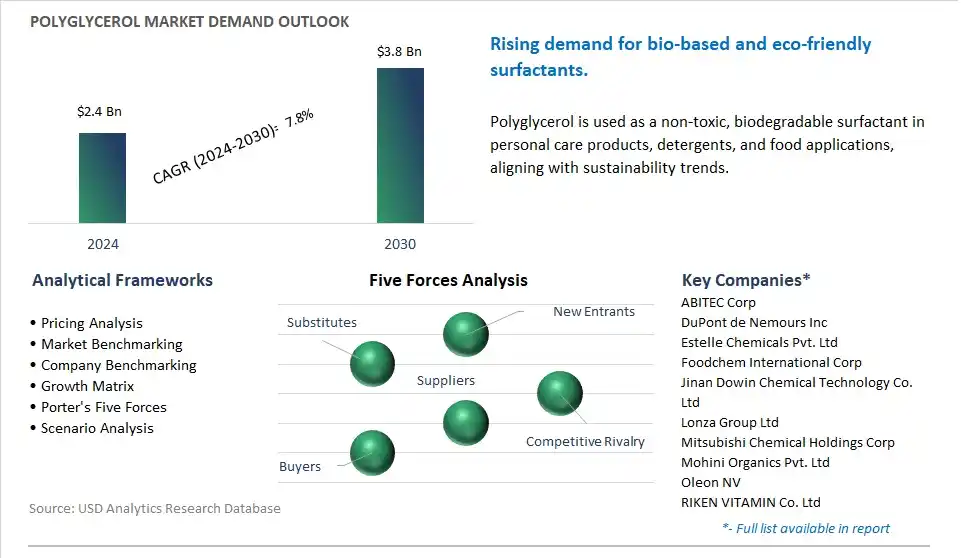
Polyglycerol Market Competitive Landscape
The market report analyses the leading companies in the industry including ABITEC Corp, DuPont de Nemours Inc, Estelle Chemicals Pvt. Ltd, Foodchem International Corp, Jinan Dowin Chemical Technology Co. Ltd, Lonza Group Ltd, Mitsubishi Chemical Holdings Corp, Mohini Organics Pvt. Ltd, Oleon NV, RIKEN VITAMIN Co. Ltd, Sakamoto Yakuhin kogyo Co. Ltd, Venus Ethoxyethers Pvt. Ltd.
Polyglycerol Market Dynamics
Polyglycerol Market Trend: Rising Demand for Natural and Sustainable Ingredients
A prominent trend in the polyglycerol market is the increasing demand for natural and sustainable ingredients in various industries. Polyglycerol, derived from renewable sources such as vegetable oils, offers a sustainable alternative to traditional petroleum-based polyols. With growing consumer awareness and regulatory initiatives focused on environmental sustainability, there is a shift towards the use of bio-based and eco-friendly ingredients in sectors such as food and beverage, cosmetics, pharmaceuticals, and personal care. Polyglycerol's versatility as an emulsifier, moisturizer, and stabilizer makes it a preferred choice for formulators seeking natural and sustainable solutions to meet consumer preferences and regulatory requirements, driving its adoption across diverse applications.
Polyglycerol Market Driver: Growth in Clean Label and Natural Products
The market for polyglycerol is driven by the growth in clean label and natural products across various industries. Clean label products, which are free from artificial additives, preservatives, and synthetic chemicals, are gaining popularity among consumers seeking healthier and more transparent options. Polyglycerol, with its natural origin and multifunctional properties, aligns well with the clean label trend, enabling manufacturers to formulate products with simpler ingredient lists without compromising on performance or quality. This growing demand for clean label and natural products is driving the use of polyglycerol as a key ingredient in food, cosmetics, and personal care formulations, fueling market growth in these sectors.
Polyglycerol Market Opportunity: Expansion into Biopolymer and Biomedical Applications
A potential opportunity in the polyglycerol market lies in expanding its applications into biopolymer and biomedical sectors. Polyglycerol's biocompatibility, water solubility, and low toxicity make it suitable for various biomedical applications, including drug delivery, tissue engineering, and medical device coatings. Additionally, polyglycerol can be utilized as a building block for the synthesis of biodegradable polymers with tunable properties, offering opportunities for developing sustainable materials for packaging, biomedical implants, and controlled release systems. By exploring new avenues in biopolymer and biomedical fields, manufacturers can diversify their product offerings and capitalize on the growing demand for biocompatible and eco-friendly materials, thereby expanding the scope and reach of the polyglycerol market.
Polyglycerol Market Share Analysis: Polyglycerol Esters generated the highest revenue in 2024
The largest segment in the Polyglycerol Market is the Polyglycerol Esters type. Polyglycerol esters are versatile compounds that find extensive applications across various industries due to their unique properties and functionalities. They are commonly used as emulsifiers, surfactants, stabilizers, and lubricants in food and beverage products, cosmetics, pharmaceuticals, personal care products, and industrial applications. In the food industry, polyglycerol esters are widely utilized to improve texture, shelf-life, and sensory characteristics in baked goods, dairy products, confectionery, and margarine. Additionally, polyglycerol esters exhibit excellent emulsifying properties, enabling the creation of stable oil-in-water emulsions in food and cosmetic formulations. Further, polyglycerol esters are considered safe for consumption and are approved for use by regulatory agencies such as the Food and Drug Administration (FDA) and the European Food Safety Authority (EFSA), further driving their widespread adoption in the food and beverage industry. Furthermore, advancements in manufacturing processes and the availability of a wide range of polyglycerol ester grades with varying molecular weights and functionalities contribute to their dominance in the Polyglycerol Market. Over the forecast period, the versatile applications, regulatory approvals, and availability of polyglycerol esters make them the largest segment in the Polyglycerol Market.
Polyglycerol Market Share Analysis: Food Additives application segment is poised to register the fastest growth rate (CAGR) over the forecast period to 2030
The fastest-growing segment in the Polyglycerol Market is the Food Additives application category. There is an increasing consumer demand for clean-label and natural food ingredients, prompting food manufacturers to seek alternatives to traditional synthetic additives. Polyglycerol, derived from natural sources such as vegetable oils, is perceived as a more natural and sustainable option for food formulation compared to synthetic additives. Accordingly, there is a growing adoption of polyglycerol as a food additive in various food and beverage products, including baked goods, dairy products, confectionery, sauces, dressings, and beverages. Additionally, polyglycerol exhibits multifunctional properties as a humectant, stabilizer, thickener, and emulsifier, enabling its versatile application in food formulations to improve texture, shelf-life, and sensory attributes. Further, polyglycerol's ability to enhance the stability of emulsions, prevent crystallization, and control moisture migration in food products contributes to its popularity among food manufacturers. Furthermore, regulatory approvals for the use of polyglycerol in food applications by authorities such as the Food and Drug Administration (FDA) and the European Food Safety Authority (EFSA) provide confidence to manufacturers and consumers regarding its safety and efficacy. Over the forecast period, the increasing consumer preference for natural and clean-label food ingredients, coupled with the multifunctional properties and regulatory approvals of polyglycerol, drive its rapid growth in the Food Additives application segment of the Polyglycerol Market.
Polyglycerol Market Share Analysis: Cosmetics end-user segment is poised to register the fastest growth rate (CAGR) over the forecast period to 2030
The fastest-growing segment in the Polyglycerol Market is the Cosmetics end-user category. There is a rising demand for multifunctional and sustainable ingredients in the cosmetics industry, driven by consumer preferences for natural and environmentally friendly products. Polyglycerol, derived from renewable sources such as vegetable oils, fits this demand profile well, positioning it as a favored ingredient in cosmetic formulations. Polyglycerol offers various benefits in cosmetics, including its ability to act as a humectant, emollient, and skin-conditioning agent. It helps to improve the texture, hydration, and overall performance of cosmetic products such as creams, lotions, serums, and makeup. Additionally, polyglycerol exhibits excellent solubility in both water and oil phases, making it compatible with a wide range of cosmetic formulations and enabling its incorporation into diverse product types. Furthermore, polyglycerol's non-toxic and non-irritating properties make it suitable for use in skincare products for sensitive skin types, further expanding its application in the cosmetics industry. Further, the growing trend towards clean beauty and the increasing emphasis on transparency and sustainability in cosmetics formulations contribute to the rising demand for polyglycerol as a preferred ingredient among cosmetic manufacturers. Over the forecast period, the multifunctional properties, sustainability credentials, and compatibility of polyglycerol with cosmetic formulations drive its rapid growth in the Cosmetics end-user segment of the Polyglycerol Market.
Polyglycerol Market Report Segmentation
By Type
Polyglycerol Polyricinoleate
Polyglycerol Esters
Polyglycerol Sebacate
Others
By Application
Food Additives
Emulsifiers
Stabilizers
Others
By End-User
Food & Beverage
Cosmetics
Pharmaceuticals
Others
Regions Included
North America (US, Canada, Mexico)
Europe (Germany, UK, France, Spain, Italy, Russia, Rest of Europe)
Asia Pacific (China, India, Japan, South Korea, Australia, South East Asia, Rest of Asia)
South America (Brazil, Argentina, Rest of South America)
Middle East and Africa (Saudi Arabia, UAE, Rest of Middle East, South Africa, Egypt, Rest of Africa)
Polyglycerol Companies Profiled in the Market Study
ABITEC Corp
DuPont de Nemours Inc
Estelle Chemicals Pvt. Ltd
Foodchem International Corp
Jinan Dowin Chemical Technology Co. Ltd
Lonza Group Ltd
Mitsubishi Chemical Holdings Corp
Mohini Organics Pvt. Ltd
Oleon NV
RIKEN VITAMIN Co. Ltd
Sakamoto Yakuhin kogyo Co. Ltd
Venus Ethoxyethers Pvt. Ltd
*- List Not Exhaustive
TABLE OF CONTENTS
1 Introduction to 2024 Polyglycerol Market
1.1 Market Overview
1.2 Quick Facts
1.3 Scope/Objective of the Study
1.4 Market Definition
1.5 Countries and Regions Covered
1.6 Units, Currency, and Conversions
1.7 Industry Value Chain
2 Research Methodology
2.1 Market Size Estimation
2.2 Sources and Research Methodology
2.3 Data Triangulation
2.4 Assumptions and Limitations
3 Executive Summary
3.1 Global Polyglycerol Market Size Outlook, $ Million, 2021 to 2030
3.2 Polyglycerol Market Outlook by Type, $ Million, 2021 to 2030
3.3 Polyglycerol Market Outlook by Product, $ Million, 2021 to 2030
3.4 Polyglycerol Market Outlook by Application, $ Million, 2021 to 2030
3.5 Polyglycerol Market Outlook by Key Countries, $ Million, 2021 to 2030
4 Market Dynamics
4.1 Key Driving Forces of Polyglycerol Industry
4.2 Key Market Trends in Polyglycerol Industry
4.3 Potential Opportunities in Polyglycerol Industry
4.4 Key Challenges in Polyglycerol Industry
5 Market Factor Analysis
5.1 Value Chain Analysis
5.2 Competitive Landscape
5.2.1 Global Polyglycerol Market Share by Company (%), 2023
5.2.2 Product Offerings by Company
5.3 Porter’s Five Forces Analysis
5.4 Pricing Analysis and Outlook
6 Growth Outlook Across Scenarios
6.1 Growth Analysis-Case Scenario Definitions
6.2 Low Growth Scenario Forecasts
6.3 Reference Growth Scenario Forecasts
6.4 High Growth Scenario Forecasts
7 Global Polyglycerol Market Outlook by Segments
7.1 Polyglycerol Market Outlook by Segments, $ Million, 2021- 2030
By Type
Polyglycerol Polyricinoleate
Polyglycerol Esters
Polyglycerol Sebacate
Others
By Application
Food Additives
Emulsifiers
Stabilizers
Others
By End-User
Food & Beverage
Cosmetics
Pharmaceuticals
Others
8 North America Polyglycerol Market Analysis and Outlook To 2030
8.1 Introduction to North America Polyglycerol Markets in 2024
8.2 North America Polyglycerol Market Size Outlook by Country, 2021-2030
8.2.1 United States
8.2.2 Canada
8.2.3 Mexico
8.3 North America Polyglycerol Market size Outlook by Segments, 2021-2030
By Type
Polyglycerol Polyricinoleate
Polyglycerol Esters
Polyglycerol Sebacate
Others
By Application
Food Additives
Emulsifiers
Stabilizers
Others
By End-User
Food & Beverage
Cosmetics
Pharmaceuticals
Others
9 Europe Polyglycerol Market Analysis and Outlook To 2030
9.1 Introduction to Europe Polyglycerol Markets in 2024
9.2 Europe Polyglycerol Market Size Outlook by Country, 2021-2030
9.2.1 Germany
9.2.2 France
9.2.3 Spain
9.2.4 United Kingdom
9.2.4 Italy
9.2.5 Russia
9.2.6 Norway
9.2.7 Rest of Europe
9.3 Europe Polyglycerol Market Size Outlook by Segments, 2021-2030
By Type
Polyglycerol Polyricinoleate
Polyglycerol Esters
Polyglycerol Sebacate
Others
By Application
Food Additives
Emulsifiers
Stabilizers
Others
By End-User
Food & Beverage
Cosmetics
Pharmaceuticals
Others
10 Asia Pacific Polyglycerol Market Analysis and Outlook To 2030
10.1 Introduction to Asia Pacific Polyglycerol Markets in 2024
10.2 Asia Pacific Polyglycerol Market Size Outlook by Country, 2021-2030
10.2.1 China
10.2.2 India
10.2.3 Japan
10.2.4 South Korea
10.2.5 Indonesia
10.2.6 Malaysia
10.2.7 Australia
10.2.8 Rest of Asia Pacific
10.3 Asia Pacific Polyglycerol Market size Outlook by Segments, 2021-2030
By Type
Polyglycerol Polyricinoleate
Polyglycerol Esters
Polyglycerol Sebacate
Others
By Application
Food Additives
Emulsifiers
Stabilizers
Others
By End-User
Food & Beverage
Cosmetics
Pharmaceuticals
Others
11 South America Polyglycerol Market Analysis and Outlook To 2030
11.1 Introduction to South America Polyglycerol Markets in 2024
11.2 South America Polyglycerol Market Size Outlook by Country, 2021-2030
11.2.1 Brazil
11.2.2 Argentina
11.2.3 Rest of South America
11.3 South America Polyglycerol Market size Outlook by Segments, 2021-2030
By Type
Polyglycerol Polyricinoleate
Polyglycerol Esters
Polyglycerol Sebacate
Others
By Application
Food Additives
Emulsifiers
Stabilizers
Others
By End-User
Food & Beverage
Cosmetics
Pharmaceuticals
Others
12 Middle East and Africa Polyglycerol Market Analysis and Outlook To 2030
12.1 Introduction to Middle East and Africa Polyglycerol Markets in 2024
12.2 Middle East and Africa Polyglycerol Market Size Outlook by Country, 2021-2030
12.2.1 Saudi Arabia
12.2.2 UAE
12.2.3 Oman
12.2.4 Rest of Middle East
12.2.5 Egypt
12.2.6 Nigeria
12.2.7 South Africa
12.2.8 Rest of Africa
12.3 Middle East and Africa Polyglycerol Market size Outlook by Segments, 2021-2030
By Type
Polyglycerol Polyricinoleate
Polyglycerol Esters
Polyglycerol Sebacate
Others
By Application
Food Additives
Emulsifiers
Stabilizers
Others
By End-User
Food & Beverage
Cosmetics
Pharmaceuticals
Others
13 Company Profiles
13.1 Company Snapshot
13.2 SWOT Profiles
13.3 Products and Services
13.4 Recent Developments
13.5 Financial Profile
ABITEC Corp
DuPont de Nemours Inc
Estelle Chemicals Pvt. Ltd
Foodchem International Corp
Jinan Dowin Chemical Technology Co. Ltd
Lonza Group Ltd
Mitsubishi Chemical Holdings Corp
Mohini Organics Pvt. Ltd
Oleon NV
RIKEN VITAMIN Co. Ltd
Sakamoto Yakuhin kogyo Co. Ltd
Venus Ethoxyethers Pvt. Ltd
14 Appendix
14.1 Customization Offerings
14.2 Subscription Services
14.3 Related Reports
14.4 Publisher Expertise
By Type
Polyglycerol Polyricinoleate
Polyglycerol Esters
Polyglycerol Sebacate
Others
By Application
Food Additives
Emulsifiers
Stabilizers
Others
By End-User
Food & Beverage
Cosmetics
Pharmaceuticals
Others
Countries Analyzed
North America (US, Canada, Mexico)
Europe (Germany, UK, France, Spain, Italy, Russia, Rest of Europe)
Asia Pacific (China, India, Japan, South Korea, Australia, South East Asia, Rest of Asia)
South America (Brazil, Argentina, Rest of South America)
Middle East and Africa (Saudi Arabia, UAE, Rest of Middle East, South Africa, Egypt, Rest of Africa)
