The global Polyhydroxybutyrate-co-hydroxyvalerate Market is poised to register a 15.6% CAGR from $48.6 Million in 2024 to $116 Million in 2030.
The global Polyhydroxybutyrate-co-hydroxyvalerate Market Study analyzes and forecasts the market size across 6 regions and 24 countries for diverse segments -By Type (Sewage Sludge, Industrial Waste Water, Food Waste), By Application (Packaging, Agriculture, Medical, Others).
An Introduction to Global Polyhydroxybutyrate co hydroxyvalerate Market in 2024
With a growing emphasis on reducing plastic pollution and transitioning towards a circular economy, PHBV holds significant promise in the bioplastics market. Key trends shaping the future of PHBV include innovations in production techniques, such as microbial fermentation and chemical synthesis, aimed at enhancing its properties and lowering production costs. The versatility of PHBV, coupled with its biodegradability and biocompatibility, makes it suitable for a wide range of applications, including packaging, agriculture, and medical devices. Moreover, increasing consumer awareness and government regulations promoting eco-friendly alternatives are driving the adoption of PHBV, paving the way for its widespread use in various industries.
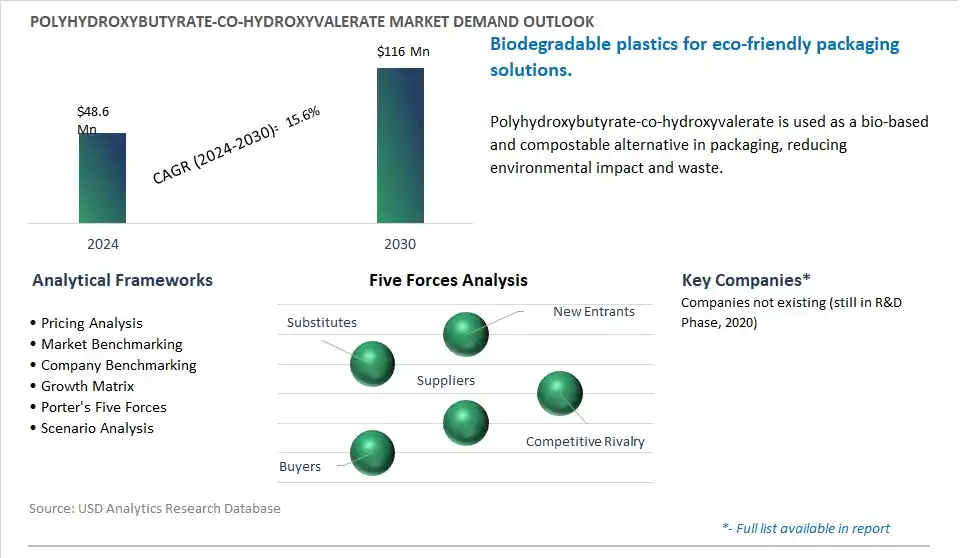
Polyhydroxybutyrate-co-hydroxyvalerate Market Competitive Landscape
The market report analyses the leading companies in the industry including Companies not existing (still in R&D Phase, 2020).
Polyhydroxybutyrate-co-hydroxyvalerate Market Dynamics
Polyhydroxybutyrate co hydroxyvalerate Market Trend: Increasing Focus on Biodegradable Packaging Solutions
A prominent trend in the polyhydroxybutyrate co-hydroxyvalerate (PHBV) market is the increasing focus on biodegradable packaging solutions. With growing concerns about plastic pollution and environmental sustainability, there is a rising demand for biodegradable alternatives to conventional plastics in the packaging industry. PHBV, a biopolymer derived from renewable resources such as plant sugars, offers excellent biodegradability, compostability, and mechanical properties, making it an attractive option for sustainable packaging applications. As consumers and businesses prioritize eco-friendly packaging solutions, the demand for PHBV-based packaging materials is expected to continue growing, driving market expansion in the bioplastics sector.
Polyhydroxybutyrate co hydroxyvalerate Market Driver: Regulatory Support for Sustainable Materials
The market for polyhydroxybutyrate co-hydroxyvalerate (PHBV) is driven by regulatory support for sustainable materials and initiatives aimed at reducing plastic waste. Governments around the world are implementing regulations and policies to promote the use of biodegradable and compostable materials as alternatives to conventional plastics. This regulatory landscape creates a favorable environment for the adoption of PHBV, as it aligns with the goals of reducing plastic pollution and promoting a circular economy. With increasing awareness of environmental issues and regulatory pressures, industries are increasingly turning to sustainable materials like PHBV to comply with regulations, meet consumer expectations, and enhance their environmental stewardship practices, thereby driving market demand.
Polyhydroxybutyrate co hydroxyvalerate Market Opportunity: Expansion into Biomedical and Agricultural Applications
A potential opportunity in the polyhydroxybutyrate co-hydroxyvalerate (PHBV) market lies in expanding its applications beyond packaging into biomedical and agricultural sectors. PHBV's biocompatibility, biodegradability, and tunable properties make it suitable for various biomedical applications, including tissue engineering, drug delivery, and medical implants. Additionally, PHBV can be utilized in agricultural applications such as mulching films, soil stabilization mats, and controlled-release fertilizers, offering biodegradable alternatives to conventional petroleum-based materials. By leveraging its unique properties and exploring new applications in biomedical and agricultural fields, PHBV manufacturers can diversify their product portfolio and tap into additional market segments, driving further growth and adoption of this sustainable biopolymer.
Polyhydroxybutyrate-co-hydroxyvalerate Market Share Analysis: Industrial Waste Water generated the highest revenue in 2024
The largest segment in the Polyhydroxybutyrate-co-hydroxyvalerate (PHBV) Market is the Industrial Waste Water type. Industrial wastewater treatment is a critical aspect of environmental management and regulatory compliance for industries across sectors such as manufacturing, chemical processing, and pharmaceuticals. PHBV, a biodegradable polymer derived from renewable resources, offers a sustainable solution for the remediation of industrial wastewater. PHBV possesses unique properties such as biodegradability, biocompatibility, and adsorption capacity, making it an effective adsorbent material for the removal of pollutants and contaminants from industrial effluents. In industrial wastewater treatment applications, PHBV-based adsorbents can selectively adsorb heavy metals, organic compounds, dyes, and other pollutants, thereby improving water quality and reducing environmental pollution. Additionally, PHBV materials can be engineered to enhance specific adsorption properties, such as surface area, pore size distribution, and surface chemistry, to optimize their performance in industrial wastewater treatment processes. Further, the growing awareness of environmental sustainability and the increasing stringency of regulations governing industrial wastewater discharge drive the demand for innovative and eco-friendly solutions like PHBV-based adsorbents. Furthermore, advancements in PHBV production technologies and the development of cost-effective manufacturing processes contribute to the widespread adoption of PHBV in industrial wastewater treatment applications. Over the forecast period, the effective adsorption capabilities, environmental benefits, and regulatory compliance drive the dominance of the Industrial Waste Water segment in the Polyhydroxybutyrate-co-hydroxyvalerate Market.
Polyhydroxybutyrate-co-hydroxyvalerate Market Share Analysis: Packaging application segment is poised to register the fastest growth rate (CAGR) over the forecast period to 2030
The fastest-growing segment in the Polyhydroxybutyrate-co-hydroxyvalerate (PHBV) Market is the Packaging application category. There is a growing global demand for sustainable and eco-friendly packaging materials driven by increasing environmental concerns and regulatory pressures to reduce plastic pollution. PHBV, being a biodegradable and compostable polymer derived from renewable resources, presents a promising solution to address these challenges. PHBV-based packaging materials offer similar or superior properties to traditional petroleum-based plastics in terms of mechanical strength, barrier properties, and shelf-life stability, while also being biodegradable and compostable under industrial composting conditions. Additionally, PHBV packaging materials can be customized to meet specific application requirements, such as food packaging, agricultural packaging, and consumer goods packaging, further expanding their market potential. Further, the rising consumer awareness and preference for sustainable packaging solutions drive the adoption of PHBV-based packaging by brand owners, retailers, and consumers. Furthermore, technological advancements in PHBV production processes, including fermentation techniques and polymer blending methods, enable cost-effective and scalable manufacturing of PHBV packaging materials, contributing to their rapid market growth. Over the forecast period, the combination of environmental benefits, regulatory support, consumer demand, and technological advancements propel the Packaging application segment to be the fastest-growing in the Polyhydroxybutyrate-co-hydroxyvalerate Market.
Polyhydroxybutyrate-co-hydroxyvalerate Market Report Segmentation
By Type
Sewage Sludge
Industrial Waste Water
Food Waste
By Application
Packaging
Agriculture
Medical
Others
Regions Included
North America (US, Canada, Mexico)
Europe (Germany, UK, France, Spain, Italy, Russia, Rest of Europe)
Asia Pacific (China, India, Japan, South Korea, Australia, South East Asia, Rest of Asia)
South America (Brazil, Argentina, Rest of South America)
Middle East and Africa (Saudi Arabia, UAE, Rest of Middle East, South Africa, Egypt, Rest of Africa)
Polyhydroxybutyrate-co-hydroxyvalerate Companies Profiled in the Market Study
Companies not existing (still in R&D Phase, 2020)
*- List Not Exhaustive
TABLE OF CONTENTS
1 Introduction to 2024 Polyhydroxybutyrate-co-hydroxyvalerate Market
1.1 Market Overview
1.2 Quick Facts
1.3 Scope/Objective of the Study
1.4 Market Definition
1.5 Countries and Regions Covered
1.6 Units, Currency, and Conversions
1.7 Industry Value Chain
2 Research Methodology
2.1 Market Size Estimation
2.2 Sources and Research Methodology
2.3 Data Triangulation
2.4 Assumptions and Limitations
3 Executive Summary
3.1 Global Polyhydroxybutyrate-co-hydroxyvalerate Market Size Outlook, $ Million, 2021 to 2030
3.2 Polyhydroxybutyrate-co-hydroxyvalerate Market Outlook by Type, $ Million, 2021 to 2030
3.3 Polyhydroxybutyrate-co-hydroxyvalerate Market Outlook by Product, $ Million, 2021 to 2030
3.4 Polyhydroxybutyrate-co-hydroxyvalerate Market Outlook by Application, $ Million, 2021 to 2030
3.5 Polyhydroxybutyrate-co-hydroxyvalerate Market Outlook by Key Countries, $ Million, 2021 to 2030
4 Market Dynamics
4.1 Key Driving Forces of Polyhydroxybutyrate-co-hydroxyvalerate Industry
4.2 Key Market Trends in Polyhydroxybutyrate-co-hydroxyvalerate Industry
4.3 Potential Opportunities in Polyhydroxybutyrate-co-hydroxyvalerate Industry
4.4 Key Challenges in Polyhydroxybutyrate-co-hydroxyvalerate Industry
5 Market Factor Analysis
5.1 Value Chain Analysis
5.2 Competitive Landscape
5.2.1 Global Polyhydroxybutyrate-co-hydroxyvalerate Market Share by Company (%), 2023
5.2.2 Product Offerings by Company
5.3 Porter’s Five Forces Analysis
5.4 Pricing Analysis and Outlook
6 Growth Outlook Across Scenarios
6.1 Growth Analysis-Case Scenario Definitions
6.2 Low Growth Scenario Forecasts
6.3 Reference Growth Scenario Forecasts
6.4 High Growth Scenario Forecasts
7 Global Polyhydroxybutyrate-co-hydroxyvalerate Market Outlook by Segments
7.1 Polyhydroxybutyrate-co-hydroxyvalerate Market Outlook by Segments, $ Million, 2021- 2030
By Type
Sewage Sludge
Industrial Waste Water
Food Waste
By Application
Packaging
Agriculture
Medical
Others
8 North America Polyhydroxybutyrate-co-hydroxyvalerate Market Analysis and Outlook To 2030
8.1 Introduction to North America Polyhydroxybutyrate-co-hydroxyvalerate Markets in 2024
8.2 North America Polyhydroxybutyrate-co-hydroxyvalerate Market Size Outlook by Country, 2021-2030
8.2.1 United States
8.2.2 Canada
8.2.3 Mexico
8.3 North America Polyhydroxybutyrate-co-hydroxyvalerate Market size Outlook by Segments, 2021-2030
By Type
Sewage Sludge
Industrial Waste Water
Food Waste
By Application
Packaging
Agriculture
Medical
Others
9 Europe Polyhydroxybutyrate-co-hydroxyvalerate Market Analysis and Outlook To 2030
9.1 Introduction to Europe Polyhydroxybutyrate-co-hydroxyvalerate Markets in 2024
9.2 Europe Polyhydroxybutyrate-co-hydroxyvalerate Market Size Outlook by Country, 2021-2030
9.2.1 Germany
9.2.2 France
9.2.3 Spain
9.2.4 United Kingdom
9.2.4 Italy
9.2.5 Russia
9.2.6 Norway
9.2.7 Rest of Europe
9.3 Europe Polyhydroxybutyrate-co-hydroxyvalerate Market Size Outlook by Segments, 2021-2030
By Type
Sewage Sludge
Industrial Waste Water
Food Waste
By Application
Packaging
Agriculture
Medical
Others
10 Asia Pacific Polyhydroxybutyrate-co-hydroxyvalerate Market Analysis and Outlook To 2030
10.1 Introduction to Asia Pacific Polyhydroxybutyrate-co-hydroxyvalerate Markets in 2024
10.2 Asia Pacific Polyhydroxybutyrate-co-hydroxyvalerate Market Size Outlook by Country, 2021-2030
10.2.1 China
10.2.2 India
10.2.3 Japan
10.2.4 South Korea
10.2.5 Indonesia
10.2.6 Malaysia
10.2.7 Australia
10.2.8 Rest of Asia Pacific
10.3 Asia Pacific Polyhydroxybutyrate-co-hydroxyvalerate Market size Outlook by Segments, 2021-2030
By Type
Sewage Sludge
Industrial Waste Water
Food Waste
By Application
Packaging
Agriculture
Medical
Others
11 South America Polyhydroxybutyrate-co-hydroxyvalerate Market Analysis and Outlook To 2030
11.1 Introduction to South America Polyhydroxybutyrate-co-hydroxyvalerate Markets in 2024
11.2 South America Polyhydroxybutyrate-co-hydroxyvalerate Market Size Outlook by Country, 2021-2030
11.2.1 Brazil
11.2.2 Argentina
11.2.3 Rest of South America
11.3 South America Polyhydroxybutyrate-co-hydroxyvalerate Market size Outlook by Segments, 2021-2030
By Type
Sewage Sludge
Industrial Waste Water
Food Waste
By Application
Packaging
Agriculture
Medical
Others
12 Middle East and Africa Polyhydroxybutyrate-co-hydroxyvalerate Market Analysis and Outlook To 2030
12.1 Introduction to Middle East and Africa Polyhydroxybutyrate-co-hydroxyvalerate Markets in 2024
12.2 Middle East and Africa Polyhydroxybutyrate-co-hydroxyvalerate Market Size Outlook by Country, 2021-2030
12.2.1 Saudi Arabia
12.2.2 UAE
12.2.3 Oman
12.2.4 Rest of Middle East
12.2.5 Egypt
12.2.6 Nigeria
12.2.7 South Africa
12.2.8 Rest of Africa
12.3 Middle East and Africa Polyhydroxybutyrate-co-hydroxyvalerate Market size Outlook by Segments, 2021-2030
By Type
Sewage Sludge
Industrial Waste Water
Food Waste
By Application
Packaging
Agriculture
Medical
Others
13 Company Profiles
13.1 Company Snapshot
13.2 SWOT Profiles
13.3 Products and Services
13.4 Recent Developments
13.5 Financial Profile
Companies not existing (still in R&D Phase, 2020)
14 Appendix
14.1 Customization Offerings
14.2 Subscription Services
14.3 Related Reports
14.4 Publisher Expertise
By Type
Sewage Sludge
Industrial Waste Water
Food Waste
By Application
Packaging
Agriculture
Medical
Others
Countries Analyzed
North America (US, Canada, Mexico)
Europe (Germany, UK, France, Spain, Italy, Russia, Rest of Europe)
Asia Pacific (China, India, Japan, South Korea, Australia, South East Asia, Rest of Asia)
South America (Brazil, Argentina, Rest of South America)
Middle East and Africa (Saudi Arabia, UAE, Rest of Middle East, South Africa, Egypt, Rest of Africa)
