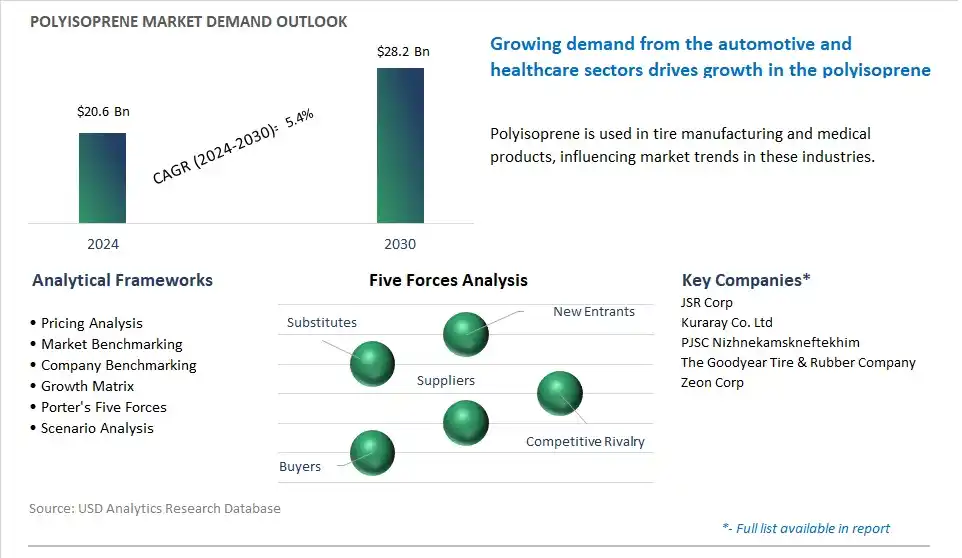
The global Polyisoprene Market is poised to register a 5.4% CAGR from $20.6 Billion in 2025 to $28.2 Billion in 2034.
The global Polyisoprene Market Study analyzes and forecasts the market size across 6 regions and 24 countries for diverse segments -By Application (Tires and Related Products, Latex, Footwear, Non-Automotive Engineering, Belts and Hose, Others), By Type (Natural Rubber, Synthetic Rubber).
An Introduction to Global Polyisoprene Market in 2025
The polyisoprene market is witnessing significant growth propelled by the healthcare sector's demand for synthetic rubber. As the global population ages and healthcare standards rise, there is an increased need for medical devices and products, such as surgical gloves, catheters, and condoms, which rely on polyisoprene. Moreover, advancements in polymerization techniques are enabling the production of high-quality synthetic polyisoprene with properties similar to natural rubber, thus reducing dependence on natural resources and ensuring a stable supply chain. Furthermore, ongoing research into bio-based polyisoprene is poised to revolutionize the market by offering sustainable alternatives.
Polyisoprene Market Competitive Landscape
The market report analyses the leading companies in the industry including JSR Corp, Kuraray Co. Ltd, PJSC Nizhnekamskneftekhim, The Goodyear Tire & Rubber Company, Zeon Corp.
Polyisoprene Market Dynamics
Polyisoprene Market Trend: Growing Demand for Biodegradable Rubber Products
A prominent trend in the polyisoprene market is the growing demand for biodegradable rubber products. As environmental concerns continue to escalate and regulations become more stringent, there is a significant shift towards sustainable materials in various industries. Polyisoprene, a natural rubber polymer, offers biodegradability and eco-friendliness, making it an attractive alternative to synthetic rubbers derived from petroleum. This trend is driving the adoption of polyisoprene in applications such as medical devices, disposable gloves, and eco-friendly packaging materials, where biodegradability and low environmental impact are valued.
Polyisoprene Market Driver: Expansion of Healthcare and Medical Industries
A key driver for the polyisoprene market is the expansion of the healthcare and medical industries. Polyisoprene rubber is widely used in medical applications due to its biocompatibility, flexibility, and resistance to tearing and puncture. With the increasing demand for healthcare services, advancements in medical technology, and the growing aging population, there is a rising need for medical devices, surgical gloves, catheters, and other healthcare products made from polyisoprene. Additionally, the COVID-19 pandemic has further underscored the importance of medical-grade rubber materials, driving the demand for polyisoprene-based products in infection control, diagnostics, and patient care.
Polyisoprene Market Opportunity: Development of High-Performance Polyisoprene Compounds
An opportunity within the polyisoprene market lies in the development of high-performance polyisoprene compounds tailored to specific applications and performance requirements. While polyisoprene offers excellent properties such as elasticity, resilience, and biocompatibility, there is potential for further optimization to meet the evolving needs of end-users. Manufacturers can capitalize on this opportunity by investing in research and development to formulate polyisoprene compounds with enhanced mechanical properties, chemical resistance, and thermal stability. By developing specialized grades of polyisoprene tailored to industries such as automotive, aerospace, and industrial manufacturing, companies can expand their product portfolio, cater to niche markets, and differentiate themselves in a competitive landscape. Additionally, there is an opportunity to collaborate with end-users and supply chain partners to co-develop innovative polyisoprene solutions that address specific performance challenges and create value across diverse applications.
Polyisoprene Market Share Analysis: Tires and Related Products segment generated the highest revenue in the industry
The Tires and Related Products segment is the largest segment in the Polyisoprene Market due to diverse key factors contributing to its dominance. Polyisoprene, a synthetic rubber, is widely utilized in the manufacturing of tires and related automotive products due to its exceptional properties such as high tensile strength, abrasion resistance, elasticity, and resilience. One of the primary reasons for the dominance of the Tires and Related Products segment is the significant global demand for tires across various transportation sectors, including automotive, commercial, and industrial. Polyisoprene-based tires offer superior performance characteristics, including excellent traction, durability, fuel efficiency, and safety, making them indispensable components in vehicles worldwide. In addition, the automotive industry's continuous innovation and the adoption of advanced tire technologies, including run-flat tires, low rolling resistance tires, and all-weather tires, drive the demand for polyisoprene as a key raw material in tire manufacturing. Additionally, the growing automotive production, expanding vehicle fleet size, and increasing demand for replacement tires due to wear and tear further contribute to the dominance of the Tires and Related Products segment in the Polyisoprene Market. Further, polyisoprene is also used in various related automotive products such as inner tubes, tire treads, seals, gaskets, and vibration damping components, further bolstering its significance in the automotive sector. As the automotive industry continues to evolve, driven by trends such as electrification, autonomous driving, and sustainability, the demand for polyisoprene-based tires and related products is expected to remain strong, solidifying the Tires and Related Products segment as the largest segment in the Polyisoprene Market.
Polyisoprene Market Share Analysis: Synthetic Rubber Segment is poised to register the fastest growth rate (CAGR) over the forecast period to 2030
The Synthetic Rubber segment is the fastest growing segment in the Polyisoprene Market due to diverse key factors driving its rapid expansion. Synthetic rubber, including polyisoprene, is experiencing increasing demand globally due to its versatility, consistency, and performance advantages over natural rubber. One of the primary reasons for the rapid growth of the Synthetic Rubber segment is the growing demand for synthetic rubber in various end-use industries, including automotive, construction, industrial manufacturing, and consumer goods. Synthetic rubber offers diverse advantages over natural rubber, including better resistance to heat, abrasion, weathering, and chemicals, as well as enhanced durability, uniformity, and processing characteristics. Additionally, the synthetic rubber industry benefits from advancements in polymerization technologies, process efficiencies, and product innovation, enabling manufacturers to develop synthetic rubber grades with tailored properties to meet specific application requirements. In addition, the increasing adoption of synthetic rubber in tire manufacturing, particularly in high-performance tires, contributes significantly to the growth of the Synthetic Rubber segment. Synthetic rubber-based tires offer improved fuel efficiency, traction, handling, and tread wear characteristics compared to natural rubber-based tires, driving their adoption in passenger cars, trucks, buses, and specialty vehicles. Further, the Synthetic Rubber segment benefits from the rising demand for sustainable and eco-friendly materials in response to environmental concerns and regulatory pressures. Synthetic rubber offers opportunities for improved resource utilization, reduced dependency on natural rubber, and enhanced product consistency and performance, making it an attractive choice for manufacturers seeking sustainable solutions. As industries continue to prioritize performance, efficiency, and sustainability, the demand for synthetic rubber, including polyisoprene, is expected to experience robust growth, making the Synthetic Rubber segment the fastest growing segment in the Polyisoprene Market.
Polyisoprene Market Report Segmentation
By Application
Tires and Related Products
Latex
Footwear
Non-Automotive Engineering
Belts and Hose
Others
By Type
Natural Rubber
Synthetic Rubber
Regions Included
North America (US, Canada, Mexico)
Europe (Germany, UK, France, Spain, Italy, Russia, Rest of Europe)
Asia Pacific (China, India, Japan, South Korea, Australia, South East Asia, Rest of Asia)
South America (Brazil, Argentina, Rest of South America)
Middle East and Africa (Saudi Arabia, UAE, Rest of Middle East, South Africa, Egypt, Rest of Africa)
Polyisoprene Companies Profiled in the Market Study
JSR Corp
Kuraray Co. Ltd
PJSC Nizhnekamskneftekhim
The Goodyear Tire & Rubber Company
Zeon Corp
*- List Not Exhaustive
TABLE OF CONTENTS
1 Introduction to 2025 Polyisoprene Market
1.1 Market Overview
1.2 Quick Facts
1.3 Scope/Objective of the Study
1.4 Market Definition
1.5 Countries and Regions Covered
1.6 Units, Currency, and Conversions
1.7 Industry Value Chain
2 Research Methodology
2.1 Market Size Estimation
2.2 Sources and Research Methodology
2.3 Data Triangulation
2.4 Assumptions and Limitations
3 Executive Summary
3.1 Global Polyisoprene Market Size Outlook, $ Million, 2021 to 2034
3.2 Polyisoprene Market Outlook by Type, $ Million, 2021 to 2034
3.3 Polyisoprene Market Outlook by Product, $ Million, 2021 to 2034
3.4 Polyisoprene Market Outlook by Application, $ Million, 2021 to 2034
3.5 Polyisoprene Market Outlook by Key Countries, $ Million, 2021 to 2034
4 Market Dynamics
4.1 Key Driving Forces of Polyisoprene Industry
4.2 Key Market Trends in Polyisoprene Industry
4.3 Potential Opportunities in Polyisoprene Industry
4.4 Key Challenges in Polyisoprene Industry
5 Market Factor Analysis
5.1 Value Chain Analysis
5.2 Competitive Landscape
5.2.1 Global Polyisoprene Market Share by Company (%), 2025
5.2.2 Product Offerings by Company
5.3 Porter’s Five Forces Analysis
5.4 Pricing Analysis and Outlook
6 Growth Outlook Across Scenarios
6.1 Growth Analysis-Case Scenario Definitions
6.2 Low Growth Scenario Forecasts
6.3 Reference Growth Scenario Forecasts
6.4 High Growth Scenario Forecasts
7 Global Polyisoprene Market Outlook by Segments
7.1 Polyisoprene Market Outlook by Segments, $ Million, 2021- 2034
By Application
Tires and Related Products
Latex
Footwear
Non-Automotive Engineering
Belts and Hose
Others
By Type
Natural Rubber
Synthetic Rubber
8 North America Polyisoprene Market Analysis and Outlook To 2030
8.1 Introduction to North America Polyisoprene Markets in 2024
8.2 North America Polyisoprene Market Size Outlook by Country, 2021-2034
8.2.1 United States
8.2.2 Canada
8.2.3 Mexico
8.3 North America Polyisoprene Market size Outlook by Segments, 2021-2034
By Application
Tires and Related Products
Latex
Footwear
Non-Automotive Engineering
Belts and Hose
Others
By Type
Natural Rubber
Synthetic Rubber
9 Europe Polyisoprene Market Analysis and Outlook To 2030
9.1 Introduction to Europe Polyisoprene Markets in 2024
9.2 Europe Polyisoprene Market Size Outlook by Country, 2021-2034
9.2.1 Germany
9.2.2 France
9.2.3 Spain
9.2.4 United Kingdom
9.2.4 Italy
9.2.5 Russia
9.2.6 Norway
9.2.7 Rest of Europe
9.3 Europe Polyisoprene Market Size Outlook by Segments, 2021-2034
By Application
Tires and Related Products
Latex
Footwear
Non-Automotive Engineering
Belts and Hose
Others
By Type
Natural Rubber
Synthetic Rubber
10 Asia Pacific Polyisoprene Market Analysis and Outlook To 2030
10.1 Introduction to Asia Pacific Polyisoprene Markets in 2024
10.2 Asia Pacific Polyisoprene Market Size Outlook by Country, 2021-2034
10.2.1 China
10.2.2 India
10.2.3 Japan
10.2.4 South Korea
10.2.5 Indonesia
10.2.6 Malaysia
10.2.7 Australia
10.2.8 Rest of Asia Pacific
10.3 Asia Pacific Polyisoprene Market size Outlook by Segments, 2021-2034
By Application
Tires and Related Products
Latex
Footwear
Non-Automotive Engineering
Belts and Hose
Others
By Type
Natural Rubber
Synthetic Rubber
11 South America Polyisoprene Market Analysis and Outlook To 2030
11.1 Introduction to South America Polyisoprene Markets in 2024
11.2 South America Polyisoprene Market Size Outlook by Country, 2021-2034
11.2.1 Brazil
11.2.2 Argentina
11.2.3 Rest of South America
11.3 South America Polyisoprene Market size Outlook by Segments, 2021-2034
By Application
Tires and Related Products
Latex
Footwear
Non-Automotive Engineering
Belts and Hose
Others
By Type
Natural Rubber
Synthetic Rubber
12 Middle East and Africa Polyisoprene Market Analysis and Outlook To 2030
12.1 Introduction to Middle East and Africa Polyisoprene Markets in 2024
12.2 Middle East and Africa Polyisoprene Market Size Outlook by Country, 2021-2034
12.2.1 Saudi Arabia
12.2.2 UAE
12.2.3 Oman
12.2.4 Rest of Middle East
12.2.5 Egypt
12.2.6 Nigeria
12.2.7 South Africa
12.2.8 Rest of Africa
12.3 Middle East and Africa Polyisoprene Market size Outlook by Segments, 2021-2034
By Application
Tires and Related Products
Latex
Footwear
Non-Automotive Engineering
Belts and Hose
Others
By Type
Natural Rubber
Synthetic Rubber
13 Company Profiles
13.1 Company Snapshot
13.2 SWOT Profiles
13.3 Products and Services
13.4 Recent Developments
13.5 Financial Profile
JSR Corp
Kuraray Co. Ltd
PJSC Nizhnekamskneftekhim
The Goodyear Tire & Rubber Company
Zeon Corp
14 Appendix
14.1 Customization Offerings
14.2 Subscription Services
14.3 Related Reports
14.4 Publisher Expertise
By Application
Tires and Related Products
Latex
Footwear
Non-Automotive Engineering
Belts and Hose
Others
By Type
Natural Rubber
Synthetic Rubber
Countries Analyzed
North America (US, Canada, Mexico)
Europe (Germany, UK, France, Spain, Italy, Russia, Rest of Europe)
Asia Pacific (China, India, Japan, South Korea, Australia, South East Asia, Rest of Asia)
South America (Brazil, Argentina, Rest of South America)
Middle East and Africa (Saudi Arabia, UAE, Rest of Middle East, South Africa, Egypt, Rest of Africa)
