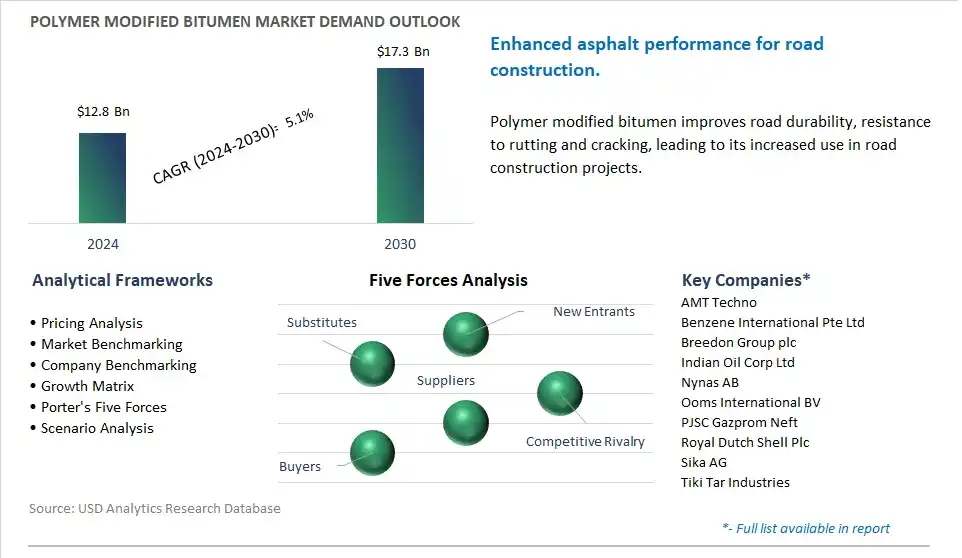
The global Polymer Modified Bitumen Market is poised to register a 5.1% CAGR from $12.8 Billion in 2024 to $17.3 Billion in 2030.
The global Polymer Modified Bitumen Market Study analyzes and forecasts the market size across 6 regions and 24 countries for diverse segments -By Product (Thermoplastic Elastomers, Plastomers), By Application (Road Construction, Roofing, Others).
An Introduction to Global Polymer Modified Bitumen Market in 2024
The polymer modified bitumen (PMB) market is experiencing robust growth, driven by the increasing demand for durable and high-performance asphalt materials in road construction and infrastructure projects. Key trends shaping this industry include the development of polymer-modified binders with enhanced resistance to rutting, cracking, and aging, thereby extending the lifespan of pavements and reducing maintenance costs. Moreover, advancements in polymer chemistry and polymer-bitumen interactions are leading to the optimization of PMB formulations for specific climatic conditions and traffic loads. Additionally, the implementation of sustainable practices in road construction, such as warm mix asphalt technology using PMB, is gaining traction due to its environmental benefits and energy savings. As governments worldwide invest in infrastructure development and transportation networks, the demand for PMB is expected to continue growing steadily.
Polymer Modified Bitumen Market Competitive Landscape
The market report analyses the leading companies in the industry including AMT Techno, Benzene International Pte Ltd, Breedon Group plc, Indian Oil Corp Ltd, Nynas AB, Ooms International BV, PJSC Gazprom Neft, Royal Dutch Shell Plc, Sika AG, Tiki Tar Industries.
Polymer Modified Bitumen Market Dynamics
Polymer Modified Bitumen Market Trend: Growing Adoption in Road Construction and Infrastructure Projects
A prominent trend in the polymer modified bitumen market is the growing adoption of polymer-modified bitumen in road construction and infrastructure projects. Polymer-modified bitumen offers enhanced performance characteristics such as improved resistance to rutting, cracking, fatigue, and aging compared to conventional bitumen. With increasing traffic loads, harsh weather conditions, and the need for durable road surfaces, there is a rising demand for polymer-modified bitumen as a superior paving material for highways, airports, bridges, and urban roads. This is driving the recognition of the benefits of polymer modification in enhancing the durability and longevity of asphalt pavements, driving the widespread use of polymer-modified bitumen in civil engineering projects worldwide.
Polymer Modified Bitumen Market Driver: Infrastructure Development and Urbanization
The market for polymer modified bitumen is driven by infrastructure development initiatives and urbanization trends across the globe. As countries invest in expanding and upgrading their transportation networks, there is a growing demand for high-performance materials such as polymer-modified bitumen to meet the increasing traffic demands and ensure the sustainability of infrastructure assets. Urbanization further drives the need for durable and resilient road surfaces to accommodate growing populations and support economic activities in urban areas. The driver of infrastructure development and urbanization fuels the demand for polymer-modified bitumen in road construction projects, making it a critical component of sustainable infrastructure development strategies.
Polymer Modified Bitumen Market Opportunity: Expansion into Waterproofing and Roofing Applications
A potential opportunity in the polymer modified bitumen market lies in expanding its applications beyond road construction into waterproofing and roofing sectors. Polymer-modified bitumen's superior waterproofing properties, flexibility, and resistance to UV degradation make it an excellent choice for waterproofing membranes and roofing materials. By incorporating polymers into bitumen formulations, manufacturers can enhance the performance and longevity of waterproofing systems for buildings, underground structures, and roofing installations. With the growing demand for reliable waterproofing solutions to protect structures from water ingress, moisture damage, and weathering effects, there is an opportunity for polymer modified bitumen to penetrate the waterproofing and roofing markets and offer innovative solutions for construction and infrastructure projects. Expanding into these applications can diversify the market reach of polymer-modified bitumen manufacturers and capitalize on emerging opportunities in the construction industry.
Polymer Modified Bitumen Market Share Analysis: Thermoplastic Elastomers generated the highest revenue in 2024
The largest segment in the Polymer Modified Bitumen Market is the Thermoplastic Elastomers category. Thermoplastic elastomers (TPEs) are polymers that combine the characteristics of thermoplastics and elastomers, offering enhanced properties such as flexibility, durability, elasticity, and resistance to temperature extremes and weathering. In the context of polymer-modified bitumen, TPEs are commonly used as modifiers to improve the performance of bituminous materials in various applications such as road construction, roofing, waterproofing, and pavement maintenance. TPE-modified bitumen exhibits superior properties compared to conventional bitumen, including improved elasticity, deformation resistance, fatigue resistance, and durability under traffic and environmental stresses. Additionally, TPE-modified bitumen demonstrates enhanced adhesion to aggregates and substrates, leading to improved pavement performance, reduced cracking, rutting, and moisture damage, and extended service life of infrastructure assets. Further, TPE-modified bitumen can be easily processed and applied using conventional paving and roofing equipment, making it a cost-effective solution for enhancing the performance and longevity of asphalt pavements, roofing membranes, and waterproofing systems. Furthermore, the increasing demand for high-performance road surfaces, sustainable construction materials, and resilient infrastructure drives the adoption of TPE-modified bitumen in construction and civil engineering projects worldwide. Additionally, regulatory initiatives promoting the use of polymer-modified bitumen for road safety, environmental protection, and infrastructure sustainability further boost the demand for TPE-based polymer modifiers in the Polymer Modified Bitumen Market. Over the forecast period, the superior properties, versatility, and widespread applications of thermoplastic elastomers make them the largest segment in the Polymer Modified Bitumen Market.
Polymer Modified Bitumen Market Share Analysis: Roofing segment is poised to register the fastest growth rate (CAGR) over the forecast period to 2030
The fastest-growing segment in the Polymer Modified Bitumen Market is the Roofing sector. polymer-modified bitumen is increasingly being utilized in roofing applications due to its superior performance characteristics compared to traditional roofing materials. Polymer-modified bitumen offers enhanced properties such as improved flexibility, elongation, tensile strength, weather resistance, and durability, making it well-suited for protecting buildings against harsh environmental conditions, including UV radiation, temperature fluctuations, moisture, and mechanical stress. Additionally, polymer-modified bitumen roofing systems exhibit excellent adhesion to various substrates, ensuring long-term waterproofing and leak-proofing performance. Further, polymer-modified bitumen membranes can be installed using various techniques such as torch application, cold application, and self-adhered systems, providing flexibility and versatility in roofing design and construction. Furthermore, the growing demand for sustainable and energy-efficient building solutions drives the adoption of polymer-modified bitumen roofing systems, which can contribute to reduced energy consumption, lower life cycle costs, and improved indoor comfort through enhanced insulation properties. Additionally, regulatory initiatives promoting energy-efficient building codes and green building practices further accelerate the adoption of polymer-modified bitumen in roofing applications. Further, the increasing investments in infrastructure development, urbanization, and industrialization globally create opportunities for the growth of the Roofing segment in the Polymer Modified Bitumen Market. Over the forecast period, the combination of superior performance, versatility, and sustainability drives the rapid growth of polymer-modified bitumen in the Roofing sector.
Polymer Modified Bitumen Market Report Segmentation
By Product
Thermoplastic Elastomers
Plastomers
By Application
Road Construction
Roofing
Others
Regions Included
North America (US, Canada, Mexico)
Europe (Germany, UK, France, Spain, Italy, Russia, Rest of Europe)
Asia Pacific (China, India, Japan, South Korea, Australia, South East Asia, Rest of Asia)
South America (Brazil, Argentina, Rest of South America)
Middle East and Africa (Saudi Arabia, UAE, Rest of Middle East, South Africa, Egypt, Rest of Africa)
Polymer Modified Bitumen Companies Profiled in the Market Study
AMT Techno
Benzene International Pte Ltd
Breedon Group plc
Indian Oil Corp Ltd
Nynas AB
Ooms International BV
PJSC Gazprom Neft
Royal Dutch Shell Plc
Sika AG
Tiki Tar Industries
*- List Not Exhaustive
TABLE OF CONTENTS
1 Introduction to 2024 Polymer Modified Bitumen Market
1.1 Market Overview
1.2 Quick Facts
1.3 Scope/Objective of the Study
1.4 Market Definition
1.5 Countries and Regions Covered
1.6 Units, Currency, and Conversions
1.7 Industry Value Chain
2 Research Methodology
2.1 Market Size Estimation
2.2 Sources and Research Methodology
2.3 Data Triangulation
2.4 Assumptions and Limitations
3 Executive Summary
3.1 Global Polymer Modified Bitumen Market Size Outlook, $ Million, 2021 to 2030
3.2 Polymer Modified Bitumen Market Outlook by Type, $ Million, 2021 to 2030
3.3 Polymer Modified Bitumen Market Outlook by Product, $ Million, 2021 to 2030
3.4 Polymer Modified Bitumen Market Outlook by Application, $ Million, 2021 to 2030
3.5 Polymer Modified Bitumen Market Outlook by Key Countries, $ Million, 2021 to 2030
4 Market Dynamics
4.1 Key Driving Forces of Polymer Modified Bitumen Industry
4.2 Key Market Trends in Polymer Modified Bitumen Industry
4.3 Potential Opportunities in Polymer Modified Bitumen Industry
4.4 Key Challenges in Polymer Modified Bitumen Industry
5 Market Factor Analysis
5.1 Value Chain Analysis
5.2 Competitive Landscape
5.2.1 Global Polymer Modified Bitumen Market Share by Company (%), 2023
5.2.2 Product Offerings by Company
5.3 Porter’s Five Forces Analysis
5.4 Pricing Analysis and Outlook
6 Growth Outlook Across Scenarios
6.1 Growth Analysis-Case Scenario Definitions
6.2 Low Growth Scenario Forecasts
6.3 Reference Growth Scenario Forecasts
6.4 High Growth Scenario Forecasts
7 Global Polymer Modified Bitumen Market Outlook by Segments
7.1 Polymer Modified Bitumen Market Outlook by Segments, $ Million, 2021- 2030
By Product
Thermoplastic Elastomers
Plastomers
By Application
Road Construction
Roofing
Others
8 North America Polymer Modified Bitumen Market Analysis and Outlook To 2030
8.1 Introduction to North America Polymer Modified Bitumen Markets in 2024
8.2 North America Polymer Modified Bitumen Market Size Outlook by Country, 2021-2030
8.2.1 United States
8.2.2 Canada
8.2.3 Mexico
8.3 North America Polymer Modified Bitumen Market size Outlook by Segments, 2021-2030
By Product
Thermoplastic Elastomers
Plastomers
By Application
Road Construction
Roofing
Others
9 Europe Polymer Modified Bitumen Market Analysis and Outlook To 2030
9.1 Introduction to Europe Polymer Modified Bitumen Markets in 2024
9.2 Europe Polymer Modified Bitumen Market Size Outlook by Country, 2021-2030
9.2.1 Germany
9.2.2 France
9.2.3 Spain
9.2.4 United Kingdom
9.2.4 Italy
9.2.5 Russia
9.2.6 Norway
9.2.7 Rest of Europe
9.3 Europe Polymer Modified Bitumen Market Size Outlook by Segments, 2021-2030
By Product
Thermoplastic Elastomers
Plastomers
By Application
Road Construction
Roofing
Others
10 Asia Pacific Polymer Modified Bitumen Market Analysis and Outlook To 2030
10.1 Introduction to Asia Pacific Polymer Modified Bitumen Markets in 2024
10.2 Asia Pacific Polymer Modified Bitumen Market Size Outlook by Country, 2021-2030
10.2.1 China
10.2.2 India
10.2.3 Japan
10.2.4 South Korea
10.2.5 Indonesia
10.2.6 Malaysia
10.2.7 Australia
10.2.8 Rest of Asia Pacific
10.3 Asia Pacific Polymer Modified Bitumen Market size Outlook by Segments, 2021-2030
By Product
Thermoplastic Elastomers
Plastomers
By Application
Road Construction
Roofing
Others
11 South America Polymer Modified Bitumen Market Analysis and Outlook To 2030
11.1 Introduction to South America Polymer Modified Bitumen Markets in 2024
11.2 South America Polymer Modified Bitumen Market Size Outlook by Country, 2021-2030
11.2.1 Brazil
11.2.2 Argentina
11.2.3 Rest of South America
11.3 South America Polymer Modified Bitumen Market size Outlook by Segments, 2021-2030
By Product
Thermoplastic Elastomers
Plastomers
By Application
Road Construction
Roofing
Others
12 Middle East and Africa Polymer Modified Bitumen Market Analysis and Outlook To 2030
12.1 Introduction to Middle East and Africa Polymer Modified Bitumen Markets in 2024
12.2 Middle East and Africa Polymer Modified Bitumen Market Size Outlook by Country, 2021-2030
12.2.1 Saudi Arabia
12.2.2 UAE
12.2.3 Oman
12.2.4 Rest of Middle East
12.2.5 Egypt
12.2.6 Nigeria
12.2.7 South Africa
12.2.8 Rest of Africa
12.3 Middle East and Africa Polymer Modified Bitumen Market size Outlook by Segments, 2021-2030
By Product
Thermoplastic Elastomers
Plastomers
By Application
Road Construction
Roofing
Others
13 Company Profiles
13.1 Company Snapshot
13.2 SWOT Profiles
13.3 Products and Services
13.4 Recent Developments
13.5 Financial Profile
AMT Techno
Benzene International Pte Ltd
Breedon Group plc
Indian Oil Corp Ltd
Nynas AB
Ooms International BV
PJSC Gazprom Neft
Royal Dutch Shell Plc
Sika AG
Tiki Tar Industries
14 Appendix
14.1 Customization Offerings
14.2 Subscription Services
14.3 Related Reports
14.4 Publisher Expertise
By Product
Thermoplastic Elastomers
Plastomers
By Application
Road Construction
Roofing
Others
Countries Analyzed
North America (US, Canada, Mexico)
Europe (Germany, UK, France, Spain, Italy, Russia, Rest of Europe)
Asia Pacific (China, India, Japan, South Korea, Australia, South East Asia, Rest of Asia)
South America (Brazil, Argentina, Rest of South America)
Middle East and Africa (Saudi Arabia, UAE, Rest of Middle East, South Africa, Egypt, Rest of Africa)
