The global Polypropylene Non woven Fabric Market is poised to register a 6.5% CAGR from $28.3 Billion in 2024 to $41.3 Billion in 2030.
The global Polypropylene Non woven Fabric Market Study analyzes and forecasts the market size across 6 regions and 24 countries for diverse segments -By Product (Spunbound, Staples, Meltblown, Composite), By Application (Hygiene, Industrial, Medical, Geotextiles, Furnishings, Carpet, Agriculture, Automotive, Others).
An Introduction to Global Polypropylene Non woven Fabric Market in 2024
The polypropylene nonwoven fabric market is witnessing robust growth, fueled by its diverse applications across various industries, including hygiene, medical, automotive, and construction. Key trends shaping this industry include the increasing demand for lightweight, durable, and cost-effective nonwoven fabrics for disposable hygiene products, such as diapers, wipes, and surgical masks, as well as geotextiles and filtration media. Moreover, advancements in nonwoven production technologies, such as spunbond, meltblown, and needlepunch processes, are enabling the efficient manufacturing of fabrics with tailored properties, including breathability, barrier performance, and absorbency. Additionally, the growing focus on sustainability and circular economy initiatives is driving the adoption of recycled and biodegradable polypropylene nonwovens, offering eco-friendly alternatives to traditional materials. With continuous investments in research and development to innovate new applications and improve product performance, the polypropylene nonwoven fabric market is poised for sustained growth in the foreseeable future.
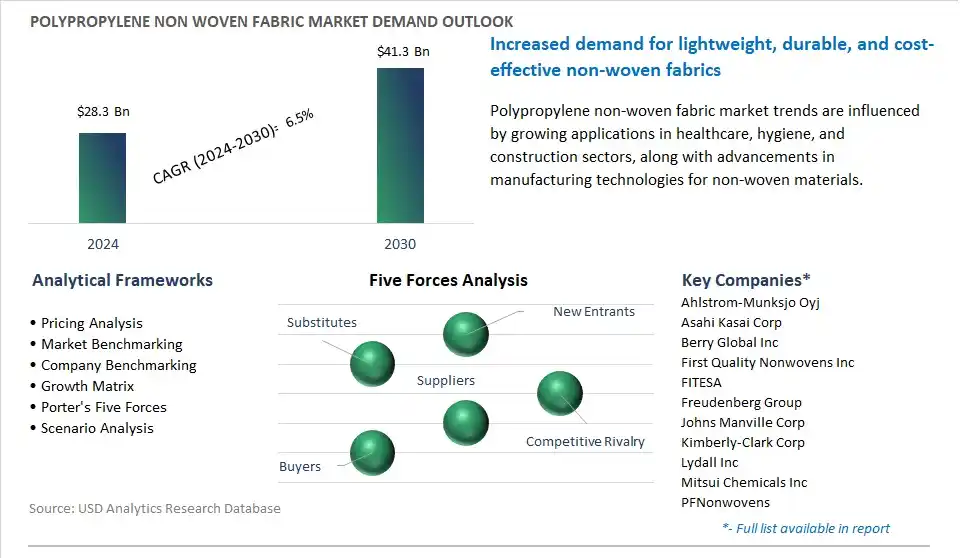
Polypropylene Non woven Fabric Market Competitive Landscape
The market report analyses the leading companies in the industry including Ahlstrom-Munksjo Oyj, Asahi Kasai Corp, Berry Global Inc, First Quality Nonwovens Inc, FITESA, Freudenberg Group, Johns Manville Corp, Kimberly-Clark Corp, Lydall Inc, Mitsui Chemicals Inc, PFNonwovens, Schouw & Co., Suominen Corp, Toray Industries Inc.
Polypropylene Non woven Fabric Market Dynamics
Polypropylene Non woven Fabric Market Trend: Growing Demand for Sustainable and Disposable Products
A prominent trend in the polypropylene nonwoven fabric market is the growing demand for sustainable and disposable products across various industries. Polypropylene nonwoven fabrics, known for their versatility, lightweight, and cost-effectiveness, are widely used in applications such as hygiene products, medical textiles, filtration, packaging, and agriculture. With increasing environmental concerns and consumer preferences for eco-friendly alternatives, there is a rising demand for nonwoven fabrics made from sustainable and biodegradable materials. Manufacturers are exploring eco-friendly production processes, recycled materials, and bio-based polymers to develop nonwoven fabrics that minimize environmental impact while meeting performance requirements. This is driving the commitment to sustainability and meeting market demands for disposable products with reduced environmental footprint.
Polypropylene Non woven Fabric Market Driver: Growth in Hygiene and Healthcare Industries
The market for polypropylene nonwoven fabric is driven by the growth in hygiene and healthcare industries, which demand reliable and cost-effective materials for disposable hygiene products, medical textiles, and personal protective equipment (PPE). Polypropylene nonwoven fabrics offer advantages such as softness, breathability, fluid resistance, and barrier properties, making them suitable for applications such as diapers, feminine hygiene products, surgical gowns, face masks, and wound dressings. With increasing population growth, aging demographics, and healthcare expenditures, there is a continuous demand for disposable hygiene products and medical textiles, driving market growth in the polypropylene nonwoven fabric segment. Additionally, the COVID-19 pandemic has further accelerated demand for nonwoven fabrics for PPE, infection control, and medical supplies, contributing to market expansion in the healthcare sector.
Polypropylene Non woven Fabric Market Opportunity: Innovation in Biodegradable and Functional Nonwoven Fabrics
A potential opportunity in the polypropylene nonwoven fabric market lies in innovation in biodegradable and functional nonwoven fabrics for diverse applications. With growing concerns about plastic pollution and single-use plastics, there is an opportunity to develop biodegradable nonwoven fabrics made from renewable resources or recycled materials. Manufacturers are investing in biodegradable polymers, natural fibers, and compostable additives to develop nonwoven fabrics that offer performance characteristics similar to traditional polypropylene materials while being environmentally friendly and biodegradable. Additionally, there is an opportunity to innovate in functional nonwoven fabrics with added features such as antimicrobial properties, UV protection, moisture management, and odor control for specialized applications in healthcare, agriculture, automotive, and personal care. By investing in research and development and collaborating with industry stakeholders, manufacturers can capitalize on emerging opportunities in the biodegradable and functional nonwoven fabric market and differentiate their products in competitive industries.
Polypropylene Nonwoven Fabric Market Share Analysis: Spunbond polypropylene nonwoven fabrics generated the highest revenue in 2024
The largest segment in the Polypropylene Nonwoven Fabric Market is Spunbond. Spunbond polypropylene nonwoven fabrics are manufactured using a continuous filament spinning process, resulting in a fabric with excellent strength, durability, and uniformity. These fabrics find widespread applications across various industries, including hygiene, medical, agriculture, automotive, and construction. In the hygiene industry, spunbond polypropylene nonwovens are extensively used in products such as diapers, sanitary napkins, and wipes due to their softness, breathability, and fluid management properties. Additionally, spunbond fabrics are favored in medical applications such as surgical gowns, drapes, and disposable medical supplies due to their barrier properties and sterilizability. Further, spunbond polypropylene nonwovens offer cost-effectiveness and versatility, making them a preferred choice for manufacturers seeking high-performance materials for a wide range of applications. These characteristics solidify the Spunbond segment's position as the largest in the Polypropylene Nonwoven Fabric Market.
Polypropylene Nonwoven Fabric Market Share Analysis: Medical segment is poised to register the fastest growth rate (CAGR) over the forecast period to 2030
The fastest-growing segment in the Polypropylene Nonwoven Fabric Market is Medical. There is an increasing demand for medical nonwoven fabrics due to their essential role in infection prevention and control, especially in light of the ongoing COVID-19 pandemic. Nonwoven fabrics are used extensively in medical applications such as surgical gowns, drapes, masks, and wound dressings due to their barrier properties, breathability, and ability to be sterilized. Additionally, the growing aging population worldwide, coupled with advancements in medical technology and increasing healthcare expenditure, drives the demand for medical nonwoven fabrics. Further, the rise of outpatient procedures and the trend towards minimally invasive surgeries further fuel the demand for disposable medical supplies made from nonwoven fabrics. Furthermore, stringent regulatory standards and guidelines regarding patient safety and infection control in healthcare facilities contribute to the rapid growth of the Medical segment in the Polypropylene Nonwoven Fabric Market.
Polypropylene Nonwoven Fabric Market Share Analysis: Automotive segment is poised to register the fastest growth rate (CAGR) over the forecast period to 2030
The fastest-growing segment in the Polypropylene Nonwoven Fabric Market is Automotive. The automotive industry's increasing emphasis on lightweighting, fuel efficiency, and sustainability drives the demand for innovative materials like polypropylene nonwoven fabrics. Nonwoven fabrics are used extensively in automotive applications such as interior trim, upholstery, carpeting, headliners, and insulation due to their versatility, durability, and cost-effectiveness. Additionally, nonwoven fabrics offer excellent sound and vibration damping properties, enhancing the comfort and driving experience for vehicle occupants. Further, the trend towards electric vehicles and autonomous driving technologies further accelerates the adoption of lightweight materials in automotive manufacturing, spurring the demand for polypropylene nonwoven fabrics. Furthermore, advancements in nonwoven fabric technology, such as improved surface aesthetics, recyclability, and sustainability, contribute to the segment's rapid growth in the Polypropylene Nonwoven Fabric Market.
Polypropylene Non woven Fabric Market Report Segmentation
By Product
Spunbound
Staples
Meltblown
Composite
By Application
Hygiene
Industrial
Medical
Geotextiles
Furnishings
Carpet
Agriculture
Automotive
Others
Regions Included
North America (US, Canada, Mexico)
Europe (Germany, UK, France, Spain, Italy, Russia, Rest of Europe)
Asia Pacific (China, India, Japan, South Korea, Australia, South East Asia, Rest of Asia)
South America (Brazil, Argentina, Rest of South America)
Middle East and Africa (Saudi Arabia, UAE, Rest of Middle East, South Africa, Egypt, Rest of Africa)
Polypropylene Non woven Fabric Companies Profiled in the Market Study
Ahlstrom-Munksjo Oyj
Asahi Kasai Corp
Berry Global Inc
First Quality Nonwovens Inc
FITESA
Freudenberg Group
Johns Manville Corp
Kimberly-Clark Corp
Lydall Inc
Mitsui Chemicals Inc
PFNonwovens
Schouw & Co.
Suominen Corp
Toray Industries Inc
*- List Not Exhaustive
TABLE OF CONTENTS
1 Introduction to 2024 Polypropylene Non woven Fabric Market
1.1 Market Overview
1.2 Quick Facts
1.3 Scope/Objective of the Study
1.4 Market Definition
1.5 Countries and Regions Covered
1.6 Units, Currency, and Conversions
1.7 Industry Value Chain
2 Research Methodology
2.1 Market Size Estimation
2.2 Sources and Research Methodology
2.3 Data Triangulation
2.4 Assumptions and Limitations
3 Executive Summary
3.1 Global Polypropylene Non woven Fabric Market Size Outlook, $ Million, 2021 to 2030
3.2 Polypropylene Non woven Fabric Market Outlook by Type, $ Million, 2021 to 2030
3.3 Polypropylene Non woven Fabric Market Outlook by Product, $ Million, 2021 to 2030
3.4 Polypropylene Non woven Fabric Market Outlook by Application, $ Million, 2021 to 2030
3.5 Polypropylene Non woven Fabric Market Outlook by Key Countries, $ Million, 2021 to 2030
4 Market Dynamics
4.1 Key Driving Forces of Polypropylene Non woven Fabric Industry
4.2 Key Market Trends in Polypropylene Non woven Fabric Industry
4.3 Potential Opportunities in Polypropylene Non woven Fabric Industry
4.4 Key Challenges in Polypropylene Non woven Fabric Industry
5 Market Factor Analysis
5.1 Value Chain Analysis
5.2 Competitive Landscape
5.2.1 Global Polypropylene Non woven Fabric Market Share by Company (%), 2023
5.2.2 Product Offerings by Company
5.3 Porter’s Five Forces Analysis
5.4 Pricing Analysis and Outlook
6 Growth Outlook Across Scenarios
6.1 Growth Analysis-Case Scenario Definitions
6.2 Low Growth Scenario Forecasts
6.3 Reference Growth Scenario Forecasts
6.4 High Growth Scenario Forecasts
7 Global Polypropylene Non woven Fabric Market Outlook by Segments
7.1 Polypropylene Non woven Fabric Market Outlook by Segments, $ Million, 2021- 2030
By Product
Spunbound
Staples
Meltblown
Composite
By Application
Hygiene
Industrial
Medical
Geotextiles
Furnishings
Carpet
Agriculture
Automotive
Others
8 North America Polypropylene Non woven Fabric Market Analysis and Outlook To 2030
8.1 Introduction to North America Polypropylene Non woven Fabric Markets in 2024
8.2 North America Polypropylene Non woven Fabric Market Size Outlook by Country, 2021-2030
8.2.1 United States
8.2.2 Canada
8.2.3 Mexico
8.3 North America Polypropylene Non woven Fabric Market size Outlook by Segments, 2021-2030
By Product
Spunbound
Staples
Meltblown
Composite
By Application
Hygiene
Industrial
Medical
Geotextiles
Furnishings
Carpet
Agriculture
Automotive
Others
9 Europe Polypropylene Non woven Fabric Market Analysis and Outlook To 2030
9.1 Introduction to Europe Polypropylene Non woven Fabric Markets in 2024
9.2 Europe Polypropylene Non woven Fabric Market Size Outlook by Country, 2021-2030
9.2.1 Germany
9.2.2 France
9.2.3 Spain
9.2.4 United Kingdom
9.2.4 Italy
9.2.5 Russia
9.2.6 Norway
9.2.7 Rest of Europe
9.3 Europe Polypropylene Non woven Fabric Market Size Outlook by Segments, 2021-2030
By Product
Spunbound
Staples
Meltblown
Composite
By Application
Hygiene
Industrial
Medical
Geotextiles
Furnishings
Carpet
Agriculture
Automotive
Others
10 Asia Pacific Polypropylene Non woven Fabric Market Analysis and Outlook To 2030
10.1 Introduction to Asia Pacific Polypropylene Non woven Fabric Markets in 2024
10.2 Asia Pacific Polypropylene Non woven Fabric Market Size Outlook by Country, 2021-2030
10.2.1 China
10.2.2 India
10.2.3 Japan
10.2.4 South Korea
10.2.5 Indonesia
10.2.6 Malaysia
10.2.7 Australia
10.2.8 Rest of Asia Pacific
10.3 Asia Pacific Polypropylene Non woven Fabric Market size Outlook by Segments, 2021-2030
By Product
Spunbound
Staples
Meltblown
Composite
By Application
Hygiene
Industrial
Medical
Geotextiles
Furnishings
Carpet
Agriculture
Automotive
Others
11 South America Polypropylene Non woven Fabric Market Analysis and Outlook To 2030
11.1 Introduction to South America Polypropylene Non woven Fabric Markets in 2024
11.2 South America Polypropylene Non woven Fabric Market Size Outlook by Country, 2021-2030
11.2.1 Brazil
11.2.2 Argentina
11.2.3 Rest of South America
11.3 South America Polypropylene Non woven Fabric Market size Outlook by Segments, 2021-2030
By Product
Spunbound
Staples
Meltblown
Composite
By Application
Hygiene
Industrial
Medical
Geotextiles
Furnishings
Carpet
Agriculture
Automotive
Others
12 Middle East and Africa Polypropylene Non woven Fabric Market Analysis and Outlook To 2030
12.1 Introduction to Middle East and Africa Polypropylene Non woven Fabric Markets in 2024
12.2 Middle East and Africa Polypropylene Non woven Fabric Market Size Outlook by Country, 2021-2030
12.2.1 Saudi Arabia
12.2.2 UAE
12.2.3 Oman
12.2.4 Rest of Middle East
12.2.5 Egypt
12.2.6 Nigeria
12.2.7 South Africa
12.2.8 Rest of Africa
12.3 Middle East and Africa Polypropylene Non woven Fabric Market size Outlook by Segments, 2021-2030
By Product
Spunbound
Staples
Meltblown
Composite
By Application
Hygiene
Industrial
Medical
Geotextiles
Furnishings
Carpet
Agriculture
Automotive
Others
13 Company Profiles
13.1 Company Snapshot
13.2 SWOT Profiles
13.3 Products and Services
13.4 Recent Developments
13.5 Financial Profile
Ahlstrom-Munksjo Oyj
Asahi Kasai Corp
Berry Global Inc
First Quality Nonwovens Inc
FITESA
Freudenberg Group
Johns Manville Corp
Kimberly-Clark Corp
Lydall Inc
Mitsui Chemicals Inc
PFNonwovens
Schouw & Co.
Suominen Corp
Toray Industries Inc
14 Appendix
14.1 Customization Offerings
14.2 Subscription Services
14.3 Related Reports
14.4 Publisher Expertise
By Product
Spunbound
Staples
Meltblown
Composite
By Application
Hygiene
Industrial
Medical
Geotextiles
Furnishings
Carpet
Agriculture
Automotive
Others
Countries Analyzed
North America (US, Canada, Mexico)
Europe (Germany, UK, France, Spain, Italy, Russia, Rest of Europe)
Asia Pacific (China, India, Japan, South Korea, Australia, South East Asia, Rest of Asia)
South America (Brazil, Argentina, Rest of South America)
Middle East and Africa (Saudi Arabia, UAE, Rest of Middle East, South Africa, Egypt, Rest of Africa)
