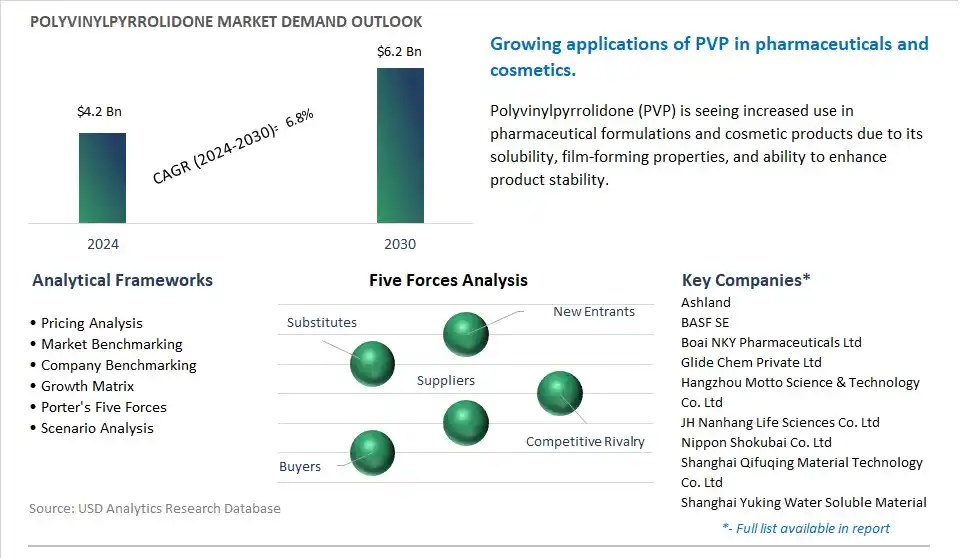
The global Polyvinylpyrrolidone Market is poised to register a 6.8% CAGR from $4.2 Billion in 2024 to $6.2 Billion in 2030.
The global Polyvinylpyrrolidone Market Study analyzes and forecasts the market size across 6 regions and 24 countries for diverse segments -By Form (Powder, Liquid), By Application (Pharmaceutical, Food and Beverage, Cosmetics, Adhesives, Others).
An Introduction to Global Polyvinylpyrrolidone Market in 2024
The future of the polyvinylpyrrolidone (PVP) market is shaped by key trends such as pharmaceutical applications, technological advancements, and regulatory compliance. PVP's unique properties, including biocompatibility, solubility, and film-forming ability, make it a versatile excipient in pharmaceutical formulations, including tablets, capsules, and topical preparations. Technological advancements in PVP production, purification, and modification processes enhance product quality and performance, meeting the stringent requirements of pharmaceutical and healthcare industries. Moreover, regulatory guidelines and quality standards drive the demand for high-purity PVP grades with consistent quality and safety profiles, ensuring compliance with pharmacopeial monographs and regulatory authorities' specifications. As pharmaceutical companies prioritize drug efficacy, safety, and patient compliance, the demand for high-quality PVP excipients will continue to grow, fueling market expansion and innovation.
Polyvinylpyrrolidone Market Competitive Landscape
The market report analyses the leading companies in the industry including Ashland, BASF SE, Boai NKY Pharmaceuticals Ltd, Glide Chem Private Ltd, Hangzhou Motto Science & Technology Co. Ltd, JH Nanhang Life Sciences Co. Ltd, Nippon Shokubai Co. Ltd, Shanghai Qifuqing Material Technology Co. Ltd, Shanghai Yuking Water Soluble Material Tech Co. Ltd, Sichuan Tianhua Chemical Group Co. Ltd, Thermo Fisher Scientific Inc, Zhangzhou Huafu Chemical Co. Ltd.
Polyvinylpyrrolidone Market Dynamics
Polyvinylpyrrolidone Market Trend: Increased Demand for Pharmaceutical and Personal Care Applications
A prominent trend in the polyvinylpyrrolidone (PVP) market is the increased demand for its use in pharmaceutical and personal care applications. PVP, known for its excellent film-forming, binding, and solubilizing properties, is widely utilized in the pharmaceutical industry for tablet and capsule coatings, as well as in topical formulations such as gels, creams, and ointments. Additionally, PVP finds extensive use in personal care products such as hair styling products, shampoos, and oral care formulations due to its film-forming and adhesive properties. With consumers seeking innovative and effective products in the pharmaceutical and personal care sectors, there is a growing adoption of PVP as a versatile ingredient to enhance product performance and functionality. This is driving the recognition of PVP's benefits in formulating stable and efficacious pharmaceutical and personal care products, driving market growth in the PVP segment.
Polyvinylpyrrolidone Market Driver: Rising Demand for Water-Soluble Polymers in Formulation Chemistry
The market for polyvinylpyrrolidone (PVP) is driven by the rising demand for water-soluble polymers in formulation chemistry across various industries. PVP, a water-soluble polymer with excellent solubility in water and many organic solvents, offers versatility and compatibility with a wide range of active ingredients and excipients. In pharmaceutical formulations, PVP serves as a binder, disintegrant, and viscosity modifier, facilitating tablet manufacturing and improving drug dissolution and bioavailability. Similarly, in personal care formulations, PVP acts as a film former, thickener, and stabilizer, enhancing product texture, appearance, and performance. With increasing formulation complexity, regulatory requirements, and consumer expectations for safe and effective products, there is a continuous need for water-soluble polymers such as PVP to address formulation challenges and optimize product quality. This driver fuels market demand and adoption of PVP in formulation chemistry, contributing to market expansion and growth opportunities.
Polyvinylpyrrolidone Market Opportunity: Expansion into Novel Applications and Industries
A potential opportunity in the polyvinylpyrrolidone (PVP) market lies in expansion into novel applications and industries where PVP's properties can address emerging market needs and challenges. While PVP is widely used in pharmaceuticals and personal care, there are opportunities to explore its applications in sectors such as food, agriculture, textiles, and adhesives. In the food industry, PVP can be used as a stabilizer, emulsifier, and clarifying agent in food and beverage formulations. In agriculture, PVP can enhance the performance of agrochemicals and fertilizers through improved dispersion and adhesion. In textiles, PVP can impart wrinkle resistance and dye absorption properties to fabrics. In adhesives, PVP can improve bonding strength and moisture resistance. By identifying new applications and industries for PVP, manufacturers can diversify their product portfolio, tap into new markets, and create growth opportunities in the PVP market. Expanding into novel applications presents an opportunity for innovation, differentiation, and market expansion in the PVP segment.
Polyvinylpyrrolidone Market Share Analysis: Powder generated the highest revenue in 2024
The largest segment in the Polyvinylpyrrolidone (PVP) Market is Powder. Powdered PVP offers potential advantages over its liquid counterpart, making it more widely used in various applications. powdered PVP is easier to handle, store, and transport compared to liquid forms, providing convenience and cost-effectiveness for manufacturers and end-users. Additionally, powdered PVP has a longer shelf life and greater stability, reducing the risk of degradation or spoilage over time. Further, powdered PVP exhibits better solubility and dispersibility in aqueous and organic solvents, allowing for versatile applications in industries such as pharmaceuticals, cosmetics, personal care, and industrial processes. Powdered PVP is commonly used as a binder, film-former, stabilizer, thickener, and drug delivery agent in tablet formulations, topical formulations, oral care products, hair care products, and adhesives. Furthermore, the ease of handling and versatility of powdered PVP make it the preferred choice for many applications, consolidating its position as the largest segment in the Polyvinylpyrrolidone Market.
Polyvinylpyrrolidone Market Share Analysis: Pharmaceutical segment is poised to register the fastest growth rate (CAGR) over the forecast period to 2030
The fastest-growing segment in the Polyvinylpyrrolidone (PVP) Market is Pharmaceutical. PVP is widely used in pharmaceutical formulations due to its unique properties such as biocompatibility, solubility, and film-forming capabilities. PVP is commonly employed as a binder, disintegrant, stabilizer, and solubilizing agent in tablet formulations, where it helps improve drug dissolution, bioavailability, and overall product performance. Additionally, PVP is utilized in oral liquids, topical preparations, ophthalmic solutions, and parenteral formulations for its versatility and safety profile. The pharmaceutical industry's ongoing research and development efforts to enhance drug delivery systems, develop novel formulations, and improve patient compliance drive the demand for PVP in pharmaceutical applications. Further, the increasing prevalence of chronic diseases, growing geriatric population, and rising demand for generic drugs further fuel the growth of the Pharmaceutical segment in the Polyvinylpyrrolidone Market. Furthermore, stringent regulatory standards for drug safety, efficacy, and quality contribute to the adoption of high-quality excipients like PVP in pharmaceutical manufacturing, supporting the segment's rapid growth.
Polyvinylpyrrolidone Market Report Segmentation
By Form
Powder
Liquid
By Application
Pharmaceutical
Food and Beverage
Cosmetics
Adhesives
Others
Regions Included
North America (US, Canada, Mexico)
Europe (Germany, UK, France, Spain, Italy, Russia, Rest of Europe)
Asia Pacific (China, India, Japan, South Korea, Australia, South East Asia, Rest of Asia)
South America (Brazil, Argentina, Rest of South America)
Middle East and Africa (Saudi Arabia, UAE, Rest of Middle East, South Africa, Egypt, Rest of Africa)
Polyvinylpyrrolidone Companies Profiled in the Market Study
Ashland
BASF SE
Boai NKY Pharmaceuticals Ltd
Glide Chem Private Ltd
Hangzhou Motto Science & Technology Co. Ltd
JH Nanhang Life Sciences Co. Ltd
Nippon Shokubai Co. Ltd
Shanghai Qifuqing Material Technology Co. Ltd
Shanghai Yuking Water Soluble Material Tech Co. Ltd
Sichuan Tianhua Chemical Group Co. Ltd
Thermo Fisher Scientific Inc
Zhangzhou Huafu Chemical Co. Ltd
*- List Not Exhaustive
TABLE OF CONTENTS
1 Introduction to 2024 Polyvinylpyrrolidone Market
1.1 Market Overview
1.2 Quick Facts
1.3 Scope/Objective of the Study
1.4 Market Definition
1.5 Countries and Regions Covered
1.6 Units, Currency, and Conversions
1.7 Industry Value Chain
2 Research Methodology
2.1 Market Size Estimation
2.2 Sources and Research Methodology
2.3 Data Triangulation
2.4 Assumptions and Limitations
3 Executive Summary
3.1 Global Polyvinylpyrrolidone Market Size Outlook, $ Million, 2021 to 2030
3.2 Polyvinylpyrrolidone Market Outlook by Type, $ Million, 2021 to 2030
3.3 Polyvinylpyrrolidone Market Outlook by Product, $ Million, 2021 to 2030
3.4 Polyvinylpyrrolidone Market Outlook by Application, $ Million, 2021 to 2030
3.5 Polyvinylpyrrolidone Market Outlook by Key Countries, $ Million, 2021 to 2030
4 Market Dynamics
4.1 Key Driving Forces of Polyvinylpyrrolidone Industry
4.2 Key Market Trends in Polyvinylpyrrolidone Industry
4.3 Potential Opportunities in Polyvinylpyrrolidone Industry
4.4 Key Challenges in Polyvinylpyrrolidone Industry
5 Market Factor Analysis
5.1 Value Chain Analysis
5.2 Competitive Landscape
5.2.1 Global Polyvinylpyrrolidone Market Share by Company (%), 2023
5.2.2 Product Offerings by Company
5.3 Porter’s Five Forces Analysis
5.4 Pricing Analysis and Outlook
6 Growth Outlook Across Scenarios
6.1 Growth Analysis-Case Scenario Definitions
6.2 Low Growth Scenario Forecasts
6.3 Reference Growth Scenario Forecasts
6.4 High Growth Scenario Forecasts
7 Global Polyvinylpyrrolidone Market Outlook by Segments
7.1 Polyvinylpyrrolidone Market Outlook by Segments, $ Million, 2021- 2030
By Form
Powder
Liquid
By Application
Pharmaceutical
Food and Beverage
Cosmetics
Adhesives
Others
8 North America Polyvinylpyrrolidone Market Analysis and Outlook To 2030
8.1 Introduction to North America Polyvinylpyrrolidone Markets in 2024
8.2 North America Polyvinylpyrrolidone Market Size Outlook by Country, 2021-2030
8.2.1 United States
8.2.2 Canada
8.2.3 Mexico
8.3 North America Polyvinylpyrrolidone Market size Outlook by Segments, 2021-2030
By Form
Powder
Liquid
By Application
Pharmaceutical
Food and Beverage
Cosmetics
Adhesives
Others
9 Europe Polyvinylpyrrolidone Market Analysis and Outlook To 2030
9.1 Introduction to Europe Polyvinylpyrrolidone Markets in 2024
9.2 Europe Polyvinylpyrrolidone Market Size Outlook by Country, 2021-2030
9.2.1 Germany
9.2.2 France
9.2.3 Spain
9.2.4 United Kingdom
9.2.4 Italy
9.2.5 Russia
9.2.6 Norway
9.2.7 Rest of Europe
9.3 Europe Polyvinylpyrrolidone Market Size Outlook by Segments, 2021-2030
By Form
Powder
Liquid
By Application
Pharmaceutical
Food and Beverage
Cosmetics
Adhesives
Others
10 Asia Pacific Polyvinylpyrrolidone Market Analysis and Outlook To 2030
10.1 Introduction to Asia Pacific Polyvinylpyrrolidone Markets in 2024
10.2 Asia Pacific Polyvinylpyrrolidone Market Size Outlook by Country, 2021-2030
10.2.1 China
10.2.2 India
10.2.3 Japan
10.2.4 South Korea
10.2.5 Indonesia
10.2.6 Malaysia
10.2.7 Australia
10.2.8 Rest of Asia Pacific
10.3 Asia Pacific Polyvinylpyrrolidone Market size Outlook by Segments, 2021-2030
By Form
Powder
Liquid
By Application
Pharmaceutical
Food and Beverage
Cosmetics
Adhesives
Others
11 South America Polyvinylpyrrolidone Market Analysis and Outlook To 2030
11.1 Introduction to South America Polyvinylpyrrolidone Markets in 2024
11.2 South America Polyvinylpyrrolidone Market Size Outlook by Country, 2021-2030
11.2.1 Brazil
11.2.2 Argentina
11.2.3 Rest of South America
11.3 South America Polyvinylpyrrolidone Market size Outlook by Segments, 2021-2030
By Form
Powder
Liquid
By Application
Pharmaceutical
Food and Beverage
Cosmetics
Adhesives
Others
12 Middle East and Africa Polyvinylpyrrolidone Market Analysis and Outlook To 2030
12.1 Introduction to Middle East and Africa Polyvinylpyrrolidone Markets in 2024
12.2 Middle East and Africa Polyvinylpyrrolidone Market Size Outlook by Country, 2021-2030
12.2.1 Saudi Arabia
12.2.2 UAE
12.2.3 Oman
12.2.4 Rest of Middle East
12.2.5 Egypt
12.2.6 Nigeria
12.2.7 South Africa
12.2.8 Rest of Africa
12.3 Middle East and Africa Polyvinylpyrrolidone Market size Outlook by Segments, 2021-2030
By Form
Powder
Liquid
By Application
Pharmaceutical
Food and Beverage
Cosmetics
Adhesives
Others
13 Company Profiles
13.1 Company Snapshot
13.2 SWOT Profiles
13.3 Products and Services
13.4 Recent Developments
13.5 Financial Profile
Ashland
BASF SE
Boai NKY Pharmaceuticals Ltd
Glide Chem Private Ltd
Hangzhou Motto Science & Technology Co. Ltd
JH Nanhang Life Sciences Co. Ltd
Nippon Shokubai Co. Ltd
Shanghai Qifuqing Material Technology Co. Ltd
Shanghai Yuking Water Soluble Material Tech Co. Ltd
Sichuan Tianhua Chemical Group Co. Ltd
Thermo Fisher Scientific Inc
Zhangzhou Huafu Chemical Co. Ltd
14 Appendix
14.1 Customization Offerings
14.2 Subscription Services
14.3 Related Reports
14.4 Publisher Expertise
By Form
Powder
Liquid
By Application
Pharmaceutical
Food and Beverage
Cosmetics
Adhesives
Others
Countries Analyzed
North America (US, Canada, Mexico)
Europe (Germany, UK, France, Spain, Italy, Russia, Rest of Europe)
Asia Pacific (China, India, Japan, South Korea, Australia, South East Asia, Rest of Asia)
South America (Brazil, Argentina, Rest of South America)
Middle East and Africa (Saudi Arabia, UAE, Rest of Middle East, South Africa, Egypt, Rest of Africa)
