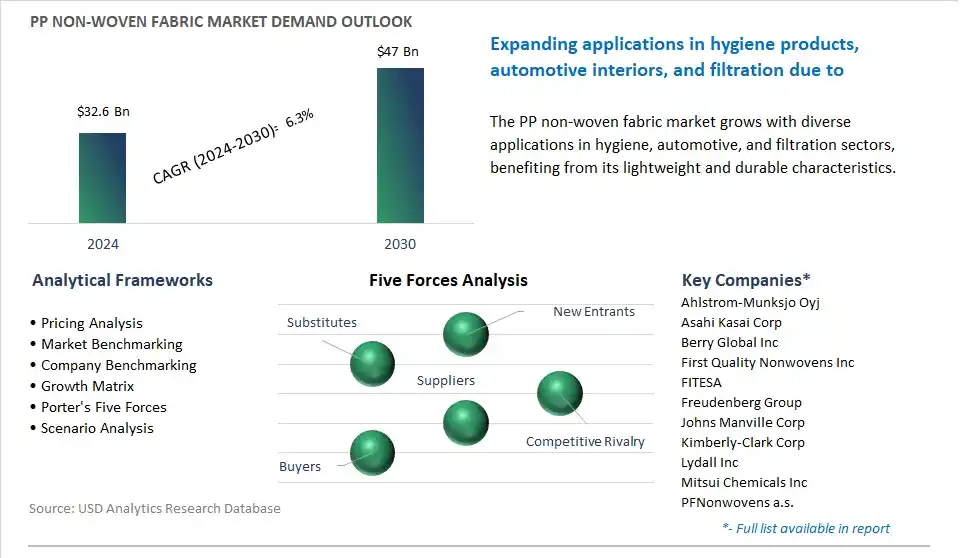
The global PP Non-woven Fabric Market is poised to register a 6.3% CAGR from $32.6 Billion in 2024 to $47 Billion in 2030.
The global PP Non-woven Fabric Market Study analyzes and forecasts the market size across 6 regions and 24 countries for diverse segments -By Product (Spunbound, Staples, Meltblown, Composite), By Application (Hygiene, Industrial, Medical, Geotextiles, Furnishings, Carpet, Agriculture, Automotive, Others).
An Introduction to Global PP Non woven Fabric Market in 2024
The PP nonwoven fabric market is experiencing robust growth driven by expanding applications in diverse industries such as healthcare, hygiene, automotive, and agriculture. Key trends shaping the future of the industry include the increasing demand for lightweight, durable, and cost-effective nonwoven fabrics in disposable medical products, filtration systems, and geotextiles, fueled by evolving consumer preferences and technological advancements. Moreover, there's a growing focus on sustainability, with manufacturers investing in recyclable and biodegradable PP nonwoven fabrics to reduce environmental impact and meet regulatory requirements. Additionally, innovations in manufacturing processes, such as meltblown and spunbond techniques, are enhancing product performance and enabling the production of tailored solutions for specific end-use applications, driving market differentiation and competitive advantage.
PP Non-woven Fabric Market Competitive Landscape
The market report analyses the leading companies in the industry including Ahlstrom-Munksjo Oyj, Asahi Kasai Corp, Berry Global Inc, First Quality Nonwovens Inc, FITESA, Freudenberg Group, Johns Manville Corp, Kimberly-Clark Corp, Lydall Inc, Mitsui Chemicals Inc, PFNonwovens a.s., Schouw & Co., Suominen Corp, Toray Industries Inc.
PP Non-woven Fabric Market Dynamics
PP Non woven Fabric Market Trend: Growing Demand for Sustainable and Versatile Non-woven Materials
PP non-woven fabric is experiencing a prominent market trend driven by the growing demand for sustainable and versatile non-woven materials across various industries. As awareness of environmental issues rises and regulatory pressures increase, there is a shift towards eco-friendly and recyclable materials in sectors such as packaging, healthcare, agriculture, and automotive. PP non-woven fabric, made from polypropylene fibers using a non-woven manufacturing process, offers advantages such as lightweight, durability, breathability, and cost-effectiveness, making it suitable for a wide range of applications. This trend is fueled by the need for alternatives to traditional woven textiles and plastics, driving the adoption of PP non-woven fabric as a preferred choice for packaging materials, hygiene products, filtration media, and geotextiles, among others.
PP Non woven Fabric Market Driver: Expansion of Hygiene and Medical Products Market
The market for PP non-woven fabric is being driven by the expansion of the hygiene and medical products market, which requires high-performance non-woven materials for applications such as disposable diapers, sanitary napkins, surgical gowns, and medical masks. With increasing concerns about hygiene, infection control, and healthcare-associated infections (HAIs), there is a growing demand for non-woven fabrics with superior barrier properties, absorbency, and comfort. PP non-woven fabric meets these requirements by offering excellent liquid repellency, bacterial filtration efficiency (BFE), and breathability, making it an essential component in the production of disposable hygiene and medical products. The growth of the hygiene and medical products market drives the demand for PP non-woven fabric and fosters innovation in non-woven manufacturing technologies to meet the stringent performance standards and regulatory requirements of the healthcare industry.
PP Non woven Fabric Market Opportunity: Diversification into Sustainable Packaging Solutions
The market for PP non-woven fabric presents a significant opportunity for diversification into sustainable packaging solutions, particularly in response to the growing demand for eco-friendly and recyclable packaging materials. With increasing concerns about plastic pollution, single-use plastics bans, and circular economy initiatives, there is a need for alternative packaging materials that offer sustainability benefits without compromising performance and cost-effectiveness. PP non-woven fabric can be utilized for a variety of packaging applications, including shopping bags, promotional tote bags, food packaging, and agricultural packaging, providing advantages such as tear resistance, moisture resistance, and customization options. By leveraging its inherent properties and versatility, PP non-woven fabric can serve as a sustainable alternative to traditional packaging materials, contributing to the reduction of plastic waste and supporting the transition towards a more circular economy.
PP Non-woven Fabric Market Share Analysis: The Spunbond segment generated the highest revenue in 2024
The largest segment in the PP Non-woven Fabric Market is the Spunbond segment. spunbond non-woven fabrics are widely used in various industries due to their versatility, durability, and cost-effectiveness. Spunbond fabrics are produced by extruding continuous filaments of polypropylene, which are then bonded together using heat and pressure, resulting in a fabric with excellent strength and uniformity. This makes spunbond fabrics suitable for a wide range of applications including hygiene products, agriculture, packaging, and automotive interiors. Additionally, spunbond fabrics offer advantages such as breathability, water resistance, and resistance to chemicals and abrasion, further enhancing their suitability for diverse applications. Further, advancements in production technology have led to increased efficiency and reduced costs in the manufacturing of spunbond fabrics, driving their widespread adoption and dominance in the PP Non-woven Fabric Market.
PP Non-woven Fabric Market Share Analysis: The Medical segment is poised to register the fastest growth rate (CAGR) over the forecast period to 2030
The fastest-growing segment in the PP Non-woven Fabric Market is the Medical application segment. There's an increasing demand for medical non-woven fabrics due to the growing healthcare industry worldwide, driven by factors such as population aging, rising healthcare expenditure, and the need for improved healthcare infrastructure. Non-woven fabrics are extensively used in medical applications such as surgical gowns, masks, drapes, and wound dressings due to their superior properties such as breathability, barrier protection, and sterilizability. Additionally, the COVID-19 pandemic has further accelerated the demand for medical non-woven fabrics, particularly for personal protective equipment (PPE) such as face masks, gowns, and surgical caps. Further, advancements in non-woven fabric technologies, including the development of antimicrobial and antiviral treatments, are further fueling the growth of the medical segment in the PP Non-woven Fabric Market. Consequently, the Medical application segment is experiencing rapid growth and is expected to continue expanding in the PP Non-woven Fabric Market.
PP Non-woven Fabric Market Report Segmentation
By Product
Spunbound
Staples
Meltblown
Composite
By Application
Hygiene
Industrial
Medical
Geotextiles
Furnishings
Carpet
Agriculture
Automotive
Others
Regions Included
North America (US, Canada, Mexico)
Europe (Germany, UK, France, Spain, Italy, Russia, Rest of Europe)
Asia Pacific (China, India, Japan, South Korea, Australia, South East Asia, Rest of Asia)
South America (Brazil, Argentina, Rest of South America)
Middle East and Africa (Saudi Arabia, UAE, Rest of Middle East, South Africa, Egypt, Rest of Africa)
PP Non-woven Fabric Companies Profiled in the Market Study
Ahlstrom-Munksjo Oyj
Asahi Kasai Corp
Berry Global Inc
First Quality Nonwovens Inc
FITESA
Freudenberg Group
Johns Manville Corp
Kimberly-Clark Corp
Lydall Inc
Mitsui Chemicals Inc
PFNonwovens a.s.
Schouw & Co.
Suominen Corp
Toray Industries Inc
*- List Not Exhaustive
TABLE OF CONTENTS
1 Introduction to 2024 PP Non-woven Fabric Market
1.1 Market Overview
1.2 Quick Facts
1.3 Scope/Objective of the Study
1.4 Market Definition
1.5 Countries and Regions Covered
1.6 Units, Currency, and Conversions
1.7 Industry Value Chain
2 Research Methodology
2.1 Market Size Estimation
2.2 Sources and Research Methodology
2.3 Data Triangulation
2.4 Assumptions and Limitations
3 Executive Summary
3.1 Global PP Non-woven Fabric Market Size Outlook, $ Million, 2021 to 2030
3.2 PP Non-woven Fabric Market Outlook by Type, $ Million, 2021 to 2030
3.3 PP Non-woven Fabric Market Outlook by Product, $ Million, 2021 to 2030
3.4 PP Non-woven Fabric Market Outlook by Application, $ Million, 2021 to 2030
3.5 PP Non-woven Fabric Market Outlook by Key Countries, $ Million, 2021 to 2030
4 Market Dynamics
4.1 Key Driving Forces of PP Non-woven Fabric Industry
4.2 Key Market Trends in PP Non-woven Fabric Industry
4.3 Potential Opportunities in PP Non-woven Fabric Industry
4.4 Key Challenges in PP Non-woven Fabric Industry
5 Market Factor Analysis
5.1 Value Chain Analysis
5.2 Competitive Landscape
5.2.1 Global PP Non-woven Fabric Market Share by Company (%), 2023
5.2.2 Product Offerings by Company
5.3 Porter’s Five Forces Analysis
5.4 Pricing Analysis and Outlook
6 Growth Outlook Across Scenarios
6.1 Growth Analysis-Case Scenario Definitions
6.2 Low Growth Scenario Forecasts
6.3 Reference Growth Scenario Forecasts
6.4 High Growth Scenario Forecasts
7 Global PP Non-woven Fabric Market Outlook by Segments
7.1 PP Non-woven Fabric Market Outlook by Segments, $ Million, 2021- 2030
By Product
Spunbound
Staples
Meltblown
Composite
By Application
Hygiene
Industrial
Medical
Geotextiles
Furnishings
Carpet
Agriculture
Automotive
Others
8 North America PP Non-woven Fabric Market Analysis and Outlook To 2030
8.1 Introduction to North America PP Non-woven Fabric Markets in 2024
8.2 North America PP Non-woven Fabric Market Size Outlook by Country, 2021-2030
8.2.1 United States
8.2.2 Canada
8.2.3 Mexico
8.3 North America PP Non-woven Fabric Market size Outlook by Segments, 2021-2030
By Product
Spunbound
Staples
Meltblown
Composite
By Application
Hygiene
Industrial
Medical
Geotextiles
Furnishings
Carpet
Agriculture
Automotive
Others
9 Europe PP Non-woven Fabric Market Analysis and Outlook To 2030
9.1 Introduction to Europe PP Non-woven Fabric Markets in 2024
9.2 Europe PP Non-woven Fabric Market Size Outlook by Country, 2021-2030
9.2.1 Germany
9.2.2 France
9.2.3 Spain
9.2.4 United Kingdom
9.2.4 Italy
9.2.5 Russia
9.2.6 Norway
9.2.7 Rest of Europe
9.3 Europe PP Non-woven Fabric Market Size Outlook by Segments, 2021-2030
By Product
Spunbound
Staples
Meltblown
Composite
By Application
Hygiene
Industrial
Medical
Geotextiles
Furnishings
Carpet
Agriculture
Automotive
Others
10 Asia Pacific PP Non-woven Fabric Market Analysis and Outlook To 2030
10.1 Introduction to Asia Pacific PP Non-woven Fabric Markets in 2024
10.2 Asia Pacific PP Non-woven Fabric Market Size Outlook by Country, 2021-2030
10.2.1 China
10.2.2 India
10.2.3 Japan
10.2.4 South Korea
10.2.5 Indonesia
10.2.6 Malaysia
10.2.7 Australia
10.2.8 Rest of Asia Pacific
10.3 Asia Pacific PP Non-woven Fabric Market size Outlook by Segments, 2021-2030
By Product
Spunbound
Staples
Meltblown
Composite
By Application
Hygiene
Industrial
Medical
Geotextiles
Furnishings
Carpet
Agriculture
Automotive
Others
11 South America PP Non-woven Fabric Market Analysis and Outlook To 2030
11.1 Introduction to South America PP Non-woven Fabric Markets in 2024
11.2 South America PP Non-woven Fabric Market Size Outlook by Country, 2021-2030
11.2.1 Brazil
11.2.2 Argentina
11.2.3 Rest of South America
11.3 South America PP Non-woven Fabric Market size Outlook by Segments, 2021-2030
By Product
Spunbound
Staples
Meltblown
Composite
By Application
Hygiene
Industrial
Medical
Geotextiles
Furnishings
Carpet
Agriculture
Automotive
Others
12 Middle East and Africa PP Non-woven Fabric Market Analysis and Outlook To 2030
12.1 Introduction to Middle East and Africa PP Non-woven Fabric Markets in 2024
12.2 Middle East and Africa PP Non-woven Fabric Market Size Outlook by Country, 2021-2030
12.2.1 Saudi Arabia
12.2.2 UAE
12.2.3 Oman
12.2.4 Rest of Middle East
12.2.5 Egypt
12.2.6 Nigeria
12.2.7 South Africa
12.2.8 Rest of Africa
12.3 Middle East and Africa PP Non-woven Fabric Market size Outlook by Segments, 2021-2030
By Product
Spunbound
Staples
Meltblown
Composite
By Application
Hygiene
Industrial
Medical
Geotextiles
Furnishings
Carpet
Agriculture
Automotive
Others
13 Company Profiles
13.1 Company Snapshot
13.2 SWOT Profiles
13.3 Products and Services
13.4 Recent Developments
13.5 Financial Profile
Ahlstrom-Munksjo Oyj
Asahi Kasai Corp
Berry Global Inc
First Quality Nonwovens Inc
FITESA
Freudenberg Group
Johns Manville Corp
Kimberly-Clark Corp
Lydall Inc
Mitsui Chemicals Inc
PFNonwovens a.s.
Schouw & Co.
Suominen Corp
Toray Industries Inc
14 Appendix
14.1 Customization Offerings
14.2 Subscription Services
14.3 Related Reports
14.4 Publisher Expertise
By Product
Spunbound
Staples
Meltblown
Composite
By Application
Hygiene
Industrial
Medical
Geotextiles
Furnishings
Carpet
Agriculture
Automotive
Others
Countries Analyzed
North America (US, Canada, Mexico)
Europe (Germany, UK, France, Spain, Italy, Russia, Rest of Europe)
Asia Pacific (China, India, Japan, South Korea, Australia, South East Asia, Rest of Asia)
South America (Brazil, Argentina, Rest of South America)
Middle East and Africa (Saudi Arabia, UAE, Rest of Middle East, South Africa, Egypt, Rest of Africa)
