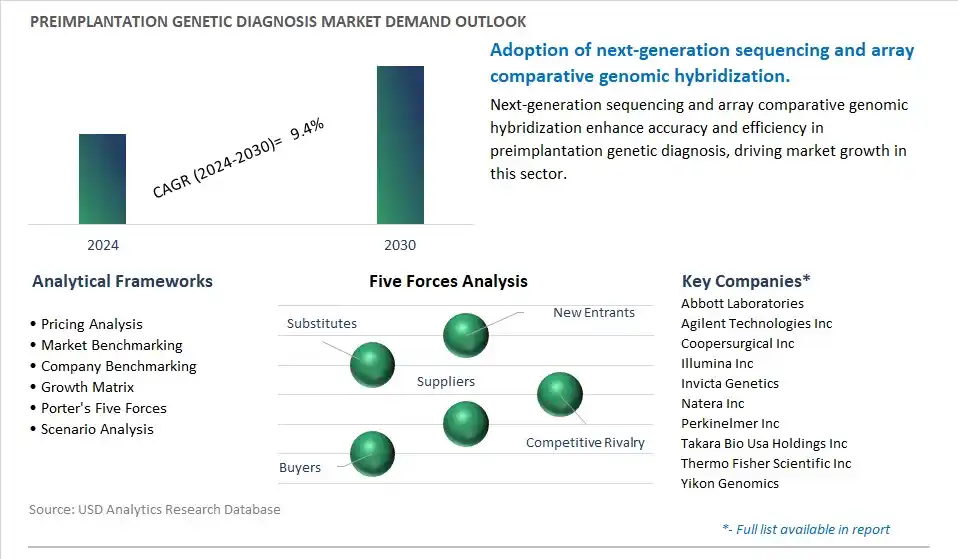
Preimplantation Genetic Diagnosis (PGD) Market is estimated to increase at a growth rate of 9.4% CAGR over the forecast period from 2024 to 2030.
The global Preimplantation Genetic Diagnosis (PGD) Market Study analyzes and forecasts the market size across 6 regions and 24 countries for diverse segments including By Product (Reagents & Consumables, Instruments, Software and Services), By Technology (Next Generation Sequencing (NGS), Polymerase Chain Reaction (PCR), Comparative Genomic Hybridization (CGH), Others), By Application (Aneuploidy, Structural Chromosomal Abnormalities, Single Gene Disorders, X-linked Disorders, Gender Identification, Others).
An Introduction to Preimplantation Genetic Diagnosis (PGD) Market in 2024
The Preimplantation Genetic Diagnosis (PGD) Market in 2024 revolutionizes assisted reproductive technologies (ART), offering genetic testing services for the screening of embryos prior to implantation during in vitro fertilization (IVF) procedures. Preimplantation genetic diagnosis (PGD) involves the biopsy of embryos to obtain genetic material for chromosomal analysis, single-gene disorder testing, or preimplantation genetic screening (PGS), allowing healthcare providers to identify embryos free of genetic abnormalities, inheritable diseases, or chromosomal imbalances before embryo transfer. With advances in genomics, reproductive genetics, and ART techniques driving demand for personalized reproductive medicine options, the PGD market witnesses continuous innovation and technological advancements, driven by factors such as embryo biopsy methods, next-generation sequencing (NGS) platforms, and bioinformatics solutions. Moreover, as stakeholders in fertility clinics, genetic counseling, and regulatory agencies navigate ethical, legal, and social implications of PGD, the PGD market plays a pivotal role in facilitating informed decision-making, reducing the risk of genetic disorders, and improving reproductive outcomes for individuals undergoing IVF treatment and seeking to build healthy families.
Preimplantation Genetic Diagnosis (PGD) Market Competitive Landscape
The global Preimplantation Genetic Diagnosis (PGD) Industry is highly competitive with a large number of companies focusing on niche market segments. Amidst intense competitive conditions, Preimplantation Genetic Diagnosis (PGD) Companies are investing in new product launches and strengthening distribution channels. Key companies operating in the Preimplantation Genetic Diagnosis (PGD) Industry include- Abbott Laboratories, Agilent Technologies Inc, Coopersurgical Inc, Illumina Inc, Invicta Genetics, Natera Inc, Perkinelmer Inc, Takara Bio Usa Holdings Inc, Thermo Fisher Scientific Inc, Yikon Genomics.
Preimplantation Genetic Diagnosis Market Trend: Advancements in Genetic Screening Technologies
The market trend for Preimplantation Genetic Diagnosis (PGD) is driven by advancements in genetic screening technologies. PGD involves the screening of embryos created through in vitro fertilization (IVF) for genetic abnormalities before implantation, enabling couples at risk of passing on hereditary genetic disorders to conceive healthy offspring. Recent technological innovations, such as next-generation sequencing (NGS), microarray-based comparative genomic hybridization (CGH), and single nucleotide polymorphism (SNP) genotyping, have significantly enhanced the accuracy, efficiency, and comprehensiveness of genetic screening tests used in PGD. These advancements allow for the simultaneous analysis of multiple genetic markers, identification of chromosomal abnormalities, and detection of gene mutations with high sensitivity and specificity, thereby increasing the diagnostic yield and reliability of PGD procedures. Moreover, the integration of advanced bioinformatics tools and artificial intelligence (AI) algorithms into genetic analysis platforms has facilitated data interpretation, variant classification, and decision support for clinicians and genetic counselors, further driving the adoption and evolution of PGD technologies in reproductive medicine.
Preimplantation Genetic Diagnosis Market Driver: Increasing Demand for Family Planning and Genetic Risk Assessment
The increasing demand for family planning and genetic risk assessment is a significant driver fueling the market for Preimplantation Genetic Diagnosis. As individuals and couples become more aware of their genetic predisposition to hereditary diseases and chromosomal abnormalities, there's growing interest in proactive measures to prevent genetic disorders in offspring and ensure the health and well-being of future generations. PGD offers a proactive approach to family planning by enabling couples with known genetic risks, such as carriers of genetic mutations or chromosomal rearrangements, to undergo IVF with genetic testing to select embryos free from the targeted genetic abnormalities for transfer. Additionally, PGD is increasingly used in fertility preservation strategies for individuals undergoing cancer treatment, in vitro maturation (IVM) cycles, and recurrent pregnancy loss (RPL) investigations, where genetic screening of embryos can optimize the chances of successful pregnancy and healthy offspring. With advancements in assisted reproductive technologies (ART) and growing acceptance of PGD as a standard of care in reproductive medicine, there's a rising demand for PGD services among fertility clinics, IVF centers, and patients seeking personalized, genetically informed family planning solutions.
Preimplantation Genetic Diagnosis Market Opportunity: Expansion of Genetic Testing Applications and Service Offerings
The Market Opportunity for Preimplantation Genetic Diagnosis lies in the expansion of genetic testing applications and service offerings to address emerging clinical needs and patient preferences. While PGD traditionally focused on the detection of monogenic disorders and chromosomal abnormalities, there's opportunity to expand testing panels to include polygenic traits, complex genetic diseases, and non-medical traits such as eye color, hair color, and ancestry. Moreover, there's potential for PGD to be integrated with other reproductive genetic technologies such as preimplantation genetic screening (PGS) for aneuploidy, mitochondrial replacement therapy (MRT) for mitochondrial DNA disorders, and genome editing techniques such as CRISPR-Cas9 for gene correction or modification. Additionally, there's opportunity to enhance the accessibility and affordability of PGD services through the development of streamlined testing workflows, point-of-care testing platforms, and direct-to-consumer genetic testing options. By embracing opportunities in expanded testing applications and service offerings, stakeholders in the PGD market can broaden their market reach, address unmet clinical needs, and empower individuals and couples to make informed decisions about their reproductive health and family planning goals.
Preimplantation Genetic Diagnosis Market Share Analysis: Next Generation Sequencing (NGS) is the fastest growing market segment over the forecast period to 2030
Next Generation Sequencing (NGS) emerges as the fastest-growing segment in the preimplantation genetic diagnosis (PGD) market. This growth is driven by several factors, including the increasing adoption of NGS technology for comprehensive genetic analysis and screening of embryos during in vitro fertilization (IVF) procedures. NGS offers high-throughput sequencing capabilities, allowing for the simultaneous detection of multiple genetic abnormalities with greater accuracy and efficiency compared to traditional methods. With the growing demand for personalized reproductive medicine and the rising prevalence of genetic disorders, NGS-based PGD enables healthcare providers to identify embryos free from aneuploidy, structural chromosomal abnormalities, single gene disorders, X-linked disorders, and other genetic conditions, thereby increasing the chances of successful pregnancy and healthy childbirth. Additionally, advancements in NGS platforms, coupled with expanding applications such as preconception carrier screening and non-invasive prenatal testing, further drive the adoption of NGS technology in the field of reproductive genetics. As healthcare providers and patients increasingly recognize the benefits of NGS-based PGD for improving IVF outcomes and reducing the risk of genetic diseases in offspring, the market for NGS-based preimplantation genetic diagnosis is expected to witness rapid growth, revolutionizing the landscape of assisted reproductive technology and genetic screening.
Preimplantation Genetic Diagnosis (PGD) Market Segmentation
By Product
Reagents & Consumables
Instruments
Software and Services
By Technology
Next Generation Sequencing (NGS)
Polymerase Chain Reaction (PCR)
Comparative Genomic Hybridization (CGH)
Others
By Application
Aneuploidy
Structural Chromosomal Abnormalities
Single Gene Disorders
X-linked Disorders
Gender Identification
Others
Geographical Analysis
North America (United States, Canada, Mexico)
Europe (Germany, France, United Kingdom, Spain, Italy, Rest of Europe)
Asia Pacific (China, India, Japan, South Korea, Rest of Asia Pacific)
South America (Brazil, Argentina, Rest of South America)
Middle East and Africa (Saudi Arabia, UAE, Rest of Middle East, South Africa, Egypt, Rest of Africa)
Preimplantation Genetic Diagnosis (PGD) Companies
Abbott Laboratories
Agilent Technologies Inc
Coopersurgical Inc
Illumina Inc
Invicta Genetics
Natera Inc
Perkinelmer Inc
Takara Bio Usa Holdings Inc
Thermo Fisher Scientific Inc
Yikon Genomics
* List not Exhaustive
Reasons to Buy the Preimplantation Genetic Diagnosis (PGD) Market Study
• Deepen your industry insights and navigate uncertainties for strategy formulation, CAPEX, and Operational decisions
• Gain access to detailed insights on the Preimplantation Genetic Diagnosis (PGD) Market, encompassing current market size, growth trends, and forecasts till 2030.
• Access detailed competitor analysis, enabling competitive advantage through a thorough understanding of market players, strategies, and potential differentiation opportunities
• Stay ahead of the curve with insights on technological advancements, innovations, and upcoming trends
• Identify lucrative investment avenues and expansion opportunities within the Preimplantation Genetic Diagnosis (PGD) Industry, guided by robust, data-backed analysis.
• Understand regional and global markets through country-wise analysis, regional market potential, regulatory nuances, and dynamics
• Execute strategies with confidence and speed through information, analytics, and insights on the industry value chain
• Corporate leaders, strategists, financial experts, shareholders, asset managers, and governmental representatives can make long-term planning scenarios and build an integrated and timely understanding of market dynamics
• Benefit from tailored solutions and expert consultation based on report insights, providing personalized strategies aligned with specific business needs.
TABLE OF CONTENTS
1 Introduction to 2024 Preimplantation Genetic Diagnosis (PGD) Market
1.1 Market Overview
1.2 Quick Facts
1.3 Scope/Objective of the Study
1.4 Market Definition
1.5 Countries and Regions Analyzed
1.6 Units, Currency, and Conversions
1.7 Industry Value Chain
2 Research Methodology
2.1 Market Size Estimation
2.2 Sources and Research Methodology
2.3 Data Triangulation
2.4 Assumptions and Limitations
3 Executive Summary
3.1 Global Preimplantation Genetic Diagnosis (PGD) Market Size Outlook, $ Million, 2021 to 2030
3.2 Preimplantation Genetic Diagnosis (PGD) Market Outlook by Type, $ Million, 2021 to 2030
3.3 Preimplantation Genetic Diagnosis (PGD) Market Outlook by Product, $ Million, 2021 to 2030
3.4 Preimplantation Genetic Diagnosis (PGD) Market Outlook by Application, $ Million, 2021 to 2030
3.5 Preimplantation Genetic Diagnosis (PGD) Market Outlook by Key Countries, $ Million, 2021 to 2030
4 Market Dynamics
4.1 Key Driving Forces of Preimplantation Genetic Diagnosis (PGD) Industry
4.2 Key Market Trends in Preimplantation Genetic Diagnosis (PGD) Industry
4.3 Potential Opportunities in Preimplantation Genetic Diagnosis (PGD) Industry
4.4 Key Challenges in Preimplantation Genetic Diagnosis (PGD) Industry
5 Market Factor Analysis
5.1 Value Chain Analysis
5.2 Competitive Landscape
5.2.1 Global Preimplantation Genetic Diagnosis (PGD) Market Share by Company (%), 2023
5.2.2 Product Offerings by Company
5.3 Porter’s Five Forces Analysis
5.4 Pricing Analysis and Outlook
6 Growth Outlook Across Scenarios
6.1 Growth Analysis-Case Scenario Definitions
6.2 Low Growth Scenario Forecasts
6.3 Reference Growth Scenario Forecasts
6.4 High Growth Scenario Forecasts
7 Global Preimplantation Genetic Diagnosis (PGD) Market Outlook by Segments
7.1 Preimplantation Genetic Diagnosis (PGD) Market Outlook by Segments, $ Million, 2021- 2030
By Product
Reagents & Consumables
Instruments
Software and Services
By Technology
Next Generation Sequencing (NGS)
Polymerase Chain Reaction (PCR)
Comparative Genomic Hybridization (CGH)
Others
By Application
Aneuploidy
Structural Chromosomal Abnormalities
Single Gene Disorders
X-linked Disorders
Gender Identification
Others
8 North America Preimplantation Genetic Diagnosis (PGD) Market Analysis and Outlook To 2030
8.1 Introduction to North America Preimplantation Genetic Diagnosis (PGD) Markets in 2024
8.2 North America Preimplantation Genetic Diagnosis (PGD) Market Size Outlook by Country, 2021-2030
8.2.1 United States
8.2.2 Canada
8.2.3 Mexico
8.3 North America Preimplantation Genetic Diagnosis (PGD) Market size Outlook by Segments, 2021-2030
By Product
Reagents & Consumables
Instruments
Software and Services
By Technology
Next Generation Sequencing (NGS)
Polymerase Chain Reaction (PCR)
Comparative Genomic Hybridization (CGH)
Others
By Application
Aneuploidy
Structural Chromosomal Abnormalities
Single Gene Disorders
X-linked Disorders
Gender Identification
Others
9 Europe Preimplantation Genetic Diagnosis (PGD) Market Analysis and Outlook To 2030
9.1 Introduction to Europe Preimplantation Genetic Diagnosis (PGD) Markets in 2024
9.2 Europe Preimplantation Genetic Diagnosis (PGD) Market Size Outlook by Country, 2021-2030
9.2.1 Germany
9.2.2 France
9.2.3 Spain
9.2.4 United Kingdom
9.2.4 Italy
9.2.5 Russia
9.2.6 Norway
9.2.7 Rest of Europe
9.3 Europe Preimplantation Genetic Diagnosis (PGD) Market Size Outlook by Segments, 2021-2030
By Product
Reagents & Consumables
Instruments
Software and Services
By Technology
Next Generation Sequencing (NGS)
Polymerase Chain Reaction (PCR)
Comparative Genomic Hybridization (CGH)
Others
By Application
Aneuploidy
Structural Chromosomal Abnormalities
Single Gene Disorders
X-linked Disorders
Gender Identification
Others
10 Asia Pacific Preimplantation Genetic Diagnosis (PGD) Market Analysis and Outlook To 2030
10.1 Introduction to Asia Pacific Preimplantation Genetic Diagnosis (PGD) Markets in 2024
10.2 Asia Pacific Preimplantation Genetic Diagnosis (PGD) Market Size Outlook by Country, 2021-2030
10.2.1 China
10.2.2 India
10.2.3 Japan
10.2.4 South Korea
10.2.5 Indonesia
10.2.6 Malaysia
10.2.7 Australia
10.2.8 Rest of Asia Pacific
10.3 Asia Pacific Preimplantation Genetic Diagnosis (PGD) Market size Outlook by Segments, 2021-2030
By Product
Reagents & Consumables
Instruments
Software and Services
By Technology
Next Generation Sequencing (NGS)
Polymerase Chain Reaction (PCR)
Comparative Genomic Hybridization (CGH)
Others
By Application
Aneuploidy
Structural Chromosomal Abnormalities
Single Gene Disorders
X-linked Disorders
Gender Identification
Others
11 South America Preimplantation Genetic Diagnosis (PGD) Market Analysis and Outlook To 2030
11.1 Introduction to South America Preimplantation Genetic Diagnosis (PGD) Markets in 2024
11.2 South America Preimplantation Genetic Diagnosis (PGD) Market Size Outlook by Country, 2021-2030
11.2.1 Brazil
11.2.2 Argentina
11.2.3 Rest of South America
11.3 South America Preimplantation Genetic Diagnosis (PGD) Market size Outlook by Segments, 2021-2030
By Product
Reagents & Consumables
Instruments
Software and Services
By Technology
Next Generation Sequencing (NGS)
Polymerase Chain Reaction (PCR)
Comparative Genomic Hybridization (CGH)
Others
By Application
Aneuploidy
Structural Chromosomal Abnormalities
Single Gene Disorders
X-linked Disorders
Gender Identification
Others
12 Middle East and Africa Preimplantation Genetic Diagnosis (PGD) Market Analysis and Outlook To 2030
12.1 Introduction to Middle East and Africa Preimplantation Genetic Diagnosis (PGD) Markets in 2024
12.2 Middle East and Africa Preimplantation Genetic Diagnosis (PGD) Market Size Outlook by Country, 2021-2030
12.2.1 Saudi Arabia
12.2.2 UAE
12.2.3 Oman
12.2.4 Rest of Middle East
12.2.5 Egypt
12.2.6 Nigeria
12.2.7 South Africa
12.2.8 Rest of Africa
12.3 Middle East and Africa Preimplantation Genetic Diagnosis (PGD) Market size Outlook by Segments, 2021-2030
By Product
Reagents & Consumables
Instruments
Software and Services
By Technology
Next Generation Sequencing (NGS)
Polymerase Chain Reaction (PCR)
Comparative Genomic Hybridization (CGH)
Others
By Application
Aneuploidy
Structural Chromosomal Abnormalities
Single Gene Disorders
X-linked Disorders
Gender Identification
Others
13 Company Profiles
13.1 Company Snapshot
13.2 SWOT Profiles
13.3 Products and Services
13.4 Recent Developments
13.5 Financial Profile
List of Companies
Abbott Laboratories
Agilent Technologies Inc
Coopersurgical Inc
Illumina Inc
Invicta Genetics
Natera Inc
Perkinelmer Inc
Takara Bio Usa Holdings Inc
Thermo Fisher Scientific Inc
Yikon Genomics
14 Appendix
14.1 Customization Offerings
14.2 Subscription Services
14.3 Related Reports
14.4 Publisher Expertise
