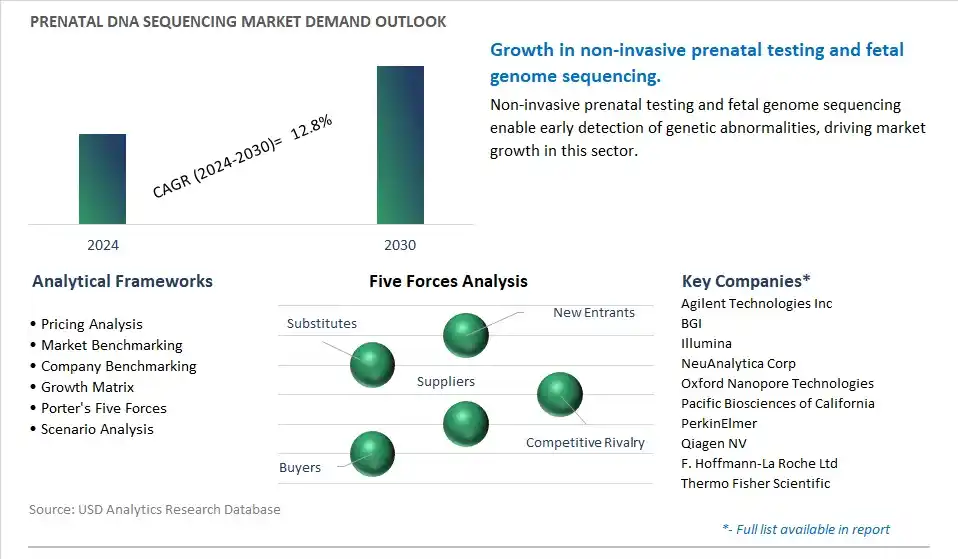
Prenatal DNA Sequencing Market is estimated to increase at a growth rate of 12.8% CAGR over the forecast period from 2024 to 2030.
The global Prenatal DNA Sequencing Market Study analyzes and forecasts the market size across 6 regions and 24 countries for diverse segments including By Application (Hemophilia, Down Syndrome, Cystic Fibrosis, Autism, DiGeorge Syndrome, AIDS, Cancer, Others).
An Introduction to Prenatal DNA Sequencing Market in 2024
The Prenatal DNA Sequencing Market in 2024 represents a transformative approach to prenatal testing and fetal diagnostics, offering advanced genetic sequencing technologies for non-invasive assessment of fetal genetic information from maternal blood samples. Prenatal DNA sequencing enables comprehensive analysis of fetal chromosomal abnormalities, genetic disorders, and inherited conditions, providing valuable insights into fetal health, development, and potential disease risks during pregnancy. With the advent of non-invasive prenatal testing (NIPT) and cell-free DNA analysis, the prenatal DNA sequencing market witnesses rapid growth and adoption, driven by factors such as increasing maternal age, rising demand for early and accurate prenatal diagnosis, and advancements in next-generation sequencing (NGS) technologies. Moreover, as healthcare providers, genetic counselors, and expectant parents seek to make informed decisions about pregnancy management, reproductive options, and neonatal care, the prenatal DNA sequencing market plays a pivotal role in empowering individuals with timely and actionable information to optimize pregnancy outcomes and facilitate personalized prenatal care.
Prenatal DNA Sequencing Market Competitive Landscape
The global Prenatal DNA Sequencing Industry is highly competitive with a large number of companies focusing on niche market segments. Amidst intense competitive conditions, Prenatal DNA Sequencing Companies are investing in new product launches and strengthening distribution channels. Key companies operating in the Prenatal DNA Sequencing Industry include- Agilent Technologies Inc, BGI, Illumina, NeuAnalytica Corp, Oxford Nanopore Technologies, Pacific Biosciences of California, PerkinElmer, Qiagen NV, F. Hoffmann-La Roche Ltd, Thermo Fisher Scientific.
Prenatal DNA Sequencing Market Trend: Increasing Adoption of Non-Invasive Prenatal Testing (NIPT)
The market trend for Prenatal DNA Sequencing is the increasing adoption of Non-Invasive Prenatal Testing (NIPT). NIPT, which involves the analysis of cell-free fetal DNA circulating in the maternal bloodstream, offers a highly accurate and less invasive alternative to traditional invasive prenatal diagnostic procedures such as amniocentesis and chorionic villus sampling (CVS). As NIPT technology continues to advance, there's growing demand for prenatal DNA sequencing services among pregnant individuals and healthcare providers seeking early and accurate detection of chromosomal abnormalities, including trisomies such as Down syndrome (trisomy 21), Edwards syndrome (trisomy 18), and Patau syndrome (trisomy 13), as well as sex chromosome abnormalities and select microdeletion syndromes. Moreover, expanding applications of NIPT beyond chromosomal aneuploidies to include screening for single-gene disorders, fetal sex determination, and assessment of fetal fraction and ploidy status contribute to the increasing popularity and utility of prenatal DNA sequencing in prenatal care.
Prenatal DNA Sequencing Market Driver: Demand for Early and Accurate Prenatal Diagnosis
The demand for early and accurate prenatal diagnosis is a significant driver fueling the market for Prenatal DNA Sequencing. Expectant parents and healthcare providers recognize the importance of prenatal genetic testing in identifying fetal genetic abnormalities, informing pregnancy management decisions, and providing emotional and reproductive counseling to affected families. Prenatal DNA sequencing offers several advantages over traditional diagnostic methods, including earlier detection of fetal abnormalities, reduced risk of miscarriage associated with invasive procedures, and the ability to perform testing as early as 9-10 weeks gestation. Moreover, advancements in sequencing technology, bioinformatics analysis, and data interpretation algorithms have led to improved test accuracy, sensitivity, and specificity, further driving the adoption of prenatal DNA sequencing in routine prenatal care. As awareness of the benefits of early prenatal diagnosis continues to grow and guidelines recommend broader implementation of NIPT as a first-tier screening test for fetal chromosomal abnormalities, there's increasing demand for reliable and accessible prenatal DNA sequencing services worldwide.
Prenatal DNA Sequencing Market Opportunity: Expansion of Testing Panels and Clinical Applications
The Market Opportunity for Prenatal DNA Sequencing lies in the expansion of testing panels and clinical applications to address emerging clinical needs and patient preferences. While NIPT traditionally focused on screening for common chromosomal aneuploidies, there's opportunity to expand testing panels to include additional genetic markers associated with rare genetic disorders, structural abnormalities, and maternal health conditions that may impact pregnancy outcomes. Moreover, there's potential for prenatal DNA sequencing to be integrated with other prenatal screening and diagnostic modalities such as ultrasound imaging, maternal serum screening, and fetal echocardiography to provide comprehensive risk assessment and personalized pregnancy management plans. Additionally, as the field of prenatal genetics continues to evolve, there's opportunity to explore novel applications of prenatal DNA sequencing in areas such as fetal epigenetics, placental genomics, and prenatal therapy monitoring. By embracing opportunities in expanded testing panels and clinical applications, stakeholders in the Prenatal DNA Sequencing market can enhance diagnostic accuracy, improve patient outcomes, and contribute to the advancement of prenatal care and reproductive medicine.
Prenatal DNA Sequencing Market Share Analysis: Down Syndrome is the fastest growing market segment over the forecast period to 2030
Prenatal DNA sequencing for Down syndrome emerges as the fastest-growing segment in the prenatal DNA sequencing market. This growth is propelled by several factors, including advances in sequencing technologies, increasing awareness of Down syndrome as one of the most common genetic disorders, and the growing demand for non-invasive prenatal testing (NIPT) options. Down syndrome, also known as trisomy 21, is characterized by the presence of an extra copy of chromosome 21 and is associated with intellectual disability, developmental delays, and certain health conditions. Prenatal DNA sequencing enables the detection of chromosomal abnormalities, including trisomy 21, through the analysis of cell-free fetal DNA in maternal blood samples, offering a highly accurate and early screening method for Down syndrome during pregnancy. With the emphasis on early detection and intervention to support individuals with Down syndrome and their families, coupled with the increasing availability and accessibility of prenatal DNA sequencing services, the market for prenatal DNA sequencing for Down syndrome is expected to witness rapid growth, providing expectant parents with valuable information and decision-making support regarding their pregnancy.
Prenatal DNA Sequencing Market Segmentation
By Application
Hemophilia
Down Syndrome
Cystic Fibrosis
Autism
DiGeorge Syndrome
AIDS
Cancer
Others
Geographical Analysis
North America (United States, Canada, Mexico)
Europe (Germany, France, United Kingdom, Spain, Italy, Rest of Europe)
Asia Pacific (China, India, Japan, South Korea, Rest of Asia Pacific)
South America (Brazil, Argentina, Rest of South America)
Middle East and Africa (Saudi Arabia, UAE, Rest of Middle East, South Africa, Egypt, Rest of Africa)
Prenatal DNA Sequencing Companies
Agilent Technologies Inc
BGI
Illumina
NeuAnalytica Corp
Oxford Nanopore Technologies
Pacific Biosciences of California
PerkinElmer
Qiagen NV
F. Hoffmann-La Roche Ltd
Thermo Fisher Scientific
* List not Exhaustive
Reasons to Buy the Prenatal DNA Sequencing Market Study
• Deepen your industry insights and navigate uncertainties for strategy formulation, CAPEX, and Operational decisions
• Gain access to detailed insights on the Prenatal DNA Sequencing Market, encompassing current market size, growth trends, and forecasts till 2030.
• Access detailed competitor analysis, enabling competitive advantage through a thorough understanding of market players, strategies, and potential differentiation opportunities
• Stay ahead of the curve with insights on technological advancements, innovations, and upcoming trends
• Identify lucrative investment avenues and expansion opportunities within the Prenatal DNA Sequencing Industry, guided by robust, data-backed analysis.
• Understand regional and global markets through country-wise analysis, regional market potential, regulatory nuances, and dynamics
• Execute strategies with confidence and speed through information, analytics, and insights on the industry value chain
• Corporate leaders, strategists, financial experts, shareholders, asset managers, and governmental representatives can make long-term planning scenarios and build an integrated and timely understanding of market dynamics
• Benefit from tailored solutions and expert consultation based on report insights, providing personalized strategies aligned with specific business needs.
TABLE OF CONTENTS
1 Introduction to 2024 Prenatal DNA Sequencing Market
1.1 Market Overview
1.2 Quick Facts
1.3 Scope/Objective of the Study
1.4 Market Definition
1.5 Countries and Regions Analyzed
1.6 Units, Currency, and Conversions
1.7 Industry Value Chain
2 Research Methodology
2.1 Market Size Estimation
2.2 Sources and Research Methodology
2.3 Data Triangulation
2.4 Assumptions and Limitations
3 Executive Summary
3.1 Global Prenatal DNA Sequencing Market Size Outlook, $ Million, 2021 to 2030
3.2 Prenatal DNA Sequencing Market Outlook by Type, $ Million, 2021 to 2030
3.3 Prenatal DNA Sequencing Market Outlook by Product, $ Million, 2021 to 2030
3.4 Prenatal DNA Sequencing Market Outlook by Application, $ Million, 2021 to 2030
3.5 Prenatal DNA Sequencing Market Outlook by Key Countries, $ Million, 2021 to 2030
4 Market Dynamics
4.1 Key Driving Forces of Prenatal DNA Sequencing Industry
4.2 Key Market Trends in Prenatal DNA Sequencing Industry
4.3 Potential Opportunities in Prenatal DNA Sequencing Industry
4.4 Key Challenges in Prenatal DNA Sequencing Industry
5 Market Factor Analysis
5.1 Value Chain Analysis
5.2 Competitive Landscape
5.2.1 Global Prenatal DNA Sequencing Market Share by Company (%), 2023
5.2.2 Product Offerings by Company
5.3 Porter’s Five Forces Analysis
5.4 Pricing Analysis and Outlook
6 Growth Outlook Across Scenarios
6.1 Growth Analysis-Case Scenario Definitions
6.2 Low Growth Scenario Forecasts
6.3 Reference Growth Scenario Forecasts
6.4 High Growth Scenario Forecasts
7 Global Prenatal DNA Sequencing Market Outlook by Segments
7.1 Prenatal DNA Sequencing Market Outlook by Segments, $ Million, 2021- 2030
By Application
Hemophilia
Down Syndrome
Cystic Fibrosis
Autism
DiGeorge Syndrome
AIDS
Cancer
Others
8 North America Prenatal DNA Sequencing Market Analysis and Outlook To 2030
8.1 Introduction to North America Prenatal DNA Sequencing Markets in 2024
8.2 North America Prenatal DNA Sequencing Market Size Outlook by Country, 2021-2030
8.2.1 United States
8.2.2 Canada
8.2.3 Mexico
8.3 North America Prenatal DNA Sequencing Market size Outlook by Segments, 2021-2030
By Application
Hemophilia
Down Syndrome
Cystic Fibrosis
Autism
DiGeorge Syndrome
AIDS
Cancer
Others
9 Europe Prenatal DNA Sequencing Market Analysis and Outlook To 2030
9.1 Introduction to Europe Prenatal DNA Sequencing Markets in 2024
9.2 Europe Prenatal DNA Sequencing Market Size Outlook by Country, 2021-2030
9.2.1 Germany
9.2.2 France
9.2.3 Spain
9.2.4 United Kingdom
9.2.4 Italy
9.2.5 Russia
9.2.6 Norway
9.2.7 Rest of Europe
9.3 Europe Prenatal DNA Sequencing Market Size Outlook by Segments, 2021-2030
By Application
Hemophilia
Down Syndrome
Cystic Fibrosis
Autism
DiGeorge Syndrome
AIDS
Cancer
Others
10 Asia Pacific Prenatal DNA Sequencing Market Analysis and Outlook To 2030
10.1 Introduction to Asia Pacific Prenatal DNA Sequencing Markets in 2024
10.2 Asia Pacific Prenatal DNA Sequencing Market Size Outlook by Country, 2021-2030
10.2.1 China
10.2.2 India
10.2.3 Japan
10.2.4 South Korea
10.2.5 Indonesia
10.2.6 Malaysia
10.2.7 Australia
10.2.8 Rest of Asia Pacific
10.3 Asia Pacific Prenatal DNA Sequencing Market size Outlook by Segments, 2021-2030
By Application
Hemophilia
Down Syndrome
Cystic Fibrosis
Autism
DiGeorge Syndrome
AIDS
Cancer
Others
11 South America Prenatal DNA Sequencing Market Analysis and Outlook To 2030
11.1 Introduction to South America Prenatal DNA Sequencing Markets in 2024
11.2 South America Prenatal DNA Sequencing Market Size Outlook by Country, 2021-2030
11.2.1 Brazil
11.2.2 Argentina
11.2.3 Rest of South America
11.3 South America Prenatal DNA Sequencing Market size Outlook by Segments, 2021-2030
By Application
Hemophilia
Down Syndrome
Cystic Fibrosis
Autism
DiGeorge Syndrome
AIDS
Cancer
Others
12 Middle East and Africa Prenatal DNA Sequencing Market Analysis and Outlook To 2030
12.1 Introduction to Middle East and Africa Prenatal DNA Sequencing Markets in 2024
12.2 Middle East and Africa Prenatal DNA Sequencing Market Size Outlook by Country, 2021-2030
12.2.1 Saudi Arabia
12.2.2 UAE
12.2.3 Oman
12.2.4 Rest of Middle East
12.2.5 Egypt
12.2.6 Nigeria
12.2.7 South Africa
12.2.8 Rest of Africa
12.3 Middle East and Africa Prenatal DNA Sequencing Market size Outlook by Segments, 2021-2030
By Application
Hemophilia
Down Syndrome
Cystic Fibrosis
Autism
DiGeorge Syndrome
AIDS
Cancer
Others
13 Company Profiles
13.1 Company Snapshot
13.2 SWOT Profiles
13.3 Products and Services
13.4 Recent Developments
13.5 Financial Profile
List of Companies
Agilent Technologies Inc
BGI
Illumina
NeuAnalytica Corp
Oxford Nanopore Technologies
Pacific Biosciences of California
PerkinElmer
Qiagen NV
F. Hoffmann-La Roche Ltd
Thermo Fisher Scientific
14 Appendix
14.1 Customization Offerings
14.2 Subscription Services
14.3 Related Reports
14.4 Publisher Expertise
