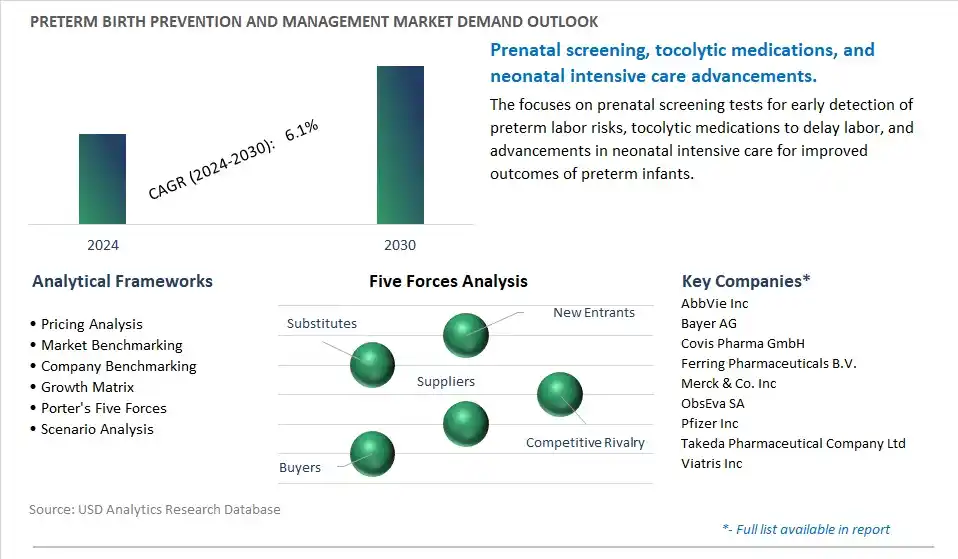
Preterm Birth Prevention and Management Market is estimated to increase at a Compounded Annual Growth Rate of 6.1% CAGR over the forecast period from 2024 to 2030
The Preterm Birth Prevention and Management Market study analyzes and forecasts the market size across 6 regions and 24 countries for diverse segments- By Therapy (Progesterone Therapy, Corticosteroid Therapy, Tocolytics Therapy, Antibiotics Therapy, Heparin Profylaxis Therapy, Others), By Route of Administration (Oral, Parenteral, Vaginal), By Distribution Channel (Hospital Pharmacies, Retail Pharmacies, Others).
An Introduction to Preterm Birth Prevention and Management Market in 2024
The market for preterm birth prevention and management is of paramount importance in 2024, given the significant health implications associated with preterm delivery and its impact on neonatal outcomes. Preterm birth, defined as birth before 37 weeks of gestation, remains a global public health challenge, necessitating effective strategies for prevention, prediction, and management. The treatment landscape encompasses a continuum of care, including preconception counseling, prenatal care, pharmacological interventions, and specialized neonatal support services. With advances in prenatal screening, maternal-fetal medicine, and neonatal intensive care, healthcare providers aim to identify high-risk pregnancies early and implement targeted interventions to prolong gestation and improve neonatal outcomes. Moreover, research into novel therapies such as progesterone supplementation and cervical cerclage offers promising avenues for further reducing the incidence of preterm birth and its associated complications, underscoring the importance of comprehensive preterm birth prevention and management strategies.
Market Trend: Focus on Maternal and Fetal Health
A prominent trend in the Preterm Birth Prevention and Management market is the increasing focus on maternal and fetal health. Healthcare systems and providers are prioritizing efforts to reduce the incidence of preterm birth and improve outcomes for both mothers and babies. This trend is driven by growing awareness of the significant medical, social, and economic burdens associated with preterm birth, including long-term health consequences for infants and substantial healthcare costs. Initiatives aimed at preconception care, prenatal screening, maternal education, and access to prenatal healthcare services are being implemented to identify and mitigate risk factors for preterm birth, promote healthy pregnancies, and optimize maternal and fetal well-being. The trend towards prioritizing maternal and fetal health underscores the importance of comprehensive approaches to preterm birth prevention and management, creating opportunities for collaboration, innovation, and investment in the Preterm Birth Prevention and Management market.
Market Driver: Advances in Prenatal Care and Neonatal Medicine
A primary driver fueling the growth of the Preterm Birth Prevention and Management market is the continuous advances in prenatal care and neonatal medicine. With advancements in medical technology, diagnostic techniques, and therapeutic interventions, healthcare providers have greater capabilities to identify and manage risk factors for preterm birth, as well as to improve outcomes for preterm infants. Prenatal screening methods, such as ultrasound, genetic testing, and biomarker analysis, enable early detection of conditions associated with preterm birth, allowing for timely interventions and personalized care plans. Additionally, advancements in neonatal intensive care, respiratory support, nutritional management, and developmental care have led to improved survival rates and outcomes for preterm infants born at lower gestational ages. The continuous progress in prenatal care and neonatal medicine drives the demand for innovative approaches to preterm birth prevention, antenatal interventions, and neonatal care, creating opportunities for market growth and advancement in the Preterm Birth Prevention and Management segment.
Market Opportunity: Development of Novel Therapeutic Interventions
An emerging opportunity in the Preterm Birth Prevention and Management market lies in the development of novel therapeutic interventions to prevent preterm birth and improve outcomes for preterm infants. Despite advancements in prenatal care, a significant proportion of preterm births occur without identifiable risk factors or preventive strategies. There is a need for innovative pharmacological and non-pharmacological interventions that target the underlying mechanisms of preterm labor, uterine contractions, cervical insufficiency, and other contributing factors to preterm birth. Opportunities exist for the development of novel drugs, biologics, medical devices, and interventions aimed at prolonging gestation, reducing the risk of preterm birth, and enhancing neonatal outcomes. Additionally, research into maternal nutrition, microbiome modulation, immunomodulatory therapies, and fetal monitoring technologies presents avenues for innovation in preterm birth prevention and management. Collaborations between academia, industry, and healthcare stakeholders can drive investment and innovation in the development of novel therapeutic interventions, unlocking new opportunities for market growth and improvement in maternal and neonatal health outcomes in the Preterm Birth Prevention and Management segment.
Preterm Birth Prevention and Management Market Share Analysis: Progesterone Therapy
In the landscape of preterm birth prevention and management, progesterone therapy emerges as a segment experiencing rapid growth. Progesterone, a hormone crucial for maintaining pregnancy, has been widely recognized for its role in preventing preterm birth. Progesterone therapy involves the administration of synthetic or natural progesterone formulations to pregnant individuals at risk of preterm delivery, aiming to reduce the likelihood of early labor and subsequent preterm birth. This therapy is available in various formulations, including oral capsules, intramuscular injections, and vaginal suppositories or gels. The efficacy of progesterone therapy in preventing preterm birth has been supported by clinical evidence, leading to its widespread adoption in prenatal care settings. Healthcare providers increasingly rely on progesterone therapy as a cornerstone intervention for women with a history of preterm birth, multiple gestations, or other risk factors predisposing them to preterm labor. Additionally, ongoing research and development efforts aim to enhance the formulation and delivery mechanisms of progesterone therapy to optimize its effectiveness and convenience for patients. With rising awareness about the importance of preventing preterm birth and the expanding utilization of progesterone therapy in obstetric practice, this segment is poised for significant growth in the preterm birth prevention and management market.
Preterm Birth Prevention and Management Competitive Analysis
The market research study provides in-depth insights into leading companies including the SWOT analyses, product profile, financial details, and recent developments acrossAbbVie Inc, Bayer AG, Covis Pharma GmbH, Ferring Pharmaceuticals B.V., Merck & Co. Inc, ObsEva SA, Pfizer Inc, Takeda Pharmaceutical Company Ltd, Viatris Inc
Preterm Birth Prevention and Management Market Segmentation
By Therapy
Progesterone Therapy
Corticosteroid Therapy
Tocolytics Therapy
Antibiotics Therapy
Heparin Profylaxis Therapy
Others
By Route of Administration
Oral
Parenteral
Vaginal
By Distribution Channel
Hospital Pharmacies
Retail Pharmacies
Others
Geographical Analysis
North America (United States, Canada, Mexico)
Europe (Germany, France, United Kingdom, Spain, Italy, Rest of Europe)
Asia Pacific (China, India, Japan, South Korea, Rest of Asia Pacific)
South America (Brazil, Argentina, Rest of South America)
Middle East and Africa (Saudi Arabia, UAE, Rest of Middle East, South Africa, Egypt, Rest of Africa)
Preterm Birth Prevention and Management Market Companies
AbbVie Inc
Bayer AG
Covis Pharma GmbH
Ferring Pharmaceuticals B.V.
Merck & Co. Inc
ObsEva SA
Pfizer Inc
Takeda Pharmaceutical Company Ltd
Viatris Inc
Reasons to Buy the Preterm Birth Prevention and Management Market Study
• Deepen your industry insights and navigate uncertainties for strategy formulation, CAPEX, and Operational decisions
• Gain access to detailed insights on the Preterm Birth Prevention and Management Market, encompassing current market size, growth trends, and forecasts till 2030.
• Access detailed competitor analysis, enabling competitive advantage through a thorough understanding of market players, strategies, and potential differentiation opportunities
• Stay ahead of the curve with insights on technological advancements, innovations, and upcoming trends
• Identify lucrative investment avenues and expansion opportunities within the Preterm Birth Prevention and Management Market industry, guided by robust, data-backed analysis.
• Understand regional and global markets through country-wise analysis, regional market potential, regulatory nuances, and dynamics
• Execute strategies with confidence and speed through information, analytics, and insights on the industry value chain
• Corporate leaders, strategists, financial experts, shareholders, asset managers, and governmental representatives can make long-term planning scenarios and build an integrated and timely understanding of market dynamics
• Benefit from tailored solutions and expert consultation based on report insights, providing personalized strategies aligned with specific business needs.
TABLE OF CONTENTS
1 Introduction to 2024 Preterm Birth Prevention and Management Market
1.1 Market Overview
1.2 Quick Facts
1.3 Scope/Objective of the Study
1.4 Market Definition
1.5 Countries and Regions Covered
1.6 Units, Currency, and Conversions
1.7 Industry Value Chain
2 Research Methodology
2.1 Market Size Estimation
2.2 Sources and Research Methodology
2.3 Data Triangulation
2.4 Assumptions and Limitations
3 Executive Summary
3.1 Global Preterm Birth Prevention and Management Market Size Outlook, $ Million, 2021 to 2030
3.2 Preterm Birth Prevention and Management Market Outlook by Type, $ Million, 2021 to 2030
3.3 Preterm Birth Prevention and Management Market Outlook by Product, $ Million, 2021 to 2030
3.4 Preterm Birth Prevention and Management Market Outlook by Application, $ Million, 2021 to 2030
3.5 Preterm Birth Prevention and Management Market Outlook by Key Countries, $ Million, 2021 to 2030
4 Market Dynamics
4.1 Key Driving Forces of Preterm Birth Prevention and Management Industry
4.2 Key Market Trends in Preterm Birth Prevention and Management Industry
4.3 Potential Opportunities in Preterm Birth Prevention and Management Industry
4.4 Key Challenges in Preterm Birth Prevention and Management Industry
5 Market Factor Analysis
5.1 Value Chain Analysis
5.2 Competitive Landscape
5.2.1 Global Preterm Birth Prevention and Management Market Share by Company (%), 2023
5.2.2 Product Offerings by Company
5.3 Porter’s Five Forces Analysis
5.4 Pricing Analysis and Outlook
6 Growth Outlook Across Scenarios
6.1 Growth Analysis-Case Scenario Definitions
6.2 Low Growth Scenario Forecasts
6.3 Reference Growth Scenario Forecasts
6.4 High Growth Scenario Forecasts
7 Global Preterm Birth Prevention and Management Market Outlook by Segments
7.1 Preterm Birth Prevention and Management Market Outlook by Segments, $ Million, 2021- 2030
By Therapy
Progesterone Therapy
Corticosteroid Therapy
Tocolytics Therapy
Antibiotics Therapy
Heparin Profylaxis Therapy
Others
By Route of Administration
Oral
Parenteral
Vaginal
By Distribution Channel
Hospital Pharmacies
Retail Pharmacies
Others
8 North America Preterm Birth Prevention and Management Market Analysis and Outlook To 2030
8.1 Introduction to North America Preterm Birth Prevention and Management Markets in 2024
8.2 North America Preterm Birth Prevention and Management Market Size Outlook by Country, 2021-2030
8.2.1 United States
8.2.2 Canada
8.2.3 Mexico
8.3 North America Preterm Birth Prevention and Management Market size Outlook by Segments, 2021-2030
By Therapy
Progesterone Therapy
Corticosteroid Therapy
Tocolytics Therapy
Antibiotics Therapy
Heparin Profylaxis Therapy
Others
By Route of Administration
Oral
Parenteral
Vaginal
By Distribution Channel
Hospital Pharmacies
Retail Pharmacies
Others
9 Europe Preterm Birth Prevention and Management Market Analysis and Outlook To 2030
9.1 Introduction to Europe Preterm Birth Prevention and Management Markets in 2024
9.2 Europe Preterm Birth Prevention and Management Market Size Outlook by Country, 2021-2030
9.2.1 Germany
9.2.2 France
9.2.3 Spain
9.2.4 United Kingdom
9.2.4 Italy
9.2.5 Russia
9.2.6 Norway
9.2.7 Rest of Europe
9.3 Europe Preterm Birth Prevention and Management Market Size Outlook by Segments, 2021-2030
By Therapy
Progesterone Therapy
Corticosteroid Therapy
Tocolytics Therapy
Antibiotics Therapy
Heparin Profylaxis Therapy
Others
By Route of Administration
Oral
Parenteral
Vaginal
By Distribution Channel
Hospital Pharmacies
Retail Pharmacies
Others
10 Asia Pacific Preterm Birth Prevention and Management Market Analysis and Outlook To 2030
10.1 Introduction to Asia Pacific Preterm Birth Prevention and Management Markets in 2024
10.2 Asia Pacific Preterm Birth Prevention and Management Market Size Outlook by Country, 2021-2030
10.2.1 China
10.2.2 India
10.2.3 Japan
10.2.4 South Korea
10.2.5 Indonesia
10.2.6 Malaysia
10.2.7 Australia
10.2.8 Rest of Asia Pacific
10.3 Asia Pacific Preterm Birth Prevention and Management Market size Outlook by Segments, 2021-2030
By Therapy
Progesterone Therapy
Corticosteroid Therapy
Tocolytics Therapy
Antibiotics Therapy
Heparin Profylaxis Therapy
Others
By Route of Administration
Oral
Parenteral
Vaginal
By Distribution Channel
Hospital Pharmacies
Retail Pharmacies
Others
11 South America Preterm Birth Prevention and Management Market Analysis and Outlook To 2030
11.1 Introduction to South America Preterm Birth Prevention and Management Markets in 2024
11.2 South America Preterm Birth Prevention and Management Market Size Outlook by Country, 2021-2030
11.2.1 Brazil
11.2.2 Argentina
11.2.3 Rest of South America
11.3 South America Preterm Birth Prevention and Management Market size Outlook by Segments, 2021-2030
By Therapy
Progesterone Therapy
Corticosteroid Therapy
Tocolytics Therapy
Antibiotics Therapy
Heparin Profylaxis Therapy
Others
By Route of Administration
Oral
Parenteral
Vaginal
By Distribution Channel
Hospital Pharmacies
Retail Pharmacies
Others
12 Middle East and Africa Preterm Birth Prevention and Management Market Analysis and Outlook To 2030
12.1 Introduction to Middle East and Africa Preterm Birth Prevention and Management Markets in 2024
12.2 Middle East and Africa Preterm Birth Prevention and Management Market Size Outlook by Country, 2021-2030
12.2.1 Saudi Arabia
12.2.2 UAE
12.2.3 Oman
12.2.4 Rest of Middle East
12.2.5 Egypt
12.2.6 Nigeria
12.2.7 South Africa
12.2.8 Rest of Africa
12.3 Middle East and Africa Preterm Birth Prevention and Management Market size Outlook by Segments, 2021-2030
By Therapy
Progesterone Therapy
Corticosteroid Therapy
Tocolytics Therapy
Antibiotics Therapy
Heparin Profylaxis Therapy
Others
By Route of Administration
Oral
Parenteral
Vaginal
By Distribution Channel
Hospital Pharmacies
Retail Pharmacies
Others
13 Company Profiles
13.1 Company Snapshot
13.2 SWOT Profiles
13.3 Products and Services
13.4 Recent Developments
13.5 Financial Profile
List of Companies
AbbVie Inc
Bayer AG
Covis Pharma GmbH
Ferring Pharmaceuticals B.V.
Merck & Co. Inc
ObsEva SA
Pfizer Inc
Takeda Pharmaceutical Company Ltd
Viatris Inc
14 Appendix
14.1 Customization Offerings
14.2 Subscription Services
14.3 Related Reports
14.4 Publisher Expertise
By Therapy
Progesterone Therapy
Corticosteroid Therapy
Tocolytics Therapy
Antibiotics Therapy
Heparin Profylaxis Therapy
Others
By Route of Administration
Oral
Parenteral
Vaginal
By Distribution Channel
Hospital Pharmacies
Retail Pharmacies
Others
Countries Analyzed
North America (United States, Canada, Mexico)
Europe (Germany, France, United Kingdom, Spain, Italy, Rest of Europe)
Asia Pacific (China, India, Japan, South Korea, Rest of Asia Pacific)
South America (Brazil, Argentina, Rest of South America)
Middle East and Africa (Saudi Arabia, UAE, Rest of Middle East, South Africa, Egypt, Rest of Africa)
