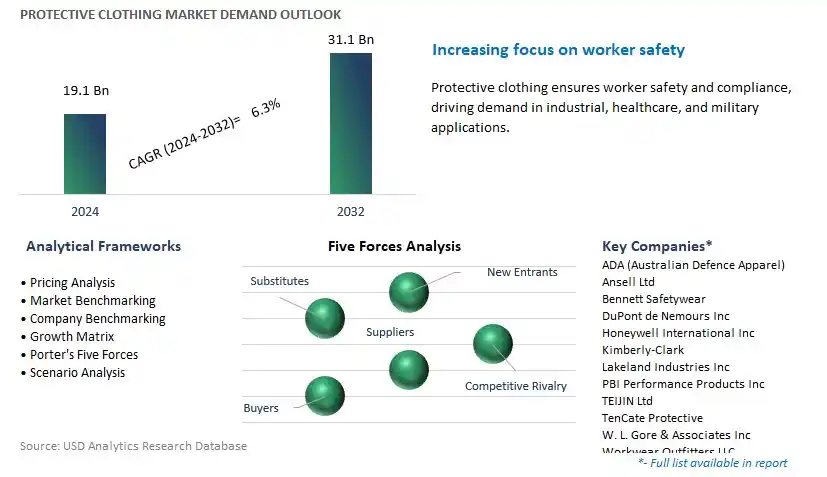
Global Protective Clothing Market Size is valued at $19.1 Billion in 2024 and is forecast to register a growth rate (CAGR) of 6.3% to reach $31.1 Billion by 2032.
The global Protective Clothing Market Study analyzes and forecasts the market size across 6 regions and 24 countries for diverse segments -By Material (Aramid & Blends, Polyolefin & Blends, Polyamide, PBI), By Application (Thermal, Chemical, Visibility), By End-User (Construction, Manufacturing, Oil & Gas, Mining).
An Introduction to Protective Clothing Market in 2024
In 2024, the protective clothing market is witnessing rapid expansion driven by heightened awareness of workplace safety standards, stringent regulatory requirements, and the increasing prevalence of occupational hazards across industries such as manufacturing, construction, and healthcare. Protective clothing encompasses a diverse range of garments and accessories designed to safeguard workers from physical, chemical, biological, and thermal hazards in the workplace. The adoption of advanced materials and innovative design technologies is revolutionizing the protective clothing landscape, enabling the development of lightweight, breathable, and ergonomic garments that offer enhanced comfort and protection. Further, the ongoing COVID-19 pandemic has accentuated the importance of personal protective equipment (PPE), further stimulating demand for protective clothing, including coveralls, gloves, masks, and face shields, to mitigate the risk of infection among frontline workers and healthcare professionals. With a growing emphasis on employee well-being and risk mitigation strategies, the protective clothing market is poised for sustained growth, driven by investments in research and development, regulatory compliance, and workplace safety initiatives.
Protective Clothing Market Competitive Landscape
The market report analyses the leading companies in the industry including ADA (Australian Defence Apparel), Ansell Ltd, Bennett Safetywear, DuPont de Nemours Inc, Honeywell International Inc, Kimberly-Clark, Lakeland Industries Inc, PBI Performance Products Inc, TEIJIN Ltd, TenCate Protective, W. L. Gore & Associates Inc, Workwear Outfitters LLC, and others.
Protective Clothing Market Dynamics
Market Trend: Increased Focus on Worker Safety and Health
One prominent trend in the Protective Clothing market is the increased focus on worker safety and health. This trend is driven by stringent regulations, heightened awareness of occupational hazards, and the growing emphasis on workplace safety culture. Industries such as manufacturing, construction, healthcare, and oil & gas are investing in high-quality protective clothing to mitigate risks of injury, exposure to harmful substances, and transmission of infectious diseases. The trend towards prioritizing worker safety aligns with corporate social responsibility initiatives and regulatory compliance efforts, driving market growth in the protective clothing sector.
Market Driver: Growth in Industrial Activities and Hazardous Work Environments
An important driver propelling the growth of the Protective Clothing market is the growth in industrial activities and hazardous work environments. With increasing industrialization, infrastructure development, and globalization of supply chains, there's a rising demand for protective clothing to safeguard workers against occupational hazards. Industries such as construction, manufacturing, mining, and chemical processing require protective clothing to protect against risks such as chemical exposure, fire hazards, electrical shock, and physical injuries. The expansion of these industries, coupled with the need for compliance with occupational safety regulations, drives the demand for protective clothing, supporting market growth.
Market Opportunity: Adoption of Advanced Materials and Technologies
A significant opportunity for the Protective Clothing market lies in the adoption of advanced materials and technologies. With advancements in materials science, nanotechnology, and wearable technology, there's potential for innovation in protective clothing design and performance. Opportunities exist for developing lightweight, breathable, and ergonomic protective garments that offer enhanced protection, comfort, and functionality. Additionally, integrating smart sensors, monitoring systems, and communication devices into protective clothing can provide real-time feedback on environmental conditions and worker health, enhancing safety and productivity in hazardous work environments. By investing in research and development and collaborating with technology partners, manufacturers can capitalize on the growing demand for advanced protective clothing solutions and gain a competitive edge in the market.
Protective Clothing Market Share Analysis: Aramid & Blends segment generated the highest revenue in 2024
The Aramid & Blends segment is the largest in the protective clothing market by material. Aramid fibers, such as Kevlar and Nomex, are renowned for their exceptional strength-to-weight ratio, heat resistance, and durability, making them a preferred choice in protective clothing applications. These fibers offer superior protection against mechanical threats like cuts and abrasions, as well as thermal hazards such as flames and high temperatures, which are critical in industries like firefighting, military, and industrial manufacturing. The high performance of aramid fibers in providing personal safety, combined with their lightweight and flexible nature, ensures user comfort without compromising protection. This balance of safety and wearability is a significant factor driving the widespread adoption of aramid and blends in protective clothing. Additionally, the continuous advancements in aramid fiber technology, which improve their protective properties and cost-effectiveness, further bolster their dominance in the market. The increasing emphasis on worker safety regulations and standards across various industries also propels the demand for high-quality protective clothing made from aramid and blends. As industries continue to prioritize safety and invest in protective gear, the aramid & blends segment maintains its position as the largest in the protective clothing market.
Protective Clothing Market Share Analysis: Chemical Protective Clothing segment is poised to register the fastest CAGR over the forecast period
The chemical protective clothing segment is the fastest-growing in the protective clothing market by application. This rapid growth is driven by the increasing awareness and stringent regulations regarding workplace safety in industries such as chemicals, pharmaceuticals, and oil and gas. Chemical protective clothing is designed to shield workers from hazardous substances, including toxic chemicals, acids, and gases, which are commonly encountered in these industries. The rising incidents of chemical spills and occupational health hazards have heightened the demand for robust protective solutions. Additionally, the expansion of the chemical industry, particularly in emerging markets, has further fuelled the need for effective protective clothing to ensure worker safety. The continuous advancements in material science have led to the development of more efficient, durable, and comfortable chemical protective clothing, enhancing its adoption across various sectors. The implementation of strict safety standards and regulations by governments and safety organizations worldwide mandates the use of high-quality protective gear, thereby driving market growth. As industries continue to prioritize the health and safety of their workforce, the chemical protective clothing segment is expected to see sustained and accelerated growth, reflecting its critical role in industrial safety protocols.
Protective Clothing Market Share Analysis: Oil & Gas segment generated the highest revenue in 2024
The oil & gas segment is the largest in the protective clothing market by end-user. This segment's prominence is due to the inherently hazardous nature of the oil and gas industry, which demands the highest levels of safety for its workforce. Workers in this sector are regularly exposed to extreme conditions, including high temperatures, fire hazards, chemical exposure, and potential mechanical injuries, necessitating the use of advanced protective clothing. The stringent safety regulations and standards imposed by governments and industry bodies to protect workers further drive the demand for high-quality protective gear. Additionally, the substantial investment in safety infrastructure by oil and gas companies underscores the critical importance of protective clothing in mitigating risks and ensuring operational safety. The industry’s global scale and continuous activities, including exploration, drilling, refining, and transportation, require a consistent and extensive supply of protective clothing. Moreover, the growing focus on sustainable and advanced materials in protective clothing enhances their performance, durability, and comfort, making them more appealing to the industry. As the oil and gas sector continues to expand, particularly with new projects in emerging markets, the demand for protective clothing is set to remain robust, solidifying the oil & gas segment's position as the largest
Protective Clothing Market
By Material
Aramid & Blends
Polyolefin & Blends
Polyamide
PBI
By Application
Thermal
Chemical
Visibility
By End-User
Construction
Manufacturing
Oil & Gas
MiningCountries Analyzed
North America (US, Canada, Mexico)
Europe (Germany, UK, France, Spain, Italy, Russia, Rest of Europe)
Asia Pacific (China, India, Japan, South Korea, Australia, South East Asia, Rest of Asia)
South America (Brazil, Argentina, Rest of South America)
Middle East and Africa (Saudi Arabia, UAE, Rest of Middle East, South Africa, Egypt, Rest of Africa)
Protective Clothing Companies Profiled in the Study
ADA (Australian Defence Apparel)
Ansell Ltd
Bennett Safetywear
DuPont de Nemours Inc
Honeywell International Inc
Kimberly-Clark
Lakeland Industries Inc
PBI Performance Products Inc
TEIJIN Ltd
TenCate Protective
W. L. Gore & Associates Inc
Workwear Outfitters LLC
*- List Not Exhaustive
TABLE OF CONTENTS
1 Introduction to 2024 Protective Clothing Market
1.1 Market Overview
1.2 Quick Facts
1.3 Scope/Objective of the Study
1.4 Market Definition
1.5 Countries and Regions Covered
1.6 Units, Currency, and Conversions
1.7 Industry Value Chain
2 Research Methodology
2.1 Market Size Estimation
2.2 Sources and Research Methodology
2.3 Data Triangulation
2.4 Assumptions and Limitations
3 Executive Summary
3.1 Global Protective Clothing Market Size Outlook, $ Million, 2021 to 2032
3.2 Protective Clothing Market Outlook by Type, $ Million, 2021 to 2032
3.3 Protective Clothing Market Outlook by Product, $ Million, 2021 to 2032
3.4 Protective Clothing Market Outlook by Application, $ Million, 2021 to 2032
3.5 Protective Clothing Market Outlook by Key Countries, $ Million, 2021 to 2032
4 Market Dynamics
4.1 Key Driving Forces of Protective Clothing Industry
4.2 Key Market Trends in Protective Clothing Industry
4.3 Potential Opportunities in Protective Clothing Industry
4.4 Key Challenges in Protective Clothing Industry
5 Market Factor Analysis
5.1 Value Chain Analysis
5.2 Competitive Landscape
5.2.1 Global Protective Clothing Market Share by Company (%), 2023
5.2.2 Product Offerings by Company
5.3 Porter’s Five Forces Analysis
5.4 Pricing Analysis and Outlook
6 Growth Outlook Across Scenarios
6.1 Growth Analysis-Case Scenario Definitions
6.2 Low Growth Scenario Forecasts
6.3 Reference Growth Scenario Forecasts
6.4 High Growth Scenario Forecasts
7 Global Protective Clothing Market Outlook by Segments
7.1 Protective Clothing Market Outlook by Segments, $ Million, 2021- 2032
By Material
Aramid & Blends
Polyolefin & Blends
Polyamide
PBI
By Application
Thermal
Chemical
Visibility
By End-User
Construction
Manufacturing
Oil & Gas
Mining
8 North America Protective Clothing Market Analysis and Outlook To 2032
8.1 Introduction to North America Protective Clothing Markets in 2024
8.2 North America Protective Clothing Market Size Outlook by Country, 2021-2032
8.2.1 United States
8.2.2 Canada
8.2.3 Mexico
8.3 North America Protective Clothing Market size Outlook by Segments, 2021-2032
By Material
Aramid & Blends
Polyolefin & Blends
Polyamide
PBI
By Application
Thermal
Chemical
Visibility
By End-User
Construction
Manufacturing
Oil & Gas
Mining
9 Europe Protective Clothing Market Analysis and Outlook To 2032
9.1 Introduction to Europe Protective Clothing Markets in 2024
9.2 Europe Protective Clothing Market Size Outlook by Country, 2021-2032
9.2.1 Germany
9.2.2 France
9.2.3 Spain
9.2.4 United Kingdom
9.2.4 Italy
9.2.5 Russia
9.2.6 Norway
9.2.7 Rest of Europe
9.3 Europe Protective Clothing Market Size Outlook by Segments, 2021-2032
By Material
Aramid & Blends
Polyolefin & Blends
Polyamide
PBI
By Application
Thermal
Chemical
Visibility
By End-User
Construction
Manufacturing
Oil & Gas
Mining
10 Asia Pacific Protective Clothing Market Analysis and Outlook To 2032
10.1 Introduction to Asia Pacific Protective Clothing Markets in 2024
10.2 Asia Pacific Protective Clothing Market Size Outlook by Country, 2021-2032
10.2.1 China
10.2.2 India
10.2.3 Japan
10.2.4 South Korea
10.2.5 Indonesia
10.2.6 Malaysia
10.2.7 Australia
10.2.8 Rest of Asia Pacific
10.3 Asia Pacific Protective Clothing Market size Outlook by Segments, 2021-2032
By Material
Aramid & Blends
Polyolefin & Blends
Polyamide
PBI
By Application
Thermal
Chemical
Visibility
By End-User
Construction
Manufacturing
Oil & Gas
Mining
11 South America Protective Clothing Market Analysis and Outlook To 2032
11.1 Introduction to South America Protective Clothing Markets in 2024
11.2 South America Protective Clothing Market Size Outlook by Country, 2021-2032
11.2.1 Brazil
11.2.2 Argentina
11.2.3 Rest of South America
11.3 South America Protective Clothing Market size Outlook by Segments, 2021-2032
By Material
Aramid & Blends
Polyolefin & Blends
Polyamide
PBI
By Application
Thermal
Chemical
Visibility
By End-User
Construction
Manufacturing
Oil & Gas
Mining
12 Middle East and Africa Protective Clothing Market Analysis and Outlook To 2032
12.1 Introduction to Middle East and Africa Protective Clothing Markets in 2024
12.2 Middle East and Africa Protective Clothing Market Size Outlook by Country, 2021-2032
12.2.1 Saudi Arabia
12.2.2 UAE
12.2.3 Oman
12.2.4 Rest of Middle East
12.2.5 Egypt
12.2.6 Nigeria
12.2.7 South Africa
12.2.8 Rest of Africa
12.3 Middle East and Africa Protective Clothing Market size Outlook by Segments, 2021-2032
By Material
Aramid & Blends
Polyolefin & Blends
Polyamide
PBI
By Application
Thermal
Chemical
Visibility
By End-User
Construction
Manufacturing
Oil & Gas
Mining
13 Company Profiles
13.1 Company Snapshot
13.2 SWOT Profiles
13.3 Products and Services
13.4 Recent Developments
13.5 Financial Profile
ADA (Australian Defence Apparel)
Ansell Ltd
Bennett Safetywear
DuPont de Nemours Inc
Honeywell International Inc
Kimberly-Clark
Lakeland Industries Inc
PBI Performance Products Inc
TEIJIN Ltd
TenCate Protective
W. L. Gore & Associates Inc
Workwear Outfitters LLC
14 Appendix
14.1 Customization Offerings
14.2 Subscription Services
14.3 Related Reports
14.4 Publisher Expertise
By Material
Aramid & Blends
Polyolefin & Blends
Polyamide
PBI
By Application
Thermal
Chemical
Visibility
By End-User
Construction
Manufacturing
Oil & Gas
Mining
Countries Analyzed
North America (US, Canada, Mexico)
Europe (Germany, UK, France, Spain, Italy, Russia, Rest of Europe)
Asia Pacific (China, India, Japan, South Korea, Australia, South East Asia, Rest of Asia)
South America (Brazil, Argentina, Rest of South America)
Middle East and Africa (Saudi Arabia, UAE, Rest of Middle East, South Africa, Egypt, Rest of Africa)
