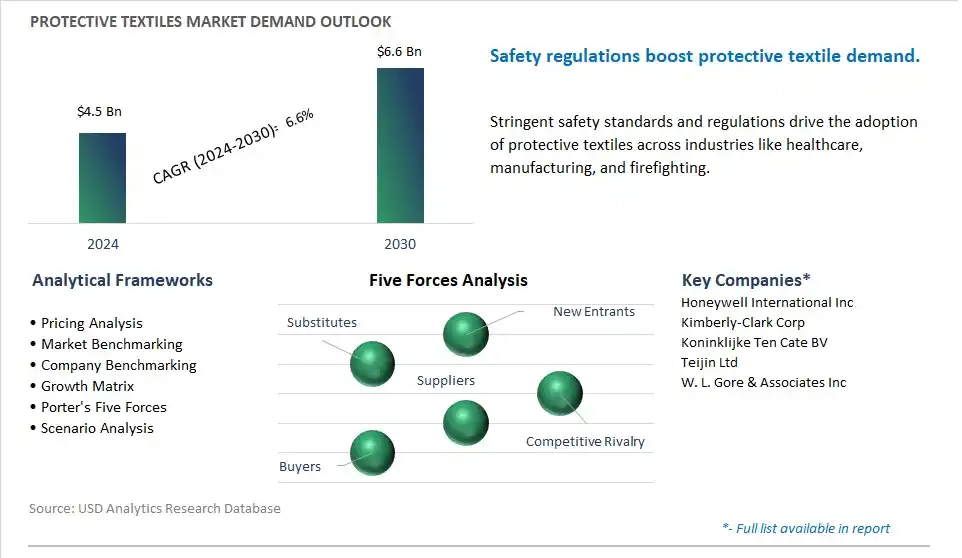
The global Protective Textiles Market is poised to register a 6.6% CAGR from $4.5 Billion in 2024 to $6.6 Billion in 2030.
The global Protective Textiles Market Study analyzes and forecasts the market size across 6 regions and 24 countries for diverse segments -By Application (Heat& flame resistant, Mechanical protection, Chemical protection, Electrical protection, Ballistic protection, Space suits, Health care garments, Others).
An Introduction to Global Protective Textiles Market in 2024
The future of the protective textiles market is shaped by key trends such as advancements in material science, increasing safety regulations, and growing demand from various industries. Protective textiles encompass a wide range of products designed to provide protection against hazards such as heat, flames, chemicals, electric arcs, and ballistic threats. As industries such as construction, manufacturing, oil and gas, firefighting, and military prioritize worker safety, the demand for high-performance protective textiles continues to grow. Advancements in material science enable the development of innovative fabrics with enhanced properties such as flame resistance, abrasion resistance, breathability, and comfort, meeting the stringent requirements of diverse applications. Moreover, increasing safety regulations and standards drive the adoption of certified protective textiles that meet specific performance criteria and ensure compliance with occupational health and safety requirements. Additionally, emerging technologies such as smart textiles, phase change materials, and nanotechnology coatings offer new opportunities for improving the functionality and effectiveness of protective textiles. As industries seek to mitigate risks, reduce workplace injuries, and enhance worker productivity, the protective textiles market will continue to evolve with innovative solutions that prioritize safety, comfort, and performance.
Protective Textiles Market Competitive Landscape
The market report analyses the leading companies in the industry including Honeywell International Inc, Kimberly-Clark Corp, Koninklijke Ten Cate BV, Teijin Ltd, W. L. Gore & Associates Inc.
Protective Textiles Market Dynamics
Protective Textiles Market Trend: Growing Demand for Functional and High-Performance Protective Textiles
One prominent trend in the protective textiles market is the growing demand for functional and high-performance protective textiles across various industries. With increasing awareness of workplace safety, health hazards, and environmental risks, there is a rising need for textiles that offer advanced protection against physical, chemical, biological, and thermal hazards. Protective textiles are designed to provide durable, comfortable, and reliable protection to workers in hazardous environments, including those in industrial, military, healthcare, and firefighting sectors. This is driven by regulatory requirements, industry standards, and a shift towards proactive risk management practices, leading to the adoption of innovative materials and technologies to enhance the protective properties of textiles and meet the evolving needs of end-users for effective personal protective equipment (PPE).
Protective Textiles Market Driver: Stringent Safety Regulations and Occupational Health Standards
The primary driver fueling the demand for protective textiles is the implementation of stringent safety regulations and occupational health standards governing workplace safety and personal protective equipment (PPE). Governments, regulatory agencies, and industry organizations worldwide enforce regulations and standards to ensure the protection of workers from workplace hazards and occupational risks. Compliance with regulations such as OSHA (Occupational Safety and Health Administration) in the United States, EN standards in Europe, and ISO certifications drives the adoption of protective textiles that meet specified performance criteria for protection levels, durability, comfort, and ergonomics. This driver is propelled by the legal obligations of employers to provide safe working environments, the emphasis on employee health and well-being, and the need to mitigate liability risks associated with workplace accidents and injuries, driving sustained demand for protective textiles in the global market.
Protective Textiles Market Opportunity: Development of Smart and Connected Protective Textiles
An attractive opportunity for the protective textiles market lies in the development of smart and connected protective textiles embedded with sensor technologies and IoT (Internet of Things) capabilities. By integrating sensors, actuators, and communication modules into textiles, manufacturers can create smart PPE solutions that offer real-time monitoring of environmental conditions, physiological parameters, and wearer's health status. Smart protective textiles enable early detection of hazards, prompt response to emergencies, and proactive risk management strategies, enhancing worker safety and operational efficiency in hazardous environments. This opportunity allows for differentiation, value-added features, and market leadership in the increasingly competitive landscape of protective textiles, as industries seek innovative solutions to address evolving safety challenges and optimize workplace performance.
Protective Textiles Market Share Analysis: Ballistic Protection generated the highest revenue in 2024
The largest segment in the Protective Textiles Market is ballistic protection, primarily due to the critical role of protective textiles in providing personal protection to military personnel, law enforcement officers, and security professionals. Ballistic protection textiles are designed to withstand and mitigate the impact of projectiles, fragments, and other ballistic threats, offering crucial defense against firearms and explosives. With the increasing focus on national security, counter-terrorism efforts, and defense modernization programs worldwide, there is a growing demand for high-performance ballistic protection textiles for body armor, helmets, and vehicle armor applications. Additionally, the rise in global conflicts, urban violence, and asymmetric threats further drive the need for reliable and lightweight ballistic protection solutions. As governments and defense organizations continue to prioritize the safety and security of personnel in high-risk environments, the demand for ballistic protection textiles remains robust, consolidating this segment as the largest in the Protective Textiles Market.
Protective Textiles Market Report Segmentation
By Application
Heat& flame resistant
Mechanical protection
Chemical protection
Electrical protection
Ballistic protection
Space suits
Health care garments
Others
Regions Included
North America (US, Canada, Mexico)
Europe (Germany, UK, France, Spain, Italy, Russia, Rest of Europe)
Asia Pacific (China, India, Japan, South Korea, Australia, South East Asia, Rest of Asia)
South America (Brazil, Argentina, Rest of South America)
Middle East and Africa (Saudi Arabia, UAE, Rest of Middle East, South Africa, Egypt, Rest of Africa)
Protective Textiles Companies Profiled in the Market Study
Honeywell International Inc
Kimberly-Clark Corp
Koninklijke Ten Cate BV
Teijin Ltd
W. L. Gore & Associates Inc
*- List Not Exhaustive
TABLE OF CONTENTS
1 Introduction to 2024 Protective Textiles Market
1.1 Market Overview
1.2 Quick Facts
1.3 Scope/Objective of the Study
1.4 Market Definition
1.5 Countries and Regions Covered
1.6 Units, Currency, and Conversions
1.7 Industry Value Chain
2 Research Methodology
2.1 Market Size Estimation
2.2 Sources and Research Methodology
2.3 Data Triangulation
2.4 Assumptions and Limitations
3 Executive Summary
3.1 Global Protective Textiles Market Size Outlook, $ Million, 2021 to 2030
3.2 Protective Textiles Market Outlook by Type, $ Million, 2021 to 2030
3.3 Protective Textiles Market Outlook by Product, $ Million, 2021 to 2030
3.4 Protective Textiles Market Outlook by Application, $ Million, 2021 to 2030
3.5 Protective Textiles Market Outlook by Key Countries, $ Million, 2021 to 2030
4 Market Dynamics
4.1 Key Driving Forces of Protective Textiles Industry
4.2 Key Market Trends in Protective Textiles Industry
4.3 Potential Opportunities in Protective Textiles Industry
4.4 Key Challenges in Protective Textiles Industry
5 Market Factor Analysis
5.1 Value Chain Analysis
5.2 Competitive Landscape
5.2.1 Global Protective Textiles Market Share by Company (%), 2023
5.2.2 Product Offerings by Company
5.3 Porter’s Five Forces Analysis
5.4 Pricing Analysis and Outlook
6 Growth Outlook Across Scenarios
6.1 Growth Analysis-Case Scenario Definitions
6.2 Low Growth Scenario Forecasts
6.3 Reference Growth Scenario Forecasts
6.4 High Growth Scenario Forecasts
7 Global Protective Textiles Market Outlook by Segments
7.1 Protective Textiles Market Outlook by Segments, $ Million, 2021- 2030
By Application
Heat& flame resistant
Mechanical protection
Chemical protection
Electrical protection
Ballistic protection
Space suits
Health care garments
Others
8 North America Protective Textiles Market Analysis and Outlook To 2030
8.1 Introduction to North America Protective Textiles Markets in 2024
8.2 North America Protective Textiles Market Size Outlook by Country, 2021-2030
8.2.1 United States
8.2.2 Canada
8.2.3 Mexico
8.3 North America Protective Textiles Market size Outlook by Segments, 2021-2030
By Application
Heat& flame resistant
Mechanical protection
Chemical protection
Electrical protection
Ballistic protection
Space suits
Health care garments
Others
9 Europe Protective Textiles Market Analysis and Outlook To 2030
9.1 Introduction to Europe Protective Textiles Markets in 2024
9.2 Europe Protective Textiles Market Size Outlook by Country, 2021-2030
9.2.1 Germany
9.2.2 France
9.2.3 Spain
9.2.4 United Kingdom
9.2.4 Italy
9.2.5 Russia
9.2.6 Norway
9.2.7 Rest of Europe
9.3 Europe Protective Textiles Market Size Outlook by Segments, 2021-2030
By Application
Heat& flame resistant
Mechanical protection
Chemical protection
Electrical protection
Ballistic protection
Space suits
Health care garments
Others
10 Asia Pacific Protective Textiles Market Analysis and Outlook To 2030
10.1 Introduction to Asia Pacific Protective Textiles Markets in 2024
10.2 Asia Pacific Protective Textiles Market Size Outlook by Country, 2021-2030
10.2.1 China
10.2.2 India
10.2.3 Japan
10.2.4 South Korea
10.2.5 Indonesia
10.2.6 Malaysia
10.2.7 Australia
10.2.8 Rest of Asia Pacific
10.3 Asia Pacific Protective Textiles Market size Outlook by Segments, 2021-2030
By Application
Heat& flame resistant
Mechanical protection
Chemical protection
Electrical protection
Ballistic protection
Space suits
Health care garments
Others
11 South America Protective Textiles Market Analysis and Outlook To 2030
11.1 Introduction to South America Protective Textiles Markets in 2024
11.2 South America Protective Textiles Market Size Outlook by Country, 2021-2030
11.2.1 Brazil
11.2.2 Argentina
11.2.3 Rest of South America
11.3 South America Protective Textiles Market size Outlook by Segments, 2021-2030
By Application
Heat& flame resistant
Mechanical protection
Chemical protection
Electrical protection
Ballistic protection
Space suits
Health care garments
Others
12 Middle East and Africa Protective Textiles Market Analysis and Outlook To 2030
12.1 Introduction to Middle East and Africa Protective Textiles Markets in 2024
12.2 Middle East and Africa Protective Textiles Market Size Outlook by Country, 2021-2030
12.2.1 Saudi Arabia
12.2.2 UAE
12.2.3 Oman
12.2.4 Rest of Middle East
12.2.5 Egypt
12.2.6 Nigeria
12.2.7 South Africa
12.2.8 Rest of Africa
12.3 Middle East and Africa Protective Textiles Market size Outlook by Segments, 2021-2030
By Application
Heat& flame resistant
Mechanical protection
Chemical protection
Electrical protection
Ballistic protection
Space suits
Health care garments
Others
13 Company Profiles
13.1 Company Snapshot
13.2 SWOT Profiles
13.3 Products and Services
13.4 Recent Developments
13.5 Financial Profile
Honeywell International Inc
Kimberly-Clark Corp
Koninklijke Ten Cate BV
Teijin Ltd
W. L. Gore & Associates Inc
14 Appendix
14.1 Customization Offerings
14.2 Subscription Services
14.3 Related Reports
14.4 Publisher Expertise
By Application
Heat& flame resistant
Mechanical protection
Chemical protection
Electrical protection
Ballistic protection
Space suits
Health care garments
Others
Countries Analyzed
North America (US, Canada, Mexico)
Europe (Germany, UK, France, Spain, Italy, Russia, Rest of Europe)
Asia Pacific (China, India, Japan, South Korea, Australia, South East Asia, Rest of Asia)
South America (Brazil, Argentina, Rest of South America)
Middle East and Africa (Saudi Arabia, UAE, Rest of Middle East, South Africa, Egypt, Rest of Africa)
