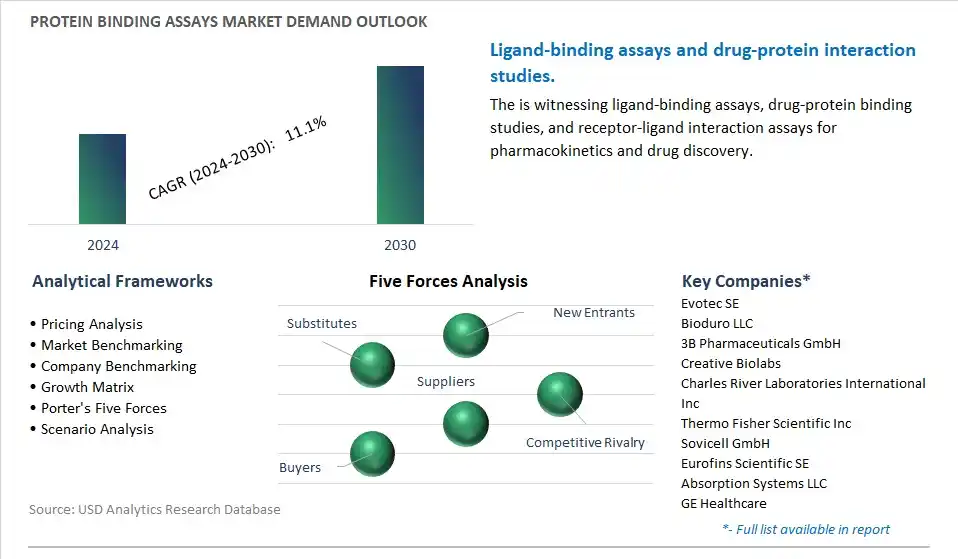
Protein Binding Assays Market is estimated to increase at a Compounded Annual Growth Rate of 11.1% CAGR over the forecast period from 2024 to 2030
The Protein Binding Assays Market study analyzes and forecasts the market size across 6 regions and 24 countries for diverse segments- By Technology (Ultracentrifugation, Equilibrium Dialysis, Ultrafiltration, Surface Plasmon Resonance, Others), By Products and Services (Instrument, Kits and Reagents, Services), By End-User (Contract Research Organizations, Pharmaceutical and Biotechnology Companies, Others).
An Introduction to Protein Binding Assays Market in 2024
Protein Binding Assays are analytical techniques used to study the interactions between proteins and ligands, substrates, inhibitors, or other biomolecules, providing insights into protein function, structure, and pharmacological properties. These assays employ various methodologies, including surface plasmon resonance (SPR), enzyme-linked immunosorbent assay (ELISA), fluorescence polarization, and radioligand binding assays, tailored to specific research or drug discovery objectives. Protein binding assays are widely used in drug development, target validation, and pharmacokinetic studies to assess binding affinity, specificity, and kinetics of protein-ligand interactions. With advancements in assay automation, high-throughput screening, and label-free detection technologies, protein binding assays continue to be invaluable tools for characterizing molecular interactions and accelerating the development of novel therapeutics across diverse therapeutic areas.
Market Trend: Shift Towards High-Throughput Screening and Automation
A significant trend in the protein binding assay market is the shift towards high-throughput screening (HTS) and automation. With advancements in robotics, liquid handling systems, and assay technologies, there is a growing adoption of automated platforms for protein binding assays. Automated systems enable researchers to perform large-scale screening of drug candidates against protein targets more efficiently, accurately, and reproducibly. By automating assay workflows, laboratories can increase throughput, reduce assay variability, and accelerate drug discovery and development processes. This trend reflects a desire for increased efficiency and productivity in pharmaceutical and biotechnology research, driving the demand for automated protein-binding assay platforms and associated consumables.
Market Driver: Expansion of Drug Discovery and Development Activities
A key driver for the protein binding assays market is the expansion of drug discovery and development activities. As the pharmaceutical industry continues to invest in research and development of novel therapeutics for various diseases, there is a growing demand for protein binding assays to assess the binding affinity, specificity, and kinetics of drug candidates to target proteins. Protein binding assays play a critical role in early-stage drug discovery, lead optimization, and preclinical development by providing insights into the interactions between drugs and their molecular targets. With the increasing complexity of drug targets and the growing emphasis on precision medicine and targeted therapies, there is a corresponding increase in demand for protein binding assays that offer accurate, reliable, and high-throughput screening capabilities, driving market growth in the drug discovery sector.
Market Opportunity: Development of Multiplexed and Label-Free Assay Platforms
An emerging opportunity within the protein binding assays market lies in the development of multiplexed and label-free assay platforms. Multiplexed assays enable simultaneous measurement of multiple protein interactions or binding events in a single experiment, providing comprehensive insights into drug-target interactions and molecular mechanisms of action. Label-free assays, which eliminate the need for fluorescent or radioactive labels, offer advantages such as reduced assay complexity, increased assay flexibility, and compatibility with diverse target proteins and assay formats. There is an opportunity for assay developers and technology providers to innovate and commercialize multiplexed and label-free assay platforms that meet the evolving needs of drug discovery researchers for high-content screening, mechanistic studies, and biomarker discovery. By offering multiplexed and label-free assay solutions, companies can address the demand for more efficient, cost-effective, and informative protein binding assays, thereby enhancing drug discovery workflows and accelerating therapeutic development processes in the pharmaceutical industry.
Protein Binding Assays Market Share Analysis: Surface Plasmon Resonance (SPR) Technology Segment is the fastest growing segment over the forecast period to 2030
Among the segments listed, the Surface Plasmon Resonance (SPR) technology segment is experiencing the fastest growth within the protein binding assays market. This growth can be attributed to several factors. Firstly, Surface Plasmon Resonance technology offers several advantages over traditional protein binding assay techniques, including high sensitivity, real-time monitoring capabilities, and label-free detection, making it particularly attractive for studying biomolecular interactions. SPR allows for the quantitative analysis of protein-protein interactions, protein-small molecule interactions, and protein-nucleic acid interactions with high precision and accuracy, providing valuable insights into drug discovery, target validation, and biomarker identification processes. Additionally, advancements in SPR instrumentation and software have improved assay throughput, sensitivity, and data analysis capabilities, further driving the adoption of SPR technology in contract research organizations, pharmaceutical and biotechnology companies, and academic research institutes. Moreover, the increasing demand for personalized medicine and targeted therapies underscores the importance of understanding protein interactions and binding kinetics, contributing to the growing popularity of SPR technology in the protein binding assays market. As stakeholders in the life sciences industry prioritize robust and efficient assay platforms for drug development and research applications, the SPR technology segment emerges as the fastest-growing segment within the protein binding assays market.
Protein Binding Assays Competitive Analysis
The market research study provides in-depth insights into leading companies including the SWOT analyses, product profile, financial details, and recent developments acrossEvotec SE, Bioduro LLC, 3B Pharmaceuticals GmbH, Creative Biolabs, Charles River Laboratories International Inc, Thermo Fisher Scientific Inc, Sovicell GmbH, Eurofins Scientific SE, Absorption Systems LLC, GE Healthcare
Protein Binding Assays Market Segmentation
By Technology
Ultracentrifugation
Equilibrium Dialysis
Ultrafiltration
Surface Plasmon Resonance
Others
By Products and Services
Instrument
Kits and Reagents
Services
By End-User
Contract Research Organizations
Pharmaceutical and Biotechnology Companies
Others
Geographical Analysis
North America (United States, Canada, Mexico)
Europe (Germany, France, United Kingdom, Spain, Italy, Rest of Europe)
Asia Pacific (China, India, Japan, South Korea, Rest of Asia Pacific)
South America (Brazil, Argentina, Rest of South America)
Middle East and Africa (Saudi Arabia, UAE, Rest of Middle East, South Africa, Egypt, Rest of Africa)
Protein Binding Assays Market Companies
Evotec SE
Bioduro LLC
3B Pharmaceuticals GmbH
Creative Biolabs
Charles River Laboratories International Inc
Thermo Fisher Scientific Inc
Sovicell GmbH
Eurofins Scientific SE
Absorption Systems LLC
GE Healthcare
Reasons to Buy the Protein Binding Assays Market Study
• Deepen your industry insights and navigate uncertainties for strategy formulation, CAPEX, and Operational decisions
• Gain access to detailed insights on the Protein Binding Assays Market, encompassing current market size, growth trends, and forecasts till 2030.
• Access detailed competitor analysis, enabling competitive advantage through a thorough understanding of market players, strategies, and potential differentiation opportunities
• Stay ahead of the curve with insights on technological advancements, innovations, and upcoming trends
• Identify lucrative investment avenues and expansion opportunities within the Protein Binding Assays Market industry, guided by robust, data-backed analysis.
• Understand regional and global markets through country-wise analysis, regional market potential, regulatory nuances, and dynamics
• Execute strategies with confidence and speed through information, analytics, and insights on the industry value chain
• Corporate leaders, strategists, financial experts, shareholders, asset managers, and governmental representatives can make long-term planning scenarios and build an integrated and timely understanding of market dynamics
• Benefit from tailored solutions and expert consultation based on report insights, providing personalized strategies aligned with specific business needs.
TABLE OF CONTENTS
1 Introduction to 2024 Protein Binding Assays Market
1.1 Market Overview
1.2 Quick Facts
1.3 Scope/Objective of the Study
1.4 Market Definition
1.5 Countries and Regions Covered
1.6 Units, Currency, and Conversions
1.7 Industry Value Chain
2 Research Methodology
2.1 Market Size Estimation
2.2 Sources and Research Methodology
2.3 Data Triangulation
2.4 Assumptions and Limitations
3 Executive Summary
3.1 Global Protein Binding Assays Market Size Outlook, $ Million, 2021 to 2030
3.2 Protein Binding Assays Market Outlook by Type, $ Million, 2021 to 2030
3.3 Protein Binding Assays Market Outlook by Product, $ Million, 2021 to 2030
3.4 Protein Binding Assays Market Outlook by Application, $ Million, 2021 to 2030
3.5 Protein Binding Assays Market Outlook by Key Countries, $ Million, 2021 to 2030
4 Market Dynamics
4.1 Key Driving Forces of Protein Binding Assays Industry
4.2 Key Market Trends in Protein Binding Assays Industry
4.3 Potential Opportunities in Protein Binding Assays Industry
4.4 Key Challenges in Protein Binding Assays Industry
5 Market Factor Analysis
5.1 Value Chain Analysis
5.2 Competitive Landscape
5.2.1 Global Protein Binding Assays Market Share by Company (%), 2023
5.2.2 Product Offerings by Company
5.3 Porter’s Five Forces Analysis
5.4 Pricing Analysis and Outlook
6 Growth Outlook Across Scenarios
6.1 Growth Analysis-Case Scenario Definitions
6.2 Low Growth Scenario Forecasts
6.3 Reference Growth Scenario Forecasts
6.4 High Growth Scenario Forecasts
7 Global Protein Binding Assays Market Outlook by Segments
7.1 Protein Binding Assays Market Outlook by Segments, $ Million, 2021- 2030
By Technology
Ultracentrifugation
Equilibrium Dialysis
Ultrafiltration
Surface Plasmon Resonance
Others
By Products and Services
Instrument
Kits and Reagents
Services
By End-User
Contract Research Organizations
Pharmaceutical and Biotechnology Companies
Others
8 North America Protein Binding Assays Market Analysis and Outlook To 2030
8.1 Introduction to North America Protein Binding Assays Markets in 2024
8.2 North America Protein Binding Assays Market Size Outlook by Country, 2021-2030
8.2.1 United States
8.2.2 Canada
8.2.3 Mexico
8.3 North America Protein Binding Assays Market size Outlook by Segments, 2021-2030
By Technology
Ultracentrifugation
Equilibrium Dialysis
Ultrafiltration
Surface Plasmon Resonance
Others
By Products and Services
Instrument
Kits and Reagents
Services
By End-User
Contract Research Organizations
Pharmaceutical and Biotechnology Companies
Others
9 Europe Protein Binding Assays Market Analysis and Outlook To 2030
9.1 Introduction to Europe Protein Binding Assays Markets in 2024
9.2 Europe Protein Binding Assays Market Size Outlook by Country, 2021-2030
9.2.1 Germany
9.2.2 France
9.2.3 Spain
9.2.4 United Kingdom
9.2.4 Italy
9.2.5 Russia
9.2.6 Norway
9.2.7 Rest of Europe
9.3 Europe Protein Binding Assays Market Size Outlook by Segments, 2021-2030
By Technology
Ultracentrifugation
Equilibrium Dialysis
Ultrafiltration
Surface Plasmon Resonance
Others
By Products and Services
Instrument
Kits and Reagents
Services
By End-User
Contract Research Organizations
Pharmaceutical and Biotechnology Companies
Others
10 Asia Pacific Protein Binding Assays Market Analysis and Outlook To 2030
10.1 Introduction to Asia Pacific Protein Binding Assays Markets in 2024
10.2 Asia Pacific Protein Binding Assays Market Size Outlook by Country, 2021-2030
10.2.1 China
10.2.2 India
10.2.3 Japan
10.2.4 South Korea
10.2.5 Indonesia
10.2.6 Malaysia
10.2.7 Australia
10.2.8 Rest of Asia Pacific
10.3 Asia Pacific Protein Binding Assays Market size Outlook by Segments, 2021-2030
By Technology
Ultracentrifugation
Equilibrium Dialysis
Ultrafiltration
Surface Plasmon Resonance
Others
By Products and Services
Instrument
Kits and Reagents
Services
By End-User
Contract Research Organizations
Pharmaceutical and Biotechnology Companies
Others
11 South America Protein Binding Assays Market Analysis and Outlook To 2030
11.1 Introduction to South America Protein Binding Assays Markets in 2024
11.2 South America Protein Binding Assays Market Size Outlook by Country, 2021-2030
11.2.1 Brazil
11.2.2 Argentina
11.2.3 Rest of South America
11.3 South America Protein Binding Assays Market size Outlook by Segments, 2021-2030
By Technology
Ultracentrifugation
Equilibrium Dialysis
Ultrafiltration
Surface Plasmon Resonance
Others
By Products and Services
Instrument
Kits and Reagents
Services
By End-User
Contract Research Organizations
Pharmaceutical and Biotechnology Companies
Others
12 Middle East and Africa Protein Binding Assays Market Analysis and Outlook To 2030
12.1 Introduction to Middle East and Africa Protein Binding Assays Markets in 2024
12.2 Middle East and Africa Protein Binding Assays Market Size Outlook by Country, 2021-2030
12.2.1 Saudi Arabia
12.2.2 UAE
12.2.3 Oman
12.2.4 Rest of Middle East
12.2.5 Egypt
12.2.6 Nigeria
12.2.7 South Africa
12.2.8 Rest of Africa
12.3 Middle East and Africa Protein Binding Assays Market size Outlook by Segments, 2021-2030
By Technology
Ultracentrifugation
Equilibrium Dialysis
Ultrafiltration
Surface Plasmon Resonance
Others
By Products and Services
Instrument
Kits and Reagents
Services
By End-User
Contract Research Organizations
Pharmaceutical and Biotechnology Companies
Others
13 Company Profiles
13.1 Company Snapshot
13.2 SWOT Profiles
13.3 Products and Services
13.4 Recent Developments
13.5 Financial Profile
List of Companies
Evotec SE
Bioduro LLC
3B Pharmaceuticals GmbH
Creative Biolabs
Charles River Laboratories International Inc
Thermo Fisher Scientific Inc
Sovicell GmbH
Eurofins Scientific SE
Absorption Systems LLC
GE Healthcare
14 Appendix
14.1 Customization Offerings
14.2 Subscription Services
14.3 Related Reports
14.4 Publisher Expertise
By Technology
Ultracentrifugation
Equilibrium Dialysis
Ultrafiltration
Surface Plasmon Resonance
Others
By Products and Services
Instrument
Kits and Reagents
Services
By End-User
Contract Research Organizations
Pharmaceutical and Biotechnology Companies
Others
Countries Analyzed
North America (United States, Canada, Mexico)
Europe (Germany, France, United Kingdom, Spain, Italy, Rest of Europe)
Asia Pacific (China, India, Japan, South Korea, Rest of Asia Pacific)
South America (Brazil, Argentina, Rest of South America)
Middle East and Africa (Saudi Arabia, UAE, Rest of Middle East, South Africa, Egypt, Rest of Africa)
