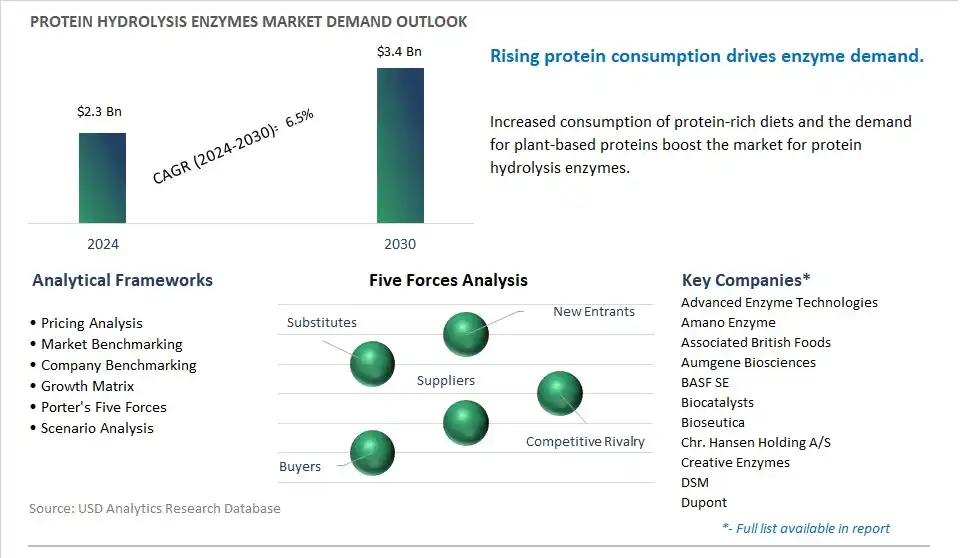
The global Protein Hydrolysis Enzymes Market is poised to register a 6.5% CAGR from $2.3 Billion in 2024 to $3.4 Billion in 2030.
The global Protein Hydrolysis Enzymes Market Study analyzes and forecasts the market size across 6 regions and 24 countries for diverse segments -By Source (Microorganisms, Animals, Plants), By Method of Production (Extraction, Fermentation), By Product (Animal Product, Plant Product, Microbial Product), By Application (Detergents, Pharmaceuticals, Food, Textiles & Leather, Others).
An Introduction to Global Protein Hydrolysis Enzymes Market in 2024
The future of the protein hydrolysis enzymes market is influenced by key trends such as growing demand for nutritional supplements, advancements in enzyme engineering, and sustainability initiatives. Protein hydrolysis enzymes play a vital role in the food and beverage industry, facilitating the breakdown of proteins into peptides and amino acids for applications such as protein hydrolysates, sports nutrition, and infant formulas. As consumers increasingly seek protein-rich diets and functional foods, the demand for enzyme-based protein hydrolysis solutions is expected to rise. Moreover, ongoing research in enzyme engineering and biotechnology enables the development of novel enzymes with improved specificity, activity, and stability, expanding their applications in food processing and nutraceuticals. Additionally, sustainability concerns drive the adoption of eco-friendly enzyme production processes, enzyme immobilization techniques, and waste valorization strategies, addressing environmental impacts and regulatory compliance. As the food industry continues to innovate and meet consumer preferences for healthy and sustainable products, the protein hydrolysis enzymes market will evolve with new formulations, applications, and market opportunities.
Protein Hydrolysis Enzymes Market Competitive Landscape
The market report analyses the leading companies in the industry including Advanced Enzyme Technologies, Amano Enzyme, Associated British Foods, Aumgene Biosciences, BASF SE, Biocatalysts, Bioseutica, Chr. Hansen Holding A/S, Creative Enzymes, DSM, Dupont, Dyadic International Inc, Jiangsu Boli Bioproducts Co. Ltd, Merck Kgaa, Novozymes, Rossari Biotech Ltd, Specialty Enzymes & Biotechnologies.
Protein Hydrolysis Enzymes Market Dynamics
Protein Hydrolysis Enzymes Market Trend: Increased Demand for Protein Hydrolysis Enzymes in Food and Beverage Industries
One prominent trend in the protein hydrolysis enzymes market is the increased demand for these enzymes in the food and beverage industries. As consumers seek healthier and more nutritious food options, there is a growing interest in protein-enriched products. Protein hydrolysis enzymes play a crucial role in the production of hydrolyzed proteins, peptides, and amino acids, which are used as functional ingredients in various food and beverage formulations. This is driven by the demand for protein fortification, flavor enhancement, and texture modification in food products such as sports nutrition supplements, infant formula, protein bars, and functional beverages. Additionally, protein hydrolysis enzymes are utilized in food processing applications to improve protein digestibility, enhance flavor profiles, and create value-added products that meet the preferences of health-conscious consumers.
Protein Hydrolysis Enzymes Market Driver: Expansion of the Nutraceutical and Functional Food Market
The primary driver fueling the demand for protein hydrolysis enzymes is the expansion of the nutraceutical and functional food market. With growing awareness of the link between diet and health, there is a rising demand for food products that offer additional health benefits beyond basic nutrition. Nutraceuticals and functional foods containing bioactive ingredients such as hydrolyzed proteins are gaining popularity due to their potential to promote health, wellness, and performance. Protein hydrolysis enzymes enable the production of bioactive peptides with physiological functions such as antioxidant activity, blood pressure regulation, and immune system modulation, driving their incorporation into functional food formulations. This driver is propelled by factors such as changing consumer lifestyles, aging populations, and increasing prevalence of lifestyle-related diseases, driving the demand for innovative food ingredients and formulations that support health and well-being.
Protein Hydrolysis Enzymes Market Opportunity: Expansion into Biomedical and Pharmaceutical Applications
An attractive opportunity for the protein hydrolysis enzymes market lies in expansion into biomedical and pharmaceutical applications. Beyond the food and beverage industries, there is potential to leverage the therapeutic properties of protein hydrolysates and peptides in biomedical and pharmaceutical products. Protein hydrolysis enzymes can be utilized in the production of peptide-based drugs, nutraceutical supplements, and biomedical materials for applications such as wound healing, tissue regeneration, drug delivery, and therapeutic interventions. By developing specialized enzyme formulations tailored to biomedical and pharmaceutical applications, manufacturers can tap into the growing demand for peptide-based therapies and medical products that address unmet medical needs and offer innovative solutions for healthcare and pharmaceutical industries. This opportunity allows for diversification, value creation, and market expansion beyond traditional food and beverage applications, positioning protein hydrolysis enzymes as versatile tools in the biotechnology and healthcare sectors.
Protein Hydrolysis Enzymes Market Share Analysis: Microorganisms generated the highest revenue in 2024
The largest segment in the Protein Hydrolysis Enzymes Market is microorganisms, primarily due to their widespread availability, scalability, and efficiency in enzyme production. Microorganisms such as bacteria and fungi are commonly used as sources for protein hydrolysis enzymes due to their ability to produce a wide range of proteases and other enzymes through fermentation processes. These microorganisms can be easily cultivated in controlled environments using inexpensive substrates, making the production of protein hydrolysis enzymes cost-effective and scalable. Additionally, microorganisms can be genetically modified or engineered to enhance enzyme yields, specific activities, and substrate specificities, further optimizing the production process. The versatility and adaptability of microorganisms make them the preferred source for protein hydrolysis enzymes in various industries such as food and beverage, pharmaceuticals, and biotechnology. As the demand for protein hydrolysis enzymes continues to grow in applications such as protein processing, animal feed, and biofuel production, the microorganisms segment remains dominant in the Protein Hydrolysis Enzymes Market.
Protein Hydrolysis Enzymes Market Share Analysis: Fermentation segment is poised to register the fastest growth rate (CAGR) over the forecast period to 2030
The fastest growing segment in the Protein Hydrolysis Enzymes Market is fermentation, driven by its numerous advantages over extraction methods. Fermentation offers higher yields, greater scalability, and better control over enzyme production parameters compared to extraction techniques. In fermentation, microorganisms such as bacteria, fungi, or yeast are utilized to produce protein hydrolysis enzymes through controlled fermentation processes. This method allows for the efficient conversion of inexpensive substrates into valuable enzymes, resulting in cost-effective production. Further, fermentation enables the development of genetically modified organisms (GMOs) or engineered strains optimized for enhanced enzyme yields, specific activities, and stability. Additionally, fermentation processes can be easily scaled up to meet growing demand, making them suitable for large-scale industrial production. As industries seek sustainable and efficient enzyme production methods to meet the increasing demand for protein hydrolysis enzymes in various applications such as food processing, animal feed, and biotechnology, fermentation is the fastest growing segment in the Protein Hydrolysis Enzymes Market.
Protein Hydrolysis Enzymes Market Share Analysis: Microbial Product segment is poised to register the fastest growth rate (CAGR) over the forecast period to 2030
The fastest growing segment in the Protein Hydrolysis Enzymes Market is microbial product, primarily due to the versatility, efficiency, and scalability of microbial enzymes compared to those derived from animal or plant sources. Microbial enzymes are produced by microorganisms such as bacteria, fungi, and yeast through fermentation processes. These microorganisms can be genetically modified or engineered to optimize enzyme production and tailor enzyme properties to specific applications. Microbial enzymes offer potential advantages, including higher enzyme yields, faster production rates, and lower production costs compared to enzymes derived from animal or plant sources. Additionally, microbial enzymes exhibit greater stability and tolerance to a wide range of pH and temperature conditions, making them suitable for diverse industrial applications such as food processing, animal feed, detergent manufacturing, and biofuel production. As industries increasingly adopt sustainable and cost-effective enzyme solutions to enhance production efficiency and meet growing consumer demand for bio-based products, the demand for microbial protein hydrolysis enzymes is expected to grow rapidly, driving the growth of this segment in the Protein Hydrolysis Enzymes Market.
Protein Hydrolysis Enzymes Market Report Segmentation
By Source
Microorganisms
Animals
Plants
By Method of Production
Extraction
Fermentation
By Product
Animal Product
-Trypsin
-Pepsin
-Renin
-Others
Plant Product
-Papain
-Bromelain
-Others
Microbial Product
-Alkaline Protease
-Acid Protease
-Neutral Protease
-Others
By Application
Detergents
Pharmaceuticals
Food
Textiles & Leather
Others
Regions Included
North America (US, Canada, Mexico)
Europe (Germany, UK, France, Spain, Italy, Russia, Rest of Europe)
Asia Pacific (China, India, Japan, South Korea, Australia, South East Asia, Rest of Asia)
South America (Brazil, Argentina, Rest of South America)
Middle East and Africa (Saudi Arabia, UAE, Rest of Middle East, South Africa, Egypt, Rest of Africa)
Protein Hydrolysis Enzymes Companies Profiled in the Market Study
Advanced Enzyme Technologies
Amano Enzyme
Associated British Foods
Aumgene Biosciences
BASF SE
Biocatalysts
Bioseutica
Chr. Hansen Holding A/S
Creative Enzymes
DSM
Dupont
Dyadic International Inc
Jiangsu Boli Bioproducts Co. Ltd
Merck Kgaa
Novozymes
Rossari Biotech Ltd
Specialty Enzymes & Biotechnologies
*- List Not Exhaustive
TABLE OF CONTENTS
1 Introduction to 2024 Protein Hydrolysis Enzymes Market
1.1 Market Overview
1.2 Quick Facts
1.3 Scope/Objective of the Study
1.4 Market Definition
1.5 Countries and Regions Covered
1.6 Units, Currency, and Conversions
1.7 Industry Value Chain
2 Research Methodology
2.1 Market Size Estimation
2.2 Sources and Research Methodology
2.3 Data Triangulation
2.4 Assumptions and Limitations
3 Executive Summary
3.1 Global Protein Hydrolysis Enzymes Market Size Outlook, $ Million, 2021 to 2030
3.2 Protein Hydrolysis Enzymes Market Outlook by Type, $ Million, 2021 to 2030
3.3 Protein Hydrolysis Enzymes Market Outlook by Product, $ Million, 2021 to 2030
3.4 Protein Hydrolysis Enzymes Market Outlook by Application, $ Million, 2021 to 2030
3.5 Protein Hydrolysis Enzymes Market Outlook by Key Countries, $ Million, 2021 to 2030
4 Market Dynamics
4.1 Key Driving Forces of Protein Hydrolysis Enzymes Industry
4.2 Key Market Trends in Protein Hydrolysis Enzymes Industry
4.3 Potential Opportunities in Protein Hydrolysis Enzymes Industry
4.4 Key Challenges in Protein Hydrolysis Enzymes Industry
5 Market Factor Analysis
5.1 Value Chain Analysis
5.2 Competitive Landscape
5.2.1 Global Protein Hydrolysis Enzymes Market Share by Company (%), 2023
5.2.2 Product Offerings by Company
5.3 Porter’s Five Forces Analysis
5.4 Pricing Analysis and Outlook
6 Growth Outlook Across Scenarios
6.1 Growth Analysis-Case Scenario Definitions
6.2 Low Growth Scenario Forecasts
6.3 Reference Growth Scenario Forecasts
6.4 High Growth Scenario Forecasts
7 Global Protein Hydrolysis Enzymes Market Outlook by Segments
7.1 Protein Hydrolysis Enzymes Market Outlook by Segments, $ Million, 2021- 2030
By Source
Microorganisms
Animals
Plants
By Method of Production
Extraction
Fermentation
By Product
Animal Product
-Trypsin
-Pepsin
-Renin
-Others
Plant Product
-Papain
-Bromelain
-Others
Microbial Product
-Alkaline Protease
-Acid Protease
-Neutral Protease
-Others
By Application
Detergents
Pharmaceuticals
Food
Textiles & Leather
Others
8 North America Protein Hydrolysis Enzymes Market Analysis and Outlook To 2030
8.1 Introduction to North America Protein Hydrolysis Enzymes Markets in 2024
8.2 North America Protein Hydrolysis Enzymes Market Size Outlook by Country, 2021-2030
8.2.1 United States
8.2.2 Canada
8.2.3 Mexico
8.3 North America Protein Hydrolysis Enzymes Market size Outlook by Segments, 2021-2030
By Source
Microorganisms
Animals
Plants
By Method of Production
Extraction
Fermentation
By Product
Animal Product
-Trypsin
-Pepsin
-Renin
-Others
Plant Product
-Papain
-Bromelain
-Others
Microbial Product
-Alkaline Protease
-Acid Protease
-Neutral Protease
-Others
By Application
Detergents
Pharmaceuticals
Food
Textiles & Leather
Others
9 Europe Protein Hydrolysis Enzymes Market Analysis and Outlook To 2030
9.1 Introduction to Europe Protein Hydrolysis Enzymes Markets in 2024
9.2 Europe Protein Hydrolysis Enzymes Market Size Outlook by Country, 2021-2030
9.2.1 Germany
9.2.2 France
9.2.3 Spain
9.2.4 United Kingdom
9.2.4 Italy
9.2.5 Russia
9.2.6 Norway
9.2.7 Rest of Europe
9.3 Europe Protein Hydrolysis Enzymes Market Size Outlook by Segments, 2021-2030
By Source
Microorganisms
Animals
Plants
By Method of Production
Extraction
Fermentation
By Product
Animal Product
-Trypsin
-Pepsin
-Renin
-Others
Plant Product
-Papain
-Bromelain
-Others
Microbial Product
-Alkaline Protease
-Acid Protease
-Neutral Protease
-Others
By Application
Detergents
Pharmaceuticals
Food
Textiles & Leather
Others
10 Asia Pacific Protein Hydrolysis Enzymes Market Analysis and Outlook To 2030
10.1 Introduction to Asia Pacific Protein Hydrolysis Enzymes Markets in 2024
10.2 Asia Pacific Protein Hydrolysis Enzymes Market Size Outlook by Country, 2021-2030
10.2.1 China
10.2.2 India
10.2.3 Japan
10.2.4 South Korea
10.2.5 Indonesia
10.2.6 Malaysia
10.2.7 Australia
10.2.8 Rest of Asia Pacific
10.3 Asia Pacific Protein Hydrolysis Enzymes Market size Outlook by Segments, 2021-2030
By Source
Microorganisms
Animals
Plants
By Method of Production
Extraction
Fermentation
By Product
Animal Product
-Trypsin
-Pepsin
-Renin
-Others
Plant Product
-Papain
-Bromelain
-Others
Microbial Product
-Alkaline Protease
-Acid Protease
-Neutral Protease
-Others
By Application
Detergents
Pharmaceuticals
Food
Textiles & Leather
Others
11 South America Protein Hydrolysis Enzymes Market Analysis and Outlook To 2030
11.1 Introduction to South America Protein Hydrolysis Enzymes Markets in 2024
11.2 South America Protein Hydrolysis Enzymes Market Size Outlook by Country, 2021-2030
11.2.1 Brazil
11.2.2 Argentina
11.2.3 Rest of South America
11.3 South America Protein Hydrolysis Enzymes Market size Outlook by Segments, 2021-2030
By Source
Microorganisms
Animals
Plants
By Method of Production
Extraction
Fermentation
By Product
Animal Product
-Trypsin
-Pepsin
-Renin
-Others
Plant Product
-Papain
-Bromelain
-Others
Microbial Product
-Alkaline Protease
-Acid Protease
-Neutral Protease
-Others
By Application
Detergents
Pharmaceuticals
Food
Textiles & Leather
Others
12 Middle East and Africa Protein Hydrolysis Enzymes Market Analysis and Outlook To 2030
12.1 Introduction to Middle East and Africa Protein Hydrolysis Enzymes Markets in 2024
12.2 Middle East and Africa Protein Hydrolysis Enzymes Market Size Outlook by Country, 2021-2030
12.2.1 Saudi Arabia
12.2.2 UAE
12.2.3 Oman
12.2.4 Rest of Middle East
12.2.5 Egypt
12.2.6 Nigeria
12.2.7 South Africa
12.2.8 Rest of Africa
12.3 Middle East and Africa Protein Hydrolysis Enzymes Market size Outlook by Segments, 2021-2030
By Source
Microorganisms
Animals
Plants
By Method of Production
Extraction
Fermentation
By Product
Animal Product
-Trypsin
-Pepsin
-Renin
-Others
Plant Product
-Papain
-Bromelain
-Others
Microbial Product
-Alkaline Protease
-Acid Protease
-Neutral Protease
-Others
By Application
Detergents
Pharmaceuticals
Food
Textiles & Leather
Others
13 Company Profiles
13.1 Company Snapshot
13.2 SWOT Profiles
13.3 Products and Services
13.4 Recent Developments
13.5 Financial Profile
Advanced Enzyme Technologies
Amano Enzyme
Associated British Foods
Aumgene Biosciences
BASF SE
Biocatalysts
Bioseutica
Chr. Hansen Holding A/S
Creative Enzymes
DSM
Dupont
Dyadic International Inc
Jiangsu Boli Bioproducts Co. Ltd
Merck Kgaa
Novozymes
Rossari Biotech Ltd
Specialty Enzymes & Biotechnologies
14 Appendix
14.1 Customization Offerings
14.2 Subscription Services
14.3 Related Reports
14.4 Publisher Expertise
By Source
Microorganisms
Animals
Plants
By Method of Production
Extraction
Fermentation
By Product
Animal Product
-Trypsin
-Pepsin
-Renin
-Others
Plant Product
-Papain
-Bromelain
-Others
Microbial Product
-Alkaline Protease
-Acid Protease
-Neutral Protease
-Others
By Application
Detergents
Pharmaceuticals
Food
Textiles & Leather
Others
Countries Analyzed
North America (US, Canada, Mexico)
Europe (Germany, UK, France, Spain, Italy, Russia, Rest of Europe)
Asia Pacific (China, India, Japan, South Korea, Australia, South East Asia, Rest of Asia)
South America (Brazil, Argentina, Rest of South America)
Middle East and Africa (Saudi Arabia, UAE, Rest of Middle East, South Africa, Egypt, Rest of Africa)
