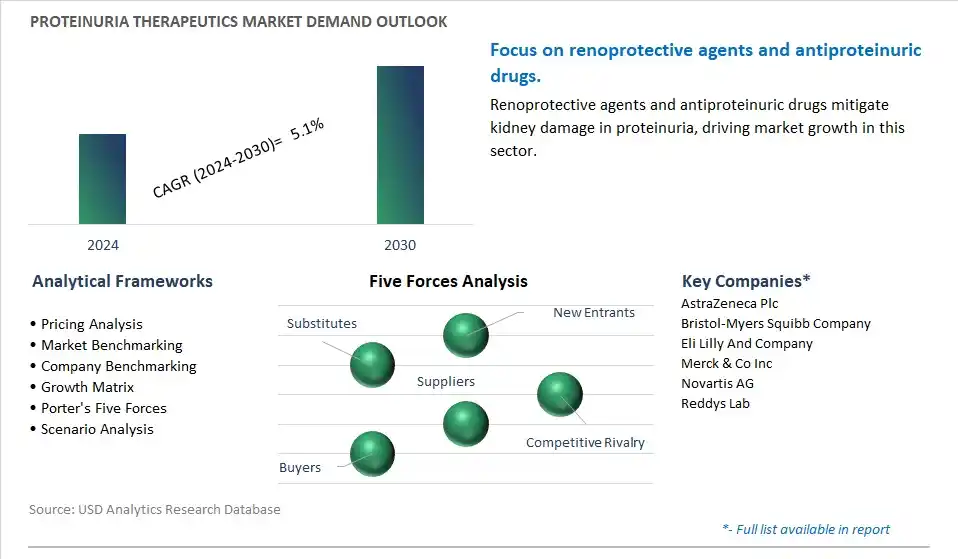
Proteinuria Therapeutics Market is estimated to increase at a growth rate of 5.1% CAGR over the forecast period from 2024 to 2030.
The global Proteinuria Therapeutics Market Study analyzes and forecasts the market size across 6 regions and 24 countries for diverse segments including By Type (ACE inhibitors (angiotensin-converting enzyme inhibitors), ARBs (angiotensin receptor blockers), DPP (dipeptidyl peptidase) IV inhibitors), By Distribution Channel (Hospital Pharmacies, Clinics, Retail Pharmacies, Others).
An Introduction to Proteinuria Therapeutics Market in 2024
Proteinuria, characterized by the abnormal presence of proteins in the urine, is a common clinical manifestation of kidney disease and a prognostic indicator of renal dysfunction and cardiovascular risk. In 2024, the Proteinuria Therapeutics Market is witnessing heightened focus and investment aimed at addressing the underlying pathophysiological mechanisms driving proteinuria and its associated complications. Therapeutic strategies encompass a range of approaches, including renin-angiotensin-aldosterone system inhibitors, endothelin receptor antagonists, and novel anti-inflammatory agents targeting glomerular injury and podocyte dysfunction. Additionally, the advent of precision medicine approaches and biomarker-guided therapy holds promise for personalized treatment regimens tailored to individual patient profiles, optimizing therapeutic efficacy and minimizing adverse effects. With the growing burden of chronic kidney disease worldwide, the proteinuria therapeutics market represents a critical frontier in nephrology research and clinical care, offering hope for improved outcomes and quality of life for affected individuals.
Proteinuria Therapeutics Market Competitive Landscape
The global Proteinuria Therapeutics Industry is highly competitive with a large number of companies focusing on niche market segments. Amidst intense competitive conditions, Proteinuria Therapeutics Companies are investing in new product launches and strengthening distribution channels. Key companies operating in the Proteinuria Therapeutics Industry include- AstraZeneca Plc, Bristol-Myers Squibb Company, Eli Lilly And Company, Merck & Co Inc, Novartis AG, Reddys Lab.
Proteinuria Therapeutics Market Trend: Targeted Approaches Addressing Underlying Causes
In the realm of proteinuria therapeutics, a significant trend is the emergence of targeted approaches addressing the underlying causes of proteinuria. Proteinuria, characterized by the presence of excess protein in the urine, is often a sign of underlying kidney disease or other systemic conditions. Recent advancements in our understanding of the pathophysiology of proteinuria have led to the development of targeted therapies aimed at specific molecular pathways involved in protein leakage from the kidneys. These therapies include angiotensin-converting enzyme (ACE) inhibitors, angiotensin receptor blockers (ARBs), and mineralocorticoid receptor antagonists, which aim to reduce proteinuria by modulating renal hemodynamics and reducing glomerular injury. This trend towards targeted therapeutics reflects the growing recognition of the importance of addressing the underlying causes of proteinuria to prevent kidney damage and improve patient outcomes.
Proteinuria Therapeutics Market Driver: Increasing Prevalence of Chronic Kidney Disease
The increasing prevalence of chronic kidney disease (CKD) serves as a significant market driver for proteinuria therapeutics. CKD is a global public health concern, with proteinuria being a key marker of kidney damage and disease progression. As the incidence of risk factors such as diabetes, hypertension, and obesity continues to rise, the prevalence of CKD and proteinuria is expected to increase accordingly. Consequently, there's a growing demand for effective therapeutic interventions that can slow the progression of CKD, preserve kidney function, and reduce the risk of adverse cardiovascular events. This driver underscores the critical need for proteinuria therapeutics that can address the underlying pathophysiology of kidney disease and improve outcomes for patients with CKD.
Proteinuria Therapeutics Market Opportunity: Development of Novel Renoprotective Agents
A promising opportunity in the proteinuria therapeutics market lies in the development of novel renoprotective agents that target specific molecular mechanisms implicated in kidney injury and proteinuria. Research efforts are focused on identifying novel therapeutic targets involved in podocyte dysfunction, glomerular inflammation, and tubulointerstitial fibrosis, which are key drivers of proteinuria and CKD progression. Additionally, there's growing interest in exploring the potential of emerging therapeutic modalities such as RNA-based therapies, anti-inflammatory agents, and mitochondrial protectants for the treatment of proteinuria and related kidney disorders. Investing in the discovery and development of novel renoprotective agents presents a strategic opportunity for pharmaceutical companies to address unmet medical needs in proteinuria therapeutics and advance the standard of care for patients with kidney disease.
Proteinuria Therapeutics Market Share Analysis: ARBs (Angiotensin Receptor Blockers) is the fastest growing market segment over the forecast period to 2030
Among the proteinuria therapeutics, ARBs (Angiotensin Receptor Blockers) stand out as the fastest-growing segment. ARBs are pharmacological agents that effectively reduce proteinuria by blocking the action of angiotensin II on its receptors, thereby dilating blood vessels, reducing blood pressure, and decreasing stress on the kidneys. This class of drugs is particularly favored for its ability to slow the progression of kidney disease and protect against cardiovascular complications in patients with proteinuria, especially those with diabetic nephropathy or hypertension-related kidney damage. With a growing prevalence of conditions contributing to proteinuria, such as diabetes and hypertension, coupled with an increasing emphasis on renal protection strategies, ARBs are witnessing heightened demand and adoption in both hospital and retail pharmacy settings. Additionally, ongoing research and clinical trials exploring novel indications and combination therapies involving ARBs further contribute to the anticipated growth trajectory of this segment.
Proteinuria Therapeutics Market Segmentation
By Type
ACE inhibitors (angiotensin-converting enzyme inhibitors)
ARBs (angiotensin receptor blockers)
DPP (dipeptidyl peptidase) IV inhibitors
By Distribution Channel
Hospital Pharmacies
Clinics
Retail Pharmacies
Others
Geographical Analysis
North America (United States, Canada, Mexico)
Europe (Germany, France, United Kingdom, Spain, Italy, Rest of Europe)
Asia Pacific (China, India, Japan, South Korea, Rest of Asia Pacific)
South America (Brazil, Argentina, Rest of South America)
Middle East and Africa (Saudi Arabia, UAE, Rest of Middle East, South Africa, Egypt, Rest of Africa)
Proteinuria Therapeutics Companies
AstraZeneca Plc
Bristol-Myers Squibb Company
Eli Lilly And Company
Merck & Co Inc
Novartis AG
Reddys Lab
* List not Exhaustive
Reasons to Buy the Proteinuria Therapeutics Market Study
• Deepen your industry insights and navigate uncertainties for strategy formulation, CAPEX, and Operational decisions
• Gain access to detailed insights on the Proteinuria Therapeutics Market, encompassing current market size, growth trends, and forecasts till 2030.
• Access detailed competitor analysis, enabling competitive advantage through a thorough understanding of market players, strategies, and potential differentiation opportunities
• Stay ahead of the curve with insights on technological advancements, innovations, and upcoming trends
• Identify lucrative investment avenues and expansion opportunities within the Proteinuria Therapeutics Industry, guided by robust, data-backed analysis.
• Understand regional and global markets through country-wise analysis, regional market potential, regulatory nuances, and dynamics
• Execute strategies with confidence and speed through information, analytics, and insights on the industry value chain
• Corporate leaders, strategists, financial experts, shareholders, asset managers, and governmental representatives can make long-term planning scenarios and build an integrated and timely understanding of market dynamics
• Benefit from tailored solutions and expert consultation based on report insights, providing personalized strategies aligned with specific business needs.
TABLE OF CONTENTS
1 Introduction to 2024 Proteinuria Therapeutics Market
1.1 Market Overview
1.2 Quick Facts
1.3 Scope/Objective of the Study
1.4 Market Definition
1.5 Countries and Regions Analyzed
1.6 Units, Currency, and Conversions
1.7 Industry Value Chain
2 Research Methodology
2.1 Market Size Estimation
2.2 Sources and Research Methodology
2.3 Data Triangulation
2.4 Assumptions and Limitations
3 Executive Summary
3.1 Global Proteinuria Therapeutics Market Size Outlook, $ Million, 2021 to 2030
3.2 Proteinuria Therapeutics Market Outlook by Type, $ Million, 2021 to 2030
3.3 Proteinuria Therapeutics Market Outlook by Product, $ Million, 2021 to 2030
3.4 Proteinuria Therapeutics Market Outlook by Application, $ Million, 2021 to 2030
3.5 Proteinuria Therapeutics Market Outlook by Key Countries, $ Million, 2021 to 2030
4 Market Dynamics
4.1 Key Driving Forces of Proteinuria Therapeutics Industry
4.2 Key Market Trends in Proteinuria Therapeutics Industry
4.3 Potential Opportunities in Proteinuria Therapeutics Industry
4.4 Key Challenges in Proteinuria Therapeutics Industry
5 Market Factor Analysis
5.1 Value Chain Analysis
5.2 Competitive Landscape
5.2.1 Global Proteinuria Therapeutics Market Share by Company (%), 2023
5.2.2 Product Offerings by Company
5.3 Porter’s Five Forces Analysis
5.4 Pricing Analysis and Outlook
6 Growth Outlook Across Scenarios
6.1 Growth Analysis-Case Scenario Definitions
6.2 Low Growth Scenario Forecasts
6.3 Reference Growth Scenario Forecasts
6.4 High Growth Scenario Forecasts
7 Global Proteinuria Therapeutics Market Outlook by Segments
7.1 Proteinuria Therapeutics Market Outlook by Segments, $ Million, 2021- 2030
By Type
ACE inhibitors (angiotensin-converting enzyme inhibitors)
ARBs (angiotensin receptor blockers)
DPP (dipeptidyl peptidase) IV inhibitors
By Distribution Channel
Hospital Pharmacies
Clinics
Retail Pharmacies
Others
8 North America Proteinuria Therapeutics Market Analysis and Outlook To 2030
8.1 Introduction to North America Proteinuria Therapeutics Markets in 2024
8.2 North America Proteinuria Therapeutics Market Size Outlook by Country, 2021-2030
8.2.1 United States
8.2.2 Canada
8.2.3 Mexico
8.3 North America Proteinuria Therapeutics Market size Outlook by Segments, 2021-2030
By Type
ACE inhibitors (angiotensin-converting enzyme inhibitors)
ARBs (angiotensin receptor blockers)
DPP (dipeptidyl peptidase) IV inhibitors
By Distribution Channel
Hospital Pharmacies
Clinics
Retail Pharmacies
Others
9 Europe Proteinuria Therapeutics Market Analysis and Outlook To 2030
9.1 Introduction to Europe Proteinuria Therapeutics Markets in 2024
9.2 Europe Proteinuria Therapeutics Market Size Outlook by Country, 2021-2030
9.2.1 Germany
9.2.2 France
9.2.3 Spain
9.2.4 United Kingdom
9.2.4 Italy
9.2.5 Russia
9.2.6 Norway
9.2.7 Rest of Europe
9.3 Europe Proteinuria Therapeutics Market Size Outlook by Segments, 2021-2030
By Type
ACE inhibitors (angiotensin-converting enzyme inhibitors)
ARBs (angiotensin receptor blockers)
DPP (dipeptidyl peptidase) IV inhibitors
By Distribution Channel
Hospital Pharmacies
Clinics
Retail Pharmacies
Others
10 Asia Pacific Proteinuria Therapeutics Market Analysis and Outlook To 2030
10.1 Introduction to Asia Pacific Proteinuria Therapeutics Markets in 2024
10.2 Asia Pacific Proteinuria Therapeutics Market Size Outlook by Country, 2021-2030
10.2.1 China
10.2.2 India
10.2.3 Japan
10.2.4 South Korea
10.2.5 Indonesia
10.2.6 Malaysia
10.2.7 Australia
10.2.8 Rest of Asia Pacific
10.3 Asia Pacific Proteinuria Therapeutics Market size Outlook by Segments, 2021-2030
By Type
ACE inhibitors (angiotensin-converting enzyme inhibitors)
ARBs (angiotensin receptor blockers)
DPP (dipeptidyl peptidase) IV inhibitors
By Distribution Channel
Hospital Pharmacies
Clinics
Retail Pharmacies
Others
11 South America Proteinuria Therapeutics Market Analysis and Outlook To 2030
11.1 Introduction to South America Proteinuria Therapeutics Markets in 2024
11.2 South America Proteinuria Therapeutics Market Size Outlook by Country, 2021-2030
11.2.1 Brazil
11.2.2 Argentina
11.2.3 Rest of South America
11.3 South America Proteinuria Therapeutics Market size Outlook by Segments, 2021-2030
By Type
ACE inhibitors (angiotensin-converting enzyme inhibitors)
ARBs (angiotensin receptor blockers)
DPP (dipeptidyl peptidase) IV inhibitors
By Distribution Channel
Hospital Pharmacies
Clinics
Retail Pharmacies
Others
12 Middle East and Africa Proteinuria Therapeutics Market Analysis and Outlook To 2030
12.1 Introduction to Middle East and Africa Proteinuria Therapeutics Markets in 2024
12.2 Middle East and Africa Proteinuria Therapeutics Market Size Outlook by Country, 2021-2030
12.2.1 Saudi Arabia
12.2.2 UAE
12.2.3 Oman
12.2.4 Rest of Middle East
12.2.5 Egypt
12.2.6 Nigeria
12.2.7 South Africa
12.2.8 Rest of Africa
12.3 Middle East and Africa Proteinuria Therapeutics Market size Outlook by Segments, 2021-2030
By Type
ACE inhibitors (angiotensin-converting enzyme inhibitors)
ARBs (angiotensin receptor blockers)
DPP (dipeptidyl peptidase) IV inhibitors
By Distribution Channel
Hospital Pharmacies
Clinics
Retail Pharmacies
Others
13 Company Profiles
13.1 Company Snapshot
13.2 SWOT Profiles
13.3 Products and Services
13.4 Recent Developments
13.5 Financial Profile
List of Companies
AstraZeneca Plc
Bristol-Myers Squibb Company
Eli Lilly And Company
Merck & Co Inc
Novartis AG
Reddys Lab
14 Appendix
14.1 Customization Offerings
14.2 Subscription Services
14.3 Related Reports
14.4 Publisher Expertise
By Type
ACE inhibitors (angiotensin-converting enzyme inhibitors)
ARBs (angiotensin receptor blockers)
DPP (dipeptidyl peptidase) IV inhibitors
By Distribution Channel
Hospital Pharmacies
Clinics
Retail Pharmacies
Others
