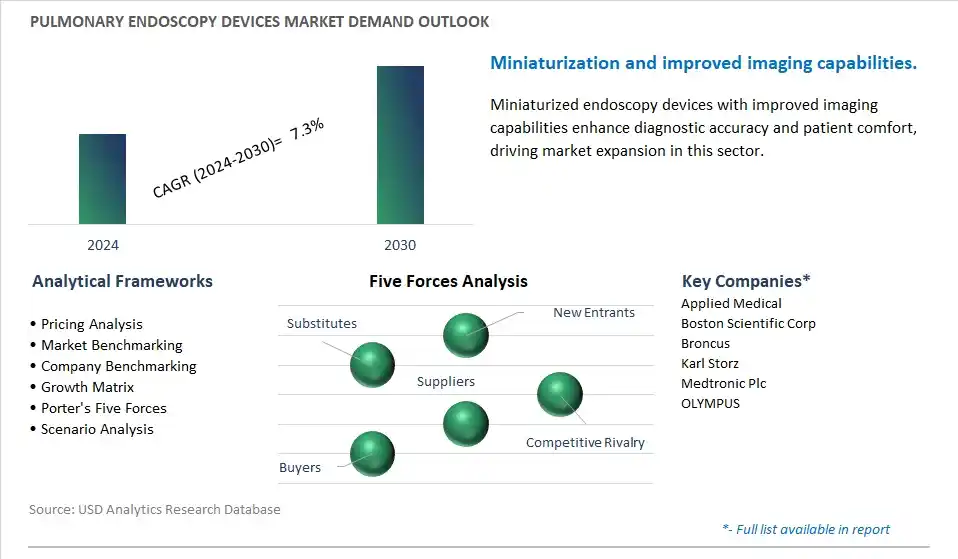
Pulmonary Endoscopy Devices Market is estimated to increase at a growth rate of 7.3% CAGR over the forecast period from 2024 to 2030.
The global Pulmonary Endoscopy Devices Market Study analyzes and forecasts the market size across 6 regions and 24 countries for diverse segments including By Type (Rigid Endoscopy Devices, Flexible Endoscopy Devices, Other), By Application (Hospitals, Clinics, Others).
An Introduction to Pulmonary Endoscopy Devices Market in 2024
Pulmonary endoscopy devices play a crucial role in the diagnosis and treatment of respiratory conditions by enabling minimally invasive procedures such as bronchoscopy and thoracoscopy. The Pulmonary Endoscopy Devices Market encompasses a wide range of endoscopic instruments, including flexible bronchoscopes, rigid bronchoscopes, video bronchoscopes, and accessories used for visualization, biopsy, and therapeutic interventions within the respiratory tract. Technological advancements, such as high-definition imaging, navigation systems, and integrated therapeutic tools, have improved the accuracy and safety of pulmonary endoscopic procedures, driving market growth. Key players are focusing on product innovation, ergonomic design, and enhanced usability to meet the evolving demands of healthcare professionals and improve patient outcomes.
Pulmonary Endoscopy Devices Market Competitive Landscape
The global Pulmonary Endoscopy Devices Industry is highly competitive with a large number of companies focusing on niche market segments. Amidst intense competitive conditions, Pulmonary Endoscopy Devices Companies are investing in new product launches and strengthening distribution channels. Key companies operating in the Pulmonary Endoscopy Devices Industry include- Applied Medical, Boston Scientific Corp, Broncus, Karl Storz, Medtronic Plc, OLYMPUS.
Pulmonary Endoscopy Devices Market Trend: Minimally Invasive Techniques
In the realm of pulmonary endoscopy devices, a significant trend is the increasing adoption of minimally invasive techniques for diagnosing and treating pulmonary conditions. Pulmonary endoscopy procedures, such as bronchoscopy and thoracoscopy, allow healthcare providers to visualize the airways and lung tissue using flexible or rigid endoscopes inserted through the mouth or nose. Recent advancements in endoscopic technology, including the development of smaller and more maneuverable scopes, improved imaging modalities, and the integration of robotic assistance, have facilitated the performance of minimally invasive procedures with greater precision and safety. This trend towards minimally invasive techniques reflects the growing demand for diagnostic and therapeutic interventions that can achieve accurate results while minimizing patient discomfort, complications, and recovery times.
Pulmonary Endoscopy Devices Market Driver: Growing Incidence of Respiratory Diseases
The growing incidence of respiratory diseases, such as lung cancer, chronic obstructive pulmonary disease (COPD), and interstitial lung disease (ILD), serves as a significant market driver for pulmonary endoscopy devices. Respiratory diseases are a leading cause of morbidity and mortality worldwide, with millions of individuals affected by these conditions each year. Pulmonary endoscopy procedures play a crucial role in the diagnosis, staging, and management of respiratory diseases by enabling tissue sampling, lesion localization, and therapeutic interventions such as tumor ablation and airway stenting. As the population ages and the prevalence of risk factors such as smoking, pollution, and occupational exposures increases, the demand for pulmonary endoscopy devices is expected to rise accordingly. This driver underscores the critical need for advancements in endoscopic technology to address the evolving clinical needs of patients with respiratory diseases and improve diagnostic accuracy and treatment outcomes.
Pulmonary Endoscopy Devices Market Opportunity: Integration of Imaging and Navigation Technologies
A promising opportunity in the pulmonary endoscopy devices market lies in the integration of imaging and navigation technologies to enhance procedural guidance and visualization. Advanced imaging modalities such as optical coherence tomography (OCT), narrow-band imaging (NBI), and confocal laser endomicroscopy (CLE) provide real-time visualization of tissue structures and cellular features, enabling more accurate lesion detection and characterization during endoscopic procedures. Additionally, the integration of navigation systems, such as electromagnetic navigation bronchoscopy (ENB) and virtual bronchoscopy, allows for precise localization and targeting of peripheral lung lesions, lymph nodes, and other anatomical structures. Investing in the development and commercialization of endoscopic devices that combine advanced imaging and navigation technologies presents a strategic opportunity for medical device manufacturers to improve procedural outcomes, reduce procedural times, and enhance patient care in the field of pulmonary endoscopy.
Pulmonary Endoscopy Devices Market Share Analysis: Flexible Endoscopy Devices is the fastest growing market segment over the forecast period to 2030
Among Pulmonary Endoscopy Devices, the Flexible Endoscopy Devices segment stands out as the one experiencing the most rapid growth. Flexible endoscopy devices offer several advantages over rigid counterparts, including enhanced maneuverability, better visualization of anatomical structures, and reduced patient discomfort during procedures. These devices are particularly favored for pulmonary endoscopy procedures due to their ability to navigate through narrow and tortuous airways with greater ease, allowing for more comprehensive diagnostic evaluations and therapeutic interventions. As a result, there has been a notable surge in the demand for flexible endoscopy devices, especially in hospital and clinic settings where pulmonary endoscopy procedures are commonly performed. The growing adoption of minimally invasive techniques and the increasing prevalence of respiratory disorders requiring diagnostic and therapeutic endoscopic interventions further contribute to the escalating demand for flexible endoscopy devices in the pulmonary healthcare sector.
Pulmonary Endoscopy Devices Market Segmentation
By Type
Rigid Endoscopy Devices
Flexible Endoscopy Devices
Other
By Application
Hospitals
Clinics
Others
Geographical Analysis
North America (United States, Canada, Mexico)
Europe (Germany, France, United Kingdom, Spain, Italy, Rest of Europe)
Asia Pacific (China, India, Japan, South Korea, Rest of Asia Pacific)
South America (Brazil, Argentina, Rest of South America)
Middle East and Africa (Saudi Arabia, UAE, Rest of Middle East, South Africa, Egypt, Rest of Africa)
Pulmonary Endoscopy Devices Companies
Applied Medical
Boston Scientific Corp
Broncus
Karl Storz
Medtronic Plc
OLYMPUS
* List not Exhaustive
Reasons to Buy the Pulmonary Endoscopy Devices Market Study
• Deepen your industry insights and navigate uncertainties for strategy formulation, CAPEX, and Operational decisions
• Gain access to detailed insights on the Pulmonary Endoscopy Devices Market, encompassing current market size, growth trends, and forecasts till 2030.
• Access detailed competitor analysis, enabling competitive advantage through a thorough understanding of market players, strategies, and potential differentiation opportunities
• Stay ahead of the curve with insights on technological advancements, innovations, and upcoming trends
• Identify lucrative investment avenues and expansion opportunities within the Pulmonary Endoscopy Devices Industry, guided by robust, data-backed analysis.
• Understand regional and global markets through country-wise analysis, regional market potential, regulatory nuances, and dynamics
• Execute strategies with confidence and speed through information, analytics, and insights on the industry value chain
• Corporate leaders, strategists, financial experts, shareholders, asset managers, and governmental representatives can make long-term planning scenarios and build an integrated and timely understanding of market dynamics
• Benefit from tailored solutions and expert consultation based on report insights, providing personalized strategies aligned with specific business needs.
TABLE OF CONTENTS
1 Introduction to 2024 Pulmonary Endoscopy Devices Market
1.1 Market Overview
1.2 Quick Facts
1.3 Scope/Objective of the Study
1.4 Market Definition
1.5 Countries and Regions Analyzed
1.6 Units, Currency, and Conversions
1.7 Industry Value Chain
2 Research Methodology
2.1 Market Size Estimation
2.2 Sources and Research Methodology
2.3 Data Triangulation
2.4 Assumptions and Limitations
3 Executive Summary
3.1 Global Pulmonary Endoscopy Devices Market Size Outlook, $ Million, 2021 to 2030
3.2 Pulmonary Endoscopy Devices Market Outlook by Type, $ Million, 2021 to 2030
3.3 Pulmonary Endoscopy Devices Market Outlook by Product, $ Million, 2021 to 2030
3.4 Pulmonary Endoscopy Devices Market Outlook by Application, $ Million, 2021 to 2030
3.5 Pulmonary Endoscopy Devices Market Outlook by Key Countries, $ Million, 2021 to 2030
4 Market Dynamics
4.1 Key Driving Forces of Pulmonary Endoscopy Devices Industry
4.2 Key Market Trends in Pulmonary Endoscopy Devices Industry
4.3 Potential Opportunities in Pulmonary Endoscopy Devices Industry
4.4 Key Challenges in Pulmonary Endoscopy Devices Industry
5 Market Factor Analysis
5.1 Value Chain Analysis
5.2 Competitive Landscape
5.2.1 Global Pulmonary Endoscopy Devices Market Share by Company (%), 2023
5.2.2 Product Offerings by Company
5.3 Porter’s Five Forces Analysis
5.4 Pricing Analysis and Outlook
6 Growth Outlook Across Scenarios
6.1 Growth Analysis-Case Scenario Definitions
6.2 Low Growth Scenario Forecasts
6.3 Reference Growth Scenario Forecasts
6.4 High Growth Scenario Forecasts
7 Global Pulmonary Endoscopy Devices Market Outlook by Segments
7.1 Pulmonary Endoscopy Devices Market Outlook by Segments, $ Million, 2021- 2030
By Type
Rigid Endoscopy Devices
Flexible Endoscopy Devices
Other
By Application
Hospitals
Clinics
Others
8 North America Pulmonary Endoscopy Devices Market Analysis and Outlook To 2030
8.1 Introduction to North America Pulmonary Endoscopy Devices Markets in 2024
8.2 North America Pulmonary Endoscopy Devices Market Size Outlook by Country, 2021-2030
8.2.1 United States
8.2.2 Canada
8.2.3 Mexico
8.3 North America Pulmonary Endoscopy Devices Market size Outlook by Segments, 2021-2030
By Type
Rigid Endoscopy Devices
Flexible Endoscopy Devices
Other
By Application
Hospitals
Clinics
Others
9 Europe Pulmonary Endoscopy Devices Market Analysis and Outlook To 2030
9.1 Introduction to Europe Pulmonary Endoscopy Devices Markets in 2024
9.2 Europe Pulmonary Endoscopy Devices Market Size Outlook by Country, 2021-2030
9.2.1 Germany
9.2.2 France
9.2.3 Spain
9.2.4 United Kingdom
9.2.4 Italy
9.2.5 Russia
9.2.6 Norway
9.2.7 Rest of Europe
9.3 Europe Pulmonary Endoscopy Devices Market Size Outlook by Segments, 2021-2030
By Type
Rigid Endoscopy Devices
Flexible Endoscopy Devices
Other
By Application
Hospitals
Clinics
Others
10 Asia Pacific Pulmonary Endoscopy Devices Market Analysis and Outlook To 2030
10.1 Introduction to Asia Pacific Pulmonary Endoscopy Devices Markets in 2024
10.2 Asia Pacific Pulmonary Endoscopy Devices Market Size Outlook by Country, 2021-2030
10.2.1 China
10.2.2 India
10.2.3 Japan
10.2.4 South Korea
10.2.5 Indonesia
10.2.6 Malaysia
10.2.7 Australia
10.2.8 Rest of Asia Pacific
10.3 Asia Pacific Pulmonary Endoscopy Devices Market size Outlook by Segments, 2021-2030
By Type
Rigid Endoscopy Devices
Flexible Endoscopy Devices
Other
By Application
Hospitals
Clinics
Others
11 South America Pulmonary Endoscopy Devices Market Analysis and Outlook To 2030
11.1 Introduction to South America Pulmonary Endoscopy Devices Markets in 2024
11.2 South America Pulmonary Endoscopy Devices Market Size Outlook by Country, 2021-2030
11.2.1 Brazil
11.2.2 Argentina
11.2.3 Rest of South America
11.3 South America Pulmonary Endoscopy Devices Market size Outlook by Segments, 2021-2030
By Type
Rigid Endoscopy Devices
Flexible Endoscopy Devices
Other
By Application
Hospitals
Clinics
Others
12 Middle East and Africa Pulmonary Endoscopy Devices Market Analysis and Outlook To 2030
12.1 Introduction to Middle East and Africa Pulmonary Endoscopy Devices Markets in 2024
12.2 Middle East and Africa Pulmonary Endoscopy Devices Market Size Outlook by Country, 2021-2030
12.2.1 Saudi Arabia
12.2.2 UAE
12.2.3 Oman
12.2.4 Rest of Middle East
12.2.5 Egypt
12.2.6 Nigeria
12.2.7 South Africa
12.2.8 Rest of Africa
12.3 Middle East and Africa Pulmonary Endoscopy Devices Market size Outlook by Segments, 2021-2030
By Type
Rigid Endoscopy Devices
Flexible Endoscopy Devices
Other
By Application
Hospitals
Clinics
Others
13 Company Profiles
13.1 Company Snapshot
13.2 SWOT Profiles
13.3 Products and Services
13.4 Recent Developments
13.5 Financial Profile
List of Companies
Applied Medical
Boston Scientific Corp
Broncus
Karl Storz
Medtronic Plc
OLYMPUS
14 Appendix
14.1 Customization Offerings
14.2 Subscription Services
14.3 Related Reports
14.4 Publisher Expertise
