
The global PVB Interlayers Market Study analyzes and forecasts the market size across 6 regions and 24 countries for diverse segments -By Type (Standard, Structural), By End-User (Automotive, Construction, Photovoltaic).
In 2024, the PVB (polyvinyl butyral) interlayers market is witnessing steady growth driven by the increasing demand for safety and security laminates in the automotive, architectural, and aerospace industries. PVB interlayers are transparent films used to bond glass layers together in laminated safety glass, offering properties such as impact resistance, adhesion, and sound insulation. In the automotive sector, laminated glass with PVB interlayers is essential for windshields and side windows, providing occupant safety, noise reduction, and UV protection while minimizing the risk of glass shattering upon impact. Additionally, the architectural industry utilizes PVB laminates for building facades, windows, and balustrades to enhance structural integrity, noise attenuation, and protection against forced entry and natural disasters. Further, the aerospace industry leverages PVB interlayers for aircraft windows and canopies to withstand bird strikes, debris impact, and cabin pressure differentials, ensuring passenger safety and comfort. With advancements in interlayer technology, customization capabilities, and regulatory standards, the PVB interlayers market is poised for d growth, driven by innovations in material formulations, processing techniques, and end-user applications.
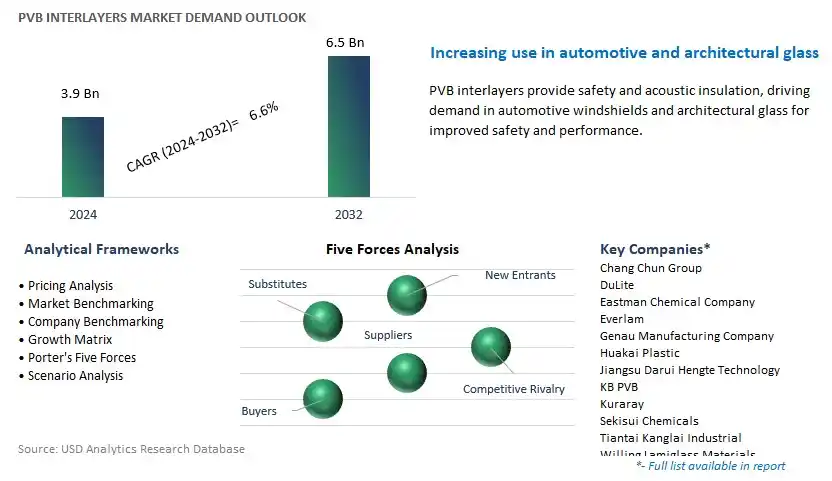
The market report analyses the leading companies in the industry including Chang Chun Group, DuLite, Eastman Chemical Company, Everlam, Genau Manufacturing Company, Huakai Plastic, Jiangsu Darui Hengte Technology, KB PVB, Kuraray, Sekisui Chemicals, Tiantai Kanglai Industrial, Willing Lamiglass Materials, and others.
One prominent trend in the PVB Interlayers market is the growing demand for safety and security in construction. This trend is driven by increasing concerns about safety, security, and protection against natural disasters, vandalism, and terrorism. PVB (polyvinyl butyral) interlayers are widely used in laminated glass applications for windows, doors, and facades to enhance structural integrity, impact resistance, and sound insulation. The trend towards safety and security in construction reflects the industry's focus on implementing measures to mitigate risks and ensure occupant safety, driving market growth in the PVB interlayers sector.
An important driver propelling the growth of the PVB Interlayers market is the growth in construction and infrastructure development. With rapid urbanization, population growth, and investments in infrastructure projects worldwide, there's a rising demand for high-performance building materials and solutions. PVB interlayers play a crucial role in laminated glass systems, offering benefits such as protection against UV radiation, noise reduction, and enhanced aesthetics. The expansion of construction and infrastructure projects, driven by factors such as urbanization, economic growth, and government initiatives, fuels the demand for PVB interlayers, supporting market growth in the construction sector.
A significant opportunity for the PVB Interlayers market lies in innovation in specialty interlayer solutions. Beyond traditional applications in architectural glass, there's potential for developing specialized PVB interlayers for niche markets and emerging applications. Opportunities exist in sectors such as automotive, aerospace, solar energy, and interior design, where PVB interlayers can offer unique properties such as impact resistance, acoustic insulation, UV protection, and decorative effects. By investing in research and development, collaborating with industry partners, and customizing interlayer formulations, manufacturers can capitalize on the opportunity to expand into new markets and applications, driving business growth and differentiation in the PVB interlayers industry.
Standard PVB (Polyvinyl Butyral) interlayers emerge as the largest segment in the PVB interlayers market due to their versatile properties and widespread applications. Standard PVB interlayers are commonly used in laminated safety glass for architectural, automotive, and aerospace applications. These interlayers provide excellent adhesion, optical clarity, and UV resistance, making them ideal for applications where transparency and safety are paramount. In architectural glass, standard PVB interlayers enhance the safety and security of buildings by holding shattered glass together upon impact, reducing the risk of injuries from broken glass shards. In automotive glass, standard PVB interlayers improve the structural integrity of windshields and windows, providing protection against impact and reducing the risk of ejection during accidents. The versatility and reliability of standard PVB interlayers make them the preferred choice for a wide range of laminated glass applications, solidifying their position as the largest segment in the PVB interlayers market.
The photovoltaic sector is the fastest-growing segment in the PVB interlayers market, driven by the increasing demand for solar panels worldwide. PVB interlayers are used in the manufacturing of photovoltaic modules to encapsulate solar cells and provide protection against environmental factors such as moisture, UV radiation, and mechanical stresses. With the global push towards renewable energy and the growing adoption of solar power generation, the demand for photovoltaic modules continues to rise. Additionally, technological advancements in solar panel design and manufacturing processes favor the use of PVB interlayers due to their excellent optical properties, adhesion strength, and durability. Moreover, government incentives, favorable policies, and declining costs of solar energy contribute to the growth of the photovoltaic sector, driving the demand for PVB interlayers. As the world seeks cleaner and sustainable energy sources, the demand for photovoltaic modules and PVB interlayers is expected to continue its rapid ascent, solidifying the photovoltaic sector as the fastest-growing segment in the PVB interlayers market.
By Type
Standard
Structural
By End-User
Automotive
Construction
PhotovoltaicCountries Analyzed
North America (US, Canada, Mexico)
Europe (Germany, UK, France, Spain, Italy, Russia, Rest of Europe)
Asia Pacific (China, India, Japan, South Korea, Australia, South East Asia, Rest of Asia)
South America (Brazil, Argentina, Rest of South America)
Middle East and Africa (Saudi Arabia, UAE, Rest of Middle East, South Africa, Egypt, Rest of Africa)
Chang Chun Group
DuLite
Eastman Chemical Company
Everlam
Genau Manufacturing Company
Huakai Plastic
Jiangsu Darui Hengte Technology
KB PVB
Kuraray
Sekisui Chemicals
Tiantai Kanglai Industrial
Willing Lamiglass Materials
*- List Not Exhaustive
TABLE OF CONTENTS
1 Introduction to 2024 PVB Interlayers Market
1.1 Market Overview
1.2 Quick Facts
1.3 Scope/Objective of the Study
1.4 Market Definition
1.5 Countries and Regions Covered
1.6 Units, Currency, and Conversions
1.7 Industry Value Chain
2 Research Methodology
2.1 Market Size Estimation
2.2 Sources and Research Methodology
2.3 Data Triangulation
2.4 Assumptions and Limitations
3 Executive Summary
3.1 Global PVB Interlayers Market Size Outlook, $ Million, 2021 to 2032
3.2 PVB Interlayers Market Outlook by Type, $ Million, 2021 to 2032
3.3 PVB Interlayers Market Outlook by Product, $ Million, 2021 to 2032
3.4 PVB Interlayers Market Outlook by Application, $ Million, 2021 to 2032
3.5 PVB Interlayers Market Outlook by Key Countries, $ Million, 2021 to 2032
4 Market Dynamics
4.1 Key Driving Forces of PVB Interlayers Industry
4.2 Key Market Trends in PVB Interlayers Industry
4.3 Potential Opportunities in PVB Interlayers Industry
4.4 Key Challenges in PVB Interlayers Industry
5 Market Factor Analysis
5.1 Value Chain Analysis
5.2 Competitive Landscape
5.2.1 Global PVB Interlayers Market Share by Company (%), 2023
5.2.2 Product Offerings by Company
5.3 Porter’s Five Forces Analysis
5.4 Pricing Analysis and Outlook
6 Growth Outlook Across Scenarios
6.1 Growth Analysis-Case Scenario Definitions
6.2 Low Growth Scenario Forecasts
6.3 Reference Growth Scenario Forecasts
6.4 High Growth Scenario Forecasts
7 Global PVB Interlayers Market Outlook by Segments
7.1 PVB Interlayers Market Outlook by Segments, $ Million, 2021- 2032
By Type
Standard
Structural
By End-User
Automotive
Construction
Photovoltaic
8 North America PVB Interlayers Market Analysis and Outlook To 2032
8.1 Introduction to North America PVB Interlayers Markets in 2024
8.2 North America PVB Interlayers Market Size Outlook by Country, 2021-2032
8.2.1 United States
8.2.2 Canada
8.2.3 Mexico
8.3 North America PVB Interlayers Market size Outlook by Segments, 2021-2032
By Type
Standard
Structural
By End-User
Automotive
Construction
Photovoltaic
9 Europe PVB Interlayers Market Analysis and Outlook To 2032
9.1 Introduction to Europe PVB Interlayers Markets in 2024
9.2 Europe PVB Interlayers Market Size Outlook by Country, 2021-2032
9.2.1 Germany
9.2.2 France
9.2.3 Spain
9.2.4 United Kingdom
9.2.4 Italy
9.2.5 Russia
9.2.6 Norway
9.2.7 Rest of Europe
9.3 Europe PVB Interlayers Market Size Outlook by Segments, 2021-2032
By Type
Standard
Structural
By End-User
Automotive
Construction
Photovoltaic
10 Asia Pacific PVB Interlayers Market Analysis and Outlook To 2032
10.1 Introduction to Asia Pacific PVB Interlayers Markets in 2024
10.2 Asia Pacific PVB Interlayers Market Size Outlook by Country, 2021-2032
10.2.1 China
10.2.2 India
10.2.3 Japan
10.2.4 South Korea
10.2.5 Indonesia
10.2.6 Malaysia
10.2.7 Australia
10.2.8 Rest of Asia Pacific
10.3 Asia Pacific PVB Interlayers Market size Outlook by Segments, 2021-2032
By Type
Standard
Structural
By End-User
Automotive
Construction
Photovoltaic
11 South America PVB Interlayers Market Analysis and Outlook To 2032
11.1 Introduction to South America PVB Interlayers Markets in 2024
11.2 South America PVB Interlayers Market Size Outlook by Country, 2021-2032
11.2.1 Brazil
11.2.2 Argentina
11.2.3 Rest of South America
11.3 South America PVB Interlayers Market size Outlook by Segments, 2021-2032
By Type
Standard
Structural
By End-User
Automotive
Construction
Photovoltaic
12 Middle East and Africa PVB Interlayers Market Analysis and Outlook To 2032
12.1 Introduction to Middle East and Africa PVB Interlayers Markets in 2024
12.2 Middle East and Africa PVB Interlayers Market Size Outlook by Country, 2021-2032
12.2.1 Saudi Arabia
12.2.2 UAE
12.2.3 Oman
12.2.4 Rest of Middle East
12.2.5 Egypt
12.2.6 Nigeria
12.2.7 South Africa
12.2.8 Rest of Africa
12.3 Middle East and Africa PVB Interlayers Market size Outlook by Segments, 2021-2032
By Type
Standard
Structural
By End-User
Automotive
Construction
Photovoltaic
13 Company Profiles
13.1 Company Snapshot
13.2 SWOT Profiles
13.3 Products and Services
13.4 Recent Developments
13.5 Financial Profile
Chang Chun Group
DuLite
Eastman Chemical Company
Everlam
Genau Manufacturing Company
Huakai Plastic
Jiangsu Darui Hengte Technology
KB PVB
Kuraray
Sekisui Chemicals
Tiantai Kanglai Industrial
Willing Lamiglass Materials
14 Appendix
14.1 Customization Offerings
14.2 Subscription Services
14.3 Related Reports
14.4 Publisher Expertise
By Type
Standard
Structural
By End-User
Automotive
Construction
Photovoltaic
Countries Analyzed
North America (US, Canada, Mexico)
Europe (Germany, UK, France, Spain, Italy, Russia, Rest of Europe)
Asia Pacific (China, India, Japan, South Korea, Australia, South East Asia, Rest of Asia)
South America (Brazil, Argentina, Rest of South America)
Middle East and Africa (Saudi Arabia, UAE, Rest of Middle East, South Africa, Egypt, Rest of Africa)
Global PVB Interlayers Market Size is valued at $3.9 Billion in 2024 and is forecast to register a growth rate (CAGR) of 6.6% to reach $6.5 Billion by 2032.
Emerging Markets across Asia Pacific, Europe, and Americas present robust growth prospects.
Chang Chun Group, DuLite, Eastman Chemical Company, Everlam, Genau Manufacturing Company, Huakai Plastic, Jiangsu Darui Hengte Technology, KB PVB, Kuraray, Sekisui Chemicals, Tiantai Kanglai Industrial, Willing Lamiglass Materials
Base Year- 2023; Estimated Year- 2024; Historic Period- 2018-2023; Forecast period- 2024 to 2032; Currency: Revenue (USD); Volume