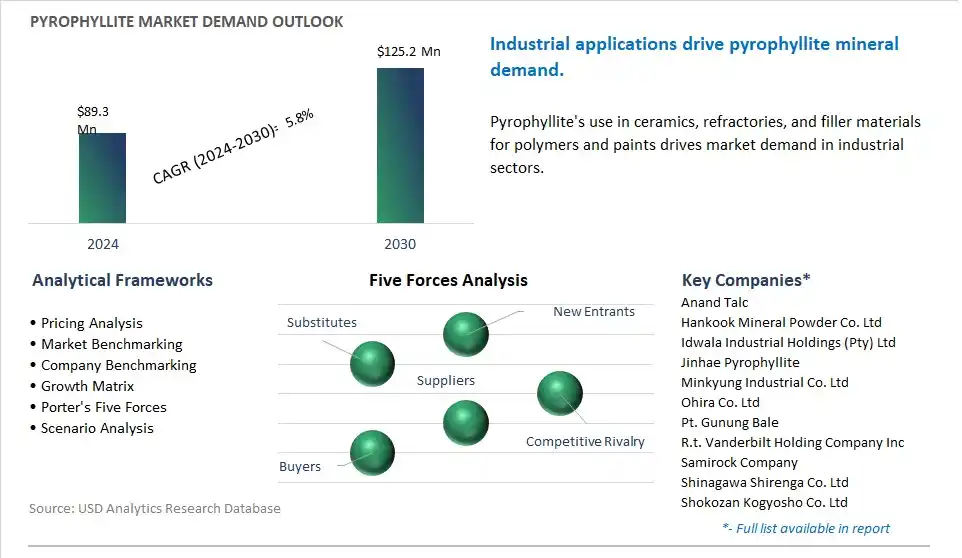
The global Pyrophyllite Market is poised to register a 5.8% CAGR from $89.3 Million in 2024 to $125.2 Million in 2030.
The global Pyrophyllite Market Study analyzes and forecasts the market size across 6 regions and 24 countries for diverse segments -By Type (Pyrophyllite Natural, Others), By Application (Ceramics, Fiberglass, Filler Materials, Fertilizer, Rubber and Roofing Refractory, Ornamental Stones, Others).
An Introduction to Global Pyrophyllite Market in 2024
The future of the pyrophyllite market is shaped by key trends such as industrial applications, technological advancements, and sustainability initiatives. Pyrophyllite, a hydrous aluminum silicate mineral, finds various applications in industries such as ceramics, refractories, paints, coatings, and construction materials due to its high alumina content, low thermal expansion, and chemical inertness. As industries such as construction, automotive, and electronics continue to grow, driven by urbanization and infrastructure development, the demand for pyrophyllite as a raw material for high-temperature ceramics and refractory products is expected to rise. Moreover, advancements in processing technologies, beneficiation methods, and product development enable the production of pyrophyllite with improved purity, particle size distribution, and performance characteristics, meeting the stringent requirements of end-use applications. Additionally, sustainability concerns drive the adoption of eco-friendly mining practices, waste management strategies, and product recycling initiatives in the pyrophyllite industry, addressing environmental impacts and community concerns. As industries seek cost-effective, high-performance materials with minimal environmental footprint, the pyrophyllite market will continue to innovate and expand to meet evolving market demands and sustainability goals.
Pyrophyllite Market Competitive Landscape
The market report analyses the leading companies in the industry including Anand Talc, Hankook Mineral Powder Co. Ltd, Idwala Industrial Holdings (Pty) Ltd, Jinhae Pyrophyllite, Minkyung Industrial Co. Ltd, Ohira Co. Ltd, Pt. Gunung Bale, R.t. Vanderbilt Holding Company Inc, Samirock Company, Shinagawa Shirenga Co. Ltd, Shokozan Kogyosho Co. Ltd, SKKU Minerals, Wonderstone.
Pyrophyllite Market Dynamics
Pyrophyllite Market Trend: Increasing Demand for Pyrophyllite in Ceramics and Refractories Industries
One prominent trend in the pyrophyllite market is the increasing demand for pyrophyllite in ceramics and refractories industries. Pyrophyllite is valued for its unique properties, including high thermal stability, low thermal expansion, and excellent resistance to heat and chemicals, making it an ideal raw material for ceramic and refractory applications. With growing construction activities, infrastructure development, and demand for high-performance materials, there is a rising need for pyrophyllite in the production of ceramic tiles, sanitaryware, refractory bricks, crucibles, and other heat-resistant products. The trend is expected to continue as industries seek innovative materials that offer superior performance and durability in harsh operating conditions.
Pyrophyllite Market Driver: Expansion of Construction and Industrial Sectors
The primary driver fueling the demand for pyrophyllite is the expansion of construction and industrial sectors worldwide. Pyrophyllite is essential in the construction industry for manufacturing ceramic products used in flooring, wall cladding, countertops, and decorative items due to its desirable properties such as hardness, abrasion resistance, and color stability. In addition, pyrophyllite is widely used in the industrial sector for refractory linings in furnaces, kilns, and reactors, as well as in foundry applications for molding sand additives. The rapid growth of construction activities, infrastructure projects, and industrial manufacturing drives the demand for pyrophyllite as a versatile and cost-effective raw material, supporting its continued market growth.
Pyrophyllite Market Opportunity: Exploration of New Applications and Markets for Pyrophyllite
An attractive opportunity for the pyrophyllite market lies in the exploration of new applications and markets beyond ceramics and refractories. Pyrophyllite possesses unique properties that make it suitable for various industrial and consumer applications beyond its traditional uses. Opportunities exist to develop pyrophyllite-based products for sectors such as cosmetics, plastics, paints, coatings, and agriculture, where its properties such as inertness, purity, and particle size distribution offer advantages. By investing in research and development initiatives to explore new applications, optimize product formulations, and penetrate untapped markets, manufacturers can diversify their product portfolios, expand their customer base, and create new revenue streams in the competitive landscape of industrial minerals. This opportunity allows for differentiation, value creation, and market leadership by leveraging the versatility and performance characteristics of pyrophyllite in emerging industries and applications.
Pyrophyllite Market Share Analysis: Pyrophyllite Natural generated the highest revenue in 2024
The largest segment in the Pyrophyllite Market is pyrophyllite natural, primarily because it constitutes the purest form of pyrophyllite, directly mined from natural deposits. Pyrophyllite is a hydrous aluminum silicate mineral that is commonly found in metamorphic rocks and clay deposits. Pyrophyllite natural is valued for its unique physical and chemical properties, including its low thermal expansion coefficient, high refractoriness, excellent thermal stability, and good electrical insulation properties. These characteristics make pyrophyllite natural suitable for a wide range of applications across industries such as ceramics, refractories, paints, plastics, and cosmetics. In ceramics, pyrophyllite natural serves as a fluxing agent and binder, improving the plasticity, strength, and firing properties of ceramic products. In refractory applications, it is used as a filler and flux in high-temperature materials due to its resistance to heat and chemical corrosion. Additionally, pyrophyllite natural finds use in the formulation of paints, plastics, and cosmetics for its properties such as opacity, rheology control, and inertness. As the purest and most versatile form of pyrophyllite, pyrophyllite natural dominates the Pyrophyllite Market due to its wide range of applications and desirable properties.
Pyrophyllite Market Share Analysis: Fiberglass segment is poised to register the fastest growth rate (CAGR) over the forecast period to 2030
The fastest growing segment in the Pyrophyllite Market is fiberglass, driven by the increasing demand for lightweight and high-strength materials in construction, automotive, aerospace, and other industries. Pyrophyllite is utilized as a reinforcing filler in fiberglass composites due to its unique combination of properties, including low thermal expansion, high temperature resistance, chemical inertness, and good adhesion to resins. Pyrophyllite-based fiberglass composites offer significant advantages over traditional materials such as steel, aluminum, and concrete, including reduced weight, improved thermal and electrical insulation, corrosion resistance, and design flexibility. Further, as industries seek sustainable and eco-friendly alternatives to traditional materials, pyrophyllite-based fiberglass composites offer a viable solution due to their recyclability and low environmental impact. With the growing emphasis on energy efficiency, infrastructure development, and lightweighting in various sectors, the demand for pyrophyllite in fiberglass applications is expected to increase rapidly, driving the growth of this segment in the Pyrophyllite Market.
Pyrophyllite Market Report Segmentation
By Type
Pyrophyllite Natural
Others
By Application
Ceramics
Fiberglass
Filler Materials
Fertilizer
Rubber and Roofing
Refractory
Ornamental Stones
Others
Regions Included
North America (US, Canada, Mexico)
Europe (Germany, UK, France, Spain, Italy, Russia, Rest of Europe)
Asia Pacific (China, India, Japan, South Korea, Australia, South East Asia, Rest of Asia)
South America (Brazil, Argentina, Rest of South America)
Middle East and Africa (Saudi Arabia, UAE, Rest of Middle East, South Africa, Egypt, Rest of Africa)
Pyrophyllite Companies Profiled in the Market Study
Anand Talc
Hankook Mineral Powder Co. Ltd
Idwala Industrial Holdings (Pty) Ltd
Jinhae Pyrophyllite
Minkyung Industrial Co. Ltd
Ohira Co. Ltd
Pt. Gunung Bale
R.t. Vanderbilt Holding Company Inc
Samirock Company
Shinagawa Shirenga Co. Ltd
Shokozan Kogyosho Co. Ltd
SKKU Minerals
Wonderstone
*- List Not Exhaustive
TABLE OF CONTENTS
1 Introduction to 2024 Pyrophyllite Market
1.1 Market Overview
1.2 Quick Facts
1.3 Scope/Objective of the Study
1.4 Market Definition
1.5 Countries and Regions Covered
1.6 Units, Currency, and Conversions
1.7 Industry Value Chain
2 Research Methodology
2.1 Market Size Estimation
2.2 Sources and Research Methodology
2.3 Data Triangulation
2.4 Assumptions and Limitations
3 Executive Summary
3.1 Global Pyrophyllite Market Size Outlook, $ Million, 2021 to 2030
3.2 Pyrophyllite Market Outlook by Type, $ Million, 2021 to 2030
3.3 Pyrophyllite Market Outlook by Product, $ Million, 2021 to 2030
3.4 Pyrophyllite Market Outlook by Application, $ Million, 2021 to 2030
3.5 Pyrophyllite Market Outlook by Key Countries, $ Million, 2021 to 2030
4 Market Dynamics
4.1 Key Driving Forces of Pyrophyllite Industry
4.2 Key Market Trends in Pyrophyllite Industry
4.3 Potential Opportunities in Pyrophyllite Industry
4.4 Key Challenges in Pyrophyllite Industry
5 Market Factor Analysis
5.1 Value Chain Analysis
5.2 Competitive Landscape
5.2.1 Global Pyrophyllite Market Share by Company (%), 2023
5.2.2 Product Offerings by Company
5.3 Porter’s Five Forces Analysis
5.4 Pricing Analysis and Outlook
6 Growth Outlook Across Scenarios
6.1 Growth Analysis-Case Scenario Definitions
6.2 Low Growth Scenario Forecasts
6.3 Reference Growth Scenario Forecasts
6.4 High Growth Scenario Forecasts
7 Global Pyrophyllite Market Outlook by Segments
7.1 Pyrophyllite Market Outlook by Segments, $ Million, 2021- 2030
By Type
Pyrophyllite Natural
Others
By Application
Ceramics
Fiberglass
Filler Materials
Fertilizer
Rubber and Roofing
Refractory
Ornamental Stones
Others
8 North America Pyrophyllite Market Analysis and Outlook To 2030
8.1 Introduction to North America Pyrophyllite Markets in 2024
8.2 North America Pyrophyllite Market Size Outlook by Country, 2021-2030
8.2.1 United States
8.2.2 Canada
8.2.3 Mexico
8.3 North America Pyrophyllite Market size Outlook by Segments, 2021-2030
By Type
Pyrophyllite Natural
Others
By Application
Ceramics
Fiberglass
Filler Materials
Fertilizer
Rubber and Roofing
Refractory
Ornamental Stones
Others
9 Europe Pyrophyllite Market Analysis and Outlook To 2030
9.1 Introduction to Europe Pyrophyllite Markets in 2024
9.2 Europe Pyrophyllite Market Size Outlook by Country, 2021-2030
9.2.1 Germany
9.2.2 France
9.2.3 Spain
9.2.4 United Kingdom
9.2.4 Italy
9.2.5 Russia
9.2.6 Norway
9.2.7 Rest of Europe
9.3 Europe Pyrophyllite Market Size Outlook by Segments, 2021-2030
By Type
Pyrophyllite Natural
Others
By Application
Ceramics
Fiberglass
Filler Materials
Fertilizer
Rubber and Roofing
Refractory
Ornamental Stones
Others
10 Asia Pacific Pyrophyllite Market Analysis and Outlook To 2030
10.1 Introduction to Asia Pacific Pyrophyllite Markets in 2024
10.2 Asia Pacific Pyrophyllite Market Size Outlook by Country, 2021-2030
10.2.1 China
10.2.2 India
10.2.3 Japan
10.2.4 South Korea
10.2.5 Indonesia
10.2.6 Malaysia
10.2.7 Australia
10.2.8 Rest of Asia Pacific
10.3 Asia Pacific Pyrophyllite Market size Outlook by Segments, 2021-2030
By Type
Pyrophyllite Natural
Others
By Application
Ceramics
Fiberglass
Filler Materials
Fertilizer
Rubber and Roofing
Refractory
Ornamental Stones
Others
11 South America Pyrophyllite Market Analysis and Outlook To 2030
11.1 Introduction to South America Pyrophyllite Markets in 2024
11.2 South America Pyrophyllite Market Size Outlook by Country, 2021-2030
11.2.1 Brazil
11.2.2 Argentina
11.2.3 Rest of South America
11.3 South America Pyrophyllite Market size Outlook by Segments, 2021-2030
By Type
Pyrophyllite Natural
Others
By Application
Ceramics
Fiberglass
Filler Materials
Fertilizer
Rubber and Roofing
Refractory
Ornamental Stones
Others
12 Middle East and Africa Pyrophyllite Market Analysis and Outlook To 2030
12.1 Introduction to Middle East and Africa Pyrophyllite Markets in 2024
12.2 Middle East and Africa Pyrophyllite Market Size Outlook by Country, 2021-2030
12.2.1 Saudi Arabia
12.2.2 UAE
12.2.3 Oman
12.2.4 Rest of Middle East
12.2.5 Egypt
12.2.6 Nigeria
12.2.7 South Africa
12.2.8 Rest of Africa
12.3 Middle East and Africa Pyrophyllite Market size Outlook by Segments, 2021-2030
By Type
Pyrophyllite Natural
Others
By Application
Ceramics
Fiberglass
Filler Materials
Fertilizer
Rubber and Roofing
Refractory
Ornamental Stones
Others
13 Company Profiles
13.1 Company Snapshot
13.2 SWOT Profiles
13.3 Products and Services
13.4 Recent Developments
13.5 Financial Profile
Anand Talc
Hankook Mineral Powder Co. Ltd
Idwala Industrial Holdings (Pty) Ltd
Jinhae Pyrophyllite
Minkyung Industrial Co. Ltd
Ohira Co. Ltd
Pt. Gunung Bale
R.t. Vanderbilt Holding Company Inc
Samirock Company
Shinagawa Shirenga Co. Ltd
Shokozan Kogyosho Co. Ltd
SKKU Minerals
Wonderstone
14 Appendix
14.1 Customization Offerings
14.2 Subscription Services
14.3 Related Reports
14.4 Publisher Expertise
By Type
Pyrophyllite Natural
Others
By Application
Ceramics
Fiberglass
Filler Materials
Fertilizer
Rubber and Roofing
Refractory
Ornamental Stones
Others
Countries Analyzed
North America (US, Canada, Mexico)
Europe (Germany, UK, France, Spain, Italy, Russia, Rest of Europe)
Asia Pacific (China, India, Japan, South Korea, Australia, South East Asia, Rest of Asia)
South America (Brazil, Argentina, Rest of South America)
Middle East and Africa (Saudi Arabia, UAE, Rest of Middle East, South Africa, Egypt, Rest of Africa)
