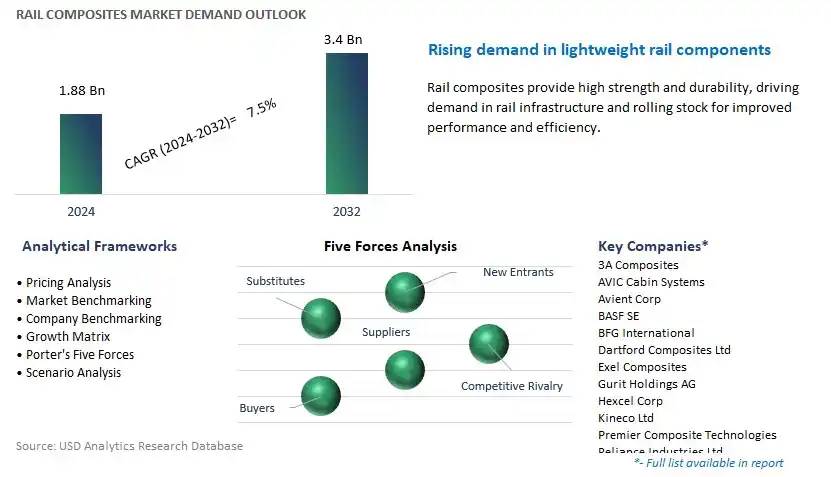
Global Rail Composites Market Size is valued at $1.88 Billion in 2024 and is forecast to register a growth rate (CAGR) of 7.5% to reach $3.4 Billion by 2032.
The global Rail Composites Market Study analyzes and forecasts the market size across 6 regions and 24 countries for diverse segments -By Fiber (Glass Fiber Composites, Carbon Fiber Composites, Others), By Resin (Polyester, Phenolic, Epoxy, Vinyl Ester, Others), By Manufacturing Process (Lay-up, Filament Winding, Injection Molding, Pultrusion, Compression Molding, RTM, Others), By Application (Interior components, Exterior Components, Others).
An Introduction to Rail Composites Market in 2024
In 2024, the rail composites market is experiencing rapid growth driven by the increasing demand for lightweight and high-strength materials in the rail transportation sector to improve fuel efficiency, reduce emissions, and enhance performance and durability of rail components. Rail composites are advanced materials comprising fiber-reinforced polymers (FRP) or carbon fiber-reinforced polymers (CFRP), offering superior mechanical properties, corrosion resistance, and fatigue performance compared to traditional materials such as steel and aluminum. The rail industry is a key driver of demand for composite materials, with applications ranging from interior components and exterior panels to structural elements such as bogies, frames, and bridges, benefiting from their lightweight design, impact resistance, and design flexibility. Further, the automotive and aerospace industries are leveraging composite technologies for lightweighting, noise reduction, and vibration damping, contributing to energy efficiency and sustainability initiatives. Additionally, the construction sector utilizes rail composites for infrastructure projects such as bridges, platforms, and tunnels, benefiting from their long-term durability and resistance to harsh environmental conditions. With advancements in composite materials, manufacturing processes, and industry standards, the rail composites market is poised for d expansion, driven by innovations in design optimization, material selection, and end-user applications.
Rail Composites Market Competitive Landscape
The market report analyses the leading companies in the industry including 3A Composites, AVIC Cabin Systems, Avient Corp, BASF SE, BFG International, Dartford Composites Ltd, Exel Composites, Gurit Holdings AG, Hexcel Corp, Kineco Ltd, Premier Composite Technologies, Reliance Industries Ltd, Solvay SA, Teijin Ltd, Toray Industries Inc, and others.
Rail Composites Market Dynamics
Market Trend: Increased Adoption of Lightweight Materials in Rail Industry
One prominent market trend in rail composites is the increased adoption of lightweight materials across the rail industry. With a growing emphasis on fuel efficiency, sustainability, and operational cost reduction, rail operators are increasingly turning towards composite materials to replace traditional metal components. Composites offer significant weight savings without compromising on strength or performance, thereby enabling enhanced fuel efficiency and reduced carbon emissions. This trend is driving the demand for composite solutions in various rail applications, including rolling stock, infrastructure, and interior components.
Market Driver: Regulatory Pressure for Fuel Efficiency and Emission Reduction
A key market driver for rail composites is the regulatory pressure for fuel efficiency and emission reduction in the transportation sector. Government regulations and environmental policies worldwide are imposing stringent standards on rail operators to minimize carbon footprint and enhance energy efficiency. In response, rail companies are actively seeking lightweight solutions such as composites to meet these regulatory requirements while maintaining operational efficiency and cost-effectiveness. The need to comply with emission standards and achieve sustainability goals is thus propelling the adoption of composite materials in rail applications.
Market Opportunity: Expansion of High-Speed Rail Networks
An emerging opportunity in the rail composites market lies in the expansion of high-speed rail networks globally. As countries invest in modernizing their rail infrastructure to accommodate high-speed trains, there is a growing demand for lightweight materials that can withstand high speeds while ensuring safety and performance. Composites offer unique advantages such as high strength-to-weight ratio, corrosion resistance, and design flexibility, making them ideal for high-speed rail applications. Leveraging this opportunity requires collaboration between composite manufacturers, rail operators, and government agencies to develop advanced composite solutions tailored to the specific requirements of high-speed rail systems. Additionally, investments in research and development are crucial to innovate new composite materials and manufacturing processes optimized for high-speed rail applications.
Rail Composites Market Share Analysis: Glass Fiber Composites segment generated the highest revenue in 2024
Glass fiber composites emerge as the largest segment in the Rail Composites market due to their widespread usage and established presence in rail manufacturing. Glass fiber composites offer a combination of strength, stiffness, and affordability, making them ideal materials for various components in rail applications, including interior panels, exterior panels, seats, flooring, and structural components. These composites provide excellent resistance to corrosion, impact, and fatigue, contributing to the durability and longevity of rail vehicles. Additionally, glass fiber composites are relatively lightweight compared to traditional materials such as steel and aluminum, leading to improved fuel efficiency and reduced operational costs for rail operators. Moreover, the versatility of glass fiber composites allows for customized designs and configurations to meet specific performance requirements and aesthetic preferences in rail manufacturing. As rail manufacturers increasingly adopt lightweight and high-performance materials to enhance the performance, comfort, and sustainability of rail vehicles, the demand for glass fiber composites is expected to remain strong, solidifying their position as the largest segment in the Rail Composites market.
Rail Composites Market Share Analysis: Epoxy Resin is poised to register the fastest CAGR over the forecast period
The epoxy resin segment is the fastest-growing segment in the Rail Composites market, driven by its exceptional mechanical properties, versatility, and increasing adoption in rail manufacturing. Epoxy resins offer high strength, stiffness, and durability, making them ideal for applications requiring superior performance and reliability in harsh operating environments. In the rail industry, epoxy-based composites are utilized for a wide range of components, including body panels, interior fittings, brake systems, and structural reinforcements. Epoxy resins also provide excellent adhesion to various reinforcement fibers, including glass, carbon, and aramid fibers, allowing for the development of lightweight and high-performance composite materials. Additionally, epoxy-based composites offer resistance to corrosion, chemicals, and fire, meeting stringent safety and regulatory standards for rail vehicles. As rail operators and manufacturers seek lightweight, fuel-efficient, and environmentally friendly solutions, the demand for epoxy resin-based composites in rail applications is expected to experience rapid growth, solidifying epoxy resin as the fastest-growing segment in the Rail Composites market.
Rail Composites Market Share Analysis: Lay-up Process segment generated the highest revenue in 2024
The lay-up process is the largest segment in the Rail Composites market, owing to its versatility, simplicity, and wide applicability in rail manufacturing. In the lay-up process, composite materials are manually or robotically placed layer by layer in a mold, followed by the application of resin and curing to form the final composite component. This manufacturing method offers flexibility in design and allows for the production of complex geometries and large-sized parts required in rail applications, such as train car bodies, interior panels, and seating components. Additionally, the lay-up process accommodates various reinforcement fibers and resin systems, including glass fiber, carbon fiber, polyester resin, and epoxy resin, providing manufacturers with options to tailor the composite properties to meet specific performance requirements. Moreover, the lay-up process is cost-effective and suitable for both small-scale and large-scale production, making it a preferred choice for rail manufacturers globally. As the rail industry continues to adopt lightweight and high-performance materials to improve fuel efficiency, reduce emissions, and enhance passenger comfort, the demand for composite components manufactured through the lay-up process is expected to remain strong, solidifying its position as the largest segment in the Rail Composites market.
Rail Composites Market Share Analysis: Exterior Components is poised to register the fastest CAGR over the forecast period
The exterior components segment is the fastest-growing segment in the Rail Composites market, propelled by the increasing demand for lightweight, durable, and aesthetically appealing materials in rail vehicle design. Exterior components play a crucial role in enhancing the performance, efficiency, and visual appeal of rail vehicles while ensuring passenger safety and comfort. Composites offer potential advantages over traditional materials such as steel and aluminum, including lower weight, higher strength-to-weight ratio, corrosion resistance, and design flexibility. As rail operators and manufacturers seek to improve fuel efficiency, reduce emissions, and enhance the overall passenger experience, there is a growing trend towards the use of composites in exterior applications such as body panels, fairings, roofs, and doors. Moreover, composites enable innovative design solutions, allowing for streamlined shapes, integrated features, and customizable finishes that contribute to the modernization and differentiation of rail vehicles in the market. With the increasing emphasis on sustainability, performance, and aesthetics in rail vehicle design, the demand for composites in exterior components is expected to experience rapid growth, solidifying it as the fastest-growing segment in the Rail Composites market.
Rail Composites Market
By Fiber
Glass Fiber Composites
Carbon Fiber Composites
Others
By Resin
Polyester
Phenolic
Epoxy
Vinyl Ester
Others
By Manufacturing Process
Lay-up
Filament Winding
Injection Molding
Pultrusion
Compression Molding
RTM
Others
By Application
Interior components
Exterior Components
Others
Countries Analyzed
North America (US, Canada, Mexico)
Europe (Germany, UK, France, Spain, Italy, Russia, Rest of Europe)
Asia Pacific (China, India, Japan, South Korea, Australia, South East Asia, Rest of Asia)
South America (Brazil, Argentina, Rest of South America)
Middle East and Africa (Saudi Arabia, UAE, Rest of Middle East, South Africa, Egypt, Rest of Africa)
Rail Composites Companies Profiled in the Study
3A Composites
AVIC Cabin Systems
Avient Corp
BASF SE
BFG International
Dartford Composites Ltd
Exel Composites
Gurit Holdings AG
Hexcel Corp
Kineco Ltd
Premier Composite Technologies
Reliance Industries Ltd
Solvay SA
Teijin Ltd
Toray Industries Inc
*- List Not Exhaustive
TABLE OF CONTENTS
1 Introduction to 2024 Rail Composites Market
1.1 Market Overview
1.2 Quick Facts
1.3 Scope/Objective of the Study
1.4 Market Definition
1.5 Countries and Regions Covered
1.6 Units, Currency, and Conversions
1.7 Industry Value Chain
2 Research Methodology
2.1 Market Size Estimation
2.2 Sources and Research Methodology
2.3 Data Triangulation
2.4 Assumptions and Limitations
3 Executive Summary
3.1 Global Rail Composites Market Size Outlook, $ Million, 2021 to 2032
3.2 Rail Composites Market Outlook by Type, $ Million, 2021 to 2032
3.3 Rail Composites Market Outlook by Product, $ Million, 2021 to 2032
3.4 Rail Composites Market Outlook by Application, $ Million, 2021 to 2032
3.5 Rail Composites Market Outlook by Key Countries, $ Million, 2021 to 2032
4 Market Dynamics
4.1 Key Driving Forces of Rail Composites Industry
4.2 Key Market Trends in Rail Composites Industry
4.3 Potential Opportunities in Rail Composites Industry
4.4 Key Challenges in Rail Composites Industry
5 Market Factor Analysis
5.1 Value Chain Analysis
5.2 Competitive Landscape
5.2.1 Global Rail Composites Market Share by Company (%), 2023
5.2.2 Product Offerings by Company
5.3 Porter’s Five Forces Analysis
5.4 Pricing Analysis and Outlook
6 Growth Outlook Across Scenarios
6.1 Growth Analysis-Case Scenario Definitions
6.2 Low Growth Scenario Forecasts
6.3 Reference Growth Scenario Forecasts
6.4 High Growth Scenario Forecasts
7 Global Rail Composites Market Outlook by Segments
7.1 Rail Composites Market Outlook by Segments, $ Million, 2021- 2032
By Fiber
Glass Fiber Composites
Carbon Fiber Composites
Others
By Resin
Polyester
Phenolic
Epoxy
Vinyl Ester
Others
By Manufacturing Process
Lay-up
Filament Winding
Injection Molding
Pultrusion
Compression Molding
RTM
Others
By Application
Interior components
Exterior Components
Others
8 North America Rail Composites Market Analysis and Outlook To 2032
8.1 Introduction to North America Rail Composites Markets in 2024
8.2 North America Rail Composites Market Size Outlook by Country, 2021-2032
8.2.1 United States
8.2.2 Canada
8.2.3 Mexico
8.3 North America Rail Composites Market size Outlook by Segments, 2021-2032
By Fiber
Glass Fiber Composites
Carbon Fiber Composites
Others
By Resin
Polyester
Phenolic
Epoxy
Vinyl Ester
Others
By Manufacturing Process
Lay-up
Filament Winding
Injection Molding
Pultrusion
Compression Molding
RTM
Others
By Application
Interior components
Exterior Components
Others
9 Europe Rail Composites Market Analysis and Outlook To 2032
9.1 Introduction to Europe Rail Composites Markets in 2024
9.2 Europe Rail Composites Market Size Outlook by Country, 2021-2032
9.2.1 Germany
9.2.2 France
9.2.3 Spain
9.2.4 United Kingdom
9.2.4 Italy
9.2.5 Russia
9.2.6 Norway
9.2.7 Rest of Europe
9.3 Europe Rail Composites Market Size Outlook by Segments, 2021-2032
By Fiber
Glass Fiber Composites
Carbon Fiber Composites
Others
By Resin
Polyester
Phenolic
Epoxy
Vinyl Ester
Others
By Manufacturing Process
Lay-up
Filament Winding
Injection Molding
Pultrusion
Compression Molding
RTM
Others
By Application
Interior components
Exterior Components
Others
10 Asia Pacific Rail Composites Market Analysis and Outlook To 2032
10.1 Introduction to Asia Pacific Rail Composites Markets in 2024
10.2 Asia Pacific Rail Composites Market Size Outlook by Country, 2021-2032
10.2.1 China
10.2.2 India
10.2.3 Japan
10.2.4 South Korea
10.2.5 Indonesia
10.2.6 Malaysia
10.2.7 Australia
10.2.8 Rest of Asia Pacific
10.3 Asia Pacific Rail Composites Market size Outlook by Segments, 2021-2032
By Fiber
Glass Fiber Composites
Carbon Fiber Composites
Others
By Resin
Polyester
Phenolic
Epoxy
Vinyl Ester
Others
By Manufacturing Process
Lay-up
Filament Winding
Injection Molding
Pultrusion
Compression Molding
RTM
Others
By Application
Interior components
Exterior Components
Others
11 South America Rail Composites Market Analysis and Outlook To 2032
11.1 Introduction to South America Rail Composites Markets in 2024
11.2 South America Rail Composites Market Size Outlook by Country, 2021-2032
11.2.1 Brazil
11.2.2 Argentina
11.2.3 Rest of South America
11.3 South America Rail Composites Market size Outlook by Segments, 2021-2032
By Fiber
Glass Fiber Composites
Carbon Fiber Composites
Others
By Resin
Polyester
Phenolic
Epoxy
Vinyl Ester
Others
By Manufacturing Process
Lay-up
Filament Winding
Injection Molding
Pultrusion
Compression Molding
RTM
Others
By Application
Interior components
Exterior Components
Others
12 Middle East and Africa Rail Composites Market Analysis and Outlook To 2032
12.1 Introduction to Middle East and Africa Rail Composites Markets in 2024
12.2 Middle East and Africa Rail Composites Market Size Outlook by Country, 2021-2032
12.2.1 Saudi Arabia
12.2.2 UAE
12.2.3 Oman
12.2.4 Rest of Middle East
12.2.5 Egypt
12.2.6 Nigeria
12.2.7 South Africa
12.2.8 Rest of Africa
12.3 Middle East and Africa Rail Composites Market size Outlook by Segments, 2021-2032
By Fiber
Glass Fiber Composites
Carbon Fiber Composites
Others
By Resin
Polyester
Phenolic
Epoxy
Vinyl Ester
Others
By Manufacturing Process
Lay-up
Filament Winding
Injection Molding
Pultrusion
Compression Molding
RTM
Others
By Application
Interior components
Exterior Components
Others
13 Company Profiles
13.1 Company Snapshot
13.2 SWOT Profiles
13.3 Products and Services
13.4 Recent Developments
13.5 Financial Profile
3A Composites
AVIC Cabin Systems
Avient Corp
BASF SE
BFG International
Dartford Composites Ltd
Exel Composites
Gurit Holdings AG
Hexcel Corp
Kineco Ltd
Premier Composite Technologies
Reliance Industries Ltd
Solvay SA
Teijin Ltd
Toray Industries Inc
14 Appendix
14.1 Customization Offerings
14.2 Subscription Services
14.3 Related Reports
14.4 Publisher Expertise
By Fiber
Glass Fiber Composites
Carbon Fiber Composites
Others
By Resin
Polyester
Phenolic
Epoxy
Vinyl Ester
Others
By Manufacturing Process
Lay-up
Filament Winding
Injection Molding
Pultrusion
Compression Molding
RTM
Others
By Application
Interior components
Exterior Components
Others
Countries Analyzed
North America (US, Canada, Mexico)
Europe (Germany, UK, France, Spain, Italy, Russia, Rest of Europe)
Asia Pacific (China, India, Japan, South Korea, Australia, South East Asia, Rest of Asia)
South America (Brazil, Argentina, Rest of South America)
Middle East and Africa (Saudi Arabia, UAE, Rest of Middle East, South Africa, Egypt, Rest of Africa)
