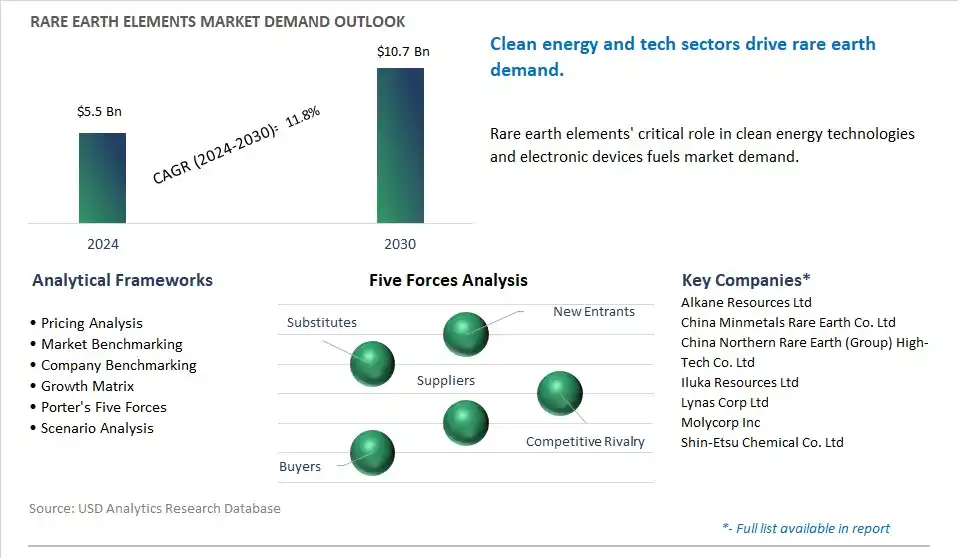
The global Rare Earth Elements Market is poised to register a 11.8% CAGR from $5.5 Billion in 2024 to $10.7 Billion in 2030.
The global Rare Earth Elements Market Study analyzes and forecasts the market size across 6 regions and 24 countries for diverse segments -By Product (Cerium, Dysprosium, Erbium, Europium, Gadolinium, Holmium, Lanthanum, Lutetium, Neodymium, Praseodymium, Promethium, Samarium, Scandium, Ytterbium, Yttrium), By Application (Magnets, Catalysts, Metallurgy, Polishing, Glass, Phosphors, Ceramics, Others).
An Introduction to Global Rare Earth Elements Market in 2024
The future of the rare earth elements (REE) market is influenced by key trends such as technological advancements, supply chain diversification, and geopolitical dynamics. REEs, a group of seventeen elements with unique magnetic, luminescent, and catalytic properties, play essential roles in various high-tech applications such as electronics, renewable energy, automotive, and defense systems. As technological advancements drive the demand for REEs in products such as smartphones, electric vehicles, wind turbines, and precision-guided munitions, there is a growing focus on supply chain resilience and diversification to reduce dependence on a few dominant producers. Moreover, geopolitical tensions and trade disputes impact REE supply chains, leading to efforts to secure new sources of supply and develop alternative extraction and processing technologies. Additionally, environmental concerns surrounding REE mining, processing, and waste management drive the adoption of sustainable practices, recycling initiatives, and green technologies in the REE industry. As industries seek reliable access to critical raw materials for advanced technologies, the REE market will continue to evolve with innovations in extraction methods, recycling technologies, and supply chain management to meet market demands and strategic objectives.
Rare Earth Elements Market Competitive Landscape
The market report analyses the leading companies in the industry including Alkane Resources Ltd, China Minmetals Rare Earth Co. Ltd, China Northern Rare Earth (Group) High-Tech Co. Ltd, Iluka Resources Ltd, Lynas Corp Ltd, Molycorp Inc, Shin-Etsu Chemical Co. Ltd.
Rare Earth Elements Market Dynamics
Rare Earth Elements Market Trend: Increasing Demand for Rare Earth Elements in High-Tech Applications
One prominent trend in the market for rare earth elements is the increasing demand for these materials in high-tech applications. Rare earth elements, such as neodymium, praseodymium, and dysprosium, are essential components in various advanced technologies including electric vehicles, renewable energy systems, electronics, and aerospace components. With the rapid advancement of technology and the transition towards cleaner energy sources, there is a growing need for rare earth elements to produce magnets, catalysts, and other materials that enable the functionality of these high-tech devices. This is driven by the expanding use of rare earth elements in emerging technologies, coupled with efforts to reduce reliance on fossil fuels and mitigate climate change through the adoption of sustainable and energy-efficient solutions.
Rare Earth Elements Market Driver: Growing Demand for Electric Vehicles and Clean Energy Technologies
The primary driver fueling the demand for rare earth elements is the growing adoption of electric vehicles and clean energy technologies. Rare earth elements are critical components in the manufacturing of permanent magnets used in electric vehicle motors, wind turbines, and other renewable energy systems. As governments worldwide implement policies to reduce carbon emissions and promote the transition towards electric mobility and renewable energy generation, there is a significant increase in the production and deployment of electric vehicles and clean energy infrastructure. This driver is propelled by factors such as environmental regulations, government incentives, technological advancements, and public awareness of climate change, driving sustained demand for rare earth elements in the automotive, energy, and clean technology sectors.
Rare Earth Elements Market Opportunity: Development of Sustainable Rare Earth Element Mining and Processing Methods
An attractive opportunity for the rare earth elements market lies in the development of sustainable mining and processing methods. Rare earth element mining and processing have historically been associated with environmental and social challenges, including habitat destruction, water pollution, and human rights abuses. There is an opportunity for companies to innovate and implement environmentally responsible and socially sustainable practices throughout the entire lifecycle of rare earth element production, from mining and extraction to refining and recycling. Opportunities exist to explore alternative sources of rare earth elements, such as urban mining, recycling of electronic waste, and extraction from unconventional sources, to reduce reliance on traditional mining operations with significant environmental footprints. By prioritizing sustainability and adopting best practices in rare earth element production, companies can mitigate risks, enhance their reputation, and meet the growing demand for responsibly sourced materials in the global marketplace. This opportunity allows for differentiation, value creation, and market leadership in the competitive landscape of rare earth elements, positioning companies as ethical and environmentally conscious suppliers in the supply chain of high-tech and clean energy industries.
Rare Earth Elements Market Share Analysis: Cerium generated the highest revenue in 2024
The largest segment in the Rare Earth Elements Market is cerium, primarily due to its widespread use across various industries and applications, as well as its abundance and relatively lower cost compared to other rare earth elements. Cerium is one of the most abundant rare earth elements and is found in various mineral deposits worldwide. It possesses unique properties that make it highly versatile and valuable in a wide range of industrial and technological applications. Cerium is commonly used as a catalyst in automotive catalytic converters to reduce emissions from internal combustion engines, contributing to air quality improvement and environmental protection efforts. Additionally, cerium compounds are utilized in glass and ceramics manufacturing to enhance optical properties, UV resistance, and mechanical strength. Cerium oxide is also employed as a polishing agent in glass, optics, and semiconductor industries, providing smooth and scratch-resistant surfaces. Furthermore, cerium-based alloys are used in metallurgy, aerospace, and defense applications due to their high melting point, corrosion resistance, and structural integrity. Further, cerium compounds find applications in various chemical processes, fuel cells, lighting, electronics, and medical devices, further driving its demand across diverse sectors. Given its abundance, versatility, and critical role in numerous industrial processes and technologies, cerium is the largest segment in the Rare Earth Elements Market.
Rare Earth Elements Market Share Analysis: Magnets segment is poised to register the fastest growth rate (CAGR) over the forecast period to 2030
The fastest growing segment in the Rare Earth Elements Market is magnets, driven by the increasing demand for rare earth magnets in various high-tech applications, particularly in renewable energy, electric vehicles (EVs), electronics, and industrial automation. Rare earth magnets, specifically neodymium-iron-boron (NdFeB) magnets, are known for their exceptional magnetic properties, including high magnetic strength, coercivity, and energy density, making them essential components in a wide range of modern technologies. In the renewable energy sector, rare earth magnets are used in wind turbines and electric generators to convert mechanical energy into electrical energy efficiently. The growing adoption of wind power and the expansion of wind energy installations worldwide drive the demand for rare earth magnets. Additionally, rare earth magnets are critical components in electric motors and traction motors used in electric vehicles (EVs), hybrid vehicles, and other transportation applications. With the increasing focus on electrification and the transition towards sustainable transportation, the demand for rare earth magnets for EVs and hybrid vehicles is experiencing rapid growth. Furthermore, rare earth magnets find extensive applications in electronics, such as hard disk drives, speakers, headphones, and magnetic resonance imaging (MRI) equipment, as well as in industrial automation, robotics, and consumer electronics. As industries continue to innovate and develop new technologies that rely on rare earth magnets for their magnetic properties and performance advantages, the demand for these magnets is expected to grow significantly, making magnets the fastest growing segment in the Rare Earth Elements Market.
Rare Earth Elements Market Report Segmentation
By Product
Cerium
Dysprosium
Erbium
Europium
Gadolinium
Holmium
Lanthanum
Lutetium
Neodymium
Praseodymium
Promethium
Samarium
Scandium
Ytterbium
Yttrium
By Application
Magnets
Catalysts
Metallurgy
Polishing
Glass
Phosphors
Ceramics
Others
Regions Included
North America (US, Canada, Mexico)
Europe (Germany, UK, France, Spain, Italy, Russia, Rest of Europe)
Asia Pacific (China, India, Japan, South Korea, Australia, South East Asia, Rest of Asia)
South America (Brazil, Argentina, Rest of South America)
Middle East and Africa (Saudi Arabia, UAE, Rest of Middle East, South Africa, Egypt, Rest of Africa)
Rare Earth Elements Companies Profiled in the Market Study
Alkane Resources Ltd
China Minmetals Rare Earth Co. Ltd
China Northern Rare Earth (Group) High-Tech Co. Ltd
Iluka Resources Ltd
Lynas Corp Ltd
Molycorp Inc
Shin-Etsu Chemical Co. Ltd
*- List Not Exhaustive
TABLE OF CONTENTS
1 Introduction to 2024 Rare Earth Elements Market
1.1 Market Overview
1.2 Quick Facts
1.3 Scope/Objective of the Study
1.4 Market Definition
1.5 Countries and Regions Covered
1.6 Units, Currency, and Conversions
1.7 Industry Value Chain
2 Research Methodology
2.1 Market Size Estimation
2.2 Sources and Research Methodology
2.3 Data Triangulation
2.4 Assumptions and Limitations
3 Executive Summary
3.1 Global Rare Earth Elements Market Size Outlook, $ Million, 2021 to 2030
3.2 Rare Earth Elements Market Outlook by Type, $ Million, 2021 to 2030
3.3 Rare Earth Elements Market Outlook by Product, $ Million, 2021 to 2030
3.4 Rare Earth Elements Market Outlook by Application, $ Million, 2021 to 2030
3.5 Rare Earth Elements Market Outlook by Key Countries, $ Million, 2021 to 2030
4 Market Dynamics
4.1 Key Driving Forces of Rare Earth Elements Industry
4.2 Key Market Trends in Rare Earth Elements Industry
4.3 Potential Opportunities in Rare Earth Elements Industry
4.4 Key Challenges in Rare Earth Elements Industry
5 Market Factor Analysis
5.1 Value Chain Analysis
5.2 Competitive Landscape
5.2.1 Global Rare Earth Elements Market Share by Company (%), 2023
5.2.2 Product Offerings by Company
5.3 Porter’s Five Forces Analysis
5.4 Pricing Analysis and Outlook
6 Growth Outlook Across Scenarios
6.1 Growth Analysis-Case Scenario Definitions
6.2 Low Growth Scenario Forecasts
6.3 Reference Growth Scenario Forecasts
6.4 High Growth Scenario Forecasts
7 Global Rare Earth Elements Market Outlook by Segments
7.1 Rare Earth Elements Market Outlook by Segments, $ Million, 2021- 2030
By Product
Cerium
Dysprosium
Erbium
Europium
Gadolinium
Holmium
Lanthanum
Lutetium
Neodymium
Praseodymium
Promethium
Samarium
Scandium
Ytterbium
Yttrium
By Application
Magnets
Catalysts
Metallurgy
Polishing
Glass
Phosphors
Ceramics
Others
8 North America Rare Earth Elements Market Analysis and Outlook To 2030
8.1 Introduction to North America Rare Earth Elements Markets in 2024
8.2 North America Rare Earth Elements Market Size Outlook by Country, 2021-2030
8.2.1 United States
8.2.2 Canada
8.2.3 Mexico
8.3 North America Rare Earth Elements Market size Outlook by Segments, 2021-2030
By Product
Cerium
Dysprosium
Erbium
Europium
Gadolinium
Holmium
Lanthanum
Lutetium
Neodymium
Praseodymium
Promethium
Samarium
Scandium
Ytterbium
Yttrium
By Application
Magnets
Catalysts
Metallurgy
Polishing
Glass
Phosphors
Ceramics
Others
9 Europe Rare Earth Elements Market Analysis and Outlook To 2030
9.1 Introduction to Europe Rare Earth Elements Markets in 2024
9.2 Europe Rare Earth Elements Market Size Outlook by Country, 2021-2030
9.2.1 Germany
9.2.2 France
9.2.3 Spain
9.2.4 United Kingdom
9.2.4 Italy
9.2.5 Russia
9.2.6 Norway
9.2.7 Rest of Europe
9.3 Europe Rare Earth Elements Market Size Outlook by Segments, 2021-2030
By Product
Cerium
Dysprosium
Erbium
Europium
Gadolinium
Holmium
Lanthanum
Lutetium
Neodymium
Praseodymium
Promethium
Samarium
Scandium
Ytterbium
Yttrium
By Application
Magnets
Catalysts
Metallurgy
Polishing
Glass
Phosphors
Ceramics
Others
10 Asia Pacific Rare Earth Elements Market Analysis and Outlook To 2030
10.1 Introduction to Asia Pacific Rare Earth Elements Markets in 2024
10.2 Asia Pacific Rare Earth Elements Market Size Outlook by Country, 2021-2030
10.2.1 China
10.2.2 India
10.2.3 Japan
10.2.4 South Korea
10.2.5 Indonesia
10.2.6 Malaysia
10.2.7 Australia
10.2.8 Rest of Asia Pacific
10.3 Asia Pacific Rare Earth Elements Market size Outlook by Segments, 2021-2030
By Product
Cerium
Dysprosium
Erbium
Europium
Gadolinium
Holmium
Lanthanum
Lutetium
Neodymium
Praseodymium
Promethium
Samarium
Scandium
Ytterbium
Yttrium
By Application
Magnets
Catalysts
Metallurgy
Polishing
Glass
Phosphors
Ceramics
Others
11 South America Rare Earth Elements Market Analysis and Outlook To 2030
11.1 Introduction to South America Rare Earth Elements Markets in 2024
11.2 South America Rare Earth Elements Market Size Outlook by Country, 2021-2030
11.2.1 Brazil
11.2.2 Argentina
11.2.3 Rest of South America
11.3 South America Rare Earth Elements Market size Outlook by Segments, 2021-2030
By Product
Cerium
Dysprosium
Erbium
Europium
Gadolinium
Holmium
Lanthanum
Lutetium
Neodymium
Praseodymium
Promethium
Samarium
Scandium
Ytterbium
Yttrium
By Application
Magnets
Catalysts
Metallurgy
Polishing
Glass
Phosphors
Ceramics
Others
12 Middle East and Africa Rare Earth Elements Market Analysis and Outlook To 2030
12.1 Introduction to Middle East and Africa Rare Earth Elements Markets in 2024
12.2 Middle East and Africa Rare Earth Elements Market Size Outlook by Country, 2021-2030
12.2.1 Saudi Arabia
12.2.2 UAE
12.2.3 Oman
12.2.4 Rest of Middle East
12.2.5 Egypt
12.2.6 Nigeria
12.2.7 South Africa
12.2.8 Rest of Africa
12.3 Middle East and Africa Rare Earth Elements Market size Outlook by Segments, 2021-2030
By Product
Cerium
Dysprosium
Erbium
Europium
Gadolinium
Holmium
Lanthanum
Lutetium
Neodymium
Praseodymium
Promethium
Samarium
Scandium
Ytterbium
Yttrium
By Application
Magnets
Catalysts
Metallurgy
Polishing
Glass
Phosphors
Ceramics
Others
13 Company Profiles
13.1 Company Snapshot
13.2 SWOT Profiles
13.3 Products and Services
13.4 Recent Developments
13.5 Financial Profile
Alkane Resources Ltd
China Minmetals Rare Earth Co. Ltd
China Northern Rare Earth (Group) High-Tech Co. Ltd
Iluka Resources Ltd
Lynas Corp Ltd
Molycorp Inc
Shin-Etsu Chemical Co. Ltd
14 Appendix
14.1 Customization Offerings
14.2 Subscription Services
14.3 Related Reports
14.4 Publisher Expertise
By Product
Cerium
Dysprosium
Erbium
Europium
Gadolinium
Holmium
Lanthanum
Lutetium
Neodymium
Praseodymium
Promethium
Samarium
Scandium
Ytterbium
Yttrium
By Application
Magnets
Catalysts
Metallurgy
Polishing
Glass
Phosphors
Ceramics
Others
Countries Analyzed
North America (US, Canada, Mexico)
Europe (Germany, UK, France, Spain, Italy, Russia, Rest of Europe)
Asia Pacific (China, India, Japan, South Korea, Australia, South East Asia, Rest of Asia)
South America (Brazil, Argentina, Rest of South America)
Middle East and Africa (Saudi Arabia, UAE, Rest of Middle East, South Africa, Egypt, Rest of Africa)
