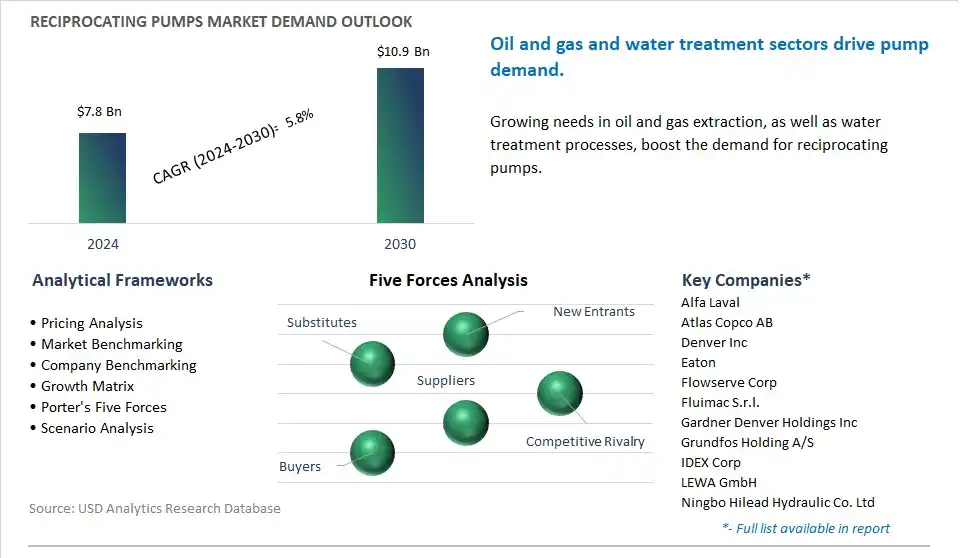
The global Reciprocating Pumps Market is poised to register a 5.8% CAGR from $7.8 Billion in 2024 to $10.9 Billion in 2030.
The global Reciprocating Pumps Market Study analyzes and forecasts the market size across 6 regions and 24 countries for diverse segments -By Type (Piston Pumps, Diaphragm Pumps, Plunger Pumps), By End-User (Agriculture, Construction & Building Services, Water & Wastewater, Power Generation, Oil & Gas, Chemical, Others).
An Introduction to Global Reciprocating Pumps Market in 2024
The future of the reciprocating pumps market is shaped by key trends such as industrial automation, process efficiency, and sustainability initiatives. Reciprocating pumps, also known as positive displacement pumps, are used in various industries such as oil and gas, chemical processing, power generation, and water treatment for applications such as fluid transfer, metering, and injection. As industries increasingly adopt automation and digitalization to improve process efficiency, reliability, and safety, there is a growing demand for reciprocating pumps with advanced control systems, monitoring capabilities, and predictive maintenance features. Moreover, energy efficiency initiatives and environmental regulations drive the adoption of pump designs, materials, and system optimization strategies to minimize energy consumption, reduce emissions, and comply with regulatory standards. Additionally, advancements in pump technology such as improved sealing systems, materials compatibility, and hydraulic efficiency enable the development of high-performance and low-maintenance pump solutions. As industries seek reliable, efficient, and environmentally friendly pumping solutions, the reciprocating pumps market will continue to innovate and expand with technological advancements and market-driven solutions to meet diverse industry needs and sustainability goals.
Reciprocating Pumps Market Competitive Landscape
The market report analyses the leading companies in the industry including Alfa Laval, Atlas Copco AB, Denver Inc, Eaton, Flowserve Corp, Fluimac S.r.l., Gardner Denver Holdings Inc, Grundfos Holding A/S, IDEX Corp, LEWA GmbH, Ningbo Hilead Hydraulic Co. Ltd, Parker-Hannifin Corp, Ruhrpumpen Group, SPX Flow, The Weir Group PLC, Xylem Inc.
Reciprocating Pumps Market Dynamics
Reciprocating Pumps Market Trend: Growing Adoption of Reciprocating Pumps in Oil and Gas Industry
One prominent trend in the reciprocating pumps market is the growing adoption of these pumps in the oil and gas industry. Reciprocating pumps are widely used in upstream, midstream, and downstream operations for various applications such as well stimulation, chemical injection, hydraulic fracturing, and pipeline pumping. With increasing demand for oil and gas globally and the exploration of unconventional reserves, there is a rising need for reliable and high-pressure pumping solutions to optimize production and transportation processes. Reciprocating pumps offer advantages such as robust construction, high efficiency, and the ability to handle high-viscosity fluids and abrasive slurries, making them well-suited for the challenging operating conditions encountered in the oil and gas sector. This is driven by the expansion of drilling activities, investments in infrastructure projects, and the need for efficient fluid handling solutions to enhance productivity and maximize resource recovery in the oil and gas industry.
Reciprocating Pumps Market Driver: Demand for Water and Wastewater Treatment Solutions
The primary driver fueling the demand for reciprocating pumps is the increasing demand for water and wastewater treatment solutions. Reciprocating pumps play a crucial role in water and wastewater treatment plants for processes such as chemical dosing, sludge handling, filtration, and disinfection. With growing population, urbanization, and industrialization, there is a rising need for clean water resources and effective wastewater management solutions to meet regulatory requirements and environmental standards. Reciprocating pumps offer versatility, reliability, and precise control over flow rates and pressures, making them essential equipment for pumping chemicals, slurries, and fluids in water treatment applications. The driver is propelled by factors such as population growth, urban development, industrial expansion, and the increasing awareness of water scarcity and pollution, driving investments in water infrastructure and treatment technologies worldwide.
Reciprocating Pumps Market Opportunity: Expansion into Emerging Markets and Applications
An attractive opportunity for the reciprocating pumps market lies in the expansion into emerging markets and applications. While reciprocating pumps are traditionally used in industries such as oil and gas, water treatment, and chemical processing, there is potential to explore new market segments and applications where reciprocating pumps can offer unique advantages. Opportunities exist in sectors such as mining, agriculture, power generation, and food and beverage processing, where reciprocating pumps can provide reliable and cost-effective pumping solutions for specific requirements such as high-pressure pumping, solids handling, and precise dosing. By diversifying into emerging markets and applications, manufacturers can expand their customer base, increase market penetration, and capitalize on the growing demand for reciprocating pumps in a wide range of industries. This opportunity allows for differentiation, value creation, and market growth in the competitive landscape of reciprocating pumps, positioning companies as providers of innovative and tailored pumping solutions for diverse applications and markets.
Reciprocating Pumps Market Share Analysis: Piston Pumps generated the highest revenue in 2024
Within the reciprocating pumps market, piston pumps emerge as the largest segment, and Piston pumps are widely favored across various industries for their robust construction, reliability, and versatility. They are capable of handling a wide range of fluids, including abrasive and viscous liquids, making them suitable for applications in sectors such as oil and gas, chemicals, and wastewater treatment. Further, piston pumps offer high efficiency and precise flow control, ensuring consistent performance even under demanding operating conditions. Their ability to generate high pressures makes them indispensable in processes that require significant pumping power, such as hydraulic systems and high-pressure cleaning equipment. Additionally, ongoing advancements in piston pump technology, including the integration of smart monitoring and control features, further enhance their appeal to end-users, driving continued growth in this market segment. As industries continue to seek reliable and efficient pumping solutions, the demand for piston pumps is expected to remain robust, solidifying their position as the largest segment in the reciprocating pumps market.
Reciprocating Pumps Market Share Analysis: Water & Wastewater segment is poised to register the fastest growth rate (CAGR) over the forecast period to 2030
The water and wastewater segment is the fastest-growing segment in the reciprocating pumps market. With growing global concerns over water scarcity and increasing urbanization, the demand for efficient water and wastewater management solutions is on the rise. Reciprocating pumps play a crucial role in this domain, offering reliable pumping solutions for various processes, including water supply, sewage treatment, and desalination. In both developed and developing regions, governments are investing heavily in infrastructure projects aimed at improving water quality and expanding access to clean water, further fueling the demand for reciprocating pumps in this sector. Additionally, stringent environmental regulations regarding wastewater discharge necessitate the use of robust pumping equipment capable of handling diverse fluids and operating under challenging conditions. As industries and municipalities prioritize sustainable water management practices, the demand for reciprocating pumps in the water and wastewater sector is projected to continue its rapid growth trajectory, making it a key driver of market expansion.
Reciprocating Pumps Market Report Segmentation
By Type
Piston Pumps
Diaphragm Pumps
Plunger Pumps
By End-User
Agriculture
Construction & Building Services
Water & Wastewater
Power Generation
Oil & Gas
Chemical
Others
Regions Included
North America (US, Canada, Mexico)
Europe (Germany, UK, France, Spain, Italy, Russia, Rest of Europe)
Asia Pacific (China, India, Japan, South Korea, Australia, South East Asia, Rest of Asia)
South America (Brazil, Argentina, Rest of South America)
Middle East and Africa (Saudi Arabia, UAE, Rest of Middle East, South Africa, Egypt, Rest of Africa)
Reciprocating Pumps Companies Profiled in the Market Study
Alfa Laval
Atlas Copco AB
Denver Inc
Eaton
Flowserve Corp
Fluimac S.r.l.
Gardner Denver Holdings Inc
Grundfos Holding A/S
IDEX Corp
LEWA GmbH
Ningbo Hilead Hydraulic Co. Ltd
Parker-Hannifin Corp
Ruhrpumpen Group
SPX Flow
The Weir Group PLC
Xylem Inc
*- List Not Exhaustive
TABLE OF CONTENTS
1 Introduction to 2024 Reciprocating Pumps Market
1.1 Market Overview
1.2 Quick Facts
1.3 Scope/Objective of the Study
1.4 Market Definition
1.5 Countries and Regions Covered
1.6 Units, Currency, and Conversions
1.7 Industry Value Chain
2 Research Methodology
2.1 Market Size Estimation
2.2 Sources and Research Methodology
2.3 Data Triangulation
2.4 Assumptions and Limitations
3 Executive Summary
3.1 Global Reciprocating Pumps Market Size Outlook, $ Million, 2021 to 2030
3.2 Reciprocating Pumps Market Outlook by Type, $ Million, 2021 to 2030
3.3 Reciprocating Pumps Market Outlook by Product, $ Million, 2021 to 2030
3.4 Reciprocating Pumps Market Outlook by Application, $ Million, 2021 to 2030
3.5 Reciprocating Pumps Market Outlook by Key Countries, $ Million, 2021 to 2030
4 Market Dynamics
4.1 Key Driving Forces of Reciprocating Pumps Industry
4.2 Key Market Trends in Reciprocating Pumps Industry
4.3 Potential Opportunities in Reciprocating Pumps Industry
4.4 Key Challenges in Reciprocating Pumps Industry
5 Market Factor Analysis
5.1 Value Chain Analysis
5.2 Competitive Landscape
5.2.1 Global Reciprocating Pumps Market Share by Company (%), 2023
5.2.2 Product Offerings by Company
5.3 Porter’s Five Forces Analysis
5.4 Pricing Analysis and Outlook
6 Growth Outlook Across Scenarios
6.1 Growth Analysis-Case Scenario Definitions
6.2 Low Growth Scenario Forecasts
6.3 Reference Growth Scenario Forecasts
6.4 High Growth Scenario Forecasts
7 Global Reciprocating Pumps Market Outlook by Segments
7.1 Reciprocating Pumps Market Outlook by Segments, $ Million, 2021- 2030
By Type
Piston Pumps
Diaphragm Pumps
Plunger Pumps
By End-User
Agriculture
Construction & Building Services
Water & Wastewater
Power Generation
Oil & Gas
Chemical
Others
8 North America Reciprocating Pumps Market Analysis and Outlook To 2030
8.1 Introduction to North America Reciprocating Pumps Markets in 2024
8.2 North America Reciprocating Pumps Market Size Outlook by Country, 2021-2030
8.2.1 United States
8.2.2 Canada
8.2.3 Mexico
8.3 North America Reciprocating Pumps Market size Outlook by Segments, 2021-2030
By Type
Piston Pumps
Diaphragm Pumps
Plunger Pumps
By End-User
Agriculture
Construction & Building Services
Water & Wastewater
Power Generation
Oil & Gas
Chemical
Others
9 Europe Reciprocating Pumps Market Analysis and Outlook To 2030
9.1 Introduction to Europe Reciprocating Pumps Markets in 2024
9.2 Europe Reciprocating Pumps Market Size Outlook by Country, 2021-2030
9.2.1 Germany
9.2.2 France
9.2.3 Spain
9.2.4 United Kingdom
9.2.4 Italy
9.2.5 Russia
9.2.6 Norway
9.2.7 Rest of Europe
9.3 Europe Reciprocating Pumps Market Size Outlook by Segments, 2021-2030
By Type
Piston Pumps
Diaphragm Pumps
Plunger Pumps
By End-User
Agriculture
Construction & Building Services
Water & Wastewater
Power Generation
Oil & Gas
Chemical
Others
10 Asia Pacific Reciprocating Pumps Market Analysis and Outlook To 2030
10.1 Introduction to Asia Pacific Reciprocating Pumps Markets in 2024
10.2 Asia Pacific Reciprocating Pumps Market Size Outlook by Country, 2021-2030
10.2.1 China
10.2.2 India
10.2.3 Japan
10.2.4 South Korea
10.2.5 Indonesia
10.2.6 Malaysia
10.2.7 Australia
10.2.8 Rest of Asia Pacific
10.3 Asia Pacific Reciprocating Pumps Market size Outlook by Segments, 2021-2030
By Type
Piston Pumps
Diaphragm Pumps
Plunger Pumps
By End-User
Agriculture
Construction & Building Services
Water & Wastewater
Power Generation
Oil & Gas
Chemical
Others
11 South America Reciprocating Pumps Market Analysis and Outlook To 2030
11.1 Introduction to South America Reciprocating Pumps Markets in 2024
11.2 South America Reciprocating Pumps Market Size Outlook by Country, 2021-2030
11.2.1 Brazil
11.2.2 Argentina
11.2.3 Rest of South America
11.3 South America Reciprocating Pumps Market size Outlook by Segments, 2021-2030
By Type
Piston Pumps
Diaphragm Pumps
Plunger Pumps
By End-User
Agriculture
Construction & Building Services
Water & Wastewater
Power Generation
Oil & Gas
Chemical
Others
12 Middle East and Africa Reciprocating Pumps Market Analysis and Outlook To 2030
12.1 Introduction to Middle East and Africa Reciprocating Pumps Markets in 2024
12.2 Middle East and Africa Reciprocating Pumps Market Size Outlook by Country, 2021-2030
12.2.1 Saudi Arabia
12.2.2 UAE
12.2.3 Oman
12.2.4 Rest of Middle East
12.2.5 Egypt
12.2.6 Nigeria
12.2.7 South Africa
12.2.8 Rest of Africa
12.3 Middle East and Africa Reciprocating Pumps Market size Outlook by Segments, 2021-2030
By Type
Piston Pumps
Diaphragm Pumps
Plunger Pumps
By End-User
Agriculture
Construction & Building Services
Water & Wastewater
Power Generation
Oil & Gas
Chemical
Others
13 Company Profiles
13.1 Company Snapshot
13.2 SWOT Profiles
13.3 Products and Services
13.4 Recent Developments
13.5 Financial Profile
Alfa Laval
Atlas Copco AB
Denver Inc
Eaton
Flowserve Corp
Fluimac S.r.l.
Gardner Denver Holdings Inc
Grundfos Holding A/S
IDEX Corp
LEWA GmbH
Ningbo Hilead Hydraulic Co. Ltd
Parker-Hannifin Corp
Ruhrpumpen Group
SPX Flow
The Weir Group PLC
Xylem Inc
14 Appendix
14.1 Customization Offerings
14.2 Subscription Services
14.3 Related Reports
14.4 Publisher Expertise
By Type
Piston Pumps
Diaphragm Pumps
Plunger Pumps
By End-User
Agriculture
Construction & Building Services
Water & Wastewater
Power Generation
Oil & Gas
Chemical
Others
Countries Analyzed
North America (US, Canada, Mexico)
Europe (Germany, UK, France, Spain, Italy, Russia, Rest of Europe)
Asia Pacific (China, India, Japan, South Korea, Australia, South East Asia, Rest of Asia)
South America (Brazil, Argentina, Rest of South America)
Middle East and Africa (Saudi Arabia, UAE, Rest of Middle East, South Africa, Egypt, Rest of Africa)
