Market Overview: Industrial Water Reuse and Advanced Filtration Drive Recycling Water Filtration Market Growth
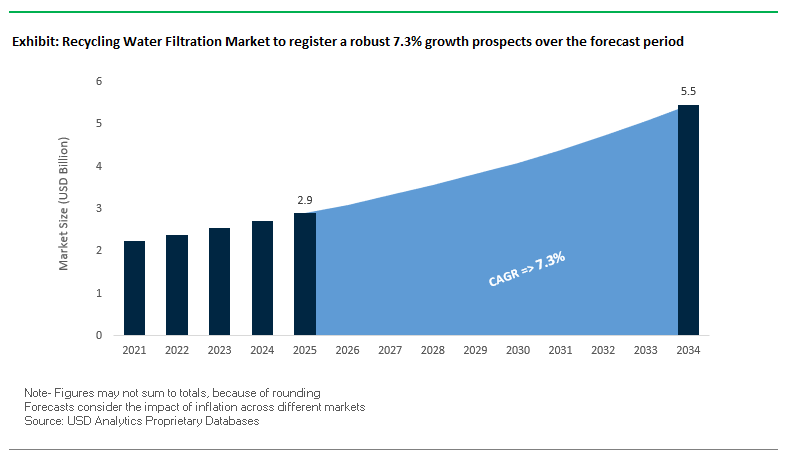
The global Recycling Water Filtration Market is projected to grow from USD 2.9 billion in 2025 to USD 5.5 billion by 2034, expanding at a CAGR of 7.3% during the forecast period. Market growth is supported by increasing industrial water consumption, freshwater scarcity, wastewater discharge requirements and the expansion of municipal and industrial water reclamation infrastructure. Growing demand for reliable alternative water supplies across power generation, semiconductor manufacturing, chemicals, food processing and other water-intensive industries is strengthening the role of advanced filtration technologies in industrial water management.
Industrial water recycling represents a major source of demand as manufacturers increasingly incorporate treated wastewater into cooling systems, process-water circuits and utility operations. Water procurement costs, wastewater disposal charges, treatment reliability and production continuity influence the economics of recycling systems. In water-stressed industrial regions, reclaimed municipal wastewater is also becoming an alternative supply source for manufacturing facilities. Large-scale water reuse projects increasingly connect municipal treatment infrastructure with industrial consumers, creating demand for membrane filtration equipment, integrated treatment systems and long-term operational services.
Reverse osmosis (RO), ultrafiltration (UF), microfiltration (MF) and nanofiltration (NF) remain important technologies within advanced wastewater recycling. Membrane-based treatment supports the production of reclaimed water with application-specific quality characteristics, while physical filtration, biological treatment and polishing processes contribute to integrated water reuse systems. The technology mix differs across industrial cooling, boiler feedwater, manufacturing processes and municipal reclamation, reflecting variations in treatment requirements and operating economics. Interest in membrane bioreactor (MBR) systems and hybrid filtration configurations is also associated with land availability, plant capacity and the treatment of variable wastewater streams.
Regional demand reflects differences in water availability, industrial activity and wastewater reuse regulations. Asia Pacific remains the leading regional market, supported by industrial expansion and municipal water recycling activity in China, India and other economies. North America represents an established market for industrial wastewater reuse, advanced water purification and potable reuse technologies, while Europe is influenced by water scarcity, environmental compliance and resource-efficiency requirements. Across these regions, filtration-system economics are shaped by capital costs, energy consumption, membrane maintenance, chemical requirements and concentrate management, alongside the availability and cost of conventional water supplies.
Key Insights: Recycling Water Filtration Market
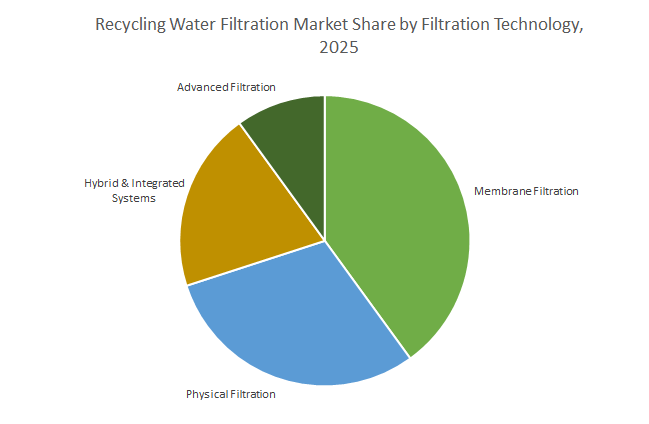
Membrane Filtration Leads Technology Demand: Membrane filtration accounts for 40% of the market in 2025, supported by RO, UF, MF and NF applications. Physical filtration holds 30%, followed by hybrid and integrated systems at 20% and advanced filtration at 10%, reflecting the use of multiple treatment approaches across wastewater recycling applications.
Industrial Water Recycling Dominates Applications: Industrial recycling represents 55% of market demand in 2025, compared with 30% for municipal recycling and 15% for commercial and residential applications. Cooling-water reuse, process-water recovery, boiler-feedwater preparation and industrial wastewater reclamation are important applications.
Power Generation and Process Industries Remain Major End Users: Power generation accounts for 20% of market share, while food and beverage and chemicals and petrochemicals each contribute 15%. Electronics and semiconductors represent 12%, reflecting demand for advanced water treatment, contaminant control and process-water recovery.
Asia Pacific Leads Regional Market Activity: China, India, Japan and other Asia Pacific economies contribute to industrial wastewater recycling and municipal reclamation demand. North America and Europe represent important markets for advanced reuse applications, regulatory-driven treatment requirements and industrial water recovery infrastructure.
Water Recovery Economics Influence Filtration Technology Demand: Electricity consumption, membrane replacement, pretreatment chemicals, maintenance requirements and concentrate disposal contribute to the operating-cost structure of recycling water filtration systems. Water tariffs, discharge charges, treatment capacity and recovery rates influence the commercial economics of industrial reuse installations.
Integrated Membrane Systems Expand Water Reuse Applications: The combination of MBR, UF, RO and advanced polishing technologies supports wastewater reclamation across applications with different water-quality requirements. Higher-recovery RO systems and improved membrane fouling control are extending the technical scope of industrial water recycling and minimum-/zero-liquid-discharge (MLD/ZLD) configurations.
Recent Developments in Recycling Water Filtration Technologies and Industrial Water Reuse
Recent developments in the recycling water filtration market reflect increasing deployment of high-recovery membrane technologies, municipal-to-industrial water reuse systems and application-specific filtration products. In September 2026, Toray Industries announced an order to supply low-fouling reverse osmosis membranes for Singapore's Changi NEWater Factory 3, a large-scale wastewater reclamation facility scheduled for completion in 2028. The company also expanded its industrial wastewater treatment portfolio in August 2026 with two new nanofiltration membrane element models, reflecting continued product development in selective separation and advanced water purification.
In April 2026, SUEZ and Salinity Solutions launched a hybrid batch reverse osmosis pilot at the Béziers wastewater treatment plant in France. The 100 m³/day installation targets water recovery of 90–95% while limiting brine generation and chemical consumption. According to the SUEZ industrial pilot announcement, the technology is being evaluated under operating wastewater treatment conditions. The project reflects growing commercial interest in higher-recovery membrane configurations and reduced concentrate-management requirements.
Industrial wastewater treatment technologies are also extending membrane applications into higher-salinity streams. In April 2026, DuPont introduced FilmTec Fortilife XC220 and XC-Max UHP reverse osmosis elements for industrial water recovery and MLD/ZLD systems. The DuPont FilmTec Fortilife portfolio expansion includes membranes designed for increased brine concentration, with potential implications for downstream treatment volumes and membrane-based water recovery economics.
Large-scale infrastructure projects represent another development area. In July 2025, Veolia was selected to deliver the Vitória Water Reclamation Station in Brazil, combining membrane bioreactor and reverse osmosis technologies to supply reclaimed municipal wastewater to industrial users. The planned facility has a treatment capacity of 38,880 m³/day and is designed to reclaim 85% of wastewater from the Camburi basin. The Veolia municipal-to-industrial water reuse project illustrates the integration of wastewater treatment infrastructure with alternative industrial water supply networks.
Emerging Trends Shaping the Recycling Water Filtration Market
Policy and Financial Incentives Driving Large-Scale Water Recycling Projects
Government policies and financial investments are catalyzing the adoption of water recycling systems, particularly in emerging economies. In India, 32 cities are actively practicing wastewater recycling, with initiatives such as Nagpur using treated water for thermal power plant cooling and Bengaluru employing treated effluent for agriculture and lake rejuvenation. Over the past decade, the Indian government has invested US$ 250 billion in the water sector, significantly supporting the deployment of advanced filtration infrastructure and incentivizing both public and private stakeholders to invest in large-scale water recycling solutions.
The Rise of Advanced and Hybrid Membrane Filtration Technologies
Technological innovation is central to improving recycled water quality. Research in the journal Membranes (2023) highlights hybrid systems combining Moving Bed Biofilm Reactors (MBBR), Membrane Bioreactors (MBR), and Direct Contact Membrane Distillation (DCMD) to treat industrial wastewater effectively, producing high-quality effluent suitable for reuse. Further advancements, such as novel matrix mixed membranes with flux recovery ratios of 97%, demonstrate ongoing efforts to enhance membrane longevity, efficiency, and fouling resistance, reflecting a market trend towards hybrid, high-performance solutions.
Industrial Sector Investment in Circular Water Management
Leading corporations are integrating recycling water filtration into their sustainability and operational strategies. For example, Carlsberg’s Fredericia Brewery reclaims 90% of process water, reducing total water consumption by 50% and saving approximately 0.5 billion liters per year. Similarly, L'Oréal in Warsaw achieves nearly 15% water savings through onsite recycling. Collaborative initiatives, such as Microsoft and the City of Quincy’s Water Reuse Utility, showcase successful public-private partnerships that optimize water reuse and reduce dependence on potable sources, demonstrating how industrial investments are driving innovation and growth in water filtration systems.
Strategic Opportunities in the Recycling Water Filtration Market
Opportunities in the market are driven by sustainability mandates, industrial efficiency, and advanced technology adoption. The growing focus on hybrid and integrated systems creates a chance for technology providers to deliver optimized, space-efficient solutions capable of handling complex wastewater streams. Industrial sectors, including power generation, electronics, and chemicals, are seeking high-quality recycled water, creating demand for advanced membrane and polishing technologies. Additionally, municipal and commercial recycling initiatives offer expansion potential, particularly in water-stressed regions where non-potable reuse and greywater recycling are increasingly mandated. Companies that provide turnkey solutions combining membranes, biological treatment, and advanced oxidation are well-positioned to capture high-value projects and long-term contracts globally.
Recycling Water Filtration Market Share Insights
Market Share by Filtration Technology (2025)
Membrane filtration leads the market with a 40% share, reflecting its ability to deliver high-purity water essential for industrial reuse, indirect potable applications, and sensitive manufacturing processes. Physical filtration (30%), including media and cartridge filters, remains foundational, protecting downstream membranes and advanced systems from fouling. Hybrid & integrated systems (20%), such as MBRs, are increasingly adopted for their compact footprint, efficiency, and ability to handle complex effluents. The advanced filtration segment (10%), incorporating AOPs, activated carbon, and ion exchange, is focused on micro-pollutant removal and trace contaminant management, catering to high-value reuse applications. The mix underscores a trend towards multi-step, technology-integrated solutions for optimized recycling.
Market Share by Application (2025)
Industrial recycling dominates with 55%, driven by the need to reduce freshwater procurement costs, lower effluent charges, and ensure continuous operational water security. Municipal recycling (30%) is growing rapidly, propelled by population growth, water scarcity, and regulatory mandates for irrigation, groundwater recharge, and indirect potable reuse. Commercial and residential recycling (15%) is expanding in response to green building standards and local ordinances, with systems designed for non-potable applications such as toilet flushing, irrigation, and cooling tower makeup. The adoption patterns highlight how economic and sustainability drivers differ across sectors, influencing technology and investment priorities.
Market Share by End-Use Industry (2025)
Power generation accounts for 20% of market share, representing high-volume applications for cooling towers, boilers, and FGD systems. Food & beverage (15%) and chemicals & petrochemicals (15%) rely on consistent quality for operational efficiency and regulatory compliance. Electronics & semiconductors (12%) demand ultra-pure water (UPW), making advanced RO and polishing technologies critical. Municipal utilities (10%) enable large-scale urban water reuse, supporting industrial clusters and potable reuse initiatives. Oil & gas (8%) utilizes recycled water for hydraulic fracturing, particularly in shale plays. Other industries such as pulp, textiles, and pharmaceuticals (20%) have specialized needs for dye, fiber, or high-purity contaminant removal. The breakdown illustrates the dual focus on volume efficiency and water quality, with industries adopting tailored filtration solutions to maximize sustainability and operational value.
Regulatory Framework and E-E-A-T: Water Reuse Quality, Membrane Validation and Compliance Standards
Regulatory requirements for recycling water filtration differ according to reclaimed-water origin, intended application, public-health exposure and environmental discharge conditions. In the European Union, the Water Reuse Regulation (EU) 2020/741 has applied since June 26, 2023, establishing minimum water-quality, monitoring, permitting and risk-management requirements for treated urban wastewater used in agricultural irrigation. Its provisions are specific to agricultural reuse and do not constitute a universal water-quality framework for industrial recycling or potable water applications.
The revised Urban Wastewater Treatment Directive (EU) 2024/3019 entered into force on January 1, 2025. It addresses urban wastewater treatment, micropollutant removal, resource recovery and water reuse, with Member States required to transpose specified provisions into national legislation by July 31, 2027. Individual treatment obligations follow separate implementation schedules. The directive expands the regulatory context for advanced wastewater treatment without imposing a uniform membrane-filtration technology requirement across all reuse applications.
In the United States, recycled-water regulations are influenced by federal environmental legislation and state-level requirements. California's adopted drinking-water and water reuse regulations identify October 1, 2024, as the effective date for direct potable reuse regulations and April 22, 2026, for onsite treatment and reuse of nonpotable water. These regulatory frameworks address different water-quality objectives, exposure pathways and treatment-verification requirements.
Technical validation is supported by internationally recognized standards. ISO 20426:2018 provides guidance for health-risk assessment and management associated with nonpotable water reuse, particularly pathogen exposure. NSF/ANSI 350 establishes material, design, construction and performance requirements for onsite residential and commercial water reuse treatment systems. Across advanced membrane reclamation applications, water-quality verification, treatment reliability, microbial reduction and application-specific contaminant control remain important elements of regulatory compliance and technical assessment.
Competitive Landscape: Global Recycling Water Filtration Market
The global Recycling Water Filtration Market includes integrated water technology providers, membrane manufacturers, wastewater treatment engineering companies and specialized filtration suppliers. Veolia and SUEZ participate through municipal water reclamation, industrial wastewater recycling and integrated treatment systems combining biological processes, membrane filtration and advanced purification. Xylem, including the former Evoqua Water Technologies business, maintains a broad water treatment portfolio covering industrial process water, advanced wastewater treatment, monitoring and utility infrastructure.
Membrane manufacturers represent an important segment of the competitive landscape. DuPont supplies FilmTec reverse osmosis and nanofiltration membranes for industrial water treatment, high-recovery applications and brine concentration. Toray Industries participates through RO, UF, NF and MBR membrane technologies used in municipal and industrial water treatment. Pentair, through its X-Flow product portfolio, supplies hollow-fiber membrane filtration technologies for water purification, wastewater polishing and process-water reuse applications.
The market also includes specialized membrane and biological treatment technology suppliers. Kubota Corporation provides submerged flat-sheet membrane systems used in municipal and industrial membrane bioreactors, while Mitsubishi Chemical Group participates through STERAPORE hollow-fiber membrane technologies. MANN+HUMMEL, through its Water & Fluid Solutions business, supplies polymeric membrane products and MICRODYN-NADIR technologies for water, wastewater and industrial process separation.
Engineering and integrated treatment providers compete across large-scale industrial reclamation, municipal water reuse and high-recovery wastewater treatment projects. Aquatech International operates in industrial water recycling, reverse osmosis, and MLD/ZLD applications. VA TECH WABAG provides municipal and industrial water treatment infrastructure, including wastewater reclamation systems, while Gradiant participates in industrial wastewater recovery, advanced membrane treatment and integrated water reuse technologies.
Competition also extends to filtration media, treatment chemistry and mechanical wastewater treatment equipment. Kuraray, including Calgon Carbon, supplies activated-carbon materials used in dissolved-organic and trace-contaminant removal. Ecolab, through Nalco Water, provides industrial water treatment chemistry, monitoring and process-water management technologies. HUBER SE participates through mechanical wastewater treatment, filtration equipment and membrane-based biological treatment systems for municipal and industrial applications.
Country Analysis of Recycling Water Filtration Market
China: Expanding Recycling Water Filtration Through Regulatory Push and Innovation
China is a major driver in the recycling water filtration market, fueled by stringent industrial wastewater regulations enforced by the Ministry of Ecology and Environment (MEE). The government’s 14th Five-Year Plan emphasizes water reuse and targets 95% wastewater treatment for all county-level cities, generating robust demand for recycling water filtration infrastructure. In 2024, researchers at the Chinese Academy of Sciences developed a dual-functional reverse osmosis (RO) membrane with enhanced antibacterial and anti-adhesion properties, improving the efficiency of RO systems commonly used in recycling applications. Significant government investments, totaling $50 billion by 2025, target wastewater treatment in heavy-polluting sectors like textiles, steel, and pharmaceuticals. Membrane bioreactors (MBRs) are increasingly deployed in municipal wastewater expansion and renovation projects to comply with stricter discharge standards while offering compact footprints.
United States: Government Funding and Corporate Innovation Driving Advanced Water Reuse
The U.S. recycling water filtration market is strongly influenced by federal funding and advanced technology deployment. Through the Bipartisan Infrastructure Law, the Environmental Protection Agency (EPA) receives over $50 billion to improve water infrastructure, including addressing emerging contaminants like PFAS. The new PFAS Maximum Contaminant Levels are prompting retrofits of existing treatment facilities with advanced membrane filtration systems. Public-private partnerships such as the National Alliance for Water Innovation (NAWI) are funding novel membrane development for waste-brine treatment and renewable-powered desalination. Corporate initiatives by Veolia Water Technologies, Evoqua Water Technologies, and Koch Separation Solutions emphasize modular MBR systems for efficient retrofitting. Investments by Micron Technology in Aqua Membranes’ 3D-printed spacers further demonstrate industrial adoption aimed at enhancing water reuse and conservation.
India: Infrastructure Expansion and Advanced Filtration Driving Water Recycling
India is witnessing significant growth in recycling water filtration through government initiatives and infrastructure investment. Programs like the Jal Jeevan Mission, Namami Gange Mission, and Smart Cities Mission are accelerating new wastewater treatment deployments and modernization of existing plants. Under the Atal Mission for Rejuvenation and Urban Transformation (AMRUT), approximately USD 10 billion has been allocated to enhance water supply and wastewater treatment, with public-private partnership (PPP) models facilitating large-scale projects. Advanced technologies such as sequencing batch reactors (SBR) and membrane bioreactors (MBR) are being adopted to achieve higher treatment efficiencies. Industrial sectors, including power plants, chemicals, and textiles, are increasingly implementing water reuse solutions to mitigate water scarcity and comply with stringent environmental regulations.
Singapore: NEWater Project Leading Advanced Recycling Practices
Singapore is a global pioneer in water recycling, with the NEWater initiative serving as a benchmark for high-quality recycled water. The system integrates microfiltration, reverse osmosis, and UV disinfection to treat wastewater for industrial and potable purposes. The Public Utilities Board (PUB) continuously invests in R&D to enhance recycling capabilities, focusing on advanced membrane technologies and monitoring systems. Recycled water is applied for industrial cooling, blended into the potable water supply, and other applications, highlighting Singapore’s commitment to sustainable and reliable water reuse solutions.
Germany: Advanced Regulations and Innovative Membrane Systems
Germany leads the recycling water filtration market in Europe through strong regulatory frameworks and innovative technological adoption. The German Federal Wastewater Charges Act imposes fees on entities discharging wastewater, encouraging the use of advanced treatment solutions. Companies like CERAFILTEC provide ceramic flat membranes for MBR projects with capacities ranging from 250 m³/d industrial to 10,000 m³/d municipal systems. PPU Umwelttechnik is developing containerized membrane systems that can retrofit existing infrastructure, providing cost-effective solutions for both industrial and municipal applications. These initiatives position Germany as a leader in efficient, high-quality water recycling.
Japan: Academic Excellence and MBR Deployment Driving Recycling Technology
Japan’s recycling water filtration market benefits from a strong focus on research and membrane technology deployment. Academic institutions and corporations, including Toray Industries Inc., are developing high-efficiency separation membrane modules, offering more than double the filtration performance of conventional systems while reducing clogging. Government programs like the Advance of Japan Ultimate Membrane bioreactor technology Project (A-JUMP) promote the integration of MBR technology in medium- to large-scale sewage treatment plants, supporting reconstruction, upgrades, and capacity enhancements. MBR technology is expected to become a core solution for improving efficiency and quality in Japan’s water recycling projects.
Competitive Landscape: Leading Companies in the Recycling Water Filtration Market
The competitive landscape of the recycling water filtration market is shaped by multinational leaders driving innovations in reverse osmosis, ultrafiltration, MBR systems, and zero liquid discharge technologies. Each company’s competitive edge is tied to technological depth, project execution capabilities, and sustainability-driven strategies.
SUEZ is a global water management leader with a diverse portfolio of reverse osmosis (RO), ultrafiltration (UF), and membrane bioreactors (MBR). Its strength lies in delivering integrated water recycling plants that combine physical membranes with predictive digital analytics. Recent contracts in Asia, including a large SWRO project in the Philippines and industrial wastewater recycling in China, reinforce its dominance. By leveraging AI-driven analytics, SUEZ ensures cost reductions and enhanced filtration performance.
Veolia Water Technologies – Global Leader in Desalination and Water Recycling
Veolia commands over 13 million m³/day of treated capacity across 44 countries, cementing its leadership in desalination and water reuse technologies. In July 2025, Veolia was selected for a major wastewater reuse project in Brazil, implementing advanced biological and membrane technologies for large-scale reclamation. Its unique MemGas™ technology is also applied in renewable gas recovery from wastewater in San Francisco, highlighting its ability to integrate energy-water circular solutions.
DuPont Water Solutions – Materials Science Expertise in Membranes
DuPont leverages decades of expertise in polymer chemistry to supply industry-leading DOW FILMTEC™ membranes for reverse osmosis and nanofiltration. Its award-winning Fortilife™ membranes are designed for challenging wastewater streams, improving efficiency and sustainability in industrial reuse. DuPont’s broad portfolio spanning RO, NF, UF, and ion-exchange resins makes it a trusted provider for zero liquid discharge (ZLD) and industrial recycling projects.
Xylem Inc. – Integrated Wastewater Recycling and Advanced Oxidation Systems
Xylem is a global water technology company delivering end-to-end wastewater recycling solutions. Its 2023 acquisition of Evoqua significantly expanded its membrane bioreactor (MBR) and oxidation process capabilities. Recent partnerships, such as with Gross-Wen Technologies, have advanced algal biofilm wastewater treatment for nutrient recovery and carbon reduction. With a portfolio spanning pumps, analytics, and digital controls, Xylem offers integrated recycling water filtration platforms to utilities worldwide.
Aquatech International – Industrial Leader in Zero Liquid Discharge (ZLD)
Aquatech specializes in industrial water reuse and ZLD technologies, delivering crystallizers, evaporators, RO, and NF systems to high-demand industries. Its partnership with AECOM to commercialize PFAS destruction technology demonstrates leadership in addressing emerging contaminants. Recently, Aquatech secured a landmark project with Kuwait Oil Company’s Lower Fars Heavy Oil Development, highlighting its role in industrial wastewater recycling under extreme conditions.
Recycling Water Filtration Market Report Scope
Recycling Water Filtration Market
Parameter
Details
Market Size (2025)
$2.9 Billion
Market Size (2034)
$5.5 Billion
Market Growth Rate
7.3%
Segments
By Filtration Technology (Physical Filtration, Membrane Filtration, Advanced Filtration, Hybrid & Integrated Systems), By Application (Industrial Recycling, Municipal Recycling, Commercial & Residential Recycling), By End-Use Industry (Power Generation, Oil & Gas, Food & Beverage, Pharmaceuticals & Biotechnology, Pulp & Paper, Textiles & Dyeing, Electronics & Semiconductors, Chemicals & Petrochemicals, Municipal Utilities, Commercial & Residential Buildings), By System Configuration (Centralized Recycling Systems, Decentralized / Modular Systems)
Study Period
2019- 2025 and 2026-2034
Units
Revenue (USD)
Qualitative Analysis
Porter’s Five Forces, SWOT Profile, Market Share, Scenario Forecasts, Market Ecosystem, Company Ranking, Market Dynamics, Industry Benchmarking
Companies
Veolia, SUEZ, Xylem Inc., Evoqua Water Technologies, Pentair plc, DuPont de Nemours, Inc., Toray Industries, Inc., Aquatech International, Kubota Corporation, The Dow Chemical Company, V.A. TECH WABAG Ltd., Mitsubishi Chemical Corporation, Kuraray Co., Ltd., Nalco Water (An Ecolab Company), MANN+HUMMEL
Countries
US, Canada, Mexico, Germany, France, Spain, Italy, UK, Russia, China, India, Japan, South Korea, Australia, South East Asia, Brazil, Argentina, Middle East, Africa
Recycling Water Filtration Market Segmentation
By Filtration Technology
Physical Filtration
Sand Filtration
Multimedia Filtration
Activated Carbon Filtration
Membrane Filtration
Microfiltration (MF)
Ultrafiltration (UF)
Nanofiltration (NF)
Reverse Osmosis (RO)
Advanced Filtration
Electro-deionization (EDI)
Ceramic & Polymeric Membranes
Forward Osmosis (FO)
Hybrid & Integrated Systems
Membrane Bioreactors (MBR)
Advanced Oxidation + Membrane Systems
By Application
Industrial Recycling
Cooling Tower Water Reuse
Boiler Feedwater Treatment
Process Water Recycling
Zero Liquid Discharge (ZLD) Systems
Municipal Recycling
Wastewater Reclamation
Stormwater & Greywater Reuse
Potable Water Reuse (direct & indirect)
Commercial & Residential Recycling
Greywater Recycling Systems
Decentralized & Building-Integrated Units
By End-Use Industry
Power Generation
Oil & Gas
Food & Beverage
Pharmaceuticals & Biotechnology
Pulp & Paper
Textiles & Dyeing
Electronics & Semiconductors
Chemicals & Petrochemicals
Municipal Utilities
Commercial & Residential Buildings
By System Configuration
Centralized Recycling Systems
Large-Scale Municipal & Industrial Plants
Decentralized / Modular Systems
On-site Recycling Units
Containerized & Mobile Filtration Systems
Countries Analyzed
North America (US, Canada, Mexico)
Europe (Germany, UK, France, Spain, Italy, Russia, Rest of Europe)
Asia Pacific (China, India, Japan, South Korea, Australia, South East Asia, Rest of Asia)
South America (Brazil, Argentina, Rest of South America)
Middle East and Africa (Saudi Arabia, UAE, Rest of Middle East, South Africa, Egypt, Rest of Africa)
Leading Companies in the Recycling Water Filtration Market
Veolia
SUEZ
Xylem Inc. (including Evoqua Water Technologies)
DuPont de Nemours, Inc.
Toray Industries, Inc.
Pentair plc
Aquatech International
Kubota Corporation
VA TECH WABAG Ltd.
Mitsubishi Chemical Group Corporation
MANN+HUMMEL
Gradiant
Kuraray Co., Ltd. (including Calgon Carbon)
Ecolab Inc. (Nalco Water)
HUBER SE
*- List not Exhaustive
Research Coverage
This report investigates the global Recycling Water Filtration Market, delivering analysis reviews on demand catalysts, technology breakthroughs, and strategic highlights that are redefining reuse quality, lifecycle costs, and compliance outcomes through 2034. Produced by USDAnalytics, this report is an essential resource for utilities, industrial operators, EPCs, and policymakers seeking to scale circular water systems with bankable ROI. It maps how hybrid trains (MBR + RO/NF + advanced polishing), decentralized modular units, and digital monitoring raise recovery rates, stabilize effluent under variable loads, and compress footprints in space-constrained sites. By linking project pipelines, policy incentives, and material innovations in membranes and adsorbents, the study equips decision-makers with upgrade archetypes, payback levers, and market entry pathways across municipal, industrial, and commercial settings. Scope Includes-
By System Configuration: Centralized (Large Municipal & Industrial Plants); Decentralized/Modular (On-site Units; Containerized & Mobile Systems).
Geographic Scope: “Analysis spans 25+ countries across North America, Europe, Asia Pacific, Latin America, the Middle East & Africa.”
Data Coverage: Historic data from 2021–2024 and forecast data from 2025–2034.
Companies (Analysis/ profiles of 15+ companies): Veolia; SUEZ; Xylem Inc.; Evoqua Water Technologies; Pentair plc; DuPont de Nemours, Inc.; Toray Industries, Inc.; Aquatech International; Kubota Corporation; The Dow Chemical Company; V.A. TECH WABAG Ltd.; Mitsubishi Chemical Corporation; Kuraray Co., Ltd.; Nalco Water (An Ecolab Company); MANN+HUMMEL.
Research Methodology
USDAnalytics evaluates the global Recycling Water Filtration Market using a combined top-down and bottom-up market-sizing framework covering filtration technologies, applications, end-use industries, system configurations and regional markets. The research incorporates primary interviews with water utilities, industrial operators, technology suppliers, system integrators and operations and maintenance providers, supplemented by company disclosures, infrastructure project information, regulatory databases and technical literature.
Market estimates are triangulated using technology-level demand, industrial water treatment activity, water recycling infrastructure, project and tender information, and application-specific market data. Competitive analysis assesses supplier portfolios, membrane technologies, project capabilities and regional participation. The 2025–2034 forecast incorporates variations in industrial water demand, wastewater reuse activity, treatment-system economics, regulatory requirements and advanced filtration technology adoption.
Deliverables:
Comprehensive Market Research Report (PDF and Excel) with detailed tables, charts, and interactive visualizations.
Country-Specific Forecasts & Analysis.
Segment-Wise Revenue Forecasts (2026–2034).
Competitive Analysis, Benchmarking, and SWOT Profiles.
Recent Developments & Innovation Tracker.
Executive Summary & Analyst Commentary.
Post-Purchase Analyst Support for Client-Specific Questions and Custom Data Requirements.
Table of Contents: Recycling Water Filtration Market
1. Executive Summary
1.1. Market Highlights and Key Projections
1.2. Key Insights for Industry Stakeholders
1.3. Global Market Snapshot
1.3.1. Current Market Valuation (2025): $2.9 Billion
Membrane trains (UF→RO/NF) lead where UPW or stringent reuse specs are required semiconductors, power boilers, and food processing. Pairing RO with activated carbon/AOP polishing achieves micro-pollutant control and stable SDI, while ceramic or low-fouling UF extends membrane life and reduces CIP frequency.
Modular containerized units fit industrial parks, SEZs, resorts, or brownfield sites with space constraints, variable flows, or fast timelines. They cut conveyance costs, scale in phases, and are ideal for greywater/process reuse retrofits delivering quicker commissioning and clearer payback than large greenfield builds.
Hybrid MBR + RO/NF systems shrink footprints and stabilize upstream loading, while AOP or ion-exchange polishing raises reuse reliability. Integrating smart controls (DO/flux set-points, predictive fouling alerts) reduces energy and chemicals, often delivering double-digit OPEX savings and longer membrane life.
Power, electronics/semiconductors, and chemicals typically see rapid ROI due to high water volumes and quality sensitivity. Cooling-tower and boiler reuse displaces freshwater purchases; UPW lines benefit from fewer line shutdowns; chemicals/petrochemicals monetize reliability and discharge-fee reductions.
Stringent discharge norms, industrial expansion, and heavy public funding converge with large municipal reuse pipelines. Mature domestic supply chains (membranes, skids) and PPP models speed deployment, while data-driven operations help cities and factories meet compliance and drought-resilience targets at scale.