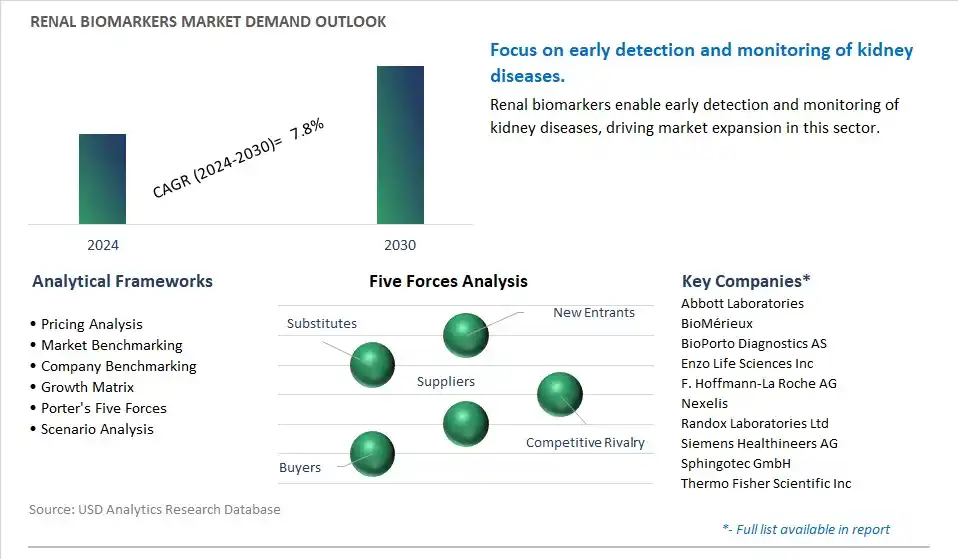
Renal Biomarkers Market is estimated to increase at a growth rate of 7.8% CAGR over the forecast period from 2024 to 2030.
The global Renal Biomarkers Market Study analyzes and forecasts the market size across 6 regions and 24 countries for diverse segments including By Biomarker Type (Functional Biomarker , Up-regulated Protein , Others), By Diagnostic Technique (Enzyme-linked Immunosorbent Assay, Particle-enhanced Turbidimetric Immunoassay (PETIA), Colorimetric Assay, Chemiluminescent Enzyme Immunoassay (CLIA), Liquid Chromatography Mass Spectrometry (LS-MS)), By End-User (Hospitals, Diagnostic Laboratories, Others).
An Introduction to Renal Biomarkers Market in 2024
Renal biomarkers are molecular indicators used to assess kidney function, detect renal injuries, and monitor kidney diseases' progression and response to treatment. The Renal Biomarkers Market includes a range of biomarker assays, immunoassays, and point-of-care tests for measuring biomarker levels in blood, urine, and other biological fluids. Key renal biomarkers include serum creatinine, cystatin C, urinary albumin, kidney injury molecule-1 (KIM-1), and neutrophil gelatinase-associated lipocalin (NGAL). Market trends focus on the development of non-invasive biomarker panels, early detection algorithms, and personalized medicine approaches for renal disease management and therapeutic interventions.
Renal Biomarkers Market Competitive Landscape
The global Renal Biomarkers Industry is highly competitive with a large number of companies focusing on niche market segments. Amidst intense competitive conditions, Renal Biomarkers Companies are investing in new product launches and strengthening distribution channels. Key companies operating in the Renal Biomarkers Industry include- Abbott Laboratories, BioMérieux, BioPorto Diagnostics AS, Enzo Life Sciences Inc, F. Hoffmann-La Roche AG, Nexelis, Randox Laboratories Ltd, Siemens Healthineers AG, Sphingotec GmbH, Thermo Fisher Scientific Inc.
renal biomarkers Market Trend: Increasing Emphasis on Early Detection and Personalized Medicine
A significant trend in the market for renal biomarkers is the increasing emphasis on early detection and personalized medicine. Renal biomarkers play a crucial role in the early identification, prognosis, and monitoring of kidney diseases, offering valuable insights into renal function, injury, and pathology. With a growing prevalence of chronic kidney disease (CKD) and acute kidney injury (AKI) worldwide, there's a heightened focus on proactive screening, risk stratification, and targeted interventions to prevent kidney damage and preserve renal function. Renal biomarkers enable healthcare providers to detect kidney dysfunction at an early stage, tailor treatment strategies based on individual patient characteristics, and optimize patient outcomes through personalized medicine approaches. This trend towards early detection and personalized medicine underscores the importance of incorporating renal biomarkers into clinical practice guidelines, diagnostic algorithms, and treatment algorithms for kidney diseases.
renal biomarkers Market Driver: Rising Burden of Chronic Kidney Disease and Acute Kidney Injury
The market for renal biomarkers is driven by the rising burden of chronic kidney disease (CKD) and acute kidney injury (AKI) globally. CKD and AKI are significant public health challenges associated with increased morbidity, mortality, and healthcare costs. Factors contributing to the rising prevalence of kidney diseases include aging populations, growing rates of diabetes and hypertension, lifestyle factors such as obesity and smoking, and environmental exposures to nephrotoxic agents. Renal biomarkers offer valuable tools for risk stratification, disease monitoring, and therapeutic decision-making in patients with CKD and AKI, enabling timely interventions to slow disease progression, prevent complications, and improve patient outcomes. As healthcare systems face mounting pressure to address the growing burden of kidney diseases, there's a growing demand for reliable and accurate renal biomarkers that can inform clinical decision-making, guide treatment selection, and monitor disease progression in patients with CKD and AKI.
renal biomarkers Market Opportunity: Development of Point-of-Care Renal Biomarker Assays
A promising opportunity in the market for renal biomarkers lies in the development of point-of-care (POC) renal biomarker assays for rapid, on-site testing in clinical settings. Traditional laboratory-based assays for renal biomarkers often involve time-consuming sample processing, specialized equipment, and skilled personnel, limiting their utility in point-of-care settings such as emergency departments, intensive care units, and primary care clinics. By investing in the development of POC renal biomarker assays that offer rapid turnaround times, minimal sample volumes, and user-friendly interfaces, diagnostic companies can address the unmet need for timely renal function assessment, AKI detection, and CKD management at the point of care. POC renal biomarker assays enable early intervention, facilitate prompt clinical decision-making, and improve patient outcomes by providing actionable information to healthcare providers in real time. Additionally, integrating POC renal biomarker testing into existing clinical workflows and electronic health record systems enhances care coordination, streamlines diagnostic pathways, and optimizes resource utilization in healthcare settings. Investing in the development and commercialization of POC renal biomarker assays presents a strategic opportunity for diagnostic companies to expand their product portfolios, differentiate themselves in the market, and meet the evolving needs of healthcare providers and patients in the diagnosis and management of kidney diseases.
Renal Biomarkers Market Share Analysis: Up-regulated Protein Biomarkers is the fastest growing market segment over the forecast period to 2030
Among the categories of renal biomarkers, the up-regulated protein biomarkers are experiencing the fastest growth. These biomarkers, including Neutrophil Gelatinase-Associated Lipocalin (NGAL), Kidney Injury Molecule-1 (KIM-1), Interleukin-18, and others, play a crucial role in identifying renal injury and dysfunction. The increasing prevalence of chronic kidney diseases (CKD) and the growing demand for early and accurate diagnostic tools are driving the adoption of up-regulated protein biomarkers in renal diagnostics. These biomarkers exhibit elevated levels in response to kidney injury, inflammation, or dysfunction, making them valuable indicators for assessing renal health and disease progression. Additionally, advancements in diagnostic techniques, such as Enzyme-linked Immunosorbent Assay (ELISA), Particle-enhanced Turbidimetric Immunoassay (PETIA), and Liquid Chromatography Mass Spectrometry (LS-MS), enhance the sensitivity and specificity of detecting up-regulated protein biomarkers in biological samples. As a result, healthcare facilities, including hospitals and diagnostic laboratories, are increasingly incorporating these biomarkers into their diagnostic protocols to improve patient outcomes and management of renal conditions. Consequently, the market for up-regulated protein biomarkers in renal diagnostics is expected to witness significant growth in the coming years.
Renal Biomarkers Market Segmentation
By Biomarker Type
Functional Biomarker
-Serum Creatinine
-Serum Cystatin C
-Urine Albumin
Up-regulated Protein
-Neutrophil Gelatinase-Associated Lipocalin (NGAL)
-Kidney Injury Molecule-1
-Interleukin-18
Others
By Diagnostic Technique
Enzyme-linked Immunosorbent Assay
Particle-enhanced Turbidimetric Immunoassay (PETIA)
Colorimetric Assay
Chemiluminescent Enzyme Immunoassay (CLIA)
Liquid Chromatography Mass Spectrometry (LS-MS)
By End-User
Hospitals
Diagnostic Laboratories
Others
Geographical Analysis
North America (United States, Canada, Mexico)
Europe (Germany, France, United Kingdom, Spain, Italy, Rest of Europe)
Asia Pacific (China, India, Japan, South Korea, Rest of Asia Pacific)
South America (Brazil, Argentina, Rest of South America)
Middle East and Africa (Saudi Arabia, UAE, Rest of Middle East, South Africa, Egypt, Rest of Africa)
Renal Biomarkers Companies
Abbott Laboratories
BioMérieux
BioPorto Diagnostics AS
Enzo Life Sciences Inc
F. Hoffmann-La Roche AG
Nexelis
Randox Laboratories Ltd
Siemens Healthineers AG
Sphingotec GmbH
Thermo Fisher Scientific Inc
* List not Exhaustive
Reasons to Buy the Renal Biomarkers Market Study
• Deepen your industry insights and navigate uncertainties for strategy formulation, CAPEX, and Operational decisions
• Gain access to detailed insights on the Renal Biomarkers Market, encompassing current market size, growth trends, and forecasts till 2030.
• Access detailed competitor analysis, enabling competitive advantage through a thorough understanding of market players, strategies, and potential differentiation opportunities
• Stay ahead of the curve with insights on technological advancements, innovations, and upcoming trends
• Identify lucrative investment avenues and expansion opportunities within the Renal Biomarkers Industry, guided by robust, data-backed analysis.
• Understand regional and global markets through country-wise analysis, regional market potential, regulatory nuances, and dynamics
• Execute strategies with confidence and speed through information, analytics, and insights on the industry value chain
• Corporate leaders, strategists, financial experts, shareholders, asset managers, and governmental representatives can make long-term planning scenarios and build an integrated and timely understanding of market dynamics
• Benefit from tailored solutions and expert consultation based on report insights, providing personalized strategies aligned with specific business needs.
TABLE OF CONTENTS
1 Introduction to 2024 Renal Biomarkers Market
1.1 Market Overview
1.2 Quick Facts
1.3 Scope/Objective of the Study
1.4 Market Definition
1.5 Countries and Regions Analyzed
1.6 Units, Currency, and Conversions
1.7 Industry Value Chain
2 Research Methodology
2.1 Market Size Estimation
2.2 Sources and Research Methodology
2.3 Data Triangulation
2.4 Assumptions and Limitations
3 Executive Summary
3.1 Global Renal Biomarkers Market Size Outlook, $ Million, 2021 to 2030
3.2 Renal Biomarkers Market Outlook by Type, $ Million, 2021 to 2030
3.3 Renal Biomarkers Market Outlook by Product, $ Million, 2021 to 2030
3.4 Renal Biomarkers Market Outlook by Application, $ Million, 2021 to 2030
3.5 Renal Biomarkers Market Outlook by Key Countries, $ Million, 2021 to 2030
4 Market Dynamics
4.1 Key Driving Forces of Renal Biomarkers Industry
4.2 Key Market Trends in Renal Biomarkers Industry
4.3 Potential Opportunities in Renal Biomarkers Industry
4.4 Key Challenges in Renal Biomarkers Industry
5 Market Factor Analysis
5.1 Value Chain Analysis
5.2 Competitive Landscape
5.2.1 Global Renal Biomarkers Market Share by Company (%), 2023
5.2.2 Product Offerings by Company
5.3 Porter’s Five Forces Analysis
5.4 Pricing Analysis and Outlook
6 Growth Outlook Across Scenarios
6.1 Growth Analysis-Case Scenario Definitions
6.2 Low Growth Scenario Forecasts
6.3 Reference Growth Scenario Forecasts
6.4 High Growth Scenario Forecasts
7 Global Renal Biomarkers Market Outlook by Segments
7.1 Renal Biomarkers Market Outlook by Segments, $ Million, 2021- 2030
By Biomarker Type
Functional Biomarker
-Serum Creatinine
-Serum Cystatin C
-Urine Albumin
Up-regulated Protein
-Neutrophil Gelatinase-Associated Lipocalin (NGAL)
-Kidney Injury Molecule-1
-Interleukin-18
Others
By Diagnostic Technique
Enzyme-linked Immunosorbent Assay
Particle-enhanced Turbidimetric Immunoassay (PETIA)
Colorimetric Assay
Chemiluminescent Enzyme Immunoassay (CLIA)
Liquid Chromatography Mass Spectrometry (LS-MS)
By End-User
Hospitals
Diagnostic Laboratories
Others
8 North America Renal Biomarkers Market Analysis and Outlook To 2030
8.1 Introduction to North America Renal Biomarkers Markets in 2024
8.2 North America Renal Biomarkers Market Size Outlook by Country, 2021-2030
8.2.1 United States
8.2.2 Canada
8.2.3 Mexico
8.3 North America Renal Biomarkers Market size Outlook by Segments, 2021-2030
By Biomarker Type
Functional Biomarker
-Serum Creatinine
-Serum Cystatin C
-Urine Albumin
Up-regulated Protein
-Neutrophil Gelatinase-Associated Lipocalin (NGAL)
-Kidney Injury Molecule-1
-Interleukin-18
Others
By Diagnostic Technique
Enzyme-linked Immunosorbent Assay
Particle-enhanced Turbidimetric Immunoassay (PETIA)
Colorimetric Assay
Chemiluminescent Enzyme Immunoassay (CLIA)
Liquid Chromatography Mass Spectrometry (LS-MS)
By End-User
Hospitals
Diagnostic Laboratories
Others
9 Europe Renal Biomarkers Market Analysis and Outlook To 2030
9.1 Introduction to Europe Renal Biomarkers Markets in 2024
9.2 Europe Renal Biomarkers Market Size Outlook by Country, 2021-2030
9.2.1 Germany
9.2.2 France
9.2.3 Spain
9.2.4 United Kingdom
9.2.4 Italy
9.2.5 Russia
9.2.6 Norway
9.2.7 Rest of Europe
9.3 Europe Renal Biomarkers Market Size Outlook by Segments, 2021-2030
By Biomarker Type
Functional Biomarker
-Serum Creatinine
-Serum Cystatin C
-Urine Albumin
Up-regulated Protein
-Neutrophil Gelatinase-Associated Lipocalin (NGAL)
-Kidney Injury Molecule-1
-Interleukin-18
Others
By Diagnostic Technique
Enzyme-linked Immunosorbent Assay
Particle-enhanced Turbidimetric Immunoassay (PETIA)
Colorimetric Assay
Chemiluminescent Enzyme Immunoassay (CLIA)
Liquid Chromatography Mass Spectrometry (LS-MS)
By End-User
Hospitals
Diagnostic Laboratories
Others
10 Asia Pacific Renal Biomarkers Market Analysis and Outlook To 2030
10.1 Introduction to Asia Pacific Renal Biomarkers Markets in 2024
10.2 Asia Pacific Renal Biomarkers Market Size Outlook by Country, 2021-2030
10.2.1 China
10.2.2 India
10.2.3 Japan
10.2.4 South Korea
10.2.5 Indonesia
10.2.6 Malaysia
10.2.7 Australia
10.2.8 Rest of Asia Pacific
10.3 Asia Pacific Renal Biomarkers Market size Outlook by Segments, 2021-2030
By Biomarker Type
Functional Biomarker
-Serum Creatinine
-Serum Cystatin C
-Urine Albumin
Up-regulated Protein
-Neutrophil Gelatinase-Associated Lipocalin (NGAL)
-Kidney Injury Molecule-1
-Interleukin-18
Others
By Diagnostic Technique
Enzyme-linked Immunosorbent Assay
Particle-enhanced Turbidimetric Immunoassay (PETIA)
Colorimetric Assay
Chemiluminescent Enzyme Immunoassay (CLIA)
Liquid Chromatography Mass Spectrometry (LS-MS)
By End-User
Hospitals
Diagnostic Laboratories
Others
11 South America Renal Biomarkers Market Analysis and Outlook To 2030
11.1 Introduction to South America Renal Biomarkers Markets in 2024
11.2 South America Renal Biomarkers Market Size Outlook by Country, 2021-2030
11.2.1 Brazil
11.2.2 Argentina
11.2.3 Rest of South America
11.3 South America Renal Biomarkers Market size Outlook by Segments, 2021-2030
By Biomarker Type
Functional Biomarker
-Serum Creatinine
-Serum Cystatin C
-Urine Albumin
Up-regulated Protein
-Neutrophil Gelatinase-Associated Lipocalin (NGAL)
-Kidney Injury Molecule-1
-Interleukin-18
Others
By Diagnostic Technique
Enzyme-linked Immunosorbent Assay
Particle-enhanced Turbidimetric Immunoassay (PETIA)
Colorimetric Assay
Chemiluminescent Enzyme Immunoassay (CLIA)
Liquid Chromatography Mass Spectrometry (LS-MS)
By End-User
Hospitals
Diagnostic Laboratories
Others
12 Middle East and Africa Renal Biomarkers Market Analysis and Outlook To 2030
12.1 Introduction to Middle East and Africa Renal Biomarkers Markets in 2024
12.2 Middle East and Africa Renal Biomarkers Market Size Outlook by Country, 2021-2030
12.2.1 Saudi Arabia
12.2.2 UAE
12.2.3 Oman
12.2.4 Rest of Middle East
12.2.5 Egypt
12.2.6 Nigeria
12.2.7 South Africa
12.2.8 Rest of Africa
12.3 Middle East and Africa Renal Biomarkers Market size Outlook by Segments, 2021-2030
By Biomarker Type
Functional Biomarker
-Serum Creatinine
-Serum Cystatin C
-Urine Albumin
Up-regulated Protein
-Neutrophil Gelatinase-Associated Lipocalin (NGAL)
-Kidney Injury Molecule-1
-Interleukin-18
Others
By Diagnostic Technique
Enzyme-linked Immunosorbent Assay
Particle-enhanced Turbidimetric Immunoassay (PETIA)
Colorimetric Assay
Chemiluminescent Enzyme Immunoassay (CLIA)
Liquid Chromatography Mass Spectrometry (LS-MS)
By End-User
Hospitals
Diagnostic Laboratories
Others
13 Company Profiles
13.1 Company Snapshot
13.2 SWOT Profiles
13.3 Products and Services
13.4 Recent Developments
13.5 Financial Profile
List of Companies
Abbott Laboratories
BioMérieux
BioPorto Diagnostics AS
Enzo Life Sciences Inc
F. Hoffmann-La Roche AG
Nexelis
Randox Laboratories Ltd
Siemens Healthineers AG
Sphingotec GmbH
Thermo Fisher Scientific Inc
14 Appendix
14.1 Customization Offerings
14.2 Subscription Services
14.3 Related Reports
14.4 Publisher Expertise
