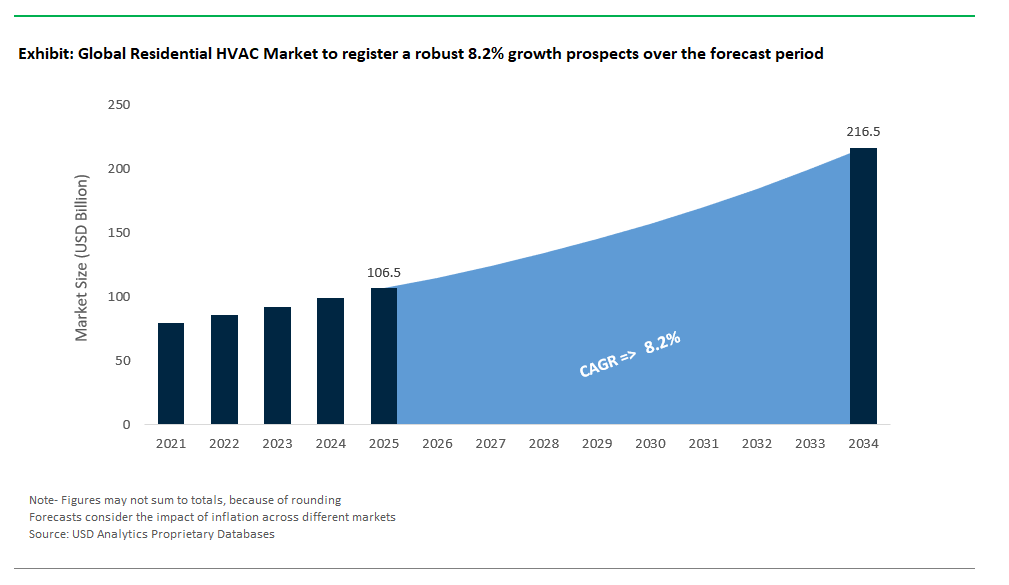
The Global Residential HVAC Market Size is estimated at $106.5 Billion in 2025 and is forecast to register an annual growth rate (CAGR) of 8.2% to reach $216.4 Billion by 2034.
The global Residential HVAC Market Study analyzes and forecasts the market size across 6 regions and 24 countries for diverse segments -By Type (HVAC equipment, HVAC services), By Product (Air conditioning system, Heating system, Ventilating system), By AC Type (Single splits/ multi splits, VRF, Air Handling Units, Others), By Heating system Type (Boilers/radiators/Furnaces, Heat Pumps).
An Introduction to Residential HVAC Market in 2025
The Residential HVAC Market is expected to experience robust growth in 2025, driven by increasing demand for energy-efficient and smart climate control solutions. Rising urbanization, coupled with growing consumer awareness of indoor air quality, is fueling market expansion. Innovations such as IoT-enabled HVAC systems and eco-friendly refrigerants are gaining traction, particularly in regions with extreme climatic conditions. Government initiatives promoting energy efficiency and sustainability are also encouraging homeowners to upgrade existing systems. However, high installation costs and the need for regular maintenance could limit adoption in cost-sensitive markets.
Residential HVAC Competitive Landscape
The market report analyses the leading companies in the industry including Carrier Global Corp, Daikin Industries Ltd, Danfoss AS, Electrolux group, Fujitsu Ltd, Gree Electric Appliances Inc of Zhuhai, Haier Smart Home Co. Ltd, Honeywell International Inc, Johnson Controls International Plc, Lennox International Inc, LG Corp, MIDEA Group Co. Ltd, National HVAC Service, Paloma Co. Ltd, Panasonic Holdings Corp, Samsung Electronics Co. Ltd, Systemair AB, Toshiba Corp, Trane Technologies Plc, Whirlpool Corp, and others.
Residential HVAC Market Dynamics
Residential HVAC Market Trend: Increased Focus on Energy Efficiency and Sustainability
A significant trend in the Residential HVAC Market is the increasing focus on energy-efficient systems and sustainable solutions. With growing concerns about climate change, homeowners and builders are more inclined towards HVAC systems that are not only energy-efficient but also environmentally friendly. As energy prices continue to rise and stricter regulations regarding emissions and energy usage are implemented, residential HVAC systems with advanced energy-saving technologies, such as variable refrigerant flow (VRF) systems, smart thermostats, and energy recovery ventilators, are gaining popularity. This trend is encouraging HVAC manufacturers to innovate and offer products that provide reduced energy consumption and lower environmental impact, thereby catering to the global demand for greener, more cost-effective home solutions.
Residential HVAC Market Driver: Rising Demand for Home Comfort and Indoor Air Quality
The primary driver behind the growth of the Residential HVAC Market is the increasing demand for enhanced home comfort and indoor air quality (IAQ). As households prioritize their health and well-being, particularly in the wake of the COVID-19 pandemic, the need for systems that ensure clean, comfortable living environments has escalated. Homeowners are increasingly aware of the role that proper HVAC systems play in maintaining optimal temperature, humidity, and air quality, driving the demand for advanced systems with better filtration and humidity control features. The desire for consistent and reliable heating and cooling, coupled with the need to mitigate airborne allergens and pollutants, is fueling the expansion of the residential HVAC market.
Residential HVAC Market Opportunity: Integration of Smart Home Technologies
A major opportunity in the Residential HVAC Market is the integration of smart home technologies into HVAC systems. With the growing adoption of IoT-enabled devices and the increasing preference for automated, voice-controlled home systems, HVAC systems equipped with smart technology offer homeowners more convenience, energy control, and monitoring capabilities. Features such as remote control via smartphones, predictive maintenance, and adaptive energy management present opportunities for manufacturers to capitalize on the connected home trend. This integration is expected to drive consumer interest in HVAC systems that not only provide comfort but also offer data-driven insights into energy usage and system performance, thereby increasing operational efficiency and reducing costs.
Residential HVAC Market Share Analysis: Air Conditioning System is expected to generate the highest revenue in 2025.
The air conditioning system segment holds the largest share in the residential HVAC market due to the increasing demand for indoor comfort and climate control, especially in regions with hot and humid climates. Air conditioning systems are essential for maintaining a comfortable living environment, particularly during the summer months, driving their widespread adoption. With rising temperatures and urbanization, more households are seeking efficient cooling solutions for their homes. Additionally, the growing awareness of energy-efficient and environmentally friendly air conditioning systems, such as those with inverter technology, further propels the growth of this segment. As a result, air conditioning systems dominate the residential HVAC market in terms of both volume and value.
Residential HVAC Market Share Analysis: HVAC Services is poised to register the fastest growth rate (CAGR) over the forecast period from 2025 to 2034.
The HVAC services segment is the Fastest growing in the residential HVAC market over the forecast period to 2034. This growth is primarily driven by the increasing need for maintenance, repair, and system upgrades as HVAC systems become more complex and technologically advanced. With the rise in the installation of energy-efficient systems, homeowners are seeking professional services for regular maintenance to ensure optimal performance, longevity, and energy savings. Additionally, the demand for smart home HVAC solutions and the growing trend of home automation is pushing the need for specialized services related to installation and system integration. As homeowners prioritize comfort and energy efficiency, the HVAC services market is expanding rapidly.
Residential HVAC Market Report Scope
|
Parameter
|
Details
|
|
Market Size (2025)
|
106.5 Billion
|
|
Market Size (2034)
|
216.4 Billion
|
|
Market Growth Rate
|
8.2%
|
|
Segments
|
By Type (HVAC equipment, HVAC services), By Product (Air conditioning system, Heating system, Ventilating system), By AC Type (Single splits/ multi splits, VRF, Air Handling Units, Others), By Heating system Type (Boilers/radiators/Furnaces, Heat Pumps)
|
|
Study Period
|
2019- 2024 and 2025-2034
|
|
Units
|
Revenue (USD)
|
|
Qualitative Analysis
|
Porter’s Five Forces, SWOT Profile, Market Share, Scenario Forecasts, Market Ecosystem, Company Ranking, Market Dynamics, Industry Benchmarking
|
|
Companies
|
Carrier Global Corp, Daikin Industries Ltd, Danfoss AS, Electrolux group, Fujitsu Ltd, Gree Electric Appliances Inc of Zhuhai, Haier Smart Home Co. Ltd, Honeywell International Inc, Johnson Controls International Plc, Lennox International Inc, LG Corp, MIDEA Group Co. Ltd, National HVAC Service, Paloma Co. Ltd, Panasonic Holdings Corp, Samsung Electronics Co. Ltd, Systemair AB, Toshiba Corp, Trane Technologies Plc, Whirlpool Corp
|
|
Countries
|
US, Canada, Mexico, Germany, France, Spain, Italy, UK, Russia, China, India, Japan, South Korea, Australia, South East Asia, Brazil, Argentina, Middle East, Africa
|
Residential HVAC Market Segmentation
By Type
HVAC equipment
HVAC services
By Product
Air conditioning system
Heating system
Ventilating system
By AC Type
Single splits/ multi splits
VRF
Air Handling Units
Others
By Heating system Type
Boilers/radiators/Furnaces
Heat Pumps
Countries Analyzed
North America (US, Canada, Mexico)
Europe (Germany, UK, France, Spain, Italy, Russia, Rest of Europe)
Asia Pacific (China, India, Japan, South Korea, Australia, South East Asia, Rest of Asia)
South America (Brazil, Argentina, Rest of South America)
Middle East and Africa (Saudi Arabia, UAE, Rest of Middle East, South Africa, Egypt, Rest of Africa)
Residential HVAC Companies Profiled in the Study
Carrier Global Corp
Daikin Industries Ltd
Danfoss AS
Electrolux group
Fujitsu Ltd
Gree Electric Appliances Inc of Zhuhai
Haier Smart Home Co. Ltd
Honeywell International Inc
Johnson Controls International Plc
Lennox International Inc
LG Corp
MIDEA Group Co. Ltd
National HVAC Service
Paloma Co. Ltd
Panasonic Holdings Corp
Samsung Electronics Co. Ltd
Systemair AB
Toshiba Corp
Trane Technologies Plc
Whirlpool Corp
*- List Not Exhaustive
TABLE OF CONTENTS
1 Introduction to 2025 Residential HVAC Market
1.1 Market Overview
1.2 Quick Facts
1.3 Scope/Objective of the Study
1.4 Market Definition
1.5 Countries and Regions Covered
1.6 Units, Currency, and Conversions
1.7 Industry Value Chain
2 Research Methodology
2.1 Market Size Estimation
2.2 Sources and Research Methodology
2.3 Data Triangulation
2.4 Assumptions and Limitations
3 Executive Summary
3.1 Global Residential HVAC Market Size Outlook, $ Million, 2021 to 2034
3.2 Residential HVAC Market Outlook by Type, $ Million, 2021 to 2034
3.3 Residential HVAC Market Outlook by Product, $ Million, 2021 to 2034
3.4 Residential HVAC Market Outlook by Application, $ Million, 2021 to 2034
3.5 Residential HVAC Market Outlook by Key Countries, $ Million, 2021 to 2034
4 Market Dynamics
4.1 Key Driving Forces of Residential HVAC Industry
4.2 Key Market Trends in Residential HVAC Industry
4.3 Potential Opportunities in Residential HVAC Industry
4.4 Key Challenges in Residential HVAC Industry
5 Market Factor Analysis
5.1 Value Chain Analysis
5.2 Competitive Landscape
5.2.1 Global Residential HVAC Market Share by Company (%), 2024
5.2.2 Product Offerings by Company
5.3 Porter’s Five Forces Analysis
5.4 Pricing Analysis and Outlook
6 Growth Outlook Across Scenarios
6.1 Growth Analysis-Case Scenario Definitions
6.2 Low Growth Scenario Forecasts
6.3 Reference Growth Scenario Forecasts
6.4 High Growth Scenario Forecasts
7 Global Residential HVAC Market Outlook by Segments
7.1 Residential HVAC Market Outlook by Segments, $ Million, 2021- 2034
By Type
HVAC equipment
HVAC services
By Product
Air conditioning system
Heating system
Ventilating system
By AC Type
Single splits/ multi splits
VRF
Air Handling Units
Others
By Heating system Type
Boilers/radiators/Furnaces
Heat Pumps
8 North America Residential HVAC Market Analysis and Outlook To 2034
8.1 Introduction to North America Residential HVAC Markets in 2025
8.2 North America Residential HVAC Market Size Outlook by Country, 2021-2034
8.2.1 United States
8.2.2 Canada
8.2.3 Mexico
8.3 North America Residential HVAC Market size Outlook by Segments, 2021-2034
By Type
HVAC equipment
HVAC services
By Product
Air conditioning system
Heating system
Ventilating system
By AC Type
Single splits/ multi splits
VRF
Air Handling Units
Others
By Heating system Type
Boilers/radiators/Furnaces
Heat Pumps
9 Europe Residential HVAC Market Analysis and Outlook To 2034
9.1 Introduction to Europe Residential HVAC Markets in 2025
9.2 Europe Residential HVAC Market Size Outlook by Country, 2021-2034
9.2.1 Germany
9.2.2 France
9.2.3 Spain
9.2.4 United Kingdom
9.2.4 Italy
9.2.5 Russia
9.2.6 Norway
9.2.7 Rest of Europe
9.3 Europe Residential HVAC Market Size Outlook by Segments, 2021-2034
By Type
HVAC equipment
HVAC services
By Product
Air conditioning system
Heating system
Ventilating system
By AC Type
Single splits/ multi splits
VRF
Air Handling Units
Others
By Heating system Type
Boilers/radiators/Furnaces
Heat Pumps
10 Asia Pacific Residential HVAC Market Analysis and Outlook To 2034
10.1 Introduction to Asia Pacific Residential HVAC Markets in 2025
10.2 Asia Pacific Residential HVAC Market Size Outlook by Country, 2021-2034
10.2.1 China
10.2.2 India
10.2.3 Japan
10.2.4 South Korea
10.2.5 Indonesia
10.2.6 Malaysia
10.2.7 Australia
10.2.8 Rest of Asia Pacific
10.3 Asia Pacific Residential HVAC Market size Outlook by Segments, 2021-2034
By Type
HVAC equipment
HVAC services
By Product
Air conditioning system
Heating system
Ventilating system
By AC Type
Single splits/ multi splits
VRF
Air Handling Units
Others
By Heating system Type
Boilers/radiators/Furnaces
Heat Pumps
11 South America Residential HVAC Market Analysis and Outlook To 2034
11.1 Introduction to South America Residential HVAC Markets in 2025
11.2 South America Residential HVAC Market Size Outlook by Country, 2021-2034
11.2.1 Brazil
11.2.2 Argentina
11.2.3 Rest of South America
11.3 South America Residential HVAC Market size Outlook by Segments, 2021-2034
By Type
HVAC equipment
HVAC services
By Product
Air conditioning system
Heating system
Ventilating system
By AC Type
Single splits/ multi splits
VRF
Air Handling Units
Others
By Heating system Type
Boilers/radiators/Furnaces
Heat Pumps
12 Middle East and Africa Residential HVAC Market Analysis and Outlook To 2034
12.1 Introduction to Middle East and Africa Residential HVAC Markets in 2025
12.2 Middle East and Africa Residential HVAC Market Size Outlook by Country, 2021-2034
12.2.1 Saudi Arabia
12.2.2 UAE
12.2.3 Oman
12.2.4 Rest of Middle East
12.2.5 Egypt
12.2.6 Nigeria
12.2.7 South Africa
12.2.8 Rest of Africa
12.3 Middle East and Africa Residential HVAC Market size Outlook by Segments, 2021-2034
By Type
HVAC equipment
HVAC services
By Product
Air conditioning system
Heating system
Ventilating system
By AC Type
Single splits/ multi splits
VRF
Air Handling Units
Others
By Heating system Type
Boilers/radiators/Furnaces
Heat Pumps
13 Company Profiles
13.1 Company Snapshot
13.2 SWOT Profiles
13.3 Products and Services
13.4 Recent Developments
13.5 Financial Profile
Carrier Global Corp
Daikin Industries Ltd
Danfoss AS
Electrolux group
Fujitsu Ltd
Gree Electric Appliances Inc of Zhuhai
Haier Smart Home Co. Ltd
Honeywell International Inc
Johnson Controls International Plc
Lennox International Inc
LG Corp
MIDEA Group Co. Ltd
National HVAC Service
Paloma Co. Ltd
Panasonic Holdings Corp
Samsung Electronics Co. Ltd
Systemair AB
Toshiba Corp
Trane Technologies Plc
Whirlpool Corp
14 Appendix
14.1 Customization Offerings
14.2 Subscription Services
14.3 Related Reports
14.4 Publisher Expertise
