
The global Resource Circulation Equipment Market Study analyzes and forecasts the market size across 6 regions and 24 countries for diverse segments -By Type (Office Equipment Circulation System, Machine Part Circulation System), By Application (Automotive, Construction, Electrical and Electronics).
The future of the resource circulation equipment market is shaped by key trends such as circular economy initiatives, waste management regulations, and resource scarcity concerns. Resource circulation equipment encompasses a wide range of machinery and technologies used in recycling, waste-to-energy, and resource recovery processes to extract value from waste materials and by-products. As governments, industries, and communities increasingly embrace circular economy principles and waste reduction goals, there is a growing demand for resource circulation equipment that enables efficient and sustainable management of resources and waste streams. Moreover, waste management regulations and environmental policies drive investment in recycling infrastructure, material recovery facilities, and waste-to-energy plants to minimize landfilling, reduce pollution, and promote resource conservation. Additionally, concerns about resource scarcity and supply chain resilience spur innovation in resource recovery technologies, such as material sorting, separation, and purification systems, to recover valuable materials from complex waste streams and secondary raw materials. As industries seek to optimize resource utilization, minimize environmental impact, and meet sustainability objectives, the resource circulation equipment market will continue to innovate and expand with new technologies, solutions, and business models to facilitate the transition towards a more circular and resource-efficient economy.
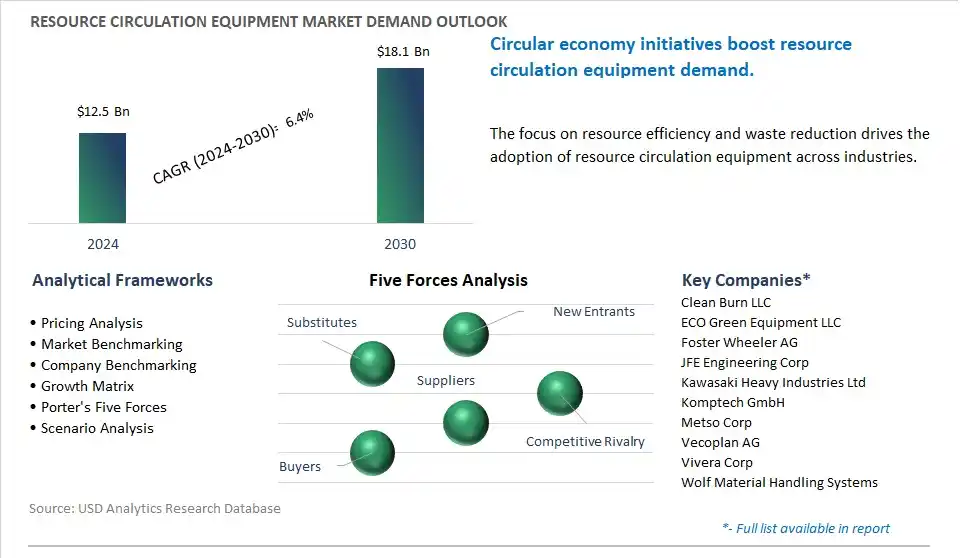
The market report analyses the leading companies in the industry including Clean Burn LLC, ECO Green Equipment LLC, Foster Wheeler AG, JFE Engineering Corp, Kawasaki Heavy Industries Ltd, Komptech GmbH, Metso Corp, Vecoplan AG, Vivera Corp, Wolf Material Handling Systems.
One prominent trend in the resource circulation equipment market is the emphasis on circular economy practices. As global awareness of environmental sustainability grows, there is increasing pressure on industries to adopt circular economy principles, which aim to minimize waste generation, maximize resource efficiency, and promote the reuse, recycling, and recovery of materials. The trend is driving the demand for resource circulation equipment, which includes various machinery and technologies for waste sorting, recycling, composting, and material recovery. Companies are investing in advanced equipment that enables them to achieve higher levels of resource recovery and diversion from landfills, aligning with regulatory mandates and corporate sustainability goals.
The primary driver fueling the demand for resource circulation equipment is government regulations and environmental policies. Governments worldwide are implementing stringent waste management regulations, landfill diversion targets, and recycling mandates to address growing concerns about waste pollution, resource depletion, and climate change. These regulations compel industries and businesses to invest in resource circulation equipment to comply with waste reduction and recycling requirements. Additionally, financial incentives, grants, and subsidies offered by governments to promote sustainable waste management practices further drive investments in resource circulation equipment. The driver is propelled by the need for companies to adhere to regulatory compliance, mitigate environmental risks, and demonstrate corporate responsibility, driving demand for equipment that enables efficient resource recovery and recycling processes.
An attractive opportunity for the resource circulation equipment market lies in the integration of digital technologies and automation. With advancements in Industry 4.0 technologies such as artificial intelligence, machine learning, Internet of Things (IoT), and robotics, there is potential to enhance the efficiency, productivity, and reliability of resource recovery and recycling processes. Equipment manufacturers aim to capitalize on this opportunity by developing smart and connected systems that enable real-time monitoring, predictive maintenance, and data-driven decision-making in waste management operations. Automation solutions such as robotic sorting systems, automated material handling equipment, and sensor-based technologies can streamline recycling operations, improve material recovery rates, and reduce labor costs. By embracing digitalization and automation, companies can offer innovative solutions that optimize resource circulation processes, increase operational efficiency, and deliver greater value to customers. This opportunity allows for technological innovation, market differentiation, and revenue growth in the dynamic and evolving landscape of resource circulation equipment.
In the resource circulation equipment market, the largest segment is the machine part circulation system, primarily. Machine part circulation systems are integral to various industries, including manufacturing, automotive, aerospace, and construction, where machinery and equipment play a critical role in production processes. These systems facilitate the efficient reuse, refurbishment, and recycling of machine parts, components, and equipment, thereby optimizing resource utilization, reducing waste generation, and lowering production costs. Additionally, machine part circulation systems enable manufacturers to extend the lifespan of machinery and equipment, enhance operational efficiency, and minimize downtime by providing timely access to replacement parts and components. Further, the increasing emphasis on sustainability, circular economy principles, and environmental regulations drive the adoption of machine part circulation systems as companies seek to minimize their environmental footprint and comply with regulatory requirements. Furthermore, advancements in technology, automation, and data analytics have improved the efficiency, reliability, and scalability of machine part circulation systems, making them indispensable for modern manufacturing operations. As industries prioritize resource efficiency, cost optimization, and sustainability, the demand for machine part circulation systems continues to grow, solidifying their position as the largest segment in the resource circulation equipment market.
Among the segments in the resource circulation equipment market, the fastest-growing segment is the electrical and electronics sector. The rapid advancement of technology and the increasing proliferation of electronic devices have led to a surge in electronic waste (e-waste) generation globally. Accordingly, there is a growing need for efficient and sustainable solutions to manage and recycle electronic waste, including components, circuit boards, batteries, and other electrical and electronic equipment. Resource circulation equipment plays a crucial role in the recycling and recovery of valuable materials from e-waste, such as precious metals, rare earth elements, and plastics, which can be reused in the manufacturing of new electronic products. Additionally, the adoption of circular economy principles and extended producer responsibility (EPR) regulations further drive the demand for resource circulation equipment in the electrical and electronics industry. Further, the increasing focus on sustainability and environmental stewardship among consumers, businesses, and governments incentivizes the adoption of recycling and resource recovery solutions in the electrical and electronics sector. Furthermore, technological innovations, such as advanced sorting and separation technologies, robotic dismantling systems, and material recovery processes, enhance the efficiency, accuracy, and scalability of resource circulation equipment in handling electronic waste streams. As the volume of electronic waste continues to grow and regulatory pressures intensify, the demand for resource circulation equipment in the electrical and electronics sector is expected to experience rapid growth, positioning it as the fastest-growing segment in the resource circulation equipment market.
By Type
Office Equipment Circulation System
Machine Part Circulation System
By Application
Automotive
Construction
Electrical and Electronics
Regions Included
North America (US, Canada, Mexico)
Europe (Germany, UK, France, Spain, Italy, Russia, Rest of Europe)
Asia Pacific (China, India, Japan, South Korea, Australia, South East Asia, Rest of Asia)
South America (Brazil, Argentina, Rest of South America)
Middle East and Africa (Saudi Arabia, UAE, Rest of Middle East, South Africa, Egypt, Rest of Africa)
Clean Burn LLC
ECO Green Equipment LLC
Foster Wheeler AG
JFE Engineering Corp
Kawasaki Heavy Industries Ltd
Komptech GmbH
Metso Corp
Vecoplan AG
Vivera Corp
Wolf Material Handling Systems
*- List Not Exhaustive
TABLE OF CONTENTS
1 Introduction to 2024 Resource Circulation Equipment Market
1.1 Market Overview
1.2 Quick Facts
1.3 Scope/Objective of the Study
1.4 Market Definition
1.5 Countries and Regions Covered
1.6 Units, Currency, and Conversions
1.7 Industry Value Chain
2 Research Methodology
2.1 Market Size Estimation
2.2 Sources and Research Methodology
2.3 Data Triangulation
2.4 Assumptions and Limitations
3 Executive Summary
3.1 Global Resource Circulation Equipment Market Size Outlook, $ Million, 2021 to 2030
3.2 Resource Circulation Equipment Market Outlook by Type, $ Million, 2021 to 2030
3.3 Resource Circulation Equipment Market Outlook by Product, $ Million, 2021 to 2030
3.4 Resource Circulation Equipment Market Outlook by Application, $ Million, 2021 to 2030
3.5 Resource Circulation Equipment Market Outlook by Key Countries, $ Million, 2021 to 2030
4 Market Dynamics
4.1 Key Driving Forces of Resource Circulation Equipment Industry
4.2 Key Market Trends in Resource Circulation Equipment Industry
4.3 Potential Opportunities in Resource Circulation Equipment Industry
4.4 Key Challenges in Resource Circulation Equipment Industry
5 Market Factor Analysis
5.1 Value Chain Analysis
5.2 Competitive Landscape
5.2.1 Global Resource Circulation Equipment Market Share by Company (%), 2023
5.2.2 Product Offerings by Company
5.3 Porter’s Five Forces Analysis
5.4 Pricing Analysis and Outlook
6 Growth Outlook Across Scenarios
6.1 Growth Analysis-Case Scenario Definitions
6.2 Low Growth Scenario Forecasts
6.3 Reference Growth Scenario Forecasts
6.4 High Growth Scenario Forecasts
7 Global Resource Circulation Equipment Market Outlook by Segments
7.1 Resource Circulation Equipment Market Outlook by Segments, $ Million, 2021- 2030
By Type
Office Equipment Circulation System
Machine Part Circulation System
By Application
Automotive
Construction
Electrical and Electronics
8 North America Resource Circulation Equipment Market Analysis and Outlook To 2030
8.1 Introduction to North America Resource Circulation Equipment Markets in 2024
8.2 North America Resource Circulation Equipment Market Size Outlook by Country, 2021-2030
8.2.1 United States
8.2.2 Canada
8.2.3 Mexico
8.3 North America Resource Circulation Equipment Market size Outlook by Segments, 2021-2030
By Type
Office Equipment Circulation System
Machine Part Circulation System
By Application
Automotive
Construction
Electrical and Electronics
9 Europe Resource Circulation Equipment Market Analysis and Outlook To 2030
9.1 Introduction to Europe Resource Circulation Equipment Markets in 2024
9.2 Europe Resource Circulation Equipment Market Size Outlook by Country, 2021-2030
9.2.1 Germany
9.2.2 France
9.2.3 Spain
9.2.4 United Kingdom
9.2.4 Italy
9.2.5 Russia
9.2.6 Norway
9.2.7 Rest of Europe
9.3 Europe Resource Circulation Equipment Market Size Outlook by Segments, 2021-2030
By Type
Office Equipment Circulation System
Machine Part Circulation System
By Application
Automotive
Construction
Electrical and Electronics
10 Asia Pacific Resource Circulation Equipment Market Analysis and Outlook To 2030
10.1 Introduction to Asia Pacific Resource Circulation Equipment Markets in 2024
10.2 Asia Pacific Resource Circulation Equipment Market Size Outlook by Country, 2021-2030
10.2.1 China
10.2.2 India
10.2.3 Japan
10.2.4 South Korea
10.2.5 Indonesia
10.2.6 Malaysia
10.2.7 Australia
10.2.8 Rest of Asia Pacific
10.3 Asia Pacific Resource Circulation Equipment Market size Outlook by Segments, 2021-2030
By Type
Office Equipment Circulation System
Machine Part Circulation System
By Application
Automotive
Construction
Electrical and Electronics
11 South America Resource Circulation Equipment Market Analysis and Outlook To 2030
11.1 Introduction to South America Resource Circulation Equipment Markets in 2024
11.2 South America Resource Circulation Equipment Market Size Outlook by Country, 2021-2030
11.2.1 Brazil
11.2.2 Argentina
11.2.3 Rest of South America
11.3 South America Resource Circulation Equipment Market size Outlook by Segments, 2021-2030
By Type
Office Equipment Circulation System
Machine Part Circulation System
By Application
Automotive
Construction
Electrical and Electronics
12 Middle East and Africa Resource Circulation Equipment Market Analysis and Outlook To 2030
12.1 Introduction to Middle East and Africa Resource Circulation Equipment Markets in 2024
12.2 Middle East and Africa Resource Circulation Equipment Market Size Outlook by Country, 2021-2030
12.2.1 Saudi Arabia
12.2.2 UAE
12.2.3 Oman
12.2.4 Rest of Middle East
12.2.5 Egypt
12.2.6 Nigeria
12.2.7 South Africa
12.2.8 Rest of Africa
12.3 Middle East and Africa Resource Circulation Equipment Market size Outlook by Segments, 2021-2030
By Type
Office Equipment Circulation System
Machine Part Circulation System
By Application
Automotive
Construction
Electrical and Electronics
13 Company Profiles
13.1 Company Snapshot
13.2 SWOT Profiles
13.3 Products and Services
13.4 Recent Developments
13.5 Financial Profile
Clean Burn LLC
ECO Green Equipment LLC
Foster Wheeler AG
JFE Engineering Corp
Kawasaki Heavy Industries Ltd
Komptech GmbH
Metso Corp
Vecoplan AG
Vivera Corp
Wolf Material Handling Systems
14 Appendix
14.1 Customization Offerings
14.2 Subscription Services
14.3 Related Reports
14.4 Publisher Expertise
By Type
Office Equipment Circulation System
Machine Part Circulation System
By Application
Automotive
Construction
Electrical and Electronics
Countries Analyzed
North America (US, Canada, Mexico)
Europe (Germany, UK, France, Spain, Italy, Russia, Rest of Europe)
Asia Pacific (China, India, Japan, South Korea, Australia, South East Asia, Rest of Asia)
South America (Brazil, Argentina, Rest of South America)
Middle East and Africa (Saudi Arabia, UAE, Rest of Middle East, South Africa, Egypt, Rest of Africa)
Global Resource Circulation Equipment is forecast to reach $18.1 Billion in 2030 from $12.5 Billion in 2024, registering a CAGR of 6.4%
Emerging Markets across Asia Pacific, Europe, and Americas present robust growth prospects.
Clean Burn LLC, ECO Green Equipment LLC, Foster Wheeler AG, JFE Engineering Corp, Kawasaki Heavy Industries Ltd, Komptech GmbH, Metso Corp, Vecoplan AG, Vivera Corp, Wolf Material Handling Systems
Base Year- 2023; Estimated Year- 2024; Historic Period- 2018-2023; Forecast period- 2024 to 2030; Currency: Revenue (USD); Volume