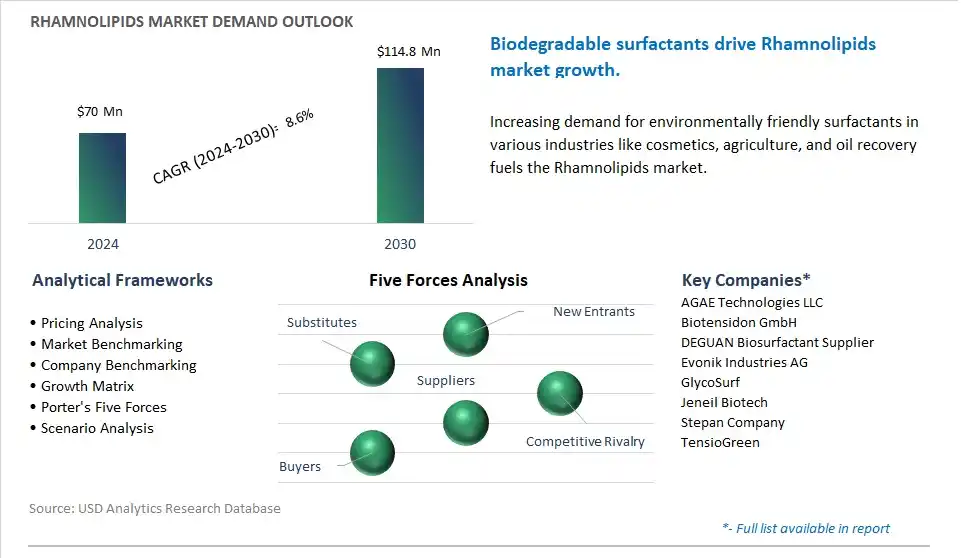
The global Rhamnolipids Market is poised to register a 8.6% CAGR from $70 Million in 2024 to $114.8 Million in 2030.
The global Rhamnolipids Market Study analyzes and forecasts the market size across 6 regions and 24 countries for diverse segments -By Type (Mono-Rhamnolipids, Di-Rhamnolipids), By Application (Surfactants, Cosmetics, Agriculture, Food, Pharmaceutical, Others).
An Introduction to Global Rhamnolipids Market in 2024
The future of the rhamnolipids market is influenced by key trends such as bioremediation, green chemistry, and sustainable manufacturing. Rhamnolipids are a class of microbial biosurfactants produced by bacteria, known for their ability to reduce surface tension and enhance the biodegradation of hydrophobic compounds. As industries and governments increasingly focus on environmental sustainability and pollution mitigation, there is a growing interest in rhamnolipids as eco-friendly alternatives to synthetic surfactants in various applications such as environmental remediation, agriculture, personal care, and industrial cleaning. Moreover, advancements in biotechnological processes, fermentation techniques, and microbial strain engineering enable the scalable production of rhamnolipids from renewable feedstocks, reducing reliance on petrochemical-derived surfactants and minimizing environmental impact. Additionally, regulatory initiatives promoting green chemistry, sustainable procurement, and bio-based products drive the adoption of rhamnolipids in industries such as oil and gas, agriculture, and cosmetics, where their biodegradability, low toxicity, and versatility offer advantages over traditional surfactants. As industries seek sustainable solutions for cleaning, soil remediation, and product formulation, the rhamnolipids market will continue to innovate and expand with new applications, formulations, and market-driven solutions to address environmental challenges and promote a more sustainable approach to surfactant usage.
Rhamnolipids Market Competitive Landscape
The market report analyses the leading companies in the industry including AGAE Technologies LLC, Biotensidon GmbH, DEGUAN Biosurfactant Supplier, Evonik Industries AG, GlycoSurf, Jeneil Biotech, Stepan Company, TensioGreen.
Rhamnolipids Market Dynamics
Rhamnolipids Market Trend: Increasing Demand for Bio-based Surfactants
One prominent trend in the rhamnolipids market is the increasing demand for bio-based surfactants. As concerns over environmental sustainability and the harmful effects of synthetic chemicals grow, there is a rising preference for bio-based alternatives in various industries, including personal care, agriculture, and oil recovery. Rhamnolipids, derived from microbial fermentation, are gaining traction as eco-friendly surfactants due to their biodegradability, low toxicity, and effectiveness in a wide range of applications. This is driven by regulatory initiatives promoting the use of renewable and sustainable materials, as well as consumer demand for safer and more environmentally friendly products.
Rhamnolipids Market Driver: Growing Applications in Diverse Industries
The primary driver fueling the demand for rhamnolipids is their growing applications in diverse industries. Rhamnolipids exhibit excellent surfactant properties, including foaming, wetting, emulsifying, and dispersing, making them versatile ingredients in various applications. In the personal care industry, they are used in formulations of shampoos, soaps, and cosmetics for their mildness and skin-friendly properties. In agriculture, rhamnolipids serve as biopesticides, biofertilizers, and soil remediation agents due to their ability to enhance soil structure and promote plant growth. Additionally, in the oil and gas industry, they are utilized as bioremediation agents and enhanced oil recovery additives. The driver is propelled by the need for sustainable solutions, technological advancements, and the expanding scope of applications for rhamnolipids across different sectors.
Rhamnolipids Market Opportunity: Development of Novel Formulations and Applications
An attractive opportunity for the rhamnolipids market lies in the development of novel formulations and applications. Manufacturers can capitalize on the unique properties of rhamnolipids to create innovative products tailored to specific industry needs and challenges. This includes exploring new applications in areas such as pharmaceuticals, food processing, and wastewater treatment, where the demand for sustainable and effective surfactants is growing. Furthermore, there is an opportunity to develop specialized formulations of rhamnolipids with enhanced properties, such as improved stability, higher purity, and targeted functionality, to meet the evolving requirements of different applications. By investing in research and development and collaborating with industry partners, manufacturers can unlock new opportunities, expand their market presence, and drive growth in the rhamnolipids market. This opportunity allows for differentiation, market expansion, and the creation of value-added solutions that address emerging needs and trends in various industries.
Rhamnolipids Market Share Analysis: Di-Rhamnolipids generated the highest revenue in 2024
The largest segment in the rhamnolipids market is di-rhamnolipids, primarily due to their higher production volume and broader range of applications compared to mono-rhamnolipids. Di-rhamnolipids are a type of biosurfactant composed of two rhamnose sugar molecules attached to a lipid tail. This molecular structure gives di-rhamnolipids superior surface-active properties, making them highly effective at reducing surface tension and forming stable emulsions. Accordingly, di-rhamnolipids find widespread use in various industries, including bioremediation, agriculture, cosmetics, pharmaceuticals, and oil recovery. They are particularly valued for their ability to enhance the solubility and bioavailability of hydrophobic compounds, making them valuable additives in formulations for soil remediation, crop protection, personal care products, and drug delivery systems. Additionally, di-rhamnolipids exhibit excellent biodegradability and low toxicity, making them environmentally friendly alternatives to synthetic surfactants in numerous applications. Over the forecast period, the versatility, effectiveness, and environmentally benign nature of di-rhamnolipids contribute to their dominance as the largest segment in the rhamnolipids market.
Rhamnolipids Market Share Analysis: Agriculture segment is poised to register the fastest growth rate (CAGR) over the forecast period to 2030
The agriculture segment is the fastest-growing in the rhamnolipids market. Rhamnolipids have gained significant traction in agriculture due to their multifunctional properties and their potential to address various challenges faced by the industry. rhamnolipids exhibit powerful surfactant properties, which enable them to reduce the surface tension of water and improve soil wetting and penetration. This, in turn, enhances the efficiency of irrigation and the uptake of water and nutrients by plants, leading to improved crop yields and quality. Additionally, rhamnolipids possess biopesticidal properties, making them effective against a broad spectrum of plant pathogens, including fungi, bacteria, and nematodes. As sustainable alternatives to synthetic pesticides, rhamnolipids offer farmers a safer and more environmentally friendly means of crop protection while reducing reliance on chemical inputs. Furthermore, rhamnolipids have been shown to stimulate plant growth and enhance stress tolerance in crops, helping plants withstand adverse environmental conditions such as drought, salinity, and temperature extremes. These beneficial effects on plant health and productivity make rhamnolipids increasingly valuable tools for modern agriculture, driving their rapid adoption and fueling the growth of the agriculture segment in the rhamnolipids market.
Rhamnolipids Market Report Segmentation
By Type
Mono-Rhamnolipids
Di-Rhamnolipids
By Application
Surfactants
Cosmetics
Agriculture
Food
Pharmaceutical
Others
Regions Included
North America (US, Canada, Mexico)
Europe (Germany, UK, France, Spain, Italy, Russia, Rest of Europe)
Asia Pacific (China, India, Japan, South Korea, Australia, South East Asia, Rest of Asia)
South America (Brazil, Argentina, Rest of South America)
Middle East and Africa (Saudi Arabia, UAE, Rest of Middle East, South Africa, Egypt, Rest of Africa)
Rhamnolipids Companies Profiled in the Market Study
AGAE Technologies LLC
Biotensidon GmbH
DEGUAN Biosurfactant Supplier
Evonik Industries AG
GlycoSurf
Jeneil Biotech
Stepan Company
TensioGreen
*- List Not Exhaustive
TABLE OF CONTENTS
1 Introduction to 2024 Rhamnolipids Market
1.1 Market Overview
1.2 Quick Facts
1.3 Scope/Objective of the Study
1.4 Market Definition
1.5 Countries and Regions Covered
1.6 Units, Currency, and Conversions
1.7 Industry Value Chain
2 Research Methodology
2.1 Market Size Estimation
2.2 Sources and Research Methodology
2.3 Data Triangulation
2.4 Assumptions and Limitations
3 Executive Summary
3.1 Global Rhamnolipids Market Size Outlook, $ Million, 2021 to 2030
3.2 Rhamnolipids Market Outlook by Type, $ Million, 2021 to 2030
3.3 Rhamnolipids Market Outlook by Product, $ Million, 2021 to 2030
3.4 Rhamnolipids Market Outlook by Application, $ Million, 2021 to 2030
3.5 Rhamnolipids Market Outlook by Key Countries, $ Million, 2021 to 2030
4 Market Dynamics
4.1 Key Driving Forces of Rhamnolipids Industry
4.2 Key Market Trends in Rhamnolipids Industry
4.3 Potential Opportunities in Rhamnolipids Industry
4.4 Key Challenges in Rhamnolipids Industry
5 Market Factor Analysis
5.1 Value Chain Analysis
5.2 Competitive Landscape
5.2.1 Global Rhamnolipids Market Share by Company (%), 2023
5.2.2 Product Offerings by Company
5.3 Porter’s Five Forces Analysis
5.4 Pricing Analysis and Outlook
6 Growth Outlook Across Scenarios
6.1 Growth Analysis-Case Scenario Definitions
6.2 Low Growth Scenario Forecasts
6.3 Reference Growth Scenario Forecasts
6.4 High Growth Scenario Forecasts
7 Global Rhamnolipids Market Outlook by Segments
7.1 Rhamnolipids Market Outlook by Segments, $ Million, 2021- 2030
By Type
Mono-Rhamnolipids
Di-Rhamnolipids
By Application
Surfactants
Cosmetics
Agriculture
Food
Pharmaceutical
Others
8 North America Rhamnolipids Market Analysis and Outlook To 2030
8.1 Introduction to North America Rhamnolipids Markets in 2024
8.2 North America Rhamnolipids Market Size Outlook by Country, 2021-2030
8.2.1 United States
8.2.2 Canada
8.2.3 Mexico
8.3 North America Rhamnolipids Market size Outlook by Segments, 2021-2030
By Type
Mono-Rhamnolipids
Di-Rhamnolipids
By Application
Surfactants
Cosmetics
Agriculture
Food
Pharmaceutical
Others
9 Europe Rhamnolipids Market Analysis and Outlook To 2030
9.1 Introduction to Europe Rhamnolipids Markets in 2024
9.2 Europe Rhamnolipids Market Size Outlook by Country, 2021-2030
9.2.1 Germany
9.2.2 France
9.2.3 Spain
9.2.4 United Kingdom
9.2.4 Italy
9.2.5 Russia
9.2.6 Norway
9.2.7 Rest of Europe
9.3 Europe Rhamnolipids Market Size Outlook by Segments, 2021-2030
By Type
Mono-Rhamnolipids
Di-Rhamnolipids
By Application
Surfactants
Cosmetics
Agriculture
Food
Pharmaceutical
Others
10 Asia Pacific Rhamnolipids Market Analysis and Outlook To 2030
10.1 Introduction to Asia Pacific Rhamnolipids Markets in 2024
10.2 Asia Pacific Rhamnolipids Market Size Outlook by Country, 2021-2030
10.2.1 China
10.2.2 India
10.2.3 Japan
10.2.4 South Korea
10.2.5 Indonesia
10.2.6 Malaysia
10.2.7 Australia
10.2.8 Rest of Asia Pacific
10.3 Asia Pacific Rhamnolipids Market size Outlook by Segments, 2021-2030
By Type
Mono-Rhamnolipids
Di-Rhamnolipids
By Application
Surfactants
Cosmetics
Agriculture
Food
Pharmaceutical
Others
11 South America Rhamnolipids Market Analysis and Outlook To 2030
11.1 Introduction to South America Rhamnolipids Markets in 2024
11.2 South America Rhamnolipids Market Size Outlook by Country, 2021-2030
11.2.1 Brazil
11.2.2 Argentina
11.2.3 Rest of South America
11.3 South America Rhamnolipids Market size Outlook by Segments, 2021-2030
By Type
Mono-Rhamnolipids
Di-Rhamnolipids
By Application
Surfactants
Cosmetics
Agriculture
Food
Pharmaceutical
Others
12 Middle East and Africa Rhamnolipids Market Analysis and Outlook To 2030
12.1 Introduction to Middle East and Africa Rhamnolipids Markets in 2024
12.2 Middle East and Africa Rhamnolipids Market Size Outlook by Country, 2021-2030
12.2.1 Saudi Arabia
12.2.2 UAE
12.2.3 Oman
12.2.4 Rest of Middle East
12.2.5 Egypt
12.2.6 Nigeria
12.2.7 South Africa
12.2.8 Rest of Africa
12.3 Middle East and Africa Rhamnolipids Market size Outlook by Segments, 2021-2030
By Type
Mono-Rhamnolipids
Di-Rhamnolipids
By Application
Surfactants
Cosmetics
Agriculture
Food
Pharmaceutical
Others
13 Company Profiles
13.1 Company Snapshot
13.2 SWOT Profiles
13.3 Products and Services
13.4 Recent Developments
13.5 Financial Profile
AGAE Technologies LLC
Biotensidon GmbH
DEGUAN Biosurfactant Supplier
Evonik Industries AG
GlycoSurf
Jeneil Biotech
Stepan Company
TensioGreen
14 Appendix
14.1 Customization Offerings
14.2 Subscription Services
14.3 Related Reports
14.4 Publisher Expertise
By Type
Mono-Rhamnolipids
Di-Rhamnolipids
By Application
Surfactants
Cosmetics
Agriculture
Food
Pharmaceutical
Others
Countries Analyzed
North America (US, Canada, Mexico)
Europe (Germany, UK, France, Spain, Italy, Russia, Rest of Europe)
Asia Pacific (China, India, Japan, South Korea, Australia, South East Asia, Rest of Asia)
South America (Brazil, Argentina, Rest of South America)
Middle East and Africa (Saudi Arabia, UAE, Rest of Middle East, South Africa, Egypt, Rest of Africa)
